Monday, January 30, 2006

Exclusive: Direct Talks�U.S. Officials and Iraqi Insurgents - Newsweek Politics - MSNBC.com

While I'm in the middle of writing something that may get a fatwa on me (inspired by "It's in the Koran"), I have suggested reading as a continuation of the information from Iraq the Model and the Newsweek article that continues to see the Sunni insurgency in Iraq being delicately sliced away from the foreign jihadists:

Feb. 6, 2006 issue - American officials in Iraq are in face-to-face talks with high-level Iraqi Sunni insurgents, NEWSWEEK has learned. Americans are sitting down with "senior members of the leadership" of the Iraqi insurgency, according to Americans and Iraqis with knowledge of the talks (who did not want to be identified when discussing a sensitive and ongoing matter). The talks are taking place at U.S. military bases in Anbar province, as well as in Jordan and Syria. "Now we have won over the Sunni political leadership," says U.S. Ambassador Zalmay Khalilzad. "The next step is to win over the insurgents."


Exclusive: Direct Talks�U.S. Officials and Iraqi Insurgents - Newsweek Politics - MSNBC.com

In the mean time, the people getting hit the most are the Iraqi police and Army with a few sectarian attacks continuing.

The current attacks are going against Christians who have not suffered as often, but have suffered much compared to the size of their community in Iraq. Fayrouz has talked about it often and has had several fund raising drives trying to assist the Christian community in Iraq.

It's likely that the Christians are now the new targets because this is the group that both the native and foreign born insurgency can agree on as enemies of Islam as opposed to picking out the Shia or other "collaborationist" Sunni, who are Muslim. I would agree with the speculation in the article that it is likely Al Qaida because they are in a bind with the rest of the insurgency who are talking with the Americans and the Iraqi government. If they start killing more of the people they want to keep on their side, then they will have even more people after them.

The Christian community is sadly a soft, non-Muslim, safe victim. The sad thing is, besides getting more assistance from outside Christian churches to help feed, clothe and protect their community, they've pretty much stayed out of the lime light and out of the way of the warring parties. But, in the ME, that doesn't buy your protection no matter what your race, creed or religion.

Other things of interest, via Fayrouz:

Al Jazeera's Editorial Policy on Airing Terrorist and Kidnapping videos.

In the case of the bin Laden message broadcast Thursday, the station played only a few minutes of the 10-minute tape, based on what it considered important, he said. The entire tape was transcribed and posted on Al-Jazeera's Web site.

Tapes of kidnap victims are the most problematic. When they arrive, the station gets in touch with the hostage's embassy and asks a representative to view the tape and contact the family. Only when the family is notified does Al-Jazeera air any footage, al-Sheikh said.


I think that it is interesting that they have recently changed their policies which means that they are considering the effect of news, the difference between reporting information and fulfilling a role in the Islamist propaganda machine. I still don't care for their content on most occasions, though, I suppose if I lived and came from there, the guests would sound about on par as some of the idiots we get on CNN, MSNBC and even Fox talking crazy stuff.

Still, as often as I have bashed Al Jazeera, I thought it was only fair to bring to light what appears to be a maturation of journalistic skills.

Although, Fayrouz had this to say about Al Jazeera:

Why bother asking Al-Jazeera who deliver these tapes. We all know they magically fall from the sky into the studios of Al-Jazeera.


No further comment is necessary.

In the meantime, the news organizations keep reporting the release of Iraqi women along with 419 other male detainees as if it was part of a bargain for Jill Caroll's release even though the US keeps denying it, even though it's probable that several women are released every month along with the other detainees as a normal part of business. Not that it will keep them from trying to tie it in anymore than some blogs supposition that the Hamas character was released for Osterhoff (whom, I think was more likely ransomed with a straight up cash transaction, but you never know). Let's not let reality get in the way of good reporting.

On another note, there are several journalists still missing including Jill Caroll and Bob Woodruff and his cameraman were severely injured when the Iraqi police unit they were riding with came under attack.

I have harsh words for the coverage sometimes, but you've got to give it up for the ones that get in the nitty gritty and come up in a bad position even when trying to stay safe with armed forces. I'll say a prayer for them, jus the same.

It may surprise some folks, but journalists are people, too.

Stand by for the first installment of, "A Middle East Story" or "Jihad Johnny on Broadway".

That is all.

Read More...

Sunday, January 29, 2006

Jihad on Broadway:

It's in the Koran

The theme song for the new, upcoming Broadway hit: Jihad Johnny, has hit the air ways and Jihadis are singing it all over the world.

Michael Moore gives it two thumbs up, "Osama and the Minutemen do it again!"

Cindy Sheehan: "Freedom Fighters will be dancing from Waziristan to Ramadi!"

Alminejahd: "I saw an aura around the singers' heads!"

You'll be clapping your hands and singing along, too. Turn up the volume and get ready to dance in your desk chair:

It's In the Koran

H/T: LGF

Read More...

Saturday, January 28, 2006

Challenger: 20 years later

CAPE CANAVERAL, Fla. - Twenty years ago, space shuttle Challenger blew apart into jets of fire and plumes of smoke, a terrifying sight witnessed by the families of the seven astronauts and onlookers who came to watch the historic launch of the first teacher in space.


Do you remember where you were? I watched it live on TV in my High School American History class. The teacher thought it would be cool to see an historical event on live television. We had talked all week about the possibility of space travel for the common citizen.

Then, lift off and it seemed like everything was going well. You could get the sense that everyone was holding their breath a little. Shuttle lift offs weren't that common back then.

All of a sudden, we saw something on the TV screen that nobody could make out what it was. I know the commentators kept saying something had happened, but most of us watching the TV couldn't totall figure out what it was not being space science geeks and only first seeing what looked like the tanks being ejected.

Then it hit us. We had just watched somebody die live on television in a national historic event. I remember the teacher had left the room for a moment and came back in, looked at the TV, heard everyone whispering amongst themselves, turned off the TV and then we sat and talked about it a few minutes.

No psychiatrists or counselors were called. Just a bunch of students and their teacher talking about history and death.

I'll never forget it because I still recall what Christa McAuliffe looked like during the interviews and walking to board the flight. I remember thinking that this was proof that we could do anything. Women can fly the space shuttle. Teachers can go to space. The US could put a space craft into the sky and bring it back without parachute landings.

It was a bit of a shock to find out that it didn't always work that way.

If you read the rest of the story, you will see a long discussion about "management hubris" which caused people to take risks they normally wouldn't, pushed people to certify status when they had questions, etc, etc, etc. But, there was something I took away from this more than the tragedy of losing seven astronauts in a clear blue sky.

I realized that doing something big takes big risks. That, if you let people keep telling you that you're not going to fly, you will never try and you will die on the ground. Sometimes, you just have to take a run a the cliff and make a leap of faith.

Ronald Reagan on the Challenger:

We've grown used to wonders in this century. It's hard to dazzle us. But for twenty-five years the United States space program has been doing just that. We've grown used to the idea of space, and, perhaps we forget that we've only just begun. We're still pioneers. They, the members of the Challenger crew, were pioneers.

And I want to say something to the schoolchildren of America who were watching the live coverage of the shuttle's take-off. I know it's hard to understand, but sometimes painful things like this happen. It's all part of the process of exploration and discovery. It's all part of taking a chance and expanding man's horizons. The future doesn't belong to the fainthearted; it belongs to the brave. The Challenger crew was pulling us into the future, and we'll continue to follow them.[snip]

The crew of the space shuttle Challenger honored us by the manner in which they lived their lives. We will never forget them, nor the last time we saw them, this morning, as they prepared for their journey and waved goodbye and "slipped the surly bonds of earth" to "touch the face of God."


Everyone always quotes the last part of Reagan's speech, but I preferred an earlier phrase:

"the future doesn't belong to the faint of heart".

Challenger 20 years later

Read More...

Mexican Soldiers and Drug Runners

FYI, this is happening in Arizona, too.

EL PASO – The men dressed in Mexican military-style uniforms who were involved in an armed confrontation between suspected drug runners and Texas lawmen were using a Mexican military-issue Humvee and weapons, the Hudspeth County sheriff said Friday.

"It was military," said Sheriff Arvin West, whose officers were involved in the standoff. "Due to the pending congressional hearings, I can't comment further."

Sheriff West said the U.S. government confirmed that the equipment was military, but he declined to elaborate.

The Mexican government has denied involvement in the clash, which occurred Monday at Neely's Crossing, about 50 miles east of El Paso. Mexican officials have said the equipment could have been stolen.

A U.S. Army spokesman said he could not confirm the analysis reported by the sheriff.

U.S. Border Patrol Chief David Aguilar, in El Paso on Friday, said he couldn't rule out Mexican soldiers' involvement in the confrontation in a remote spot along the Rio Grande. [snip]

Homeland Security officials had documented more than 200 incursions into the United States by the Mexican military since 1996.


Although, I'm not sure that last has a significance if the incursions generally occured during chases of criminals or other issues since I am certain that we probably have "incurred" on the Mexican side a few times. The important part was that soldiers acted as guards to protect these men who were driving very nice vehicles by the picture with the story. These guys were big time and they can pay for it.

Department of Public Safety troopers chased to the Rio Grande three SUVs thought to be carrying drugs. There they encountered heavily armed men dressed in army uniforms driving a military-style Humvee equipped with an M4 carbine machine gun.

The "soldiers" helped the suspects unload marijuana – they abandoned more than a half-ton – and torch one of the SUVs before they all fled into Mexico, out of Texas law enforcement's reach. [snip]

The chief said Mexican officials have pledged to investigate.

The standoff, during which guns were drawn but no shots fired, has increased tensions between Mexico and the United States.


In otherwords, the police were out gunned and had to stand there and watch them do whatever they wanted to do and the Mexican soldiers decided they would get less heat if they didn't kill the American law enforcement guys. No kill the LEOs, the Mexican government says they'll "investigate", but they likely won't find anyone. Kill the American LEO, there would be hell to pay.

These aren't small time fish we're dealing with. They know their way around diplomatic issues and have connections somewhere in the government that will protect them.

In the meantime...

On Thursday, the Mexican government asked U.S. Ambassador Tony Garza to stop making public comments about immigration and border security. Also Thursday, Mexican Foreign Relations Secretary Luis Ernesto Derbez suggested that the men in Monday's incident were really American soldiers or criminals trying to look like Mexican soldiers.

Mr. Aguilar said he wouldn't respond directly to Mr. Derbez's comments but they "didn't make sense."


I feel like I'm watching Abbot and Costello: Who's on first. Who? That's what I said, "Who". Well, Who's on first? Who. Who? Who.

Or, doesn't that moron claiming American soldiers dressed as Mexicans sound like one of those third world ME conspiracy theorists? Like the Iranians claiming it was the British who bombed the banks the other day and completely denying they have an armed resistance somewhere in their country?

They're all alike.

Calling Black Jack. Your country needs to you.

Read the rest (free registration required)
Dallas Morning News | News for Dallas, Texas | Latest News

Read More...

Friday, January 27, 2006

COOL TECH THIS WEEK: Armor, Predictions, and Hyperspace

This article jokes about the project, but I think it has interesting connotations:

Navy Wants Insurgent-Predicting Program

Recent work has applied and extended discrete choice models originally developed for use in econometrics to predicting the spatial probability of criminal activity. These point-pattern based density models have also been applied to the military domain for prediction of terrorist strikes and IEDs. The result is that the geographical patterns established by past events can be used to build threat maps showing where future strikes are most likely to take place, with accuracies notably better than hot-spotting techniques. The same basic strategy seems likely to be applicable to prediction of the timing of such activities as well as their location.


The person that noted the article went on to say:

I'd like to be able to pick the terrorist out. I'd like a detector 'tricorder' for intent or evil. I'd like to know ahead of time that this person is planning to hurt other people with the use of IEDs," Office of Naval Research chief scientist Starnes Walker told the magazine.

This project won't do that, of course. But getting it right "will not only contribute to defensive operations, saving lives of civilians and U.S. servicemen, but will also contribute to quick and effective counterstrikes to weaken and eliminate enemy forces," the Navy notes. "The same techniques can be applied to civilian law enforcement to counter gangs, organized crime, and other groups with the capacity to adapt their patterns of behavior through experience."

Maybe it could even predict politicians' behavior, too.


Okay, he laughed, but now I will tell you something very serious. Old fashioned detective work used to put pins in a map to locate similar crimes and come up with "hotspots" in the civilian world and the military picked up on it. Several years ago, a group of people including officers of the law and profilers, actually came up with a program similar to what the Navy is looking for in which specific parameters of similar crimes were in put. In particular, serial rape. By noting common characteristics of rapists behavior based on the crime such as, did the rapist take his time, did he enter and leave the home easily, did he seem to disappear easily from the immediate vicinity, etc, etc, etc, all of these things indicated a familiarity with the area, the streets, the homes, etc. The rapists was comfortable and that usually means that he lives within the community.

They were able to solve several high profile serial rape cases with this program. Using this technique and behavioral patterns gleaned from thousands of interviews with other criminals, the program has been rather successful in the civilian world.

For sometime I have been thinking that the military needed a similar program that was easily accessible, portable and could be used from any FOB or at Centcom. We already know somethings like how close a person would have to be to detonate an IED with a remote control, even the phone variety (particularly since phone service in Iraq is not 100% guaranteed in every area plus those detonations require some sort of line of sight ability to know when to set it off); we know that a guy putting IEDs in a water drain running underneath the road indicates a familiarity with the area beyond simply driving by and dropping a package.

Of course, the FBI is already giving us a hand with investigative techniques identifying bombers by their bomb blue prints.

This is not an unusual tool to have and may help speed up the process in the same way that other programs have allowed the military to triangulate on groups of terrorists, leaders, financiers, etc by building on intelligence, interviews, etc that relate these people to one another.

This is not a joke and may be extremely handy in the future.

Thus, this gentleman may laugh, but in the future of fourth generation continuous warfare, it might be the best idea they've had yet.

COOL TECH THIS WEEK: Armor, Predictions, and Hyperspace

Read More...

CSI: Army

Move over NCIS...the real guys are on the job:

Forensic biologist Debbie Glidewell insists the work at the new U.S. Army Criminal Investigation Laboratory at Fort Gillem lacks the high emotion, suspense and pathos that people expect from television shows like "CSI."

But sometimes reality tops television.[snip]

The lab has a special department to examine documents, such as a threatening letter a rape victim received from her unknown attacker.

Must-Have Gear


WINGNUT WATERPROOF WALLET
Keep your credentials, credit cards and cash dry and safe in the Wingnut Gear Wallet. The quick-drying ripstop closes with heavy-duty Velcro.


Angry that the woman had reported the crime to police, the man created a letter by cutting letters of the alphabet from newspapers, said documents expert Marvin Reid. The letters were pasted onto a lined sheet of paper to form a crudely worded threat: "Don't tell or you'll die."

Document examiners tested the paper and recovered the impression of an earlier letter written on the same note pad. That impression included a major clue: the rapist's signed name.[snip]

The lab's firearms expert, Don Mikko, told a story that proved nobody can predict how a case will end.

A recent investigation started with an AK-47 assault rifle shell pulled from the abdomen of an American soldier serving in Baghdad, Iraq.

The lab's firearms experts examined the shell and found no rifling marks, which meant the shell had not been fired from any weapon. How was the solider wounded?

"Turns out the soldier went into the field, made an incision in his abdomen and inserted the shell to make it look as though he'd been wounded," Mikko said.

"He wanted a Purple Heart."


Not very flattering on the soldier, but damn good detective work. Of course, I think some soldiers I know would be happy to have this schmuck join them on their patrols where the chances of purple hear winning will go up considerably.

Any how, an interesting article on the future of military forensic capabilities. Frankly, I said last year that the military was going to have to start acting like a police outfit in some countries with detective work and smashing small time criminals if they want to dry up terrorist facilitators, money and transport of people.

I think this would be a good start. They need to get those little tin cans put together for forensic teams in the field if they don't have any yet.

Read on, Mcduff.
CSI: Army

Read More...

Wednesday, January 25, 2006

Things To Read While I Rejoin the Work World

I'm busy right now trying to get acclimated to the new job. I'm torn right now between complaining about the crappy pay (comparatively speaking to my last 8 years of employment)and enjoying the view from the 26th floor of a high rise down town; being only responsible for me, myself and I; only working 8:00 to 5:00 and actually meeting regular folks. I think I might even enjoy working "downtown" because it is different than working in a low rise industrial building with 40 other schmucks that are the only people you see or know. You don't get that "family" feeling that's for sure, but interestingly, I think I like that, too. That way, when I do find the job that I really want, I won't be bogged down by feelings of loyalty to the people around me. I'll just go.

It is a strangely liberating feeling.

On that note, I haven't had time to form many thoughts on the latest and greatest geo-political issues. Or, I should say, I haven't had time to write as much about them as I would.

Iran and Nukes: All I got to say is that I hope the Chinese and the Russians get on board and that the Euro-weenies don't get all sentimental over ol' Persia that they don't stick to their guns. Or, worse, because they fear the US "imperialism", they cut their noses off to spite their faces. Personally, I'd love to see the revolution of democracy and freedom in Iran, but I'm not holding my breath. From all I've seen and heard, it's completely underground with little acts of defiance that the government routinely tolerates and cracks down on in rotating efforts to keep the population from getting too antsy, give them a little butter, then steal their bread so they keep the illusion that they are making progress while the nut jobs take over the hen house.

And, we made deals with these morons for commercial and infrastructure support in Iraq and Afghanistan, arguably the two hotspots of the area with direct conflict. I hate to give away the game plan, but everybody knows we aren't going to war with these punks though I wouldn't mind giving some money (lots of it) to the anti-regime groups, including any of the separatist organizations who are not peaceful. I am even prepared to take the bus in the impending oil/gas price explosion. Anything as along as CooCoo for Cocoa Puffs don't their hands on nukes.

Joel Stein's "I don't support the troops" piece: Well, at least he's honest, if not completely clueless in terms of real geo-politics, the purpose of militaries and the fact that you cannot be an internationalist without protecting your ability to be an internationalist. Folks who talk about "imperialist America" have really no clue about how the international world works. They are completely myopic and pretend that it is better to be the country with piddily forces at home and continuously struggling economically while fearing for our safety and making pacts with bigger, most likely uglier countries who are willing to put their military out there and do what others think we should morally feel as repugnant. Apparently, people like Joel would rather be the victims and moan about it then be able to do something when it is necessary.

Frankly, as I look around my home and see the items that come from many countries or are made from materials from many countries, knowing that even in the homes of people like Joel these same items abound (like, today, I will be wearing a shirt made in India that I know is only here because we are financially AND militarily capable of protecting trade routes) to be moral hypocrites. So, while he is desperately trying to prove he is not a hypocrite by pronouncing his lack of support for the troops at war in Iraq, he is still a hypocrit since he'd never put two and two together, suddenly throw out all of his conveniences, give up his home and go live in a cave for his convictions.

Must be nice to be able to pretend anyway.

I think that Hugh Hewitt drives the point home the best in his interview with Joel.

On a funny note, I thought this was one of the best personal views from Iraq in awhile:

My loyal but spasmodic SAW gunner, SPC Gunderson, recently penned a blistering love letter via email to his dearly beloved back home.
“It was juicy,” he says. “Real juicy.”
“So what exactly's the problem, Gundy?”
“Well, you know that quick address box on Hotmail, right? The one that just lets you just click on the recipient’s email without actually typing it in?”
“Yeah.”
“Well, they should really space out those names more. Cause as soon as I sent it off I got a confirmation page saying I’d emailed this racy love letter to some friends of my parents!”
“Hahahaha.! So what’d you do?”
“What could I do? I immediately called my folks, that’s what I did. I told them to tell their friends that they were not--under any circumstances--NOT to open any emails with my name on them.”
“And..?”
“And… they said they didn’t read it.”
“And you believe this?”
“No. Of course they read it. I would have."
He got up to leave. “But the next time my folks have them over for dinner, it sure is gonna be awkward."


Go read the rest.

And, I hope that most of you are regular readers of Mudville Gazette so you didn't miss this piece about some real troopers of love. Makes me feel like a selfish wimp in comparison.

Or this great piece from Christopher Hitchens on Osama's truce offering which I didn't have time to comment on with funerals and work and other personal crisis clouding the horizon. My response to Osama is still: Nutz!

However, Hitchens nails it on the head what I and many others have been saying about the "second front" of the GWOT in Iraq:

Given the utter discredit and isolation of its forces in Iraq, who would still say that the fighting there is a "distraction" from the hunt for al-Qaida? They have taken tremendous casualties, obviously in the hope that their atrocious tactics would swiftly dissipate coalition morale and coerce Iraqi support. And it seems as if they haven't learned from their mistake.

The fratricide within the insurgency offers a perfect opportunity, which one hopes is being fully exploited, for infiltration, for the spread of damaging rumors about secret negotiations with one faction, for sabotage and for provocations that will increase the misery and distrust now infecting the ranks. It also offers an occasion to reverse the questions that we have been so anxiously asking ourselves. It is for the murderers and video-beheaders to ask themselves: How long can we sustain this effort? How many casualties is too many? Was our postwar planning adequate to the task? Are we winning hearts and minds? Are we endangered by sectarian strife within our own camp? And they have to pursue these discussions in secrecy, with superstitious reference to dreams and omens and prophecies, whereas at last we can pursue our argument in the open.


Someday, if you don't get it yet, I'll explain to you why blogging on certain subjects is an important part of the information war long and far away from getting our voices heard in the American public square. Think about how google works and the interconnectivity of the internet then get back to me if you have further questions.

Someone I haven't linked to in awhile, Sandmonkey directs us to an article about Egyptian and Israeli commerce. Something about hypocrits again. Sandmonkey will explain it all as our interpeid reporter from the APU (Arab Parallel Universe if you've forgotten). Just remember whatever you think you know about the ME is probably not even a tenth of what you'd need to know about the complications of relations there particularly when it comes to finance in order to make really good decisions about who, what, when and where one might need to apply sticks and carrots.

Last, don't forget to pray for Jill Carroll. I might have some things to say about the media and it's reporting, but Jill's work was good, concise and not full of too much ideological bull. She was kidnapped several weeks ago, the captors gave America 72 hours to release "all female prisoners in Iraq", of course we won't comply, though there is speculation about six individuals that we did release at the request of the Iraqis who may have negotiated on their own behalf, but it is unknown but for speculation. No word yet from her captors. In any case, her reporting was good, her family is very worried for her (so much that the sister took down her website) and many friends in Iraq and the US are praying as well.

That is all.

Read More...

Tuesday, January 24, 2006

Conservative Party Wins in Canada Election - Yahoo! News

Conservative Party Wins in Canada Election - Yahoo! News

Minority government. Could be quickly sticky if Harper doesn't put forth for immediate attention some programs that he promised that does not require parliamentary approval.

Always go direct to the masses. Then the "opposition" will be a little more leary of outright sabotage since it would be a "nose-cut-spite-face" situation with their constituency and possibly engender voting for the conservatives in previously center or liberal areas if the liberals try to cause the government to shut down and call for early elections.

However, the blame anyone but the candidate and the message project is well underway. You'd think these guys would have learned from the Democrats in the US after 2004 what happens when you look and sound like a bunch of whiney babies. It leaves a bad taste in the center voters' mouths and you're left with pandering to your radical base to keep the momentum up.

MONTREAL (CP) - With Paul Martin announcing his resignation as Liberal leader, and party recriminations well underway, his closest advisers were indignant at suggestions they might be responsible for a campaign gone wrong.

They've long blamed the Jean Chretien administration for the sponsorship scandal that dragged them down throughout their 25 months in office. Now, the news media and the RCMP are the latest additions to their black list.[snip]

Liberal election strategy was knocked off kilter by the RCMP's stunning - and very public - announcement of a criminal probe into alleged insider trading at the Finance Department.

And advisers accuse the media of an obvious bias in favour of Stephen Harper's Conservatives.

They say Liberal promises - such as a $4-billion plan to reduce tuition - went virtually unreported while the Conservatives scored a daily hit with their announcements.

"How many Canadians have even heard about our tuition plan?" one senior Liberal lamented.

But many within Liberal ranks feel no sympathy for those complaints, saying Martin's campaign was dysfunctional from the start.

He hammered away on the Kyoto accord without putting forward a plan to meet its clean-air targets. He talked about national unity but offered no new ideas for bringing the country together.

He used same-sex marriage and abortion to paint the Tories as rabid right-wingers - while conveniently ignoring the dozens of his own MPs who sided against his policy.

The media spent eight weeks pointing out those glaring inconsistencies while ignoring many of Martin's attacks - or worse, dismissing them as fear-mongering.

One Liberal MP said his leader should have projected a more positive and prime ministerial message by focusing on his economic platform.

Liberals are also wondering why they delayed so many of their policy announcements until the second half of the campaign.

The strategy was supposed to unfold like this: draw attention to Harper's weaknesses before Christmas, and kill any momentum he might have had by unrolling Liberal promises in January.

It didn't quite work out that way.

"We began our campaign after Christmas and, by then, it was over," said one well-connected Liberal. "We were constantly on the defensive, constantly reacting to Harper's announcements."

But of all the things that grated on Liberal nerves, one thing reigned supreme.

Many of the Chretien-era Liberals who helped the party win three majority governments say they were essentially forced to the sidelines.

"I have never been so disconnected from party headquarters in any campaign in my life. And it's the same story across the country," said the Quebec operative.

"They pushed aside our most experienced organizers and replaced them with young guns who didn't know their butts from their elbows."


Wow. Sounds like somebody we all know. Wrong message at the wrong time. Kicking seasoned, winning strategists to the curb in favor of morons. And, in case you're wondering, I believe I will be correct on the liberal party swinging even more left after this campaign:

One of the country's best-known Liberals used more diplomatic language to express the same grievance. He said the party must now reach out to the hundreds of grassroots organizers who were sidelined during - and after - Martin's leadership run.

"In this campaign we had 60 per cent of our people sitting on their hands," he said.

"We need to reunite the big Liberal family."


Next campaign I see the liberals accusing Harper of spending the 8 consecutive year surplus that the liberal party swears they had before the conservatives came in even after the economy picks up, the military gets some needed equipment and tax cuts put money back in the pockets of the people. I imagine it will be an even uglier fight.

Howard Dean, the Canadian Liberals need you.

A little polarization might be good for the complacent Canadian soul. Put some fire in their bellies and a little pep in their step.

Read More...

The Charge of the Geek Brigade

January 18, 2006: American troops appear to have a considerable advantage because most of them grew up playing video games and using PCs. More and more military equipment uses computers, or are basically electronic gadgets. American troops require a lot less time to learn how to use this stuff, and tend to be very good with it. This extends from fire control systems in armored vehicles, to new radios, electronic rifle sights and training systems (which are very similar to those video games.) Many other countries have to spend a lot more time training their troops to use this stuff, and the proficiency of the troops is never particularly good. This effect is often seen when this high tech American equipment is provided to foreign troops who didn’t have such an electronic childhood.

Military Training: Geek Advantage

And this from Glenn Reynolds:

But the move against violent videogames strikes me as a bad idea for other reasons. Not only does it represent an unconstitutional infringement on free speech -- as the Wired News story notes, "None of the measures that passed have survived legal challenge" -- but it may actually make America weaker.


American troops are already using videogames in training. Some are fancy custom jobs, like the combat simulators described in this article by Jim Dunnigan at StrategyPage:


    The new ambush simulators were done in less than six months. Using existing simulator technology, two different ambush simulator designs were created. Lockheed-Martin is delivering eight simulators based on large video screens, that surround the trainees and replicate the sights and sounds of an attack. Weapons equipped with special sensors allow the troops to shoot back from mockups of vehicles, and they also receive feedback if they are hit. . . .


This is the future. It doesn't mean that ground pounders and General Pattons aren't necessary or should not exist in the future military. The perfect military will indeed be able to integrate both the fantastic geekish gadgetry and the John Wayne "get some" soldier. Ground pounders often speak of the timely intervention of CAS (close air support) or supporting artillary and, while today the men and women in the rear using joysticks are still somewhat of a joke to the bad asses kicking in doors, I think there will be a future where real respect and admiration for the geek in glasses who spent hours in his momma's basement playing video games will be seen, just like the days of Huey and A-10 pilots.

Most UAV missions with a geek in a tin can back at base are intelligence gathering or surveillance post attack that sometimes leads the military to the bad guys. Some have included hellfire missile attacks on known targets. I believe the future is near at hand where the geek in a tin can will be providing CAS to ground units with a relatively inexpensive vehicles and some weaponry that gamers can only dream about handling in their Spec Op games and simulators.

Many reports are indicating that Unmanned fighters on near to rolling off the test line.

It doesn't mean ground pounders go away. You can't win a war decisively unless you have the ability to hold the land and physically depose the political structure of a country. Destroying even a large part of their military does not constitute an end to a regime as we saw after Desert Storm.

While many worry about the psychological effects of videos on children and adults, I believe the real concern that the military must constantly balance against is the tendency to rely too much on electronic devices. It is all good and well that a GPS can give you correct location, but it doesn't help any when the batteries go dead and you're stuck behind enemy lines or on covert mission and can't get a new supply. Even with the military working on better batteries, the loss of basic skills would be disasterous in many situations.

I know that the military trains our men and women to use compass skills (for instance), but I wonder, in the post basic training world, how often units work to keep these skills up? While simulators are great for honing reflexes for battle, I am hoping that commanders in the field or at least their NCOs think that the reasons for those skills are important and should be continuously trained on (I am mentioning compass skills as a basic example, but other simple survival skills should not be lost; war cannot be predicated on the flow of electricity).

That being said, I wonder if the military will relax any of its physical requirements for the geek brigades? If not, they'll be some of the most physically fit couch potatoes on the planet. I don't think it will be too far off when being designated a member of the geek brigade will be a serious badge of honor. What sort of medals will they get if they don't risk life and limb in the midst of combat, but save a squadron from annhilation and bring home the million dollar electronic baby without a scratch?

Or, will that simply become "just another day at the office"? I think the military will have to consider this as well as the technological age comes along. Certainly, you don't have to give them the same awards as a ground pounder, but successful electronic missions are going to become more and more the norm with more brain power than brawn involved. How is the military going to keep the geek brigade if it does not start recognizing their contributions and provide as much or as quick promotional opportunities as a battle hardened commander who's actually traded physical blows with the enemy face to face? Or a guy that has led infantry or tanks on the ground?

What is the military going to offer the geek brigade to get them to join? Or, is the allure of playing with the real thing going to be enough to drive future recruits?

Somewhere in the bowels of the Pentagon or in civilian contracting facilities around the United States, a robotics and computer geek brigade is imagining the day when they drop computerized tanks into a war zone driven by guys 9000 miles away, whose technology will be advanced enough that is excellent while being relatively cheap, like the advent of personal computers, where the vehicle can be very fast, require limited, but excellent armor and whose destruction would cost less than an Abrams and it's tank crew in terms of operational disfunction, real monetary costs and political costs. Something that could be easily manufactured and quickly replaced on the battle field. Instead of repairing the tanks, they'd be discoarded like used bic lighters or Hyundai's after 100k miles.

You wouldn't need to worry about sleep, rest or food, just a renewable energy supply, scheduling shifts of other geeks in camouflage and supplying replacement tanks on the go with remote controlled air drops. Imagine the pace of battle, performed 24/7 under those conditions. If the enemy did not have the same capabilities, the idea of getting inside a the enemies decision cycle would be moot. It practically wouldn't exist.

Or imagine fleets of armed UAVs over Tora Bora with the ability to fly high altitudes, with infra red and other radar or sensory abilities (like the infamous Vietnam era people sniffers, but better) or the ground penetrating radar system that could make out a cave as well as its inhabitants, constantly on station. There would have been no escape from Tora Bora. Or, if they did "escape" we would know where they went. Even if ground pounders had to go, these fleets could hold the enemy in place, attrit his forces or provide the ability to track, locate, evaluate defenses and direct forces to those sites for immediate reaction as well as maintain CAS for incoming forces.

Again, there would be very little decision cycle and a lot of confusion on the part of even small, non-technologically advanced enemies.

Yet, as I imagine this future, there are two things that concern me from a mostly philosophical point:

1) Cheap and easy war may lead to a cheapening of life and consequences. I remember an episode of the original Star Trek where they came to a planet where both sides had advanced so far technologically that whole populations were simply annhilated. Instead of coming to a political compromise and resolving the war, for a century, both sides would simply have a lottery of its citizens and they would send them through a supposedly painless particle evaporater, ten thousand every month as per the agreement between warring parties. It was cheaper, less bloody and less politically volatile. In the mean time, they had nearly managed to make their people extinct anyway but they couldn't figure out how to stop it.

That's the war I worry about.

2) History says that the further advanced a society is in law and technology, the more likely it is to be defeated by a completely "barbarian" stone age enemy using low-tech or no tech means. I think it's dangerous to imagine a time when technology makes us so comfortable that we forget the mightiest civilizations were destroyed by the barbarians at the gate.

In the meantime, somewhere deep inside all this philosophical meanderings and futuristic dreaming, I feel a deep vindication for the time I've spent gaming with my brothers as well as a little "up yours" to all those smarmy folks who think they are culturally advantaged because their children don't spend as much time playing computer games or watching TV.

There's a future coming and it says that the geeky couch potatoe will be a force to reckon with.

Maybe then food companies and nutritionists will make a bigger and better effort to develop couch potatoe food with less calories, helps burn fat instead of creating it, lowers cholesterol, less sugar content, more energy creating and doesn't taste like crap. Very likely that the military will invest more in this research instead of just trying to develop high energy compact meals for the guys on the go on the ground. They will have a lot of interest in insuring that their geek brigades don't kill over from heart attacks to early with all the money invested in their training.

Hoo-ah for the geek brigades.

Read More...

Monday, January 23, 2006

Warm 'n Fuzzy Conserva-Puppies: Code Pink Sounds the Retreat!

Last night [ed...Friday]outside the main entrance to Walter Reed Army Medical Center in Washington DC, the anti-war leftists of Code Pink were forced into an ignominious retreat! They were obliged to abandon their protest corners and seek refuge a block away, where they licked their wounds. For at least one evening, the wounded troopers in the hospital, some of whom can see the entrance where all this takes place from their windows, did not have to see the Pinkos who mock them with their fake vigils.

The battle was not won with bombs or bullets, or even with force of numbers. We simply outmaneuvered them...


Read the rest (with photos)
Warm 'n Fuzzy Conserva-Puppies: Code Pink Sounds the Retreat!

This was Tom the Redhunter. He and I have conversed several times and I have posting privileges at the Conserva-puppies though I've been very dilinquent in posting (for months actually).

I will not give away all of our conversations, but on a recent email Tom was telling me about a conversation he had with a vet from the Vietnam era about the current episodes of protesting and anti-war activity. He said he remembered a comment I made at his site about the difference between then and now and he paraphrased it to the vet.

The difference is that, this time, we are not abandoning the public square to only those who voice dissent.

I was very humbled by Tom's email and that he remembered that long ago comment.

I wanted to thank Tom publically for all his efforts and all of those (freepers) that go every Friday to Walter Reed to show support for our men and women in uniform.

I think it's interesting that whenever I read an editorial or some other report regarding the "freepers" of Free Republic, they are often referred to as "fringe", "right-wing" or "radical" even.

Interestingly, you never see those same kind of words used for groups like Code Pink or the "anti-war" protests that are often headed up by "ANSWER", which is a radical socialist "workers" group, and includes such interesting folks as Anarchists and Communists, Anti-Semitics, Pro-Palestinians, etc, etc, etc. Those same groups will carry around signs about "baby killers", "no blood for oil", "9/11 was an inside job", urging soldiers to shoot their officers, calling the terrorists "Freedom Fighters" or legitimate resistance and carrying around flag draped caskets representing our soldiers killed in action while carrying offensive signs.

Worse yet, the Code Pink crowd stood outside of Walter Reed with signs that read "maimed for a lie" (Tom and the freepers have photos of the signs in earlier posts). Or maybe the worst was when they sent $600,000 in supplies to the insurgents in Fallujah. This is the group that Murtha met with and then assisted in getting them inside Walter Reed to see some of the troops and hand out "baskets" of items in order show their "support".

Maybe Murtha and some other folks are fooled by this endeavor, but the troops aren't and neither are we.

We no longer cede the public square. That is why I blog and why many others do.

Yet, to some so called "journalists" and opinion makers, it is people like Tom and the freepers who are the radical or right "wing" implying somebody who does not represent any majority.

I know what these folks really are: patriots. They are the "silent majority" who have sworn not to cede the public square and, in this case, they actually took it back completely.

I just wanted to say, "Thank you."

PS...Don't miss Gunn Nutts' report and even more pictures. It simply warms the cockles of your heart.

"It was a soul-stirring moment when the WR bus came back from dinner. The driver swung into the entrance and stopped for quite a long time, turning on the inside light so we could cheer our beloved heroes and see their smiling faces. Chants of 'USA! USA! USA!' swelled as we exchanged hearty waves and thumbs-up with them. On the opposite side of the light a smaller WR transport van was also honking wildly, joining in for a heroes welcome."


Don't forget that part of this war is at home.

Sisku Hanne: How many of our heroes came to WR as a result of the $600,000 Code Pink sent to the insurgents? How many of our heroes have been maimed or killed because Gael Murphy and Cindy Sheehan publicly proclaimed the 'right' of the insurgents to shoot at our troops? Commie-worshipping Pinkos give aid and comfort to the enemy, we will NEVER give them an unopposed moment. We will not tire, we will not falter, and we will not fail!"


We will not cede the public square.

Read More...

Sunday, January 22, 2006

TIME.com: A Rebel Crack-Up? -- Jan. 30, 2006 -- Page 1

Even by the standards of al-Qaeda in Iraq, the suicide bombing in Ramadi on Jan. 5 was stunning for its audacity. The bomber had blended into the ranks of Iraqi police recruits outside the Ramadi Glass and Ceramics Works before blowing up his explosive vest, loaded with ball bearings for maximum devastation. The blast killed two U.S. service members and more than 70 Iraqi police recruits--but it also turned out to be a deadly miscalculation by the jihadis and their leader, Abu Mousab al-Zarqawi. Most of the victims were local Sunnis, and they were joining the police force under the protection of tribal chieftains who, with the U.S. military's approval, are trying to impose order over their violent swath of Iraq. After the Jan. 5 blast, according to insurgents, tribal chiefs in Ramadi notified al-Qaeda that they were withdrawing protection in the city for the group's fighters. The jihadis responded by gunning down several prominent Sunni clerics and tribal leaders. Now al-Qaeda fighters who once swaggered through Ramadi are marked men. "It's war," says an Iraqi intelligence officer with contacts among the insurgents.[snip]

"We're starting to see a little bit more every day," says Army Lieut. General Ray Odierno, assistant to the Chairman of the Joint Chiefs of Staff. In places like Ramadi and Fallujah, Odierno says, "we've had some Iraqi insurgents' groups actually put up defenses to protect their people against al-Qaeda forces."[snip]

Sunni politicians managed to convince some key rebel groups that unless the Sunni minority voted, the elections would enhance the power of Kurdish and religious Shi'ite parties, some of which have ties to Iran. (Election results released last week showed that Sunni Arab parties will hold 55 seats in the new parliament, up from 17 in the previous one.) Abu Noor al-Iraqi, a leader of the Unified Leadership of Mujahedin, a new amalgam of four nationalist guerrilla outfits, tells TIME that "when al-Zarqawi's group threatened to attack the polling centers, we stood against them."

Since then, the fissures between the nationalists and al-Zarqawi have widened. U.S. political and military officers persuaded some Sunni tribal chiefs to send their youths into the security forces to ensure that Sunnisnot Shi'ite outsiders--would command their cities' police. But in recent meetings with various insurgent groups, says a nationalist field commander near Ramadi, al-Zarqawi's lieutenants made it clear that any Iraqi who joined the security forces was considered the enemy, thus drawing a battle line between the jihadis and their former comrades.[snip]


Read the rest.

TIME.com: A Rebel Crack-Up? -- Jan. 30, 2006 -- Page 1

Of particular note also were these reports:

After the backlash in Ramadi, al-Zarqawi's men supposedly retreated into the rocky western deserts but have continued to target local leaders. A senior security officer says jihadist fighters followed a Ramadi chieftain from the powerful Dulaimi tribe into Baghdad on Wednesday; handcuffed him, a nephew and a senior security officer for the western provinces; and executed each of them with a bullet through the head. In Samarra members of the Alboubaz tribe killed four foreign fighters and drove out 11 others after the assassination of a local police chief. After the tribesmen urged Sunni youths to join the local police, al-Zarqawi got his revenge. The instructors weren't going to make the same mistake they had made in Ramadi by allowing recruits to become an easy target for a suicide bomber, so they had them sign up in Baghdad. But al-Zarqawi's men were tipped off. Al-Qaeda ambushed the Sunnis' bus on the road and kidnapped the recruits. Their bodies have yet to be found.


Actually, as of Sunday, they did find their bodies:

The bodies of the 23 men were found partially buried near Dujail, about 50 miles north of Baghdad, said Interior Ministry police Lt. Thair Mahmoud. They had been abducted Wednesday while traveling from Baghdad to their homes in Samarra after failing to be accepted at a police recruit center.


While the "Crack Up" report ends on a pessimistic note, it is more a matter of "managing expectations" than a true barometer of the situation. In fact, one of the key comments was concerning the attack on a Dulaimi tribal chief by Zarqawi. The Dulaimi tribe is one of the largest tribes in Iraq in the Al Anbar and Baghdad area. If there was one thing that Zarqawi should have avoided, it was a p*ssing match with this group. Withdrawal of protection from this tribe means denial of a vast territory for operations.

Which is why this report about Zarqawi and his "suicide belt" is so interesting:

IRAQ’S most wanted man, Abu Musab al-Zarqawi, goes to sleep every night wearing a suicide belt packed with explosives, according to a leading insurgent who met him two weeks ago.
“He never takes it off,” said Sheikh Abu Omar al-Ansari, leader of a Sunni resistance group called Jeish al-Taiifa al-Mansoura (Army of the Victorious Sect).

“He told me: ‘I would rather blow myself up and die as a martyr — and kill a few Americans along the way — than be arrested and humiliated by them’.”


It would be nice if we could come up with the frequency for the detonator. But that is not the most fascinating part of the story:

“He is known by America and the world as the prince of beheadings, the murdering sheikh of innocents, the blood spiller,” said Ansari.

By contrast, he said, Zarqawi seemed a “simple” man and put on a show of humility at a two-day meeting to secure the co-operation of the Army of the Victorious Sect and other groups with Al-Qaeda in Iraq.

According to the sheikh, Zarqawi sat cross-legged on a rug to eat with his guests and some of his 12 bodyguards, most of whom also wore suicide belts and carried American and Russian automatic rifles.[snip]

The sheikh also claimed one of the most widely circulated pieces of supposed western intelligence about Zarqawi — that he sought treatment in Iraq after losing a leg in a US missile strike on Al-Qaeda militants — is false.

Ansari confirmed that he has both his legs and “walks with confidence and balance”.

He appeared to have recovered from chest and shoulder injuries he suffered in a separate US airstrike last year. [snip]

The meeting with Zarqawi had been arranged to help insurgent groups co-ordinate their attacks on coalition forces. [snip]

Al-Qaeda members said the insurgent groups attending the meeting were discussing possible co-ordination of their attacks and plans to create an Islamic state.

The next morning, the leaders of four other Sunni groups joined the gathering. [snip]

The meeting led to the subsequent announcement about an umbrella body called the Mujaheddin Council, which posted a statement on the internet two weeks ago. The council claims to be representing Al-Qaeda in Iraq, the Army of the Victorious Sect and the four lesser-known Sunni groups. Other leading Sunni groups were conspicuously absent.

The development suggested to some Middle East watchers that despite his reputation, Zarqawi may be struggling to consolidate his grip on the resistance. Many Iraqis have tired of violence and politicians were beginning negotiations this weekend to form a coalition government after election results announced on Friday.

“Zarqawi is not in the position he used to be before — he seems to have lost the hospitality that he enjoyed in the past in Iraq,” said Dr Nimrod Raphaeli, a specialist at the Middle East Media Research Institute in Washington. “He is trying to find a new base and new links with other groups.”


Raphaeli is probably correct in his assessment. It also ties in with the letter from Zawahiri last year urging Zarqawi not to make Shi'ite killings so prominent and spectacular as well as to tone down the religious discussions. He also seemed to have been telling Zarqawi that he needed to find some people participating in the election to be their political wing. Almost all things that Zarqawi rejected.

He seems quite willing to cut his nose off to spite his face. Bad for him, good for us and the Iraqis althoug it's clear that it is not the Shia killing the Sunni leadership:

Elsewhere, the bodies of prominent Sunni Arab tribal leader, Sayid Ibrahim Ali, 75, and his 28-year-old son, Ayad, were found in a field near Hawija, 150 miles north of Baghdad, police said. They were shot as they left a funeral Saturday.


Don't mistake the situation. Zarqawi can't do anything to us militarily. It is completely political. However, militarily and politically we can damage him. He wears that suicide belt for more reasons than to avoid capture. The underlying point is that Zarqawi cannot trust the people that he meets not to turn him in. He cannot trust but a few body guards. Even his allies may decide that he is too troublesome to keep around. Bin Laden's recent statement that Zarqawi is a "prince of Al Qaida" can be analyzed, as well, that bin Laden is trying to extend his protection over him. It is not praise. He is telling these others that betraying Zarqawi is betraying Al Qaida.

However, it is unlikely that it will have effect on some of the insurgent groups if Zarqawi continues to take out their leadership.

One other interesting point that was not lost on me and should have some interesting connotations for westerners: at the meeting discussed, Zarqawi came with 12 "body guards" with suicide vests; before prayers, according to the interviewed "sheikh", water was scarce so Zarqawi fetched a bucket of water and helped the attendees to wash prior to prayers (something that includes the hands and the feet, is typically left to "junior" members or servants); sat around talking religion and dining on a meal of rice and chicken.

The picture would have been complete if he announced that he knew somebody would betray him and he knew who that person was. Of course, that might have been the point of the suicide vests.

Update from Iraq the Model via Threats Watch and Winds of Change:

(ITM)Meanwhile, Mowaffac al-Rubai’i warned today from the allegedly continuous negotiations between the Americans and Iraqi militants and he strongly condemned these negotiations which he described as a threat to national security.

While the American embassy today resumed its talks with the Sunni leading politicians, 6 Iraqi militant groups announced that they will unite their forces and join the rest of resident of Anbar and Salahiddin in fighting al-Qeda. The new militant groups included the Islamic army, the Anbar martyr’s brigades and the 1920 revolution brigades.

This change sounds positive and encouraging. Although I always preferred that the government deals with such issues instead of militias because if those militias succeed in their new mission, they will have demands and they will gain leverage in later bargains when they will be asked to drop their arms (that’s if they have a plan to do so in the future).

However, the facts on the ground are not the same and the theory of excluding militias can be overlooked for a while because the government already has no enough power in the areas in question while those militias know their targets and they can reach those targets; they know the battlefield very well and they have the sufficient intelligence for this kind of battle.


Bill Roggio at Threats Watch goes on to say:

The defection of insurgent groups and Sunni support is a continuing trend which must give Zarqawi and al-Qaeda’s high command pause. The refocus of al-Qaeda efforts towards Afghanistan becomes understandable as more information on the fractionalization of Iraqi’s insurgency is released.


I happen to agree with him. There are two factors at play:

1) Al Qaida succeeded in collapsing their own support network through arrogance and short sightedness in Iraq;

2) AQ rightly surmises that the Europeans are much weaker than Americans in Afghanistan and is looking for quick, short term victories to bolster their flagging "wasta" in the region. They figure they can get such groups as the Danish to talk about not going into "dangerous areas" and, voila, they succeed in routing the westerners.

However, I believe they have overplayed their hand in Afghanistan already. This will not be a situation like the post Russian conflict where so many groups go at each other in civil war where AQ can pretend to be allies with a particular group to support them in war and use it to drive fund raising back home in the magical kingdom. The problem is, as much as any might say Afghanistan was a "puppet" regime, it's backed by an international coalition including the big European countries and the Afghanis have elected people several times to represent them so an insurgency or civil war the likes that was suffered in the late 80's and early 90's will not get as much sympathy back home. Even better, now that the would be fund raisers have gotten a taste of murder and mayhem in their back yard, large scale terrorist attacts used as a war tactic, instead of a political tactic, where the civilian casualties among fellow Muslims reaches hundreds if not thousands during multiple back to back attacks on one day, will do the same that it did in Iraq, if it hasn't already begun to have such an impact.

If they can't hide and rely on the usual tribal and Muslim tradition of hospitality as a major part of their security, what can they do?

Apparently offer a truce while they try to sort out exactly where they can go next.

Maybe back to Chechnya or Sudan or Somalia.

Read More...

Iraqi Cleric: Militia Would Defend Iran - Yahoo! News

Muqtada al-Sadr, speaking on the sidelines of a meeting with the top Iranian nuclear negotiator, said his Mahdi Army was formed to defend Islam.

"If neighboring Islamic countries, including Iran, become the target of attacks, we will support them," al-Sadr was quoted as saying. "The Mahdi Army is beyond the Iraqi army. It was established to defend Islam."

The comments could be seen as a message that Tehran has allies who could make things difficult for U.S. forces in the region if Iran's nuclear facilities are attacked.


No kidding. I have serious regrets about letting Sadr get off after Najaf. Sistani did not do the Shi'ites any favors trying to hold them together as one big group, pretend they actually had some things in common and trying to protect Sadr so that Sistani and other clerics could keep the idea circulating that clerics were untouchable by the law. The major failing of most of the ME nations with more than their fair share of Islamist nutballs.

Read the rest.

Iraqi Cleric: Militia Would Defend Iran - Yahoo! News

This is the part where King Henry says, " 'Will no one rid me of this troublesome priest?'"

Read More...

Thursday, January 19, 2006

Remembering: FSB Ripcord

We were looking at some pictures and paperwork tonight trying to put together a CD for my cousins about the life of their dad, Lewis Henry. It's interesting what you can remember when you look at pictures of your family from all different periods. I was helping my brother, pointing to photographs and reading names on the back, identifying this or that person:

Oh, that's Babe Howard and Sidney, grandma's cousins, they were in the Army in WWII. Grandma said that Babe was never the same. Drank alot. Shot up the town a few times. The sheriff would bring him back home or call them to pick him up.

Oh my God, that is great grandpa and his brothers running a moonshine still. See, he's missing a finger where a gun blew up in his hand. He always said the revenuers shot it off in a gun fight. (laugh)

Now, that lady with the seeing eye dog is Lynnie May. She was grandpa's mother. She died in 1964 I think. Aunt Lorene was driving and they had an accident down on K-32. I think they all lived in Muncie.

I think that is Dad, Uncle Lewis and Aunt Cynthia around 1963. Dad's about thirteen in that picture. That's the house grandma and grandpa built off of 55th I think.


On and on. It was interesting.

Then we came across Uncle Lewis's service pictures. Some of them were a little messed up with time and water damage. One of the photos was our cousin Max Brewer who was also in Vietnam. Then there was a photo of my Uncle in Thailand on leave with his arm around some Thai girl drinking beer. He's in the yellow shirt I mentioned before where the old man had put a python around his neck. We couldn't find that photo though. We'll have to ask Aunt Jeanie. What was funny was my brother agonizing about whether to put that in. Maybe it would bug Aunt Jeanie? I told him that it was long before he met her and it was part of his story, so why not?

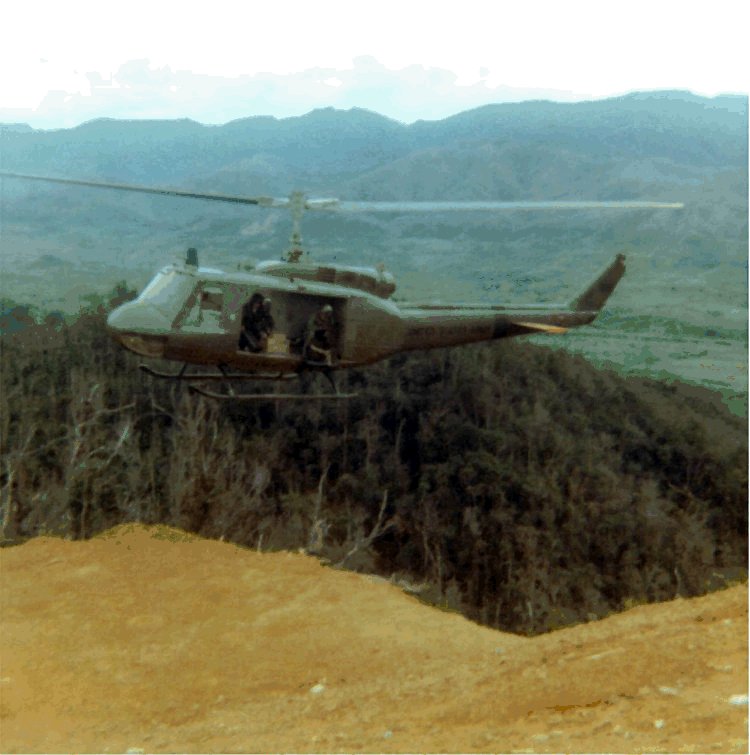
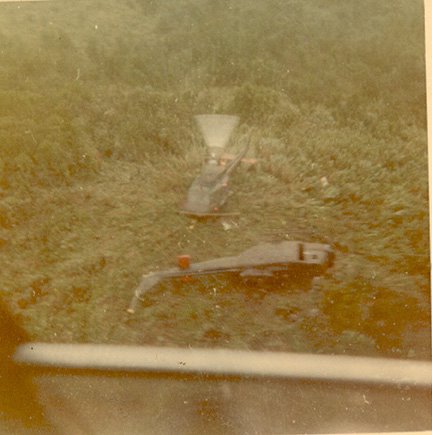
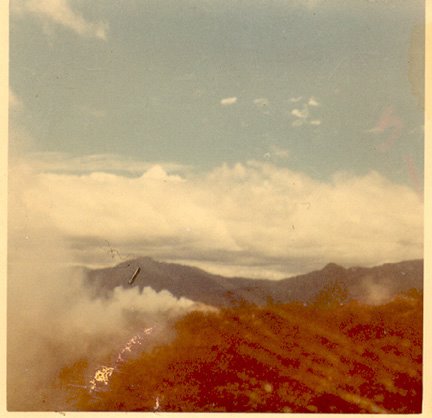
Anyway, as we were looking at some info I noted one of his medals was an Air Medal with V device. I couldn't remember them all the other night when I was writing his story. It had a little tag beneath it that said, "Ripcord". I remember reading that name on the Black Widows' website and vaguely recalled it from a History Channel story so I decided to look it up.

Wow. I mean, "WOW!" You know, he told me stories, but he didn't tell me everything. I was reading the story of FSB Ripcord and I realized why he didn't speak on it. It's the type of thing that movies are made of. It's the kind of thing that may be hard for people to understand or believe if they weren't there, if it wasn't written in history. It's the stuff that heroes are made from.

A few excerpts:

Rescue From FSB Ripcord by Tom Marshall

For the helicopter pilots, the rules were simple. If Americans were in trouble, the pilots would come to their aid no matter what.

Fire Support Base Ripcord, one of a string of firebases along the eastern perimeter of the A Shau Valley, came under heavy enemy fire in the early summer of 1970, while American troops were using the base as a jumping-off point for operations in the valley. Their mission was to block NVA divisions positioned to move on the coastal city of Hue.

Ripcord had been carved out near the top of a 2,800-foot-high mountain. First used by the U.S. Marines in 1967 and 1968, the firebase had again been operated by the 101st Airborne Division in 1969 and closed when monsoons prevented its resupply. It was reopened once more in April 1970. On April 1, B Company of the 2nd Battalion, 506th Infantry (2/506), 101st Airborne Division was inserted in the firebase.

Soon after the infantrymen arrived, the level of NVA activity increased around the Khe Sahn plain and the A Shau Valley. The intensity of the fighting in the area around Ripcord soon overshadowed ongoing enemy harassment of nearby ARVN Firebases O'Reilly and Barnett.[snip]

On July 20, Captain Chuck Hawkins, commander of A Company, 2/506, which had reinforced the original B Company defenders at the firebase, reported that a tap had been made on a land line between an NVA division headquarters and an artillery regiment on the valley floor below Ripcord. The Americans had learned that surrounding the firebase were four NVA regiments with up to 12, 000 men. Their immediate objective was the destruction of Ripcord.

On hearing that new and disturbing intelligence, Maj. Gen. Sidney Berry, commander of the 101st Airborne Division, took action. Early on the morning of July 21, Berry called Colonel Harrison and told him, "We're closing Ripcord." [snip]

At first light on July 23, 14 Chinooks-each large enough to carry more than 30 men per trip-headed toward Ripcord to begin lifting out the B Company 2/506 troops. Everything went smoothly until 7:40 a.m., when anti-aircraft fire again knocked out a Chinook. the chopper crashed in flames on the firebase's large lower landing pad, preventing the other Chinooks from lifting out the rest of the men, artillery and heavy equipment. The infantrymen would have to be evacuated by Bell UH-1 Hueys, which could carry only six men at a time. All available Hueys in the 101st Airborne were detailed to head for the beleaguered firebase. They would dart in and out one at a time, dodging continuous anti-aircraft and artillery fire.


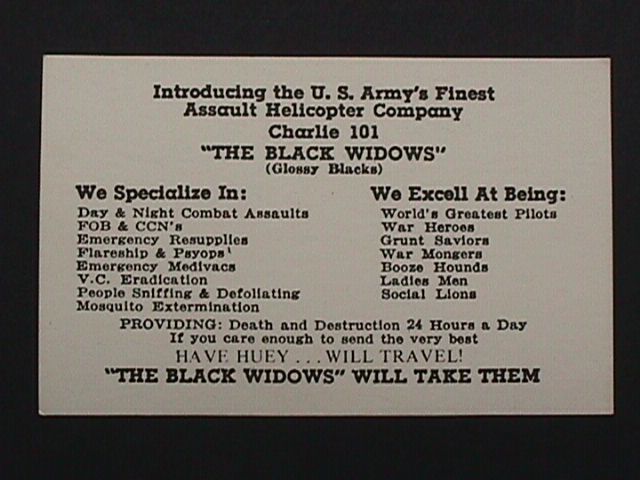
Looking at the information from my uncle's things, I realized that he was with the Black Widows in '70-71 which by then had been redesignated from the 188th Assault Helicopter Company to the 101st Aviation Battalion (AHB) Charlie Co. A patch he had said "CE 562" on the body of a Black Widow spider. You can see the years he was in on the roster and, if you read the history of the Black Widows you can see that they were redesignated as 101st AHB in 1968. They were at LZ Sally, but were eventually moved to Phu Bai which is on my uncle's paperwork.

And then there was this "calling card":


Reading that, I realized where he'd been exposed to Agent Orange. It says, "People Sniffing & Defoliating" which of course is reference to spraying Agent Orange. I had been reading information about the actual rate of exposure and was trying to figure out why a guy in a helicopter would be exposed to Agent Orange when it would be sprayed on the ground. That's when I realized that it was the helicopters doing the spraying.

Returning to our story:

The Hueys were refueled and assembled for one of the largest hot extractions of U.S. forces in South Vietnam. Sixty Hueys from the companies of the 158th Aviation Battalion and the "Redskins" from Camp Evans and 60 Hueys from the 101st Aviation Battalion and the "Hawks" at Camp Eagle - both groups flying Bell AH-1G Cobra gunships-plus the 4/77 "Griffins" in rocket-equipped gunships, joined the lift birds and the other Cobras from Camp Eagle in the mission to subdue the NVA around Ripcord.

Aboard one of the Hueys was Captain Randy House, platoon leader from C Company, 158th Aviation Battalion, who was serving as leader of the extraction flight-call sign Phoenix-that day. Approaching the area, he could clearly see that it was time to get on with the mission, but as yet his flight had had no contact with the command-and-control ship flying high above. It turned out that the NVA and some of their Communist Chinese advisers had managed to deny the Americans use of the radio frequencies.[snip]

House observed that the firebase's upper landing pad, located near it 155mm howitzers, was taking much less mortar fire than the lower pad, which was under continuous shelling-and at any rate was partially blocked by the burning Chinook wreckage. House made contact with a pathfinder (a combat controller) at Ripcord and told him he was ready to continue the extraction. House ordered the 101st Airborne Division's Hueys to approach the firebase along a riverbed, turn above a waterfall on the mountain and continue to Ripcord. Others from the the 158th and 101st Aviation battalions would follow.

House directed the choppers to the available landing areas. As the extraction continued, the pathfinders instructed some birds to land on different pads, but the NVA were clearly listening in on their communications. If a Huey was directed to a particular pad, mortars were fired on that landing area. Undaunted, the pathfinders working the extraction from Ripcord developed their own strategy to foil the enemy's efforts. When they heard the mortar shells fires, the pathfinders would divert each Huey to another pad at the last second. Five soldiers would scramble aboard and the Hueys would lift off, just before the next round of mortars arrived.

One by one, the Hueys touched down. Some of the landing pads were big enough for only one Huey to land at a time, pick up five or six passengers and depart-all under .51-caliber (12.7mm) anti-aircraft fire, joined by fire from hundreds of AK-47s. One of the upper pads was not targeted as often, receiving only intermittent 88mm mortar and 75mm recoilless rifle fire.[snip]

Captain House, still circling above Ripcord, continued the extraction with the other lift companies. They were circling in sight of Ripcord, keeping an eye on the deadly landing zones marked by mortar explosions. House continued to fill the position of command and control. He had just seen his Hueys getting shot to hell while getting the job done. Painfully aware that there were troops still waiting for extraction on the firebase, House understood his importance in the role of impromptu air mission commander. He figured the sooner they finished, the better.

House called to the leader of the Ghostrider flight, "Rider one-six, Phoenix one-six." Ghostrider one-six responded, "Go!"

"This is Phoenix Lead. The other briefers are not up," said House. "Its pretty strong (anti-aircraft fire) west of Ripcord. I hate to be the one to keep this damn thing going, but give me your poz (position)."

"Between Phon Dien, blueline by Jack (southwest of Camp Evans combat base over the river)" came the reply. House then gave the pilots instructions on the best approach direction. Ghostrider Lead briefed the other birds in his flight, but he knew all of the pilots in the area could see the continuous bombardment underway. Ghostrider Lead continued, "I'm not gonna order you into that stuff, but if you think you can get onto the pad, do it!"

The Hueys would come as long as there were Americans on the ground. The pilots and crews saw what they would have to go through and made their approaches one by one. The airwaves became clogged with incessant reports: "Pretty white stuff on top," called a Ghostrider as he approached the upper LZ in a flurry of mortar shells.

"It's CS," another pilot calmly remarked-tear gas.

Another asked, "Are we using CS?"

"No," responded the first pilot. "They are."

Not only would the Huey pilots fly through walls of .51 caliber anti-aircraft tracers to land amid exploding clouds of tear gas, which might temporarily blind them.[snip]

Another Ghostrider, also touching down at Ripcord, called, "Go in top pad, one more hit just right beside me!"

A pathfinder at Ripcord asked, "Did a slic (UH-1D) just get shot down?"

Commanchero one-one, from A Company, 101st Aviation Battalion, replied, "No, a mortar hit him sitting on the ground."

Ghostrider Chalk-Seven broke in with: "Taking small arms fire 100 meters out. They're leading it onto the pad."

Ghostrider Lead called, "Abort, Chalk-Seven!"

Chalk-Seven responded: "No, I've aborted three times already, I'll just continue in!"

Ghostrider Lead said: "I'll leave it up to you. Go in if you can!"

Another pilot called out, "POL (the fuel dump) just went up-took a mortar, right beside me."

The lift companies - Ghostriders, Lancers, Comancheros, Black Widows and Kingsmen-continued the procession. Many of the choppers were taking hits. The smoke, the streams of green and gold enemy tracers, the jets swooping low, laying napalm while Cobra gunships attacked lines of enemy troops-all of it nearly overwhelmed the senses of the chopper crews.

But the Hueys kept coming. When one chopper was shot down, another landed to retrieve its crew. By noon, only 18 fighting men remained at Ripcord from an original force of nearly 400. Driven from their secure positions by exploding 155mm ammunition that had been ignited by the fires, those remaining soldiers ran to one end of the firebase and attempted to form a security perimeter. They could see NVA swarming up the mountainside toward them like ants, breaching the lower perimeter wires less than 100 yards away.

Most of the GIs were carrying M-60 machine guns, firing from the hip as they moved from one position to another. They simply wanted to get off that Godforsaken mountain alive. Private first class Daniel Biggs watched as a Huey approached the pad and landed in the exact spot where two mortar shells had hit seconds earlier. Biggs later told a Stars and Stripes correspondent, "He came right in, didn't turn away or nothin'."[snip]

A short while alter, the last Huey to lift off from the firebase sustained major damage and heavy casualties to its passengers. The last men off the mountain were members of B Company, 2/506. They had also been the first ones to arrive in April. The troop withdrawals from the valley floor below would not end for another two hours.[snip]

Operations in the area around Firebase Ripcord had proved to be a costly undertaking. Between April 1 and July 31, 1970, 135 UH-1H Hueys were seriously damaged and rendered unflyable. They vast majority of the division pilots and crew members survived despite combat damage to their aircraft. Ten Cobras and three Hughes OH-6a Loaches also sustained serious hits. Only two of the six Huey lift companies involved in operations in that area did not lose a crew killed in action. All the pilots who participated in the evacuation earned Distinguished Flying Crosses. The crew chiefs and door gunners received Air Medals with a "V" for valor.

Helicopters, including gunships and lift ships, were crucial to the evacuation of Ripcord. The withdrawal could not have succeeded without the courage and daring of Huey pilots and crewmen who repeatedly braved direct mortar fire, recoilless rifle fire and walls of neon-green .51-caliber anti-aircraft tracers to save the lives of their countrymen.


Read the rest here. There is a lot more to the story of Ripcord.

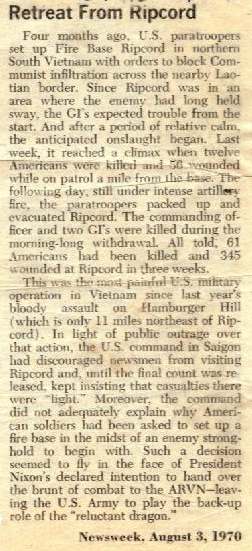
Here's a newspaper clipping about the retreat and rescue:


Somethings never change.

Sometimes, that's good. Our current men and women continue on the proud tradition:

On December 19, 1989 under permanent orders 179-1, the 6th Battalion, 101st Aviation Regiment was redesignated as the 9th Battalion, 101st Aviation Regiment.

The “Black Widows” of Alpha Company, 9th Battalion (Eagle Strike), 101st Aviation Regiment, 101st Airborne Division (Air Assault), returned home in February 2004, after a one year tour of duty as proud combat veterans from the unforgiving deserts of Iraq during Operation “Iraqi Freedom.” Black Widow black hawk helicopters were the first to cross the Iraqi border in March 2003, when the war began. Their motto: MATE AND KILL.

After their return to Fort Campbell Alpha Company was re-flagged as Alpha Company, 4th Battalion, 3rd Aviation Regiment, 3rd Infantry Division. Commander, Captain Jason Blevins, chose to continue the Black Widow legacy by choosing “SPIDERS” as their new logo and call sign. The legacy of the 188th Assault Helicopter’s gun platoon will live on with A/4/3. The new A/4/3 pocket patch will include reference to the establishment of the 188th Assault Helicopter Company in 1966.


And this update seems to indicate that they returned for a second tour of duty:

2. Alpha Company flew one Air Assault mission with Task Force 2-7 CAV of the 1 st Cavalry Division on 16 February [2005]. The ground tactical plan included IED sweeps along MSR routes west of Taji. The Task Force discovered IEDs along MSR routes, validating the success of the Air Assault. [snip]

3. Alpha Company also planned and briefed a pending Air Assault into Zone 66 with Task Force 3-325 Airborne Infantry (82 nd Airborne Division). The Air Assault was planned in order to destroy counter insurgents firing rockets and mortars into Zone One, targeting the newly formed Iraqi National Assembly.


Just another fascinating piece of history.

Read More...

Winchester Rifles to Be Discontinued - Yahoo! News

NEW HAVEN, Conn. - The traditional Winchester rifles carried by pioneers, movie stars and Wild West lawmen will be discontinued in March, a Belgian manufacturer said Wednesday, confirming the end of an American icon that became known as "The Gun that Won the West."


Is it me, or is there something wrong with this?

Once the U.S. Repeating Arms plant closes March 31, the only new rifles carrying the famous Winchester name will be the modern, high-end models produced in Belgium, Japan and Portugal. The older models, including the famous Winchester Model 94, will be scrapped.

"The name will continue, but not with those traditional products," said Robert Sauvage, a spokesman for the Herstal Group, the Belgian company that owns U.S. Repeating Arms and the right to the Winchester name.

Herstal announced Tuesday that the U.S. Repeating Arms factory in New Haven would soon close, capping 140 years of Winchester manufacturing in the city.


But then I read this and felt much better:

Missouri-based Olin Corp. owns the Winchester brand name. In the late 1970s, after a massive strike by its machinists, Olin sold the plant to U.S. Repeating Arms along with the right to use the Winchester name until next year.

Sauvage said the Herstal Group wants to extend that right past 2007 but Olin has not decided whether to allow it. Spokeswoman Ann Pipkin said Olin is disappointed with Herstal's decision to close the plant and may sell the Winchester naming rights to someone else.

"The legendary Winchester name, we want it to be on a great-quality firearm," she said.


In other words, it seems that Herstal group has ticked folks off for screwing with their heritage.

Read the rest.

Winchester Rifles to Be Discontinued - Yahoo! News

Read More...

Tuesday, January 17, 2006

Dying is an Expensive Undertaking

As some may be aware, my uncle passed away over the weekend. I wrote a tribute to him here. It was barely sufficient to show my respect and love. You know, he wasn't perfect. He could be quick to anger and he could ferret out your "buttons" and push them quite regularly. He was always tough and ready to kick somebody's butt. But, the truth was, he was that guy everybody always talks about: tough on the outside, soft and marshmallowy inside.

He'd sneak candy to his grandkids whenever they came over. He kept a giant candy jar full just within arm's reach behind his reclining chair. He had taken courses to repair motorcycles and, if you had a problem, he could tell what it was and how to fix it in a few minutes. He had connections with local repair shops. He helped me get my bike fixed for $246 (when the real cost should have been about $500) by hooking me up with a repair shop where he'd made friends with the owner (he swore it was because my t-shirt was too tight, conveniently forgetting that I had my cousin and brother with me who the repair guy thought were my body guards or boyfriends).

He was never a joiner. He said he always wanted to go his own way. Probably doing that now, as a matter of fact.

His obituary was in the Kansas City Star. His guest book is here.

As noted, his family is having a hard time paying for the funeral. Some great folks like Chief Bill and a few others have pitched in to help us figure out how to contact agencies or work with the VA to see if there is something else that can be done. Some other folks have been nice enough to ask how to send donations and I wanted to say thank you and God Bless everyone of you who have gone out of your way to help us out.

Some may not yet have experienced personally the death of a close relative where they are responsible for making the arrangements and figuring out how to pay for it. You'd be surprised (or not) what a no frills funeral costs. There are so many line items that you never realize, until you do it, how much it costs or that it was even necessary.

Things like preparing the body includes more than embalming. There's a charge for putting their clothes on. A charge for putting on make up or fixing little flaws related to their illness or cause of death. There's a charge for fixing their hair. It's like an ultimat spa for the dead and they charge you because you can't get away from it, particularly if you want to do a visitation. Visitation can cost you between $100 and $300 an hour depending on what you ask for. A plot of land can cost over $600 and the opening and closing is over $500 (a vet could get this part for free if they opt for burial in a national cemetary; if their last wish is someplace else, you or your insurance is paying for it). Don't forget the casket and the vault. You cannot have a burial without a vault. If you're lucky and your relative was a vet, the VA will supply a headstone. If not, it can be between $600 and $2000 (particularly if you need to get a double for an already deceased or future deceased spouse; we're opting for government headstone to hold the position until a much future date). There's transportation from the hospital to the undertaker, from the funeral home to the grave. (The VA is going to pay for that for us, but don't think you're going to ride in a limo; the transportation is for the body and hearse).

All in all, an inexpensive funeral can cost about $4000 (if you simply put them in the casket and then the ground) and can go as high as $10,000 or more.

Non-Service Connect death benefit $300.00
Medicare death benefit: $255.00

Paying for your loved ones funeral: Eternity

Don't forget the flowers.

Read More...

New York Times: You've Been Propagandized

Update:

John at the Castle believes he's located the type and maker of the round. It ain't ours.

Another commenter, Donal, notes that this photo appears to show the same kinds of rounds being policed up by the paramilitary after raids near the Paki-Afghan border. See the caption for details. Oh, and it is taken by the same gentleman that took the questionable photo below: Thir Khan


You may have missed this yesterday, but since this blog is associated with the Castle, arguably the home of the military ordnance and equipment experts, I thought I would bring it to your attention and get a little more perspective on it as well as make my own observations.

The caption of this photo originally read:

Pakistani men with the remains of a missile fired at a house in the Bajur tribal zone near the Afghan border.


A number of people noticed that this was not a missile, but, in fact, an artillery shell, starting with American Thinker, then LGF and, another excellent website, Winds of Change who drills down the farthest to the identification of the shell:

However, this object is not a missile nor a missile's remains.

What is it, and in light of these facts, why did the New York Times decide to run it with such an inflammatory and false caption?

As a retired artillery officer, it's easy for me to see that the blue object in the photo is an artillery projectile. Do you see the golden-colored stripe running horizontally around it near the bottom? That is called a rotating band. The rotating band is what seals an artillery projectile tightly inside the cannon tube. When fired, the band does two things: it seals the propellant gases behind the projectile so that they don't blow by the projectile as it travels down the barrel, and it expands into the grooves of the rifling of the cannon tube to start the projectile spinning, like a rifle bullet does, vastly increasing the accuracy of the firing.


Winds and another commenter go on to say:

There seems to be a consensus among artillerists who have commented that the projectile pictured is either a 152mm (that is, Russian manufacture) or 155mm (used by US, NATO and other countries). Retired artilleryman William Krulac says

    the round has been fired, and was probably a training round that does not explode, a base-ejection round (base ejection is used to deliver illumination flares or sub-munitions over a target) or, a dud. U.S. artillery training rounds are blue, but do not have a yellow band. The evidence that the round was fired is the grooves in the rotating band near the bottom of the round.


Read the rest. He comments about the size and the fact that the "rifling" on the copper band looks like its clockwise so not a Russian round. Yet, another commenter noted that maybe the photo was flipped because of the buttons. A primer is here and the yellow band could indicate one of several possibilities including HE:

Table F-3:

8) Yellow band put on when the ammunition contains explosives used to fracture the projectile.
9) Yellow band put on to indicate HE burster.


NYT did take the picture off their front page of their website with this note:

Correction: A picture caption on Saturday with an article about a U.S. airstrike on a village in Pakistan misidentified an unexploded ordinance. It was not the remains of a missile fired at a house.


But, I think it's worse than that. I am not an expert by any means, but this looks photo shopped. (Click on picture for larger image)

1) Look at the edges. While this shell has some white chalky marks on it, the edges show obvious straight white lines, particularly between the yellow stripe and the copper band. The most telling are on the left, the area where the off colored patch on the wall in the background meets the shell and lower where the shell meets the gray of the boy's jacket. You can see similar straight white lines on the right edge. Even on the top right hand side you can see where the shell has a little "crooked" flaw that is obviously digital and not a matter of damage to a fired shell.

2) Look at the size. While Winds makes a note that the size seems a little off, but he's not sure, I'm more than positive that the size is all wrong for the photo, particularly since we can look at actual artillery shells with men (and here, here, here, and here)in the photos and know that I have never seen an artillery shell as tall as a man in modern warfare (maybe "super guns" of the past WW but I don't know of modern artillery shells that are that big; maybe an artillery guy would know better). Second, below the copper band, the shell is tapering. That usually signifies the bottom of the shell is coming up quick. So, either this shell is sitting on something behind the wall, or it's been added. Third, looking at the copper bands on similar artillery shells, they seem to only be about an inch and a half, maybe two inches tops. In this photo it appears to be about four inches or more. Whoever did this not only didn't know the difference between a missile and a shell, but they have no experience with shell size or they wouldn't have made such noticable errors in size context.

3) Look at the people in the picture. They are all looking at the cameraman, not the big "ordnance/missile" that is directly in the line of site of several of the boys. Everybody seems like they don't even notice this big thing in the middle of the picture.

Other issues of "staged" photo seem pretty evident as well. I would even question if this house was the house that was allegedly hit by "American" fire power.

1) Man on the left. Look at his hands. His hands are "city" hands. They don't show any roughness or indications of manual labor. On top of that, he either has a nice white shirt sleeve that goes into a brown suit (his shaw and hat seem like token observations of local fashion) or that's a big silver watch on his wrist. If this guy belonged to a "village" he was the richest man in the neighborhood.

2) The wall in the rear of the picture. Look at the top edge of the wall. Except for the small imperfection in the middle and the little patch in the middle, the wall appears to be undamaged. Worse, based on that top edge, it doesn't even appear that a roof was attached to it. It's possible that the wall is some sort of outer wall, but it seems odd in context to the "destroyed" wall and door in the front.

3) Where's the rubble? If the house is as big as the back wall seems to indicate and it was struck by a missile, there would have been huge amounts of debris lying around inside and out. Look at the boys and the men standing there. Does it look like they are standing on a lot of debris? Wouldn't they be much higher in the photo or even standing differently? Particularly the old man behind the broken wall in comparison to the door he seems the right height. Where's the debris?

4) The door. It doesn't look like it suffered any damage from an explosion. The wall next to it is "destroyed", there is no roof, yet the door attached to what appears to be two by twos is barely leaning out, still in it's frame, the frame not warped or broken. The door itself is not warped or showing damage from a high explosive or fire, assuming that it was closed at the time of the alleged bombing. The bolt lock is not damaged (look at the left hand side of the door, right in the middle). The door is still on its hinges. An explosion destroyed this house enough to take the roof off and the door is still standing?

5) The shell. If it is not photo shopped (which I believe it is), we would not have used it or the artillery necessary to lob it, to take out a house in Pakistan. We would have used a hellfire missile on a UAV which looks nothing like it or a tomahawk missile from a sea born ship. An air asset because that would have had the correct accuracy for a one shot explosion at a house. Artillery can be very accurate, but is typically more than one shot to insure the target is hit at the right coordinates and would have required an observer to direct fire. On top of that, looking at the top, as one person noted, this thing looks like it's missing its top screw on fuse and there certainly would not have been that much of the shell left to identify it.

In short, the photo and the story stink, not only should the NYT put it out front and apologize for running this bad piece of propaganda (not just a correction about "ordnance" v. "missile"), but the AFP should as well since it is fake and their "stringer" is probably in the pay of the AQ. These groups should both advise the public that they have been victims of propaganda because it isn't the first time it's happened (Ramadi photoe of "insurgents" supposedly taking over the city anyone?). They are so busy looking for to appear "objective" that they are printing any BS propaganda from the "others" and not using their supposedly superior editorial skills to evaluate it.

I think that the media would be better served by putting this out front themselves and not let it become and underground issue since either way they are going to be discredited. The question will be whether they are the witting or unwitting dupes of propaganda (something they are so afraid of that they won't report anything that even vaguely appears optimistic about Iraq, particularly if it comes from the military, without making any sort of "yeah, but" comment and here they let themselves be had by the enemy). The American people should know that such photos may be the work of sympathizers or propaganda machines of AQ and its fellow travellers.

The media should tell people how difficult it is to evaluate all the images and stories coming from the places where they cannot go and warn them that they cannot verify the information or the relationship of the source. They should also try to get some experts on military matters on board because they keep screwing it up. Or, at least be as sceptical about information from places they do not have their own known people at. Maybe, amazingly, use that cool internet tool to look up and evaluate things before they print it.

As for "Thir Khan", I'd be taking anymore of his photos with an entire lick of salt, forget the "grain".

Last, I believe the Pakistani government needs to get real and investigate this thing before they start demanding "apologies" because somebody is full of $#*%. Not that I don't suppose we wouldn't take out an AQ operative even in Pakistan, particularly if it was Zawahiri, but the story has changed from "maybe Zawahiri was there" to "Zawahiri was supposed to be there but sent deputies instead" (as if he had some sort of sixth sense omnipotent capability to smell out danger and avoid it; sounds like the enhancing of a myth) to "look at this missile used" to "oops, it's an unexploded "ord[i]nance" (their spelling not mine) and now to the probability that this photo is photoshopped.

News flash NYT, AFP, Americans and news consumers around the globe: You've been propagandized.

How's that feel?

Read More...

Sunday, January 15, 2006

Lewis Henry, 56 Dies Kansas City, Mo

January 14th 2006

This is a sad post for me. My uncle, Lewis Henry, passed to his maker, January 14th, 2006 10:21 PM at the Kansas City, Missouri Veterans Hospital. He was 56 years old. A veteran of Vietnam, he leaves behind him his wife of 35 years, his son and two daughters along with many grieving family members that will miss him dearly, including me.

I am tired after two days at the hospital with only a catnap on the waiting room couch. I feel I cannot do the kind of fitting tribute here that he deserves as a man that was well loved and respected. In the movie "13th Warrior", the character Buliwyf, having left his father's inheritence on the shores of the Volga to return to Norse Land to fight the dreaded "fire worm", was dying slowly of blood poisoning. He said to Antonio Banderas' character, Ahmed, that a man with nothing might be thought a king if another man "drew the words of his story". My uncle died with little having given it all, in the end, for service to his country. So, I wanted to give him this last gift, that some might read his story and think him a king.

If you read here over any length of time, you may have read a series of posts called "Beverly Hillbilly Bikers" in which I recount the 2500 mile bike trip of my family from Kansas City to Gulf Port, Mississippi and back. He was a key figure in the story and, while I poked fun at all of our exploits and all of the family members on this trip, I never finished telling the story. Nor did I tell you how, at the end and even today, we thought that trip, with all its fun and terror, was the highlight of our lives. Even Friday night, while we waited for the first news, we stood around the MICU telling snippets from the trip and laughing at some of the more exciting moments. I won't do it here, but soon the completed saga will appear.

Of course, that is not the only story of this man. I want to tell you about him, even in my nearly catatonic sleepless state because I don't want the moment to be gone just yet. I suppose, in some ways, I don't want to let him go yet either. So, if I stumble or mis-spell a word, I hope that you will forgive me and hold it no less a sign of my true love and respect, or in anyway denigrate the honor I wish I could adequately provide for the man who taught me to ride my first motorcycle.

That was an event unto itself. He and my aunt had me riding a Vulcan 500cc around and around the front yard of their house, getting me used to balancing the bike and shifting into and out of 1st and second gear as a starter. The front yard was convenient because it was dirt and, therefore, softer to land on instead of the asphalt of a parking lot. At one point, he directed me to drive up his driveway with a gentle slope and come to a stop near the top so I could get the feel of stopping on a hill. As I came up the drive, I failed to give it enough throttle and the bike died. I, being unprepared, had not put my feet down to hold the bike up and it started tipping over. Finally, having my wits about me, I attempted to get my feet down, but the bike had already gone over to the right too far to stop. That didn't stop me from putting on an herculean effort with both arms and both legs locked on the drive to stop it. The bike having the momentum, won the struggle and yanked me to the right with the force of it's weight. I was still bound and determined to keep my feet, but physics and gravity are impossible to overcome and the weight of the bike sent me cart wheeling across the yard, arms windmilling, legs churning until I completed a final "commando roll", smashing into the plastic bird bath on the lawn which promptly spewed about a gallon of rancid "bird spit" infested water on me.

I lay there a few moments checking to make sure everything was functioning as the motorcylce engine whined it's highpitched scream in the back ground. I heard my uncle yelling to my aunt Jeanie, "Make sure she's alright" as he ran over to kill the engine. Jeanie came over and kept repeating, over and over, "Are you alright?" Solicitous as she tried to be, she couldn't hide the hysterical laughter very well and I, realizing all systems were go and te ridiculous position I was in, began laughing, too. In a moment we were all laughing loudly as both aunt Jeanie and Uncle Lewis took turns immitating parts of my embarrassing debacle, windmill arms and all.

Uncle Lewis, between gasps, asked, "What the hell was that "commando roll" thing??" I shrugged, squeezing my lips together to hold in the gaffaws, replied as seriously as possible, "I don't know. I saw the bird bath coming up and I thought "tuck and roll" seemed like a good thing to do at the time." At which, we all busted out laughing with my Aunt Jeanie pointing to my wet clothes and holding her nose, "Eww...you stinky." More laughs.

That seems like the story of our family. Even tragedies turn to moments of laughter.

I also remember this man who, along with my father, built me, my brothers and cousins "toy machine guns" out of scrap wood, running with us through my grandparents' barns playing "army". Here you could hear the voices of grown men and young children together yelling out, "D-d-d-d-d-d-d-da! I got you! Why didn't you fall down and play dead?" To which came the infamous reply, "No you didn't, it was only a flesh wound!" Courtesy of the many hours of John Wayne and other western or army movies on the "Wednesday Night Western" and Saturday TV "matinees".

He was cruising the Lake in Lodi, CA with my dad in a dune buggy he made out of a Chevy when my dad met my mom.

Thirty years later, older and wiser and having returned from my so-journ to Philadelphia, I would go visit, talking with him and Jeanie about motorcycles and discussing whatever was on the history channel when I arrived. We both shared a passion for history, particularly Civil War, Indian Wars and World War II. Sometimes when I came over something about Vietnam would be on and, as we watched, he would mute the sound and talk about this or that incident that he was involved in or a similar situation. Like most vets, he wasn't overly chatty about the subject. Mainly I would get little anecdotes here and there that I eventually put together as an extremely small part of the story of his service. I think he felt comfortable talking to me about it because we were talking about "history" in an almost abstract, clinical way as if it was something that happened to somebod else.

My uncle volunteered to join the army and go to Vietnam for several reasons, one of which was because my dad, who was older, married and had a child (me), had a lower draft number than he did. Because one son was already in, my dad's classification was changed and he was never drafted. One cannot know the vagaries of fate. What lies ahead of any person in any situation is in God's hands, but I can say with full knowledge of the Vietnam Conlfict, the number of dead and wounded, the number of men who returned changed forever by what they saw and did, that this was the first of many times that he changed my life for the good. Who could know, had my dad been drafted, whether he would have returned to be my father or been unchanged physically and mentally? Whether I would have brothers or sweet memories of childhood when my dad played Santa Claus while my uncle served in unpronouncable places?

So you see, I owe him a lot.

He served as a Crew Chief/Door Gunner on a Huey flying with the 101st Airborn, 188th Assault Helicopter Company, "Black Widows".

I don't know everything about his service, but if you read the page I noted, you will see referrences to flying SOGs into Cambodia and Laos. He mentioned that briefly one day when I was asking him about the medals in his shadow box. The medals had been put away for many years. He used to say that they were "nothing", just pieces of worthless ribbon and metal. After awhile we never asked to see them. Something happened in 1995. I think that Desert Storm had blown away the "dishonored" army aura from Vietnam. People remembered and began to talk about our Vietnam Vets in different ways. He had also met one of his friends (Albert Sass)who had flown with him who asked him to go to a support group with him. As the years went by, he began to see the real value in his service. It was no longer just a time in his life where he "went somewhere and did somethings".

Twenty-six years after returning from Vietnam, he took his medals out the suitcase in the closet and put them in a shadow box along with a few other mementos. He had lost some of the medals and tried, with various degrees of success, to have them re-issued, but some of the documents he needed were "classified" due to the nature of the mission. That's how I knew he flew SOGs and LRPS to certain destinations in order to do certain things that we know nothing about.

In his shadow box he has two purple hearts, a bronze star with V device, and several more commendation medals including, of course, his Vietnam service ribbon. There was also a piece of bent metal on a chain he had worn as a necklace in Vietnam after his M-60 took a round meant for him. The piece had flown off and stuck in his chest (one of the purple hearts). If it hadn't been for the M-60, it would have been a 7.62 round in his chest instead.

I have no idea what incident led to the bronze star with V. He never specified, though I know that he was shot down twice. One event where both the pilot and co-pilot were severely injured. He and the other gunner, suffering from a broken wrist, set up a perimeter and waited for rescue. They had one functioning M-60, one broken M-60, two M16s with two magazines each, four pistols and a few grenades. They knew the enemy was out there, all around them, moving in. In order to make it seem like they had more functioning weapons and more viable people on the ground with them, my uncle and the door gunner moved (the only two able to move) from position to position, calling out to different made up people about their condition and ammunition, acting like they saw something and firing a burst of rounds one time from each position and weapon in order to appear better armed and better covered.

They kept the enemy at bay for two hours, using subterfuge and big brass balls, until another "slick" could come in and rescue them. He admitted that day was the scariest day of his entire service because it was the closest he came to being captured or killed, having a long time to think about the consequences. Unlike the times when he was flying into a hot LZ when the sheer adrenaline rush kept such thoughts at bay even as rounds were pinging off of everything around him. On the ground, waiting for rescue, he didn't have the luxury of distractions. He just had time. Time to think about dying or being taken prisoner. He wasn't going to be a prisoner.

When they lifted off they could see a whole company of VC moving in on the helicopter. The pilots of the rescue helicopter called in an air strike on the position, destroying the downed craft and many enemy.

I remember when he told me that story. He was sitting in his recliner, smoking a cigarette and drinking the inevitable can of coke with the giant screen TV playing some hokey western in the background on mute. He paused after the story for a few seconds looking at his coke can and then said, "Did you catch that battle field forensics show about Custer's "Last Stand"?" And we talked about something else.

He showed me a picture of he and some friends on leave. He had a giant snake around is neck. He said the old man just walked up to him and put it around his neck, saying, "picture, picture...one dollar" in pidgen English. He didn't want to seem like a "pussy" in front of all his friends even though what he wanted to do was throw the snake off and run. So, there he is in a picture with a yellow python around his neck and a frozen, gritted teeth smile. His friends were laughing and he was thinking, "Assholes". Of course, nobody else was volunteering to get their photo taken.

We were watching the history channel one day and they were showing a door gunner hanging out of door firing at something below. He hit the mute button and said the first time he knew he killed a man they were taking fire from his side; he saw a guy standing up in a rice paddy firing an AK47 and he let loose with about fifty rounds. Next thing, the guy was on the ground not moving. Then he hit the mute button again and we continued watching the program.

Later, the program was showing the helicopters flying into a forward firing base, taking fire from all positions. One helicopter was on the ground broken and smoking. He hit the mute button again and said they were flying men and supplies into a base one day. It was super hot and he watched the helicopter in front of them suddenly swing right and hit the ground hard, flipping over on its side. Pieces of rotor blade and what he later realized were men came flying at their helicopter. He credited the pilot with saving them all by doing a quick manouver and pulling them up out of the line of fire from the debris. Then he hit the mute button again.

That's how I learned about his service in Vietnam. One small snippet at a time.

Of course, he had plenty of adventures before he was sent over. He had basic training in Washington. While there he caught Pneumonia. He said that the DIs would ream your ass if you tried to make sick call and you weren't two seconds from dying so he never went. He was about 5 weeks into basic and they were finally allowed to call home. When he talked to his mom (my grandmother) he told her he was really sick. She kept asking him why he didn't go to the doctor and he tried to explain that you just didn't do that without a good reason (of course, he didn't know he actually *had* pneumonia, he thought it was just a bad case of the flu). My grandmother, you would have to have known (she died in March 2004 at 75). She was very fiesty. When she hung up the phone, she called the base commander and demanded to know why her son was not being taken care of. She informed the commander that she was a tax payer, paid his salary and that she expected that her son would be taken care of. They certainly were not going to turn him into a useful soldier if they killed him.

Of course, the base commander thanked her for her concern and said he would look into it. The next day, during formation, my uncle was called forward in front of everybody and God. The DI said that his "mommy had called" and said he was sick. "Are you sick, Private Henry?!" Well, he said he felt like he was dying, but there was no way in hell he was going to answer "yes" to that and let every guy there think he was a "momma's boy". "No, Sergeant!" he yelled back as best as he could. "Are you sure, Private Henry?!" "Yes, Sergeant!" He was allowed to go back into formation. He said that he wasn't sure what would kill him first, the pneumonia or the embarrasment.

Later that night he called his mom and told her that she had embarrassed him beyond belief. My grandmother was not sorry. He might think he was a man, but he was still her son and she would worry about him if she wanted. She then demanded whether he had went to the hospital or not. He told her "no" he hadn't and he was not planning to. He had the flue and he'd be fine. He told her not to call the base commander any more.

Well, people in my family aren't very good at following orders so the next day my grandmother told my grandfather that she was driving to Washington (ed...I said "Georgia", but that's where he was stationed when he came back) and he could come if he wanted. If he didn't, just get out of her way. They borrowed my dad's Mustang and drove down to Washington where he was doing basic training. When she got to the gate, the guards wouldn't let her in. She raised such a ruckus that the MP's came to escort her. She demanded to see the commander and told them that she had just talked to him the day before about her son. Well, the commander had not forgotten my grandmother so he had her escorted to his office where she proceeded to ring a peel over his head about not only "not" taking care of her son, since he obviously had pneumonia after two weeks of being sick, but for also using it to embarrass him in front of his "friends". The commander had my uncle brought to his office to see his mother and assure her that he was not dying. When he arrived, the commander realized that Mrs. Henry was right, the white faced, white lipped, red eyed, profusely sweating in the middle of February soldier was indeed very sick.

He told my uncle to report to sick call, called up the captain in charge of his unit and proceeded to ring him a peel for not taking care of his soldiers and forcing some soldier's mom to drive for over 12 hours to come down and take care of it herself (unspoken, of course, was that the captain had caused the commander severe embarrassment and, as the say, shit rolls down hill). My uncle spent three weeks in the infirmary recovering from pneumonia. However, his story was, by now, legend. He said that he had to repeat basic training. By the end of basic training he couldn't wait to get his orders to go to Vietnam.

When he came back, my grandmother said he was a changed man. Of course, he was a man and not the boy she remembered. But he was also quieter, didn't laugh as much and had a much shorter fuse that got him in trouble several times. This contributed to his being busted down to an E4 right before he was discharged (honorably) from the army.

He told me that when he came back from Vietnam, there were two foods he couldn't eat. In fact, if he even smelled them he would throw up. The first was rice. When I asked him why, he said, "You know how they fertilize the rice paddies?" Okay, point taken. The second was Peanut Butter and Jelly. Mainly the peanut butter. I found out because I offered him a peanut butter girl scout cookie one day. He said that when they were flying around they didn't have time to mess with the rations or go to the chow halls at the different bases so they would buy peanut butter and jelly from the PX, very non-perishable, so that they could make peanut butter and jelly sandwiches to eat on the fly. He said he remembered eating peanut butter and jelly sandwiches while flying body bags from a forward position to I Corps. He said it didn't bother him because they were just bodies, but sometimes I wondered if he didn't tell that to see if he could shock me, to see if I would get disgusted and not ask him again.

When he returned from Vietnam, he met my Aunt Jeanie who was divorced and had a two year old son. He told me my grandmother was extremely upset that he wanted to marry a divorced woman. You know, one of "those" because even in the early 70's divorced women were still thought of as floozies. But they married anyway, presenting my grandmother with a fait accompli and a new grandson (the first grandson, Jeanie's son, who joined our family when I was two and has been my cousin - not step cousin, my cousin - ever since).

He raised her son as his own. When my cousin was a teenager he tried to run away to see his real father, thinking that his mom and my uncle had kept him away from him on purpose. The truth was, his father had abandoned him a long time ago after his mom left him because he was abusive and broke her jaw. Hoping that he had changed and would help my cousin keep from getting in more trouble, his mom tracked down his dad and asked him if he would take him for the summer. He spent the summer in Alaska with his father. My cousin came back and never asked to see his father again. His father hadn't changed and had, in fact, hit him many times and humiliated him, according to my cousin, forcing him one time to eat his dinner out of a dog bowl on the floor because the man said he had the table manners of a dog. When he came back and told my uncle, my uncle called up that man and told him that if he ever saw him, he would kill him. In fact, my grandma, grandpa and dad had to corner him in the house and keep him there because he had packed a bag and was getting ready to fly to Alaska to make good on his threat.

My uncle told my cousin that he was his son and he would take care of him. Any man could be a father, but it took a real man to be a dad. The other man would not sign papers to allow my uncle to adopt my cousin so, on the day my cousin turned 18, he went to court and had his legal name changed from David W**** to Lewis Henry, Junior. Ever since the day they had talked about the difference between a father and a dad, my cousin refused to call my uncle "father"; he was always "dad".

My uncle held many different jobs. First he went to college and got a degree in Criminal Justice. Then he became a police officer for several years. Unfortunately, he was too quick to anger. Since he nearly shot a man resisting arrest, he decided that being an officer was not for him. He then went on to take training to be a paramedic, but soon discovered that blood and dying people reminded him too much of Vietnam so he went on to be a restaurant manager and bartender for many years. He and his wife would often work at the same place, she as a waitress, he running the bar or restaurant.

At one point, my uncle, dad and aunt's husband went into trucking, hoping to start a small business, but it was right in the middle of the recession so that only lasted a few years.

They started moving around and went to Beaumont, TX where they managed a truck stop slash restaurant together. Later they went to Las Vegas where they opened a very successful lock smith business. When my grandpa became ill in 1986, they returned to Kansas City and opened their business here until in 1990, when my uncle suffered a massive heart attack. He'd been feeling unwell for sometime, but had no idea that he had advanced diabetes. The heart attack was brought on by the diabetes. He went to the VA and they noted that he was having some sort of skin problem. Patches of skin would flake and peel off. At first, they thought it was brought on by the untreated diabetes, but some doctors at the VA thought it might be related to Agent Orange. The idea that Agent Orange was responsible for many illnesses suffered by Vietnam vets was just getting some acceptance by the medical field and the government, though it was difficult to prove. The doctors also found that he had an enlarged heart and thought that, along with the diabetes caused his heart attack and was the result of Agent Orange.

My uncle couldn't remember being directly exposed to it and many of his records were "classified" due to the nature of the missions. In order to prove he was exposed, even though the symptoms were similar to those seen by others, he had to fight for his records to be declassified for many years. The VA certified him as 50% disabled because they couldn't immediately prove the cause of his condition. He had another heart attack in 1995 which again kept him out of circulation for a year and caused him to be unable to run his lock smith business which he eventually gave up. Because he was not yet certified 100% disabled, he and my aunt lived off the small disability checks and the money that she made as a waitress or sometimes manager of a restaurant until she suffered a heart attack herself (my aunt had a congenital heart defect that had been treated by open heart surgery when she was just 31). After that they lived simply on his disability. They bought an RV and travelled around the US on a shoe string. At one point going to Arizona to live by my middle brother where my uncle would ride motorcycles with him and enjoy talks about history and the military (my brother also being a history buff and serving in the Air Force).

Even with his condition, my uncle tried to stay active. He enjoyed riding motorcycles (obviously) and we would all take short day trips to local destinations. On one such trip we were near Atchison, Kansas and had stopped to get a soda. While we were standing in the parking lot, a bee flew down my shirt and stung me twice on a delicate part of the anatomy (of course, the second time was because when it stung me the first time, I reacted automatically, slamming my hand against my chest). My uncle, told my aunt to give me a cigarette and directed me to go in the bathroom, wet the tobacco and put in on the stings to draw out the stinger. He said his mom had always used that when they were growing up. By the way, it really works. However, I did have to suffer through some rather unsympathetic pokes about lost bees and what happens when you try to smash them against your own body.

In 1999, my uncle Lewis and I put our bikes on a trailer and drove down to Arizona to visit my brother. We drove for two days, laughing and talking about history, music and all the things we saw along the way. He was shocked to learn I had a collection of CDs with music from the fifties, sixties and seventies. He supplemented it with his own and we would play "name that tune and singer". Occassionally, one would remind him of something when he was growing up or later as an adult and he would talk about things like my grandma and grandpa making "bathtub gin", or the parties they held with all the family there (my grandpa died in 1987). One time, during a party, they were playing a polka. He was dancing with his aunt Wig (real name Lavivian, but everybody called her "Wig" because sometimes she would just "wig" out; she was 4'11" and 89 lbs). He was swinging her around when his and her hand slipped. They were going to fast that the momentum flung her out the screen door (the old fashion kind with just a spring, not the hydraulic variety of today). After everybody realized she was okay, they all stood around laughing hysterically.

On the way down to Tucson, he pointed out things like mule eared deer, road runner birds and old line shacks on the vast ranches. He knew a lot of things. We stopped in Santa Rosa, New Mexico as a sort of "half way" point. The next morning we woke up to six inches of snow. He bought us a big breakfast at the local diner frequented by truck drivers (he knew where to go since he had driven that way many times in the past) making chit chat with the other drivers who told us the best route to go if we wanted to get out of the weather.

There was still a lot of snow on the roads and we were pulling a trailer with motorcycles. I had to drive because my uncle's nueropathy had made it hard for him to hold the clutch down in the truck and shift gears. It was quite an experience. I think I might have scared the hell out of him a few times, though he never said so. I know I was scared every time the trailer wheels would catch a ridge of snow in the tracks and jerk the back end of the truck sideways. We had a CB and the truckers were talking back and forth about "watch out for that crazy little blue truck pulling the motorcyles". We both laughed our asses off.

In Tucson, we rode up to the top of Mount Lemon with my brother. That was a trip. It was 85 at the bottom and 52 at the top. Halfway up we had to stop and put on our leathers and guantlets. On the way up we stopped and took pictures of the fantastic scenery below. Seguaro cactus like soldiers marching down the mountainside as far as the eye could see. Tucson was a speck in the distance. Before we started up, my uncle knew I hadn't ridden in the mountains before so he told me how to handle driving up and taking the sharp turns by accelerating through. When we reached the top we stopped at the ski lodge and got cups of hot coffee. The waitress came back to fill up our cups and noticed that we were slow to drink them. She asked if there was something wrong with it and we all laughed. "No," we all answered,"it's just our hands are so cold we were using it to warm up."

We had a really great time. We rode our bikes down to Tombstone and took a tour. On the way back we stopped at Boothill to look at the headstones with their nifty epitaphs like "Here lies Tom Moore, Shot in the head with a .44". I was taking photos of the funniest headstones when I backed into a cactus, getting stuck in the ass. He and my brother were laughing so hard they almost couldn't walk. Later, we were leaving. We jumped on our bikes and started pushing them out of the gravel parking space with our feet. As soon as they cleared the cars, my bro and uncle took off towards the exit. I did the same thing only to discover that the cactus needle was still in my butt and sitting down on the seat to take off had jammed in even further. I yelped really loud and nearly dropped the bike as I tried to come to a stop and stand up so I could feel for the cactus needle. They both realized I wasn't with them and turned back yelling, "What's wrong!?"

I yelled back, "I gotta cactus needle in my butt!"

"What?" they asked while I was feeling around for the needle.

I yelled again, "I gotta cactus needle in my butt!"

"What?!" they yelled louder, trying to hear over the bikes.

Frustrated with the needle and the questions, I yelled even louder, "I gotta G-d D*mned cactus needle in my ass!"

Just then a little old man was walking by with his walker and said, "Is that anyway for a lady to talk?"

I said, "Pardon me, sir, but it is when you gotta cactus needle in your butt."

He just shook his head and walked on. When I got up to my brother and uncle, I told them what the old man had said and that shot them off into hysterical laughter again so hard they almost couldn't ride their bikes either.

On the way back from Tucson to Kansas City, we were driving along chatting about the rock formations just past the Arizona/New Mexico border. Later we discussed the incident and realized we had both seen what was coming, but didn't say anything to the other because we thought maybe we were hallucinating and didn't want to get ribbed. This was in the middle of nowhere. No cars on the side of the road. The last habital place we saw was a Stucky's about three miles back. As we got closer and closer we were both squinting and finally, as we got about 100 ft away, my uncle and I were like, "Holy shit! Do you see that?" jabbering over the top of each other.

Zoom! We passed it by, "DAmn!" "Shit" we were both gawking in the mirrors. It was a man, stark naked, walking down the side of the highway without even a pair of shoes or a hair on his head.

I always told people that on my bike trip with uncle Lewis, I saw all sorts of interesting things: a mule eared dear, a howling coyote silohuetted against the moon, a real live road runner and a naked man on highway 10.

We had our big 2500 mile bike trip in 2000. If you read the series you'll know that he had heat stroke (and possibly a cerebral stroke) during the trip. After that trip, his condition got worse and worse. The neuropathy was so painful that he was taking morphine every day just to stop it along with about 15 other pills. He kept riding his bike until 2004. In 2002, the VA finally had all his records and discovered that, yes, he had been exposed to Agent Orange. New tests and case studies indicated that his condition was similar to other cases and they certified him as 100% with retro pay back to 1995. He took some of the money and bought a new fifth wheel trailer so they could travel (though they never really did except a quick jaunt down to see my brother). Then he bought a brand new Harley Road King which he had always wanted to own. He could only ride it for six months before the neuropathy pain in his feet made it too hard to stand or push the bike and the pain pills made him too drowsy to drive. Of course, he found this out the hard way when he nearly wiped out our pack on a short day ride around the area.

He said he didn't mind if he died on his motorcycle, but he didn't want to be responsible for killing anyone else so he sold it and bought a trike. But he was never going to ride again. He had another small stroke and his feet were so bad the toes were turning black. Even his special boots he had made just for riding wouldn't give him any relief. He lived on pain medication and sheer pervisity for the last year and a half. That and he said that he didn't want to leave my Aunt Jeanie because he knew that she would be lost without him. Of course, she had been taking care of him for several years since his condition had become worse and worse, making sure that he took his meds, cleaning up when he made a mess. On their 30th anniversary, they both got little tattos on their ring fingers with each others' names. Then they put their wedding bands over them. That's how much they loved each other.

We all realized at Christmas time that, despite his insistence he was going to get his right leg amputated, get a prosthetic and ride his trike so we could all go on a motorcycle trip again, that he was not going to ever to that again. He could barely stay awake or stand or eat. My cousins had to carry him out to their truck.

Two weeks ago he was trying to walk over to my dad's house. He had moved down there about two years ago to be close to my grandma who passed away in 2004 and stayed to be near my dad who was also living on disability in the lake area. He went to step out of the fifth wheel trailer, stumbled and fell against the trike that was parked outside. The doctors think the fall knocked a blood clot loose and caused him to have the stroke.

For ten days he was in a coma on a ventilator. Finally, he came out of it and had the vent taken off. The doctors said they didn't know his prognosis because he had contracted bacterial pneumonia, his lungs were weak and he had another blood clot that they couldn't operate on until his condition improved. We was only able to be without the vent for one day. When the doctors told him that they could only save him if they re-intubated him, he looked at my Aunt Jeanie and told her he loved her, to tell the kids he loved them, too and then told the doctor that he revoked my Aunt's power of attorney and demanded a DNR (do not resucitate). He'd been in pain so long and realized that the next thing to come, if he survived, would be paralysis or worse like PVS. He'd already been living in depends and sleeping for most of the day before the stroke.

As his condition worsened, my cousin called us and asked us to come over to the hospital Friday night. Many of my uncle's cousins (my second and third cousins) came to the hospital too and we stood around talking about the old days, telling stories about different experiences, laughing about the funny things he did or said. We had the chaplain come in and say a prayer, fifteen people squeezed into his ICU room (the folks there were very understanding and allowed us to go in and out as we wished and have as many visitors as we wished), holding hands, he said a few words about the flesh not being the end and gave a final benediction. Everyone was crying quietly, trying to squeeze their lips together and muffle their sobs.

Then I looked around at them and said, immitating his voice, "You know, if he could set up and talk right now he'd say, 'What the hell are you crying for? I told you when I died I wanted a G*d D*mn party! Now, d*mn it, party!" Everybody started laughing because that is what he would have said. Then my other cousin chimed in and said, "Yeah, don't make me give you something to cry for!" Just like he would have said it and there was more laughter.

About 11pm, everybody started filtering out. We hugged and made sure everyone had numbers to call, yes, we'd call if there was a change. Thank you, we'll keep in mind your offers to help with anything. And then we were alone, just us few immediate family. We took turns through out the night, sitting in his room, two or three of us at a time so others like my aunt could go get a soda, go to the bathroom, smoke a cigarette or just walk around. Nobody slept much, just a 30 minute nap here or there.

A king could not die with out somebody in attendance to record his last moments.

Saturday morning a few of us went to Denny's for breakfast and brought back food for the others. Later going to get lunch and watching as the numbers on his machine slowly, slowly went down. Until Saturday, his two daughters were in denial about his pending death. Several times I heard each of them say, "Com'on, daddy, wake up. You can make it." It was so sad because everybody knew that he wasn't. The doctor had put him on a morphine drip and gave him oxygen as a palative measure. As his breathing became more and more labored they increased the dosage and the oxygen until they could give him no more.

Around 9:55 pm my aunt and I went to smoke a cigarette. My cousin Lewis and his wife went to take a nap on the hard couches in the waiting room and one of his daughters and her husband took the watch. My brother and his wife went to get some food. We walked back to the room about 10:10, my aunt not wanting to be away from him for long. All day long, as his condition worsened, he had been aspirating liquid from his lungs and during our turns we would have to suction out his mouth and throat. The first time I did it, I thought I was going to lose what little was in my stomach. It's not a pleasant thing to do. But, I got hold of myself because you can do things for people you love you never thought you could do before.

At 10:12 pm his blood pressure suddenly started dropping. I rang my brother on the cell phone and told him to hurry back, but he never made it. At 10:21pm, he passed with his wife, children and eldest grand child in attendance, and me, of course. My brother came a few minutes later and realized he'd missed being there. I thought he was going to lose his mind. He finally got control and went into see him one last time.

There was much sadness, love, tears and hugging.

The king was dead, long live his story.

The wake will be next Thursday and the funeral on Friday. When he died, they were very much in debt. His kids are having a hard time trying to figure out how to pay for his funeral. Because he died from respiratory failure associated with the pneumonia he contracted, the VA is not certifying his death as "service connected" so his wife is getting very little in terms of assistance from the VA or Medicare. I am not asking for money, but I would like to know if anyone knows of any veterans associations that might help his family pay for his funeral or offer other services. I know he did not belong to the VFW, but I don't know of other associations. We know that he could be buried at Leavenworth with no money paid for the plot or headstone, but his family is trying to honor his wish to be buried in the same cemetary as my grandparents so the cost is slightly higher. Still, the highest part is the other necessary activities regarding preparation of the body, the casket, etc.

If you know of any groups that could help, please email me at kehenry1 at hotmail dot com.

Thank you.

[ed...my uncle's last helicopter in Vietnam was selected by the Smithsonian to represent pilots and crew of the era, having been shot down once and recovered, then shot many times, but repaired and still flying, it was one of the longest serving Huey's in the Army. Another helicopter from the era came to Kansas City with an assault helicopter crew association. My uncle took us to see the helicopter and, as a special favor, we were allowed to climb into the helicopter and sit in the pilot and gunner seats. Just another one of our biker day trips.

There are so many more stories I could tell, but I just wanted to tell you about a special man whom I loved very much. Thank you for reading. Kat]

Read More...

Saturday, January 14, 2006

Thank You!

The family of Lewis Henry thanks you for your assistance with paying for his funeral.

God bless you!

Read More...

Friday, January 13, 2006

Stomping the News II...

...so you won't have to.

Stomping the news I.

Islam

The meaning of Eid and Hajj
-Lessons in cultural and religious sensitivity, recommended by Gen. Alwyn-Foster
Razor Wielding Renegades Pose Threat
-Unlicensed barbers give bad head
Ringtone Rage At Hajj
-Proving that inconsideration is a cross cultural consistency
345 Die At Hajj
-"Custodians of the Holy Cities" shrug and say, "Inshallah" (Allah's Will)

Iraq

Reporting From Iraq (embed reporter)
Friends Get Tattoo To Remember Soldier
-Lucas Frantz from Tonganoxie
The Curse Is Broken
-Women on board "ship" are ba-a-a-d luck
How Much Is That Duck?
-Reparations for Daffy
Life at a Mosul Market
-Fresh Vegetables and equally fresh blood

Paul Bremer: Setting the Record Straight
-Things happen, particularly when it's "rule by committee"
Three Top Iraqi Cops Fired For Prisoner Abuse
-Officers confused between Miranda Rights and "Give them a right" to the jaw
German Spies Deny Guiding US Bombs
-Leakers try to embarrass Merkel into towing the party line when she visits
Merkel to Visit US: Offer More Help With Iraq
-Largely to improve their police training taking place in Kuwait which many Iraqi officers are calling "useless"
Slovenia to Send Soldiers to Iraq
-Once again, Balkan states step up to the plate
Police Arrest Moroccan for Helping Jihadists Go to Iraq
-All new meaning to "Highway to Hell"
Kurds Sentence Journalist to 30 years in prison
-No, he wasn't an insurgent. He had the gall to coplain about the government

Still Missing, But Not Forgotten - Keep Her Name In the News

It's Been a Week with No Sign of Jill
-Jill's Iraqi friend with a blog, talking about Jill and her murdered translater, Allan.
We Miss You Jill
-Another blogger talks about Jill
Helping the translater's family
-No pension, no life insurance, just a mom and a child now with no support


Read More...

At Least 345 People Die in Hajj Stampede - Yahoo! News

According to Wiki, this happens every year:

MINA, Saudi Arabia - Thousands of Muslims surging to complete a stoning ritual before sunset stampeded Thursday after some pilgrims tripped over dropped luggage, causing a pileup that killed at least 345 people in the second tragedy to hit this year's hajj.


The report says this year was one of the biggest with 2.5 million pilgrims.

In typical Arab sang freud, Inshallah:

Ensuring a smooth pilgrimage is a key concern for Saudi Arabia's royal family, which bolsters its legitimacy by touting its role as the "custodian of the holy cities" of Mecca and Medina, where Islam's 7th century prophet Muhammad was born and lived.

Crown Prince Sultan Bin Abdel Aziz told reporters the kingdom had "spared no effort" to avoid such disasters but, he added, "it cannot stop what God has preordained. It is impossible."


The truth is, it's not just quiet in Iraq because we've decreased the terrorist talent pool, nor because it is Eid, but it is very likely that a number of young men who have not become martyrs yet, but have also not completed the Hajj, have been traveling into Saudi Arabia to get a little R&R, spiritual renewal and triple the guarantee of salvation by completing this difficult and expensive pillar of Islam.At Least 345 People Die in Hajj Stampede - Yahoo! News

Read More...

Ring-Tone Rage at Haj

It's not just at the movies:

MINA, 12 January 2006 — A pilgrim acted out the anger that many people have over the disrespectful use of overly loud and offensive mobile-phone ring tones, reported the Okaz daily. While many might simply stew quietly over the rudeness of a gadget freak and his obnoxious club music announcing a constant barrage of incoming calls, one Haj pilgrim took another to task for interrupting the spiritual experience. The owner of the mobile refused to change the tone or to reduce the volume. Security men had to intervene before the two men began brawling over the noisy gadget.

Ring-Tone Rage at Haj

Read More...

Razor-Wielding Renegades Pose a Threat

And now to find out that this is one of the most sensationalist titles you've ever read:

MINA, 12 January 2006 — Unlicensed barbers faced scrutiny by Health Ministry officials yesterday warning that they pose a risk of spreading diseases, such as Hepatitis and other blood-borne pathogens.

Dr. Yaqoub Al-Mazrou, assistant deputy minister of health, told Arab News that illegal barbers — who are congregating around Jamrat in Mina and the Grand Mosque in Makkah offering head-shaving services — might be putting pilgrims at risk if they use the same razors repeatedly. The risk is exacerbated by the fact that pilgrims come from all over the world, including regions where blood-borne viruses are common.


It's their title by the way, not mine.

Razor-Wielding Renegades Pose a Threat

Read More...

Thursday, January 12, 2006

Middle East Culture - Islam: Eid and Hajj

Every Eid Al Adha Mohammad Hani heads off to prayer with his sons. To him, Eid is a time of the year to step back and look at the bigger picture.

“It's a very spiritual time for our family during which we like to think of others; from family members we haven't seen for a while to other people in need of help,” Mohammad explains.

The family follows their morning prayers by the annual tradition of sacrificing and offering the meat to the less fortunate; “ it is our duty to God. I do it to thank Him for the blessings in our lives by sharing a little with others less fortunate. We should try to give more often,” says Mohammad.

The rest of the day he spends with the family visiting relatives where they drink Arabic coffee and try fresh home made mamoul cookies, a holiday speciality stuffed with dates, walnuts or pistachio.[snip]

Cosmetics shop owner

“I will start the first day of Eid Al Adha, with the Eid prayer, a special prayer for Muslims performed at dawn on the first day of Eid. I will accompany three of my children to the prayer,” said the 39-years- old businessman.

Khalil said that after the prayers he will go with his 59-year old father, his children and some of his relatives, to the graveyard to visit the tombs of his relatives and friends.

“This is something traditional in Islam, I usually go with other members of my family members to visit the tombs of our relatives and beloved friends and pray for them over the Eid period. To visit the tombs of relatives and friends and pray for them is something common in Islam,” Khalil told The Jordan Times.

“After we return from the graveyard, all my family members, my parents and sisters gather for breakfast and share opinions on what to do during Eid. Then, after breakfast I give my kids and parents the Eidiah (a money gift usually given to children and female relatives during Eid).

After afternoon prayers, Khalil said he will buy a sheep, slaughter it, keep some of it and distribute the rest to poor neighbours. [snip]

University student

To Sara, Eid is all about spending time with her family. “Everyone is so busy throughout the year, so Eid is an excellent occasion for us to get together,” she explains.

This Tuesday, Sara will be waking up early to visit her relatives and enjoy lunch in a restaurant with her parents and four sisters.

“As a kid, Eid was about the presents and getting money from my parents. I've come to realise growing up a different meaning to it in spending time with my family and its spiritual aspect.” [snip]

By the spiritual aspect, Sara means Hajj, a dream she has not fulfilled but is in her plans for the future. “I can imagine it to be an extraordinary experience — for all these people to come together regardless of race or background and join each other for the single purpose of worshipping God.”

While sacrificing is not an annual tradition in her family, it is still a valuable part of Eid Al Adha. “It helps us become less self-centred and think of others less fortunate.”


Eid al Adha

If you're wondering why there is so much "slaughtering" of animals during Eid, it is not simply a hold over pagan part of the celebration. It actually has meaning. Eid commemorates:

Prophet Ibrahim's (ed...Abraham)willingness to sacrifice his son for God.


According to Islamic tradition:

Muslims believe that God revealed in a dream to Ibrahim (Prophet Abraham) to sacrifice his son Isma’il. Ibrahim and Isma’il set off to Mina for the sacrifice. As they went, the devil attempted to persuade Ibrahim to disobey God and not to sacrifice his beloved son. But Ibrahim stayed true to God, and drove the devil away. As Ibrahim prepared to sacrifice his son, God stopped him and gave him a sheep to sacrifice instead. The story is also a part of the other Abrahamic religions


Isma'il was Abraham's first son by Sarah's handmaiden, Haga and is considered by Muslims to be the son whom God referred to as a sign of his covenant with Abraham and that it was Isma'il's sons that would inherit the land of Caennan, now called Israel, Palestinian territories, the Sinai, parts of Jordan, Lebanon and Syria (the Levant).

In Judeo-Christianity, the son that God spared Abraham from sacrifice was Isaac, his second son by Sarah.

The purpose of slaughtering sheep or other animals is to commemorate the gift of the sheep in place of Abraham's son. Giving gifts to family is an outcrop of this celebration, much like giving gifts at Christmas time to commemorate the gifts of the wisemen to Jesus. Slaughtering extra sheep or animals and giving it to the poor is another representation of Allah (God) showing mercy and kindness to his faithful servant (as in "believer").

Hajj

The Hajj or Haj (Arabic: حج Ḥaǧǧ) is the Pilgrimage to Mecca (or, "Makkah") and is the fifth of the "Five Pillars of Islam" in Sunni Islam and one of the ten Branches of Religion in Shi'a Islam. Every able-bodied Muslim who can afford to do so is obliged to make the pilgrimage to Mecca at least once in his/her lifetime.


To symbolize the equality of the pilgrims, whether prince or pauper, the pilgram wears a simple ihram or white robe like garment. Men and women go on the Hajj. It can be performed at any time of the year, but the special time is during the month of Dhu al-Hijjah which usually coincides with Ramadan and Eid.

Muslims circle the Ka'aba four times and then three more counter clockwise. The pilgrims then walk between the hills of Safa and Marwah to re-enact Hagar's frantic search for water, before the Zamzam well was revealed to her by God.

In the Abrahamic tradition, Judeo-Christian and Islam, Sarah asked Abraham to force Hagar to leave, taking Isma'il with her. Depending on which version you read, it was either because of jealousy or because Sarah felt Isma'il would injure her son. In either case, Abraham took Hagar to the desert with little food and water after he had a dream that God told him He would look after Hagar and that Isma'il would, like Isaac, father 12 princes (from whom Islam believes Arabs are descendent). After nearly starving to death and suffering dehydration, carrying her son for some distance, Hagar was shown the well.

Some Muslims believe that the Zumzum well has special healing powers, though other sects like Wahhabism, discourage the belief as idolatry.

The pilgrim dons the ihram once again and performs the final three acts of faith. This is known as the Al Hajjul Akbar, or "greater hajj." The duties of the greater hajj are:

Journey to the hill of Arafat and spend an afternoon there. The journey usually takes three to five days for the full round trip. At the plain of Arafat, the pilgrim stays from afternoon until sundown. No specific rituals or prayers are required during the stay at Arafat[snip]

Upon returning from Arafat, pilgrims travel to the city of Mina just outside of Mecca, and participate in the stoning of the devil. This requires collecting a number of pebbles from the ground on the plain of Muzdalifah (various Hajj accounts list the number of pebbles as between 49 and 70), and throwing the pebbles at the three pillars at Mina, which represent the devil. All three pillars represent the devil: the first and largest is where he tempted Abraham against sacrificing Ishmael, the second is where he tempted Abraham's wife Hagar to induce her to stop him, and the third is where he tempted Ishmael to avoid being sacrificed. He was rebuked each time, and the throwing of the stones symbolizes those rebukes. [snip]

Perform a second tawaf around the Kaaba. This completes the requirements of the Hajj. The tawaf is known as Tawaful - Widah.
After stoning the devil, many male pilgrims will then shave their head; women may cut off a lock of their hair. This is a symbol of rebirth, signifying that the pilgrim's sins have been cleansed by completion of the Hajj.


Culture Middle East - Islam: Eid and Hajj

Read More...

L. Paul Bremer III on Iraq on National Review Online

De-Ba'athification and Disbanding the Army:

Lopez: What was your biggest mistake while in Iraq and what are you proudest of?

Bremer: We were right to exclude the top Baathist-party officials from government jobs. Saddam modeled the party, openly, on the Nazi party — even having young members report on their parents. Our policy was designed to only the top one percent of the party’s members. And we were right to say that the implementation had to be handled by Iraqis. Only they could make the narrow distinctions about which Iraqis had joined the party because they believed the ideology, and which joined just to get a job or because of threats to family members. My mistake was turning the implementation over to a political body, the Governing Council, where it became embroiled in Iraqi political maneuvering. I should have foreseen this and instead put a judicial body in charge of implementation.[snip]

Lopez: What's the biggest myth about your time in Iraq you want to set people straight about in this book?

Bremer: I suppose the myth that we made a mistake “disbanding” the Iraqi army. The facts are these: There was not a single Iraqi army unit intact in the country at Liberation. There was no army to “disband.” It had “self-demobilized,” in the Pentagon’s phrase. Hundreds of thousand of Shia draftees, seeing which way the war was going, had simply gone home. They were not going to come back into a hated army.

The army and intelligence services had been vital instruments of Saddam’s brutal regime. He had used the army in a years’ long campaign against the Kurds, killing tens of thousands of them, culminating in the use of chemical weapons against men, women, and children in 1988. The army had brutally suppressed the Shia uprising after the first Gulf war, machine gunning tens of thousands of Shia civilians into mass graves in the south. Together these two groups make up about 80 percent of the population.

So recalling the Iraqi army (which would have meant sending American soldiers into Shia homes, farms, and villages and forcing them back into the army under their Sunni officers) would have had dire political consequences. The Kurds told me clearly that they would not have accepted it, and would have seceded from Iraq. Such a move would probably have ended Shia cooperation with the Coalition and perhaps even led to a Shia uprising, initially against such an Iraqi army, and eventually against the Coalition.


Read the rest if you're interested in hearing Paul Bremer's side of the story. I've argued all over the net that this whole "disbanding the army" was, in fact, a myth since it was clear from the reporting coming back on the drive to Baghdad that the army was essentially disbanding itself and didn't exist in any formal sense to "disband". Some disagree or try to point to the Baghdad police as an example, but I disagree there too since I was watching the coverage, staying up late every night due to the 9 hour difference and I clearly recall that the Baghdad police simply went home and stayed there, probably because they feared for their safety. Not from us, but from all those they had been complicit in suppressing or arbitrarily arresting and just generally poor behavior for a professional police force.

Although, if you ask *some* Iraqis, they would have preferred that too the lawlessness afterwards. But, I always liken that to the woman who prefers who abusive husband to the fear, loneliness and uncertainty of shelter. Better the devil you know and all that.

Anyhoo...read on.

L. Paul Bremer III on Iraq on National Review Online

Read More...

Reporting from Iraq Mosul, Pearl of the North�

Lt. Col. Jeffrey Kelly toured several areas to acquaint his embedded News-Miner reporter with the landscape. The areas of the town are as varied in socio-economics and ethnicity as they are in the role Kelly’s command plays in the continued fight and rebuilding efforts.

Kelly’s first stop was the Maresh Market, which is perhaps the largest outdoor market in the city. While most of the city’s landscape and architecture is subdued in earth tones, the market offered a palette of vibrancy in the form of fresh produce. There were crates of oranges, in season now in this area, emitting a sweet, acid citrus scent. Pink apples, piles of dates, reddish-yellow potatoes, ripe red tomatoes, bales of deep green parsley, onions, eggplants, and cabbages were piled along the sidewalks in pickup beds.

Beets are in season right now as well, and the dusty bulbs were loaded so high in trucks that the back ends were nearly dragging. Amid trash on the sides of the road, an amber muck of blood was trickling from a butcher’s operation somewhere up the street.


Read the restReporting from Iraq � Blog Archive � Mosul, �Pearl of the North�

Read More...

Reporting from Iraq Neighborhood watch

MOSUL, Iraq—The going rate for a duck in this northern town is about $5.

That’s what Sgt. 1st Class Michael Steffey and his platoon found out while patrolling the neighborhood of Al Ahmil on Friday.

As Steffey walked the street with the 2nd platoon, Alpha Co. of the 1st Battalion, 17th Regiment, asking about the safety of the neighborhood, a woman came out of a gate and said a Stryker vehicle had run over one of her ducks recently.

Steffey didn’t argue or press the point, but asked how much it was worth. The woman said $5. Steffey only had 20-dollar bills, but Pfc. John Follman passed over five singles.

“That one was on me,” Follman said.


Read the rest.

Reporting from Iraq � Blog Archive � Neighborhood watch

Read More...

Reporting from Iraq The curse is broken

I felt like the Red Sox of reporters.

That might be stretching it—a lot. But I did break a curse, if only a few-months-old one.

The second platoon of Alpha Co. of the 1-17 is a little superstitious. Sgt. Michael Steffey attributes that to the fact that he’s a former paratrooper, a line of work that is inherently superstitious.

He explained his and his squad’s routine before each mission: They must conduct a precise radio check; he must pat a picture of a pretty girl hanging in the vehicle for good luck; and as the vehicle barrels down a small hill on its way out of base, everyone standing out of a hatch must raise their arms as if they are on a rollercoaster.


Read the restReporting from Iraq � Blog Archive � The curse is broken

Read More...

Reporting from Iraq � Blog Archive � Remembering Spc. Lucas Frantz

Spc. Lucas Frantz died here in Mosul in mid-October of injuries suffered during a sniper attack. He is the first member of the Stryker Brigade killed in combat and was part of the 1st Brigade 17th Infantry, Alpha Co. I’m staying with for this week.

A few days ago, the soldiers I was out with on patrol pointed up a street we were on near the Maresh Market. Frantz had been killed just a few blocks away, they pointed out.

I met a friend of his who remembers the day Frantz died as the same day the battalion moved into their new battalion headquarters here on base.


Lucas Frantz was from Tonganoxie, KS. I wrote about him here and here. This is more of his story.

Because the story of their lives is as important as their deaths, we should know these men and women. This is just a little snippet of his life in Iraq.

Read the restReporting from Iraq � Blog Archive � Remembering Spc. Lucas Frantz

Read More...

Kurdish regional government says 30-year sentence was imposed for defaming public institutions

Reporters Without Borders has reiterated its call for the release of Kamal Sayid Qadir after the Kurdish regional government in northern Iraq said his 30-year prison sentence was imposed in accordance with a law punishing "defamation of public institutions."

In a statement released on 9 January 2006, the Kurdish authorities said the law, identified as Law 21 was passed by the region's national assembly and took effect in 2003. "The Kurdistan Regional Government (KRG) affirms that the principles of human rights and freedom of expression continue to be respected, promoted, and assured for all persons throughout the Kurdistan Region," the statement added.

Kurdish regional government says 30-year sentence was imposed for defaming public institutions

I protest this, too. That law should be thrown out and second, so should this sentence. The US should put pressure on these guys. I hope somebody helps these guys with some money and an appeal (assuming of course, there is any such thing in Kurdish)

Read More...

Iraq fires three top cops over abuse

To rid his special police units of prisoner abuses and human rights violations, Iraq’s Interior minister has fired three top special police commanders and disbanded a rogue internal affairs unit, said the U.S. general who advises the minister on training and operations.

In an interview with The Washington Times, U.S. Army Maj. Gen. Joseph Peterson detailed those and other measures taken to reform the ministry’s operations and deal with charges that Iraqi police have formed death squads and tortured prisoners at secret sites.

Iraq fires three top cops over abuse

Read More...

Merkel to tell Bush Germany can do more for Iraq - Yahoo! News

BERLIN (Reuters) - German Chancellor Angela Merkel will couple criticism of the U.S. prison in Guantanamo Bay with a vow to do more to help stabilize Iraq when she meets President George W. Bush on Friday, a senior German diplomat said.

Deputy Foreign Minister Gernot Erler, in an interview with the German daily Passauer Neue Presse published on Thursday, said however that German aid to Iraq would remain limited to the training of security personnel and humanitarian relief.

"Mrs Merkel will certainly speak in critical terms about Guantanamo when she is in Washington. She has signaled that herself," Erler said.

"At the same time, she will strengthen Germany's commitment to helping stabilize Iraq. We are talking about the areas where Germany is already present -- the training of security staff and humanitarian aid."

Merkel to tell Bush Germany can do more for Iraq - Yahoo! News

Read More...

Spanish police arrest Moroccan said to recruit for Iraq - Yahoo! News

MADRID (AFP) - Spanish police said they had detained a Moroccan whom they suspect of being the leader of two extremist groups recruiting volunteers to fight in Iraq.


Spanish police arrest Moroccan said to recruit for Iraq - Yahoo! News

Read More...

German spies deny guiding U.S. bomb raids in Iraq - Yahoo! News

BERLIN (Reuters) - Germany's foreign intelligence agency denied on Thursday reports its spies in Baghdad had helped U.S. warplanes select bombing targets during the invasion of Iraq, which the Berlin government had strongly opposed.


Okay, part of me wants to know if anyone really cares or didn't suspect such a thing in the first place. The other part of me wonders why this info is coming out so soon after the war. Seems like some sort of tit-for-tat on intelligence efforts. Or, it might be one of those "open secrets" where it's okay as long nobody talks about it.

On the other hand, it seems kind of stupid to say it just in case we'd want to use those same sources again in the future, if it were true, that is.

I predict by the end of this war, politics as we knew it and governments will be forever changed in the way we inter-act.

Read the resGerman spies deny guiding U.S. bomb raids in Iraq - Yahoo! News

Read More...

Slovenia to send soldiers to Iraq for the first time - Yahoo! News

LJUBLJANA (AFP) - Slovenia is for the first time to send troops to Iraq, four officers and other ranks who will take part in a NATO training mission for local security forces.

Slovenia to send soldiers to Iraq for the first time - Yahoo! News

Read More...

Stomping the News...

...So you won't have to.

Humor
Mattel Oppresses Barbie, Forces Her To Wear Islamic Veil

    -Ken grows a beard and finds his name on the "no fly" list
    -Barbie prays for GI Joe with Kung Fu grip

Blame Bush! Stroke of Good Luck
    -Berkley resident loses his mind when he finds out he agrees with Pat Robertson


Iraq
Continuing Post Election Political Analysis
    -Confederation or Federalism: Iraq the Model says Welcome to the Darkside
    -Civil War or Not To Civil War, That Is the Question
    -Cordesman says it's Vietnam, EJ Dionne says it's Somalia, Democrats say, "Pick a war we started and then left before it was done and Iraq is just like that."

Right Hand Doesn't Know What the Left Hand Is Dooing
    -Iraq Government asks US to realease former regime prisoners; Judges say they weren't notified or asked, but nobody is pardoned and they are still going to prosecute

Iraq Reconstruction
    Reconstruction in the hands of State and out of the hands of Pentagon
    -Reporter proves all truth is subjective: says it's a bate and switch proving failure of Bush's strategy and military efforts; forgets to mention things like Iraq electing permanent sovereign government, obtaining total autonomy and automatically making all financial aid a matter of State. Also fails to mention that the military will continue to administer many projects through civil affairs
    -Basra, the land of Shia Islamist militias, starts urban renewal plan
    -US Forces build a school in the hills of Dahuk, New York inner city schools ask, "why can't we do that here?"

Iraq Healthcare: The Good, The Bad, And The Ugly
    -Chidlren's hospital from video earlier this week is getting a make over, but Health Minister says it's going to take $8 Billion to refurbish 30 years of decline

Eid al Adha: Children Play, Parent's Pray
    -Favored Eid gifts by kids are toy guns so they can play "Cops and Terrorists"

Widows Feel Lost In Land of Two Rivers
    -Nothing funny here. Being a widow in a patriarchal, war torn country is instant poverty

There's Civilians in Them Thar Hills
    -Civilian Contractor by day; Fairy Godmother on her days off

What Happens If American Loses?
    -Member of DU poses as Iraqi opinion writer. Reminds Iraqis Americans massacred Red Indians and will soon abandon Iraq.


Things Military
Terrorists Win Darwin Award
    -Terrorist talent pool continues to decrease. Thinks "Allahu Akbar" makes them invincible, but finds kryptonite can ruin the day.

Brit General Says US Army In Iraq Institutionally Racist
    -Amercian colonel says, "Sod off, swampy!"

Did You Know You Can Die of Hypothermia in Iraq?
    -Medevac'd soldiers at risk for hypothermia, US Army responds with space aged sleeping bags

Around the World in 2 Seconds Flat

Bush's Would Be Assassin Get's Life
    -Says he'd do it again. Roar of applause heard from the DU

CIA Prison in Kosovo?
    -EU committee says they have pictures, but can't find Kosovo on the map
    -Political leaders of different countries make speeches while getting a squishy feeling in their pants knowing that if anyone finds it they may have to release half of their convicted terrorists due to government complicity.
    -Italy and others still trying to figure out how to arrest CIA agents. US silence on the matter seems to echo back, "diplomatic immunity, immunity, immunity" while visions of jailed criminal consulate employees and billions of unpaid tickets in New York City dance in European ambassadors' heads.

Read More...

This Guy Must Read the DU

Surfing about for reconstruction info, I noted this little opinion gem in the Azzaman news of Iraq:

What if America’s presence in Iraq is crushed?

Those putting all their eggs in the U.S. basket in Iraq should remember that America is not a land from the outer space and Americans are not superhuman.

Despite its massive military and economic power, it is very likely for America to be defeated in Iraq. The world’s only superpower has a history of cut and run.

It also has a legacy of injustice right from the very beginning of its history which is based on the extermination of the Red Indians who, from time immemorial, had for themselves the plateaus, the mountains, the rivers and the falls of the land.

The history of the U.S. as a nation started with a tragedy, the victims of which were the original inhabitants of the land known today as America.

The Indians must have cursed their tormentors for not only usurping their land but having them finished off as a nation.


On one hand, you can understand that the guy is responding to the political bru-haha in the US about "cutting and running" and his hopes that the people of Iraq and its politicians will get their act together and act on behalf of the Iraqi people. On the other, one must wonder what the heck "red Indians" have to do with it?

Of course, we've seen this on the DU, European commenters on blogs and it is basic Ameircan History 101 (ie, your ancestors were not heroic pioneers, they were mass murderers) in places like Berkely and other nifty liberal education joints. But, just as I find any European comment on the subject rather disengenuous and dishonest, I find the same in regards to this opinion piece. Particularly from a land where the last 2000 years, long before Europeans even knew there was another land across the ocean, has seen one massacre and displacement of people after the other.

But it's nice to know people don't see us as perfect.

Read More...

Deutsche Welle | 11.01.2006 - CIA Prison is in Kosovo

So far, there has been no concrete proof of secret CIA prisons in Europe. But now, a Swiss newspaper says it has evidence. What is the next step?[snip]

Still, the General Secretary of the Council of Europe, Terry Davis, has already criticized, for example, Kosovo, for denying the council's committee against torture access to its detention centers. Davis has hinted that the peacekeepers in Kosovo may have to become involved.


Shocking, isn't it? Or not. Likely this whole kerfuffle is over legitimate government run institutions where it is possible that the CIA has been helping the Kosovoan government contend with its continual problem dealing with left over remnants of the KLM that has morphed into an underground stop for terrorists coming in and out of the Balkans as well as providing European Muslims for terrorist cells in countries like France, Spain and Belgium to name a few.

And the article asks, what's next? Fines? A stiff warning letter?

Probably little because the program has probably resulted in much intel being provided to other European nations about terrorist cells in these countries and, if they say anything, they might get a backlash from their own folks when they find out they've arrested and tried people based on the information.

However, it's all because:

And while there remains little concrete proof of the existence of these prisons, the problem is, is that the EU has little legal room to maneuver begin searching for such evidence -- to settle the issue once and for all.


They still don't know jack and it's all supposition.

Nice photo on the page though.


The CIA Affair and EU: Who Has Responsiblity? | Europe | Deutsche Welle | 11.01.2006

Read More...

Wednesday, January 11, 2006

There's Civilians in Them Thar Hills

With all the focus on our military in Iraq, sometimes we forget we have civilians doing their part to support our military and help the Iraqi people:

Each week Paula Morris and a number of other equally conscientious and caring volunteers visit the Ibn Sina Hospital, International Zone, Iraq with love, words of encouragement and gifts for Iraqi children.

Morris, a tall woman with thick, blond hair, is known as “Barbie” by the Iraqi children who think she resembles the famous doll.

“From children’s clothing – what we need most – through personal hygiene items and food,” Morris itemizes, “to magazines, toys and coloring books, generous people from all over the U.S. have been forwarding items to people here as individuals. We’ve neither asked for nor solicited contributions. They’ve all come totally voluntarily out of the kind generosity of the hearts of Americans.”


Read the rest

Read More...

New equipment helping wounded Soldiers in Iraq

First I wondered, why they would need this in Iraq:

Because combat support hospitals typically saw 10 patients a month who were suffering from complications of hypothermia during medical evacuations, Dalle Lucca began searching for yet another solution.

"Until now, the policy here was to wrap the patient with body bags made of plastic to help prevent heat loss during MEDEVAC," he said. "We were able to bring important new tools, such as hypothermia prevention kits and temperature sensor catheters, which are sure to cause a dramatic decrease in complications associated with hypothermia."

As a result of the effort, 4,000 kits were fielded, as well as core temperature monitors, to prevent hypothermia.


The answer comes to those who read.
New equipment helping wounded Soldiers in Iraq

Read More...

US army in Iraq institutionally racist, claims British officer

A senior British officer has criticised the US army for its conduct in Iraq, accusing it of institutional racism, moral righteousness, misplaced optimism, and of being ill-suited to engage in counter-insurgency operations.

The blistering critique, by Brigadier Nigel Aylwin-Foster, who was the second most senior officer responsible for training Iraqi security forces, reflects criticism and frustration voiced by British commanders of American military tactics[snip]

American soldiers, says Brig Aylwin-Foster, were "almost unfailingly courteous and considerate". But he says "at times their cultural insensitivity, almost certainly inadvertent, arguably amounted to institutional racism".

The US army, he says, is imbued with an unparalleled sense of patriotism, duty, passion and talent. "Yet it seemed weighed down by bureaucracy, a stiflingly hierarchical outlook, a predisposition to offensive operations and a sense that duty required all issues to be confronted head-on."[snip]

While US officers in Iraq criticised their allies for being too reluctant to use force, their strategy was "to kill or capture all terrorists and insurgents: they saw military destruction of the enemy as a strategic goal in its own right". In short, the brigadier says, "the US army has developed over time a singular focus on conventional warfare, of a particularly swift and violent kind".

Such an unsophisticated approach, ingrained in American military doctrine, is counter-productive, exacerbating the task the US faced by alienating significant sections of the population, argues Brig Aylwin-Foster.


Then somebody from the War College got a little hot under the collar:

Colonel Kevin Benson, director of the US army's school of advanced military studies, who told the Washington Post the brigadier was an "insufferable British snob", said his remark had been made in the heat of the moment. "I applaud the brigadier for starting the debate," he said. "It is a debate that must go on and I myself am writing a response."


Yeah, and I think it goes something like, "Sod off, swampy."

But I could be wrong.


Guardian Unlimited | The Guardian | US army in Iraq institutionally racist, claims British officer

Read More...

TERRORISTS BLOW THEMSELVES UP, GUNMEN LOSE BATTLES

Frankly, I love that title and in plays into a commentary that I'm working on regarding how and why certain things work against the terrorist/insurgents. In the meantime, here's the report:

TIKRIT, Iraq – Two terrorist bombers and two gunmen were killed during a series of unrelated incidents throughout northern Iraq Jan. 9.

Two terrorists were killed in Samarra early in the evening Jan. 9 when an IED they were attempting to emplace detonated prematurely.

In a separate incident near Samarra, Soldiers killed one man and captured another during a brief engagement after the gunmen fired at their patrol.

Accurate return fire from the patrol killed one and forced the other to run away, but the Soldiers chased and quickly apprehended the man.

A lone gunman was also killed the morning of Jan. 9 after shooting at a joint Iraqi and U.S. patrol near Balad. The man began firing at the patrol as it approached the building he was in and the patrol returned fire, killing the gunman. The Soldiers searched the building and seized a variety of IED-making materials.

A joint mission by Iraqi and Coalition Soldiers in Mosul resulted in the detainment of a man who was attempting to follow the Soldiers as they moved through a residential neighborhood. The man was questioned by the Iraqi Soldiers and detained after he tested positive for explosives residue.


Okay, get the score:

2 Suck at placing an IED and kill themselves (yet another incident that indicates spiraling incompetence of the insurgents that are left)

1 Died at the hands of soldiers when he apparently decided that he should stand up and shoot in the open so he could go to Allah sooner rather than later (that makes three idiots)

1 Runs like hell and ends up getting flex cuffed anyway (and probably smacked around like yesterdays pizza dough)

1 Goes paranoid like Harry Belefonte on LSD, gives up his probably secure location and starts firing on a regular patrol only to eat lead

1 Apparently didn't pass the "spotters are us" class and got snagged like Wynona Ryder in Saks Fifth Ave.

It was a good day to be the good guys.Web Part Page

Read More...

BlameBush!: A Stroke of Good Fortune

I’ve been out of the loop the past few weeks, so I was pleasantly surprised when a co-worker gave me the wonderful news this morning.

“Did you hear?” she asked. “Ariel Sharon suffered a massive stroke! They don’t think he’s going to make it.”

I eased back into my chair, put my Birkenstocks up onto my desk, and grinned with delight.

At last, the murderous Grand Poobah of the International Zionist PNAC Neo-Con Cabal that put Bush into office was getting his just desserts. The puppet master pulling the strings of every right-wing spook group from Skull & Bones on down to the Cub Scouts; who plowed over little girls with bulldozers, fired guided missiles at helpless old men in wheelchairs, and made Cindy Sheehan cry, was mere hours from his final reward. And I couldn’t be happier.


Read the restBlameBush!: A Stroke of Good Fortune

Read More...

Iraq Health Care

BAGHDAD: Iraq's neglected health system needs up to eight billion dollars over the next four years for reconstruction, the deputy health minister said. The U.S. pledged $786 million in 2004 to build clinics, repair neglected hospitals and buy modern medical equipment.

But some 25 percent of the money - which is fast running out - was spent on security as a bloody insurgency that emerged after the March 2003 US-led invasion targeted the projects, a U.S. health official said.

Asked in an interview how much money Iraq required to restore its health care system, which suffered decades of neglect under Saddam Hussein, Saffar said: "Over the next four years, we need seven to eight billion dollars just for reconstruction. This does not include the operational budget."


Under the new situation, they are going to have to look for private donors and hope that the government finds health as important as new roads and stuffing their own greedy pockets or those of their provinces and business partners.

As I noted in a previous post, the health situation in Iraq is pretty dire. It wasn't very good during the sanctions and it has to overcome even more problems since corruption, theft and general violence eats up the money for supplies.

Not that there wasn't corruption under Saddam, it's just that it was a little more organized and the administraters of the hospital knew who to deal with. Now, every man and his brother wants something and that probably includes the appointed administraters.

Last year, Dr. Humanity, no longer blogging, said that supplies would be delivered and then routinely stolen right from the hospital to be sold on the black market.

The Daily Star - Politics - Iraq needs up to $8 billion to revive neglected health sector

At the same time, it appears that the largest Children's Hospital in Iraq is about to get upgraded:

Work is underway to renovate Alwaiya Children’s Hospital, which sees 300 youngsters daily, from newborns up. The $2.9 million project is upgrading and modernizing the 217-bed facility’s capabilities. Upgrades include a new water purification system, new air conditioning and heating system, medical waste incinerator, oxygen plant and central vacuum system, nurse call system, intercom paging system, data communications network, new toilets, showers and sinks. Additionally, workers will install a new exhaust system to remove unhealthy air and odors, a new generator system for emergency power, new lighting, and new surface treatments, and perform structural repair.

Three Baghdad medical schools use Alwaiya Children’s Hospital for internships and about 70 percent of the construction is completed.

Dr. Khalilzad pointed out Alwaiya is part of a broader effort to help Iraq. “The U.S. is renovating some 19 hospitals across Iraq, and building a new one in Basrah.” In addition, 142 primary healthcare centers are being constructed.


Of course, if you saw this video earlier this week, refurbishing the hospital is only half the problem, but supplies and medicine are bound to be the responsibility of the new government. The other problem is trained specialized physicians who can operate on heart conditions, brain tumors and the many other specialized treatments and operations. It's a long hard slog until Iraq can see the kind of care that is even available in countries like Jordan, Kuwait and Saudi Arabia.

It's crying out for privatization.

Read More...

Iraqi children venture out to play in safety on Muslim holiday

BAGHDAD: Thousands of children ventured out onto the bomb-scarred streets of Baghdad and into a zoo Wednesday amid a lull in violence as Iraqis observed a major Muslim holiday. Across the country, people were enjoying the four-day Eid al-Adha (feast of the sacrifice) holiday, but celebrations were largely subdued after almost three years of violence.

In a rare public show of festivity, families poured into Baghdad's main Azzawra zoo to check out the animals - including a tired-looking bear and lion - even though at least half of the cages were empty.

They also crammed onto amusement rides and paddled about on boats in a small lake inside the zoo area. Other revelers stretched out on a grassy field or ate at a number of restaurants.

Adding to the party atmosphere, music blasted from stereos carried by young men as boys and girls danced around their parents.

"We are fed up with staying indoors so we decided to come out for a change," said Amal Mohammad, 35, whose two young daughters were prancing to the beat of the music.


Actually, from the Iraqi bloggers it seems that every holiday people go out and make the best of it. Apparently, even the terrorists are moved by the holiday and lay off a bit.

But, the most interesting part was this:

The insurgency has had another impact on children's lives, inspiring them to play "terrorist and policeman" rather than "cops and robbers."

"I shot the terrorist, I shot the terrorist," shouted Omar, eight, as he played with his brother and two friends at the zoo.

Asked why they were playing such a game, he said: "There are a lot of terrorists so we have to fight." At the entrance to the zoo, a toy vendor said he had swapped plastic cars and dolls for plastic Kalashnikovs, other rifles and even plastic mortars.

"These toys are all the rage now. It is what children want," said Maan Mohammad, 22, noting that business was booming.


One hates to see children imbued with the idea that violence is natural, but the important lesson here is that the "terrorists" who think its okay to set off bombs and kill people have already lost by way of the youngest generation.

Read the restThe Daily Star - Politics - Iraqi children venture out to play in safety on Muslim holiday

Read More...

Iraq Political Situation - Analysis

BAGHDAD, Iraq (AP) - The most influential politician in Iraq issued a veiled warning Wednesday to Sunni Arabs that Shiites would not allow substantive amendments to the country's new constitution, including to the provision that keeps the central government weak in favor of strong provincial governments.

Abdul Aziz al-Hakim, the leader of the Supreme Council for the Islamic Revolution in Iraq, or SCIRI, said in an address in honor of the Islamic holiday of Eid al-Adha that provincial governments will remain strong in the constitution, which can be amended for four months after the next government is installed.

"The first principle is not to change the essence of the constitution. This constitution was endorsed by the Iraqi people," he said. "It is our responsibility to form Baghdad province and the southern Iraq provinces."

Sunni Arabs place great stock in their ability to change the constitution, one of the reasons their politician urged the minority to turn out in large numbers during the Dec. 15 election.

They want a stronger central government because the constitution now bestows most power, including control over oil profits, to provincial governments. The Shiites in the south and the Kurds in the north control most of Iraq's oil. There are few oil reserves in central Iraq, where Sunnis live.

To win their support for the new constitution, which was approved in an Oct. 15 vote, Sunni Arabs were promised they could propose amendments to it during the first four months of the new parliament's tenure. That government is expected to be seated around the end of February. Amendments need two-thirds approval in parliament and a majority in a national referendum.


In short, there are two major issues that will be driving the new government when it is seated:

1) Federalism
2) Oil Revenue Sharing

These go hand in hand, really, since the major natural resources for Iraq are in Kurdistan and the Shia South, plus, Baghdad being its own province will leave almost all power out of Sunni hands. The issue of federalism might not be so bad except that these provinces fully intended to keep all the profits for themselves and that is just not going to work. The Sunni only agreed to the constititution because they plan on changing it and part of that included the section on oil profit sharing.

The Sunni also prefer a central strong government that would provide security for all of the people and hopefully be more aminable to keeping the Shia from continuing reprisals against them. Of course, the Shia are thinking along the lines of Balkanization where they can have their own state and the fractious, dangerous Sunni who continue to blow up people can stay in their own. For the Sunni, it's going to take a real test of their abilities to control their insurgents and tone down the violence since continued violence at this point is counter productive to inducing the Shia that there is a viable, healthy and secure reason to NOT break off into their own federal state.

This is where I believe the Sunni may have realized that they made a few mistakes. The big mistake, aside from letting Zarqawi run wild in their area, was in going hell bent for leather insurgent in the first place instead of organized political activity. Secondly, when they resorted to violence it was often fractious with little political point accept to kill as many Shia as possible, which may have its own political point, but not when the Shia own the army, the police, their own militia and 60% of the population.

As one recent analyst said, the Sunni may have believed their own press, imagining that, because they were able to control Iraq for so long they were either far larger in numbers (ie, not a minority or less of a minority group than they really were) or, more likely, they imagined themselves to be so superior to the Shia and Kurds they thought they could simply bring the others to their knees.

In either case, they may be reaping what they had sown with the help of their Islamist friend: sectarianism where everybody is no longer Iraqi but is a member of a separate group who happens to live in Iraq.

Now we will see how badly that the Shia want peace since, if they totally hold this line of federalism without conceding some economic and physical protection to the Sunni, the Sunni may figure they have nothing left to lose and begin civil war where they will certainly get assistance from Assad and probably the back channels of Saudi Arabia, while the Kurds stand guard on their own borders and the Shia get help from Iran. One thing would be sure, at the end of the day, there would be a lot less people left living in Iraq.

Now, this is not dire predictions of all out civil war. The Shia may simply be doing what anyone in power does, strengthen your position and negotiate down. Let's hope they are willing to compromise for the sake of peace and not decide that they are now the super humans and the rest can piss off.

For the Kurds, they win either way except of course, they want the oil revenue to line their pockets and fund their dreams, otherwise, they already enjoy the freedom of federalist democracy. The only thing they will be interested in is keeping the oil, gas and sea port lines open (being a land locked area).

As for the US, we have our cards to play in this situation as well.

1) Money
2) Military security

We may need the Iraqis to become peaceful and help us decrease our burden and re-align for the next confrontation, but we have plans that would allow us to do that even if Iraq went crazy. If they don't work towards compromise and secure their country, we can withhold or block funds. Most people already heard that we had cut off funding for the rebuilding of Iraq. Many people think that is a sign of "defeat" and recognizing it can't be done. However, those folks totally missed the point of that action. It's another step in the political process.

We take it out of the Pentagon's hands, we give it to State. Now State works to provide aid through USAID, the IMF and a few other organizations which we control or are very powerful in. Now it is not a matter of obligation by us, but a matter of obligation by Iraq to do their part. Further, they are now a sovereign nation with a freely independent elected government. Now all negotiations and situations are a matter of state to state function, not occupation.

In many respects, it strengthens our political hand which we need right now at this stage of the insurgency. It does weaken somewhat our military situation since now it is reliant more on the Iraqis, but even that is a plus since we can now tell them that we will not fund, equip or train their forces if things do not improve. Dangerous for us, but worse for them since we have not given them the type of equipment and training yet that makes them completely capable of being an overwhelming force against one another. Instead, they have equal equipment and training and the only difference would be numbers.

So, contrary to the Fisher report below, this is "staying the course" and taking the right actions to defeat an insurgency and declare victory.

I think we may have seen the first birthing pains of our new doctrine, both military and political.Powerful politician says Iraq's Shiites won't accept changes to constitution

Cordesman in the CSM echoes some of my thoughts:

The debate has been far too ideological," says Anthony Cordesman of the Center for Strategic and International Studies here. "It doesn't prepare US citizens for all the contingencies when we might have to leave. It has been far too unwilling to ask: What really happens next?"

In his speeches, Mr. Bush has refused even to consider the possibility of failure - such as a political collapse, a deepening of civil strife, or the disintegration of the Iraqi Army. In many respects, positive pronouncements are natural - and not altogether unwise. "The president shouldn't go out and talk about all the ways we can lose," says Dr. Cordesman.[snip]

"If Iraq falls apart, that's a defeat," he says. "There's not a lot you can do by sending in more American troops."

This not to suggest that America should pull out - "It's a war we should win if we possibly can," he says - but rather it is an acknowledgment that policymakers must prepare for every eventuality. And in some cases, losing in Iraq might make more strategic sense than blindly staying the course at all costs.

"If the country moves into a major civil war, we can't afford to take sides," he says.

It is a controversial notion, even among analysts. And to be sure, Iraq presents different challenges than did Vietnam. "In Vietnam, you always had an alternate government," says Dan Byman of the Brookings Institution here, noting that when the US-backed South Vietnamese government fell, North Vietnam assumed control. If Iraq's government falls, he adds, "chaos brings a different set of circumstances."


And this from another analyst:

A lawless Iraq could become a much greater threat to the US than Afghanistan ever was as a nest for terrorist training and activity. Or it could destabilize the world's foremost oil- producing region. "Losing in Iraq has considerable costs," says Dr. Byman.

Yet he also suggests that the notion of winning and losing in Iraq has been overly simplified. It is probable that at some point "complete victory" might come into conflict with pragmatism, as America wrestles with when to cede its authority to a government still seeking its way.

Says Byman: "How satisfied are you with progress and not with absolutes?"


Iraq the Model had stated on January 9:

The surge in violence has immediately influenced the political situation and in a seriously dangerous manner. The Accord Front and the UIA started exchanging accusations; the UIA is frankly accusing the Front and al-Mutlaq of standing behind terror attacks. In a press conference yesterday Jawad al-Maliki said that killings are targeting people according to their sectarian backgrounds and accused Sunni parties of feeding terror to gain political gains and apply pressure on the government. A security committee of the government is calling the coalition forces to offer “more freedom for Iraqi security forces in chasing terrorists and criminals”.

Amid this, negotiations have reached a standstill. Actually what we are hearing now is announcements and claims from this or that party but there are no more joint press conferences like we used to see till recently.

The Accord Front didn’t remain silent after those accusation, Tariq al-Hashimi and Adnan al-Dulaimi condemned the terror attacks “that target all Iraqis regardless of their sect or religion”.
Al-Hashimi said they want the new president to be a Sunni Arab and declared they-the Front-will not accept a renewal for certain UIA ministers “especially Bayan Jabor”.
The Sadrists-who we mentioned in a previous post that they were trying to ally with the Islamic Party-expressed their readiness to accept a president from the Accord Front and continued their support for Jafari’s nomination for PM.

The Kurdish politicians aren’t commenting but a press release for the PUK made it clear that the Kurds “are ready to cooperate with whoever believes in applying federalism in Iraq”. A statement that makes one think that no deal is final as of now.


Interestingly, Iraq the Model felt it was the "darkest times" they had ever reported. I think this is fairly representative of the stress of the moment. This is make or break time and this election was to seat a permanent government for the next four years. The brothers, as well as several other Iraq bloggers had been hoping that the seculars would have a better showing in these elections or at least knock the Shia Islamists off their majority pedestal by not voting "sectarian", but it didn't happen. Understandably, they are feeling a little tense over the situation. However, there is hope considering what each party wants, needs and hopes for something better and none of them can really govern without the others.

Included in their "darkest times" analogy, was a comment about reported corruption:

The election commission is also coming under attack from al-Mada paper, the respectable newspaper has published a lengthy report supported with names, dates and figures that accuses top commission officials of corruption and skimming million of dollars from the money that was allocated for media campaigns that were conducted shortly before the January and December election.


    One example was a contract for producing and broadcasting public service TV clips with a total of 4,666,000 $. The contract was signed in Jan-3-2005, 27 days before the first election day! The contract didn’t specify the number of items produced, their broadcast time, the stations where they will appear on or the number of times each item is broadcast!

    Another contract for printing posters with a total cost of 300,000 $ was signed and paid for without even mentioning the number of posters or their technical specifications in the contract. Moreover, the amount of the contract was cashed to the commission’s media officer and not to the print house as it should be.


However, this may be a good sign that at least there is some sort of internal auditing and it is being reported. Something I'm quite sure would never have happened in Iraq before unless Saddam was getting ready to kill or jail an "opponent" and was hoping to discredit him before the swarm.

Things can still go either way, but it's arguably better than last year at this time.

Then there's this piece by EJ Dionne, still clamoring about the potential for civil war - It's no longer Vietnam, now it's Somalia:

"You can only help people if you have sufficient resources and they have sufficient political unity and will to be helped," declared Anthony Cordesman, the well-known military analyst. "And we should not risk American lives without far better planning, intelligence and understanding of exactly what it is we're trying to do and of the risks."

One prominent senator declared: "If the Congress voted right now, we would vote to pull our troops out." Another warned against "a vague, open-ended, humanitarian mission, gradually taking sides against an urban guerrilla force, having no exit strategy before you go in, having troops on the ground before you've defined their mission, and a series of ad hoc decisions."

But the president insisted that we should "finish the work we set out to do," and he won praise from an official on the ground who declared: "It would be a disaster if the United States pulled out now."

All these eerily contemporary comments came from an Oct. 10, 1993, broadcast of ABC's "This Week With David Brinkley." The participants were reflecting on administration policy in Somalia a week after a Black Hawk helicopter was shot down by rebel forces. [snip]

There are many flaws in comparisons between Somalia and Iraq, but one similarity should not be forgotten. If the United States is not careful, our troops will find themselves in the middle of a full-blown Iraqi civil war. This could make President Bush's talk about "victory" -- he used the word at least 13 times in his speech on the war yesterday -- seem hollow.[snip]

Maybe Bush, who yesterday reminded the Shiites and the Kurds of the importance of protecting minority rights "against the tyranny of the majority," is listening. Somalia offers a sobering lesson of what can happen to American forces when our government blunders into the middle of a civil war. We dare not do it again. And we had better see the warning signs.


Too bad he didn't list out what all the "many flaws". The primary difference between Iraq and Somalia is that Somalia was in the middle of a civil war when we decided to intervene. There was no government, no elections, no political process beyond war lords with guns staking out their territory and stealing the food from the people who were systematically starving while the militia men sat around sucking up ju-ju weed to get high and die because there was nothing else. Obviously, there are still militias in Iraq, but there are political parties, political processes a government, a central military and police to insure some sort of stability and security unlike Somalia where the only security was whether you had a gun and how close you were to your chosen war lord.

While there is an insurgency in Iraq and foreign terrorists, there is no "civil war" like Somalia or any other state.

In Iraq, the different groups know that the future of wealth, power and stability comes from the political process. Most of these groups know that civil war means that the money and power are gone or at least devolve into little petty fiefdoms where they will preside over ruins and the dead. In Somalia, it was already petty fiefdoms with no money or power and there was no immediate future where it would be anymore than than ruins and the dead. Thus, the warlords were quite happy to preside over fiefdoms of blood and rubble.

In Somalia, we went in as "humanitarian assistance" with little armor, force protection or men. Secondly, in Somalia, we were not prepared to use force of arms to settle the situation as we have in Iraq. In Somalia, we had no allies except the foreign countries and NGOs we came in with. Obviously, in Iraq, it's a whole different ball of wax.

In Somalia, we were not prepared to spend money to develop political processes, infrastructure, business or security. We've definitely put a lot into Iraq and have, even with the over all slow process and continued insurgency, definitely put it back on the right track (of course, in Somalia, there was very little left to rebuild, Iraq had something).

In Somalia, we weren't thinking about Islamist terrorists taking over a country with weapons systems, natural resources worth billions or land where they could set up shop to kill us (although, on that last one, speaking of being caught by surprised, we should have been). In Iraq, the stakes are much different. We know the Islamists are there. They've already killed 2987 of our people and many more Iraqis as well as killed a sizable portion of our over 2180 troops. We know that if the Islamists get any part of this territory, it changes the whole future of the region, our economy and security, as well as any plans for the future of the war on "terror" (Islamists).

In Iraq, we know whose there and what happens if we give it to them. We weren't nearly as informed in 1993.

So, while Dionne's main point about not getting involved in a civil war is well taken, this administration is at least twenty steps ahead of Clinton in 1993, all-be-it, learned the hard way.

Iraq is neither Vietnam nor Somalia. It's Iraq and some people need to get used to that idea. They'd probably sleep a lot better at night and eat less anti-acids.

Read More...

Saddam's Judge: Former Regime officials still Under Investigation Despite release by U.S. Military

I think this shows a bit of a disconnect between the government and the judicial system. It seems that the government directed the US to release these folks, possibly as part of an agreement with insurgent tribes or groups, or in order to bring in certain political groups? It was not done through judicial review and any sort of bail agreement to bind them over for trial.

London, Asharq Al-Awsat- Senior officials in Saddam Hussein’s former regime will remain under investigation, despite being released by the U.S. military in December, Raid Juhi, an Iraqi Special Tribunal judge revealed Tuesday.

Eight senior officials in the former Iraqi government were released on 19 December, including two former ministers. US military spokesman Lieutenant-Colonel Barry Johnson said Tuesday, “The eight high-value detainees had been freed a month ago, in total accord with the Iraqi government.” He added, “Most were detained for war crimes or testimonies that can be used against the former regime.”

Juhi disputed these claims and indicated, ‘As a tribunal, we did not release any members of the former regime. Officially, we consider those who have been freed as fugitives from justice wanted for questioning, especially as some of those released are wanted by our tribunal for crimes against humanity and human rights breaches.”

“We were not informed by any official party and did not receive any documents that indicated several senior officials in the former regime were released. However, we learned about this in a non-official and illegal manner. This is why we consider them fugitives from justice and we will investigate them and arrest them with all available means. One way of doing this is to ask Interpol to detain them and hand them over to the Iraqi legal authorities.”


In either case, this bodes ill for the judicial process in Iraq if it can be arbitrarily over turned by the government without even the appearance of going through bail motions. Further, one wonders if that is even appropriate in a setting for crimes against the Iraqi people by leaders. This isn't a case of citizen crime on citizen, but the entire government complicit in torture, illegal imprisonment and murder, just to name a few.

It's confusing to both the "Arab street" and "Americans" I think.Saddam's Judge: Former Regime officials still Under Investigation Despite release by U.S. Military

Read More...

Iraq Reconstruction

After a thousand days of widely acknowledged failure in the job of rebuilding Iraq, the department of defence has quietly been relieved of that responsibility, with the State Department taking over as America's lead reconstruction agency and coordinating the work of all other government departments.

While supporters of the policies of President George W. Bush dismiss the change as an administrative adjustment, others suggest it is symbolic of a decades-old turf battle between the two departments, and the administration's increasing frustration with the reconstruction performance of the DOD and its contractors.

They also point to the switch as an example of how the president goes about making policy changes in Iraq: Exhorting the public to “stay the course” while changing it without fanfare.


First of all, the tone of this report I disagree with. Since Iraq was becoming a sovereign state with a permanent elected government, without a military government (ie, the United States Military), it is no longer a matter of military activity and it is appropriate that it changes to the State Department whose responsibility IS to deal with foreign states.

Look at the dates that it was changed:

The switch was made through a little noticed Dec. 7 Presidential National Security Directive. Its objective is “to promote the security of the United States through improved coordination, planning, and implementation for reconstruction and stabilisation assistance for foreign states and regions at risk of, in, or in transition from conflict or civil strife.”

The directive says: “The Secretary of State shall coordinate and lead integrated United States government efforts”, coordinating these efforts with the secretary of defence to ensure harmonisation with any planned or ongoing US military operations across the spectrum of conflict.”


December 7 is 8 days before the Iraq election on December 15. This is not a change in "course" nor any recognition of "failure" on the military's part to do reconstruction. It is a process of politics, not as this man implies, but in regards to how states function and relate to each other.

But, that's what you get when you apply objective subjectivity of your own politics and perceptions to a story.

Read the restJordan Times (Opinion Section)

While in other news, areas that are relatively stable begin construction that looks like average community planning:

Work on a large project has started in the southern city of Basra, declared Makki Hamad Ghali, Basra’s housing director.

Basra, he said, will have several housing projects each costing nearly 25 billion Iraqi dinars (approx. $18 million).

Work on the first such project has already started, he said.

He said the project will include the construction of 50 three-storey- buildings each with 10 flats.

Each of the housing complexes will have its own primary and secondary schools, shopping centers, car parks, a mosque and a football stadium.

Ghali did not say how many complexes will eventually be built in the city.

However, he said, the first stage of the projects had started and hoped the construction will send a signal to the tight housing market that the government is determined to solve the housing crisis.


Obviously, this is a government program with the money coming from either aid or oil revenue profits, but it will create public sector jobs for the foreseeable future which, in some respects, is more important than providing the government built housing since it means that unemployment in the area will go down, more money will enter the economy, people will be able to buy things, including possibly their own homes instead of government apartments, some will be convinced to start their own businesses and certainly, there will be corruption, but there will also be tax money from revenues put back into the system.

My only concern is the tendency of third world countries in Africa and the Middle East to build cheap, ugly tenements that quickly turn into the ghetto. Let's hope they have better planners than, say, Libya.


DAHUK, Iraq, Jan. 11, 2006 — Within a community, the activities occurring in two specialized types of buildings hold great sway and influence for the residents of the community – they are schools and religious structures. Because of the influence a school can have on the current and future society, it is important to the reconstruction of Iraq to provide sound lasting facilities that will positively influence the future of this country for years to come. [snip]

The Kovak Primary School in the Dahuk District is one of those buildings. This 12-classroom school was newly constructed from the ground up. A year in the making, it is now complete and ready to house 36 teachers and about 825 students.

Read More...

Iraqi widows feel lost in land that can't provide

MOSUL — Three sewing machines in a dingy apartment were all Munna Abdul Adeem Ahmed could scrape together when she set up a tailoring co-op for poor widows. She soon realised it was not enough.

More than 1,000 women from the northern city of Mosul turned up looking for work on the first day. Ahmed finally stopped registering new names after the 1,200th widow signed up.

The women were mostly young, poor and desperate for work.

Many lost their spouses during the wars, uprisings and civil conflict that have bedevilled Iraq over the past 25 years.

Now, a raging insurgency is adding to their numbers.

Behind the daily bloodshed and attacks that make headlines across the world, there is a growing population of widows.

Traditionally, Iraqi widows have been supported by their late husband's family or other relatives, but in a country brought to its knees by violence and war, there is now little to spare for the most vulnerable members of society.

“We don't have enough money to clothe our children,” said Nawal Ayob, who lost her husband during the bombings in the first Gulf War in 1991 and has since joined Ahmed's co-op. “We have no salaries, no support. How can we survive?” There are few reliable statistics on the number of widows, but the ministry of women's affairs has recorded at least 206,000 in Iraq, outside of Kurdish provinces. There are just over half as many widowed men.

Women's groups, however, say anecdotal evidence suggests the number of widows is far higher, with some estimates putting the number in Baghdad alone at 250,000 out of a population of about seven million.

“In every house in Iraq, you will find at least one widow,” said Azhaar Al Hakim, member of the Women's Alliance for a Democratic Iraq, an activist group. “In some houses, there may be two or three.”


Read the restJordan Times (News Section)

Read More...

Man Sentenced to Life in Bush Attack - Yahoo! News

TBILISI, Georgia - A court Wednesday convicted a man of trying to assassinate President Bush and the leader of Georgia by throwing a grenade at them during a rally last year, and he was sentenced to life in prison.

Vladimir Arutyunian also was convicted of killing a policeman in the course of an operation to arrest him several weeks after the May 10, 2005, incident at a rally that drew tens of thousands of people to the capital of this former Soviet republic.

The grenade that Arutyunian threw during the rally attended by Bush and President Mikhail Saakashvili landed about 100 feet from the stage where they were standing behind a bulletproof barrier and did not explode. No one was hurt.

The grenade, which was wrapped in a cloth, apparently malfunctioned, investigators said.

Arutyunian, 27, has acknowledged that he threw the grenade in the direction of the stage and said he would try again to kill Bush if he had the chance.

He was arrested in July on the outskirts of Tbilisi after a shootout that killed one officer and was shown in video broadcast on television as saying from a hospital bed that he had thrown the grenade high with the goal of having it explode so that the bulletproof glass would not block shrapnel.

Bush and Saakashvili learned of the grenade only after the rally.

Arutyunian did not testify during the trial, which began last month. In December, he appeared in court with his mouth sewn shut in what he called a show of solidarity with thousands of inmates conducting a hunger strike in the ex-Soviet republic.


Man Sentenced to Life in Bush Attack - Yahoo! News

Read More...

You Know the World Has Gone to Hell When

Mideast Barbie dolls don Islamic veil

CAIRO (AFP) - Move over Barbie, veiled is beautiful. The physical ideal of Muslim girls increasingly includes the hijab, as evidenced by toy shops' best-selling doll "Fulla" and the string of showbiz stars opting to cover up.

The dark-eyed and olive-skinned Fulla has replaced her American rival's skimpy skirts with more modest "outdoor fashion" and Barbie's luxuriant blonde mane with an Islamic veil.

"Fulla sells better because it is closer to our Arab values: she never reveals a leg or an arm," says Tarek Mohammed, chief salesman at a Toys'R'Us branch in Mohandessin, one of Cairo's more upmarket neighbourhoods.


Read the restMideast Barbie dolls don Islamic veil - Yahoo! News

Read More...

KCTV5 - Search continues for American reporter missing in Iraq

As first reported Jill is Still Missing

KCTV5 - Search continues for American reporter missing in Iraq

BAGHDAD, Iraq The search continues for an American journalist kidnapped over the weekend in Iraq.

Jill Carroll is a freelance reporter on assignment for The Christian Science Monitor. She was seized Saturday in one of the most dangerous parts of Baghdad. Gunmen ambushed her car and killed her translator. Police say Carroll was on her way to a meeting with a Sunni Arab politician.

After initial reports of the kidnapping, The Associated Press and other news organizations honored a request from the newspaper and a journalists' group in Baghdad for a news blackout. The request was made to give authorities an opportunity to try to resolve the incident during the early hours after the abduction.

No one has claimed responsibility for the abduction.


Please note the highlighted words. While watching the actual video of this report, the news caster said that Jill went to Dulaimi's office to try to arrange a meeting, not that one was already planned.

As in all things, the first reports are often wrong. The first reports indicated, not only that she already had a meeting arranged, but that she was stood up, had waited 25 minutes to try to meet him and then left, giving the impression that someone in Dulaimi's office might have set her up. With this new news, it is more likely that she fell victim as many others had: she was known, she'd been followed and they had 20 minutes while she was in the office to set up the street where she was grabbed.

More information from Christopher Allbriton who also wrote a blog called Iraq 3.0 (as in his third trip there and he and I had several rousing debates last year about the war):

When Jill Carroll, 28, a Baghdad-based freelancer for the Christian Science Monitor was kidnapped on Saturday, the tightly knit community of reporters in the Iraqi capital knew of the abduction within hours. But in an almost unprecedented move, media organizations in Baghdad— Arabic and English alike—kept a lid on the news in hopes that a media blackout would give negotiators and rescuers time to win her release. For two days it mostly held, to the point where early reports mentioning her affiliation with the Christian Science Monitor were pulled from Web pages. A blog kept by her sister called “Lady of Arabia,” which detailed many of Carroll’s exploits in Baghdad, was pulled down.

“It wasn't just U.S. media, there were various Italian agencies that ran with a lot of details, and a Kuwaiti news agency that ran with it, they all pulled it down,” the Monitor’s managing editor, Marshall Ingwerson, told Editor & Publisher. “Basically, everyone who ran with it, once we reached them, was cooperative. I was surprised and very heartened that people were so willing to help us.”


Including blogs. We might not always like what the media writes, but antipathy stops at the kidnappers' door, so yes, I deleted comments here about her name until we got the all clear, even though I felt we should get the info out ASAP in case a citizen had seen anything. However, it's hard to tell if the same process (like amber alert) that works here goes in Iraq, so I complied.

Slate talks about why the media blackout is asked and, in the process, finally gives an explanation about how the media works on these issues. Something we are always asking about, but it took the unfortunate kidnapping of Ms. Carroll to bring it about:

Returning to the Carroll case, starving her kidnappers of information might save her life. However, that's also true in the case of a domestic abduction, and not many reporters would withhold the news of a kidnapping for very long based on that rationale. No group has yet claimed credit for taking Carroll, leaving the abduction's purpose murky. It could be that she was seized by vicious opportunists, who observed her waiting for an appointment in a tough part of the Baghdad without any bodyguards.

If Carroll's grabbing was a pure ransom play, planned meticulously in advance, the silence may buy time for a transfer of money or for a rescue. If the intent of the kidnappers was pure terror, the blackout may have convinced the insurgents that they got a nobody who won't produce much in the way of publicity for them, prompting them to release her. On the other hand, it's possible the kidnappers have gamed out all these variables in advance and may be content to wait until the Western press confirms Carroll's identity before issuing—or even formulating—their demands. Those demands could, of course, escalate if the kidnappers were to suddenly make a connection between Carroll and the "Christian" Science Monitor.


And, I'm not the only one that was worried about her affiliation with CSM:

There was fear that her affiliation with a paper with the word “Christian” in the title might cause her captors to treat her harshly. After two days however, the Monitor ran a story of its own and other media organizations followed suit. “Jill worked for a lot of newspapers and media from many countries,” Ingwerson told E&P. “She is not a Monitor staffer.”


Well, she isn't. She's a free lance writer whose stories were often bought by CSM. I hope, if her kidnappers read this, they understand that a free lance reporter writes and sells to whoever will buy it and print it.

In other news, as previously reported, a raid took place on a local mosque that has long been suspected of ties with the insurgents. Shortly after that, Sunni's began to protest against the raid

"The attack on the Umm al-Qura mosque is an attack on Muslims and Islam," read one of the banners at the protest, according to Agence France-Press (AFP).

The United Nations also criticized the U.S. operation, saying it could hinder efforts to build a political consensus.

The mosque is in the Adel neighborhood, where Ms. Carroll was seized.

The U.S. military told Agence France Presse that the raid was linked to the hunt for Carroll. Lt. Col. Barry Johnson, a U.S. military spokesman, said the raid was ordered "as a direct result of a tip by an Iraqi civilian that activities related to the kidnapping were being carried out inside the mosque."[snip]

"Both Iraqi and coalition forces raided the mosque in the early morning hours in order to minimize the impact on worshipers and the surrounding neighborhood," Johnson told AFP Tuesday. Six people were detained for questioning, he added.

The Association of Muslim Scholars, which is based at the mosque, confirmed that one of its members, Yunis Aikali, and five mosque guards were arrested in the raid. The Association accused U.S. soldiers of desecrating the mosque and carrying away files containing the names of members.


It's hard to tell who's who and what is what, but the Association of Muslim Scholars is a Sunni cleric group that has been directly linked to the insurgents and has a history of being able to "negotiate" with kidnappers to free their victims.

And, I notice that these folks aren't to worried about whether the gunmen used the mosque to wait for and make a quick plan to catch Ms. Carroll, nor are they in too fired hurry to give information that might help rescue her since the attack took place in broad daylight.

I might also note that the Association of Muslim Scholars is associated with the Accord Front as well so I am still not certain that the Dulaimi interview of this story has been completely cleared. Stay tune for more information.

To the kidnappers of Jill Carroll. Please release her and let her return to her family. She is no threat to you and has been fair in her reporting. She has always loved and cared about the Iraqi people. Please let her return so she can do her job and tell their story.

To the readers of this site, please say a prayer for the safe return of Ms. Carroll.

Thank you.

Read More...

KCTV5 - LSD inventor celebrates his 100th birthday.

GENEVA The Swiss chemist who discovered L-S-D is celebrating his 100th birthday tomorrow. Albert Hoffman is in good health -- and still promoting the mind-bending drug for medical purposes. He plans on attending an international seminar on the hallucinogenic on his big day.

Recalling his first accidental consumption of the drug, Hoffman says he had "wonderful visions." Although he also had bad experiences with L-S-D, he continues to insist it should be legalized for medical treatment, particularly in scientific research.

But he has said that when it's used as a "pleasure drug," it can have "catastrophic consequences."

L-S-D helped inspire the 1960s hippie generation.


Who'd of thunk that the guy probably responsible for millions of deaths by OD and stupidity during hallucination would live so long?KCTV5 - LSD inventor celebrates his 100th birthday.

Read More...

KCTV5 - Two British men to stand trial for leaking Bush memo to Blair.

LONDON A judge has ordered two British men to stand trial on charges of leaking a government memo.

In the 2004 memo, President Bush reportedly suggested to British Prime Minister Tony Blair bombing the headquarters of the Arab satellite news channel Al-Jazeera in Qatar.

Civil servant David Keogh and Leo O'Connor, a lawmaker's former researcher, are charged with breaching Britain's Official Secrets Act.


KCTV5 - Two British men to stand trial for leaking Bush memo to Blair.

Read More...

KCTV5 - Soldier With 101st Airborne Killed in Explosion in Iraq

Defend American: DoD Identifies Two Casualties

Spc. Clinton R. Upchurch, 31, of Garden City, Kansas, died in Samarra, Iraq, on Jan. 7, during patrol operations when an improvised explosive device detonated near his HMMWV and enemy forces attacked using small arms fire. Upchurch was assigned to the 1st Battalion, 187th Infantry Regiment, 3rd Brigade Combat Team, 101st Airborne Division, Fort Campbell, Ky.


KCTV5 - Soldier With 101st Airborne Killed in Explosion in Iraq

GARDEN CITY, Kan. (AP) -- Cindy Upchurch had just put the care package full of cookies and candy in the mail when she heard the terrible news -- her soldier son would never be able to open it.

The Army announced Tuesday that Spc. Clinton R. Upchurch, 31, of Garden City, was killed Saturday near the predominantly Sunni Arab town of Samarra, about 60 miles north of Baghdad. He was the gunner on one of three Humvees that were escorting higher-ranked officials.

He is the 22nd Kansan to die in the war in Iraq.

"(The Army representatives) said he died a hero, that he saved his guys," Cindy Upchurch said. "Knowing Clint, I'm not surprised he died defending them. He did his mission. That's just the kind of guy he was."

It was the end, Upchurch said, of her son's lifelong dream. She had tried to talk him out of the service but couldn't, maybe because it was in his blood. His father served in Vietnam; his grandfather and great-grandfather were veterans too.

"It's been something he and I have been fighting about since he was 17," she said. "But I knew he would enlist and I knew he was doing something he wanted to do. He loved the service and defending his country."

The soldier was killed when a roadside bomb detonated near his Humvee and enemy forces fired on him. He had joined the Army in August 2004 and was assigned to Fort Campbell, Ky., in March 2005. Before that, he worked for the Finney County Sheriff's Office.

(ed...pay close attention to this comment from the mom)"As a mom, you know there's danger involved. But to me, he wasn't in any more danger over there than here," Upchurch said.


Garden City Telegram - Clinton Upchurch

"As a mom, you know there's danger involved. But to me, he wasn't in anymore danger over there than here," where he worked in the Finney County Sheriff's Office gang unit, she said.


Notice anything different?

Continue on, because Clinton's story of his life is as important as his death.

She said the family hopes Clint Upchurch's stepson, Ryan, who is stationed in Kuwait, can escort his stepdad's body back to the U.S. Clint Upchurch had another stepson, Earl, with his wife Kari, who still is at Fort Campbell.


According to the news reports, Clint Upchurch was in IRR and re-enlisted as active duty when he took his stepson Ryan down to the recruiters office. That was about two years ago, right in the middle of the war in Iraq.

Clint Upchurch will be buried at Arlington National Cemetery in Washington, D.C., and there will be memorial services at Fort Campbell and in Garden City. Her son planned it all before he was deployed to Iraq.

It's important, Cindy Upchurch says, for his buddies here and there to get a chance to say goodbye.

Upchurch's roots in Garden City were deep. He was a fourth-generation resident and lived his whole life here, save a few years after high school and since he enlisted in the Army in 2004.

He was raised in the Word of Life Church, played football at Garden City High School and earned an associate's degree at Garden City Community College while working for the Finney County Sheriff's Office.

Word of Life Church Associate Pastor Jeff Crist knew Clint Upchurch most of his life and said he was as proud of him "as a man can be. I'm proud to have known him and proud of the service he gave to this community."

"It probably sounds cliché, but he had a huge heart. He just was a darn fine young man. Clint was one of those young men you just wanted to be around," Crist said. "He was a very personable young man, and I'm sure probably the people he served with would tell you the same thing. He was quick with a smile and just a joy to be around."

Faith was a cornerstone of Clint Upchurch's life, and Cindy Upchurch said it's what gives her and her family the strength to carry on.

"The Bible says there is no greater gift you can give than to save your friends. He knew Jesus. He knew the Lord and he's with Jesus now," she said. "The only thing that makes me mad is he's in heaven playing with (his niece) Alyssa, and I'm not. But that's one thing I can be at peace about. I know where he is, and I know I'm going to be with him someday."


Some things the 101st, 1st Battalion, 187th 3rd BCT were doing in Iraq:

Working with Iraqi Soldiers Uncovering Weapons Cache's

BAYJI, Iraq -- Rakkasans from Headquarters and Headquarters Company, 1st Battalion, 187th Infantry Regiment, and the Iraqi Army uncovered a weapons cache in west Bayji Nov. 28.

Specialist Zachary McCracken and Sgt. Joshua Weiss, HHC 1-187, and two Soldiers from the Iraqi Army found two Soviet made rockets in a graveyard being guarded by Iraqi Security Forces.

Saddam Hussein had a strong influence in the area prior to his capture. The area still harbors many Anti-Iraqi Forces. The graveyard itself holds the tombs of two of Saddam’s cousins. The Rakkasans decided to search the sight based on information
gathered from previous missions in the area.


PATROL IN BAYJI — Sgt. Jose Rivera and his team, with 1st Battalion 187th Infantry Regiment, 3rd Brigade Combat Team, 101st Airborne Division, wait for the signal to enter a house while conducting a foot patrol in Bayji, Iraq, Dec. 10, 2005. U.S. Air Force photo by Tech. Sgt. Andy Dunaway

September 13

Iraqi Citizens' Tips Aid Coalition Forces
MOSUL, Iraq - the 3rd Brigade Combat Team of the 101st Airborne Division detained an Iraqi man and his brother on Sep. 11 for violating Coalition weapons laws, according to U.S. Central Command officials.

A walk-in source said he knew where an individual lived who was hiding a weapons cache. Second Battalion, 187th Infantry Regiment immediately sent a quick reaction force to the location of the house. The soldiers confronted the man, asking whether he had any weapons in his house. He responded affirmatively and brought out a rocket-propelled grenade.

Suspicious, the QRF then went into the house and found two RPGs with boosters, 25 rounds of 14 mm anti-aircraft ammunition and six AK-47 magazines.

The 101st Airborne Division encourages local citizens to cooperate with authorities in identifying those who would upset the peace and stability of northern Iraq. In most cases a monetary reward is paid for information that proves accurate.


Please say a prayer for his family. His mom is particularly upset because she missed his email two days before he died.

Read More...

Tuesday, January 10, 2006

Washington Post Strikes Bloggers Again?

Well, if they wanted to generate some hits and drive the ad revenue from the internet, there is nothing like putting the hex on some bloggers to get a good head of steam up on the internet and drive visitors there.

Far be it for me to cut the revenues of the Washington Post and not keep them out of a future of bankruptcy, from Castle Argghh! a link to what looks like hit job number two from the post: Army Buying PR

Word comes from RL that the Army has hired PR firm Hass MS&L of Detroit to offer "exclusive editorial content" to blogs willing to run government propaganda.

"The Army believes that military blogs are a valuable medium for reaching out," account executive Charlie Kondek has written to a number of pro-military blogs in a January 6 Email.

"To that end, the Army plans to offer you and selected bloggers exclusive editorial content on a few issues you’re likely to be interested in," Kondek says. The Email has been mentioned in Black Five, One Hand Clapping and Fuzzilicious Thinking.

I'm not sure I know what the think of this. Military families are increasingly relying on soldier blogs and support networks based on blogs to keep in touch, and maybe this is an innocuous way for the Army to push its "public affairs" content to the new medium.


I responded with a comment that starts out with:

I guess I take issue with a few things that have been said about this. First of all, the title is misleading because you are implying these blogs will take money for this effort:

The Army's Buying PR


Update: Fuzzilicious, one of the Posts "hit" people, responds here and here

The rest of the comment posted to the Post in the "read more" section here.

I know your first sentence talks about a PR firm that the military has hired and I'm sure somewhere in there the intent was to talk about the military using and paying for a PR firm, but since the rest of your post was about blogs, you and I both know that you are implying these blogs are "bought" in some way. It sounds like the same hatchet job that the Post did on Bill Roggio.

When in truth, the military working with PR firms is not new news (except maybe in the media who are now acting all surprised when I'd bet my last dollar this paper and many like it have been approached with stories or received over the "wire" reports pushed, ranked or otherwise indicated by PR organizations - is the media "bought"? Or, because they choose which of these stories to print and follow up on, are they still independent?)

Second, from my perspective, this sounds like an end-run operation of the media itself that has been hostile to blogs as some sort of "rabble" to try to discredit blogs (what are you saying? See, they aren't all "independent" thus are untrustworthy as opposed to papers like the Post?)

Third, you'd be really surprised to learn that the military has been doing more than hiring PR firms. For instance, after linking to several stories from Centcom, a very nice PAO sent me an email and pointed out that there were icons and other nifty features on the site that I could use and would I consider giving them a link on my side bar? (Oh, no, the Nazis in the government had a site meter and could see what IPs and web addresses had visited their site! Er...wait a minute, doesn't every website basically do that, like this paper? I mean, I know I have a site meter that provides me a list of "referrers" whenever I want and I regularly go see who's referring to me and why and, hey, sometimes, I even end up linking permanently to those sites and vis-a-versa...it's all a conspiracy I tell ya!)

As a blogger, I actually didn't have a problem with this. Yes, I realize they were asking for "free publicity" but three factors were at play: 1) I do link to them and people read my blog to get a round up of stories and a few comments or, when I have time, longer analysis of the situation, so why should I hold them hostage to only seeing the links to the military site whenever I feel like discussing it? What if they wanted to read information themselves on a regular basis after they saw comments from me? Thus, good reason to put a permanent link on the side bar; 2) If I put a link on my sidebar, I don't have to go searching through a long list of "favorites" or do a search to locate the site again, I can just hit it myself on a regular basis to see if there were any interesting stories that went along with my general theme for the day (kind of like the media and news wire services except I get to by pass the media and decide for myself, and, oh, I don't get paid); 3) The military offered me no money nor made any pitches about PR or gave me any sob story about lack of information getting out, the email was in fact nearly a mirror of many emails that I had gotten from other people asking me to give them a link on my side bar or the many emails I had sent fellow travellers requesting the same. A very common practice on the internet for both commercial and non-commercial entities (see the links to other stories and advertisers on this page of the online Washington Post; same goes for personal websites except there is a whole lot less money- if any- being exchanged)

An interesting fact for myself, that I'm sure will apply to these other bloggers, linking to Centcom on my side bar did not make me link directly to anymore stories from there than I had previously. I still read the site and still decide if I am going to link or talk about any story. the only difference is, providing the link, if I don't provide a story from there, my readers can do an "end run" around me and go read things for themselves. Shockingly, the very thing that the internet is best at: free flow of info and freedom of choice to read or not (something that papers like the Post just aren't very good at comparatively speaking).

As I am a reader of these blogs that you mention, I am aware of the content that they provide already and none of them are parrots of some military line, all have posted on different subjects (for instance, Fuzzilicious blogs a lot about the project she is involved with Project Valour IT that provides voice activated laptops for wounded soldiers) and they aren't always "good news". They blog about what hits them at that moment and I am thinking they will continue to do the same, just as I have, ie, be independent and decide whether any information provided fits with their current thoughts or stories they are talking about.

Thus, whatever you are implying here about the lack of independence of blogs is just dead wrong. They aren't going to become some dreaded automaton "wire service" for the media just turning out the stories fed to them on a daily basis. You have one part right and that is that blogs have been independent and will stay so unless they are a "corporate blog" and then all bets are off.

Fourth, why are the main stream media folks so upset about this? The military is doing an end run around them and looking for other outlets for the news. There are a few issues that have been at play since the beginning. The media is a commercial entity. It needs to make money to stay alive. It only has so many reporters, so much space and so much time to put out their product. Ipso Facto, the media tries to cover the widest gamut of stories in order to attract the widest variety of readers so, by necessity, it cannot cover all the stories. And, Mr. Arkin, as a consumer of news, I find your ascertions that there are plenty of good news stories out there kind of funny. It's true of course that there are "good news" stories, however, noting my "consumer of the news" description, I'm well aware of how many "good news" stories come out compared to the latest three paragraphs about political strife inside the war zone and out, bombings, dead and wounded, etc, etc, compared to "good news" or any other news about schools being built, reconstruction or our military interacting with and working with the locals to build a better Iraq. As a matter of fact, funny enough, most of us who comment on military subjects now refer to Afghanistan as the "forgotten war" since there is such a dirth of news coming out of there from the MSM- yeah that's sarcasm - so I found that comment a little disengenuous.

Of course, the other end run is the media filter, often referred to as "investigation" and "editing" which means that the stories coming out will a) not be controlled by the media and b) not include the media's own analysis (spin?) of the story; c) be straight from the military's mouth without any aggregating information (oh, no, propaganda?).

Well, here's a shocker for Mr. Arkin and his readers here: did you know most of those three paragraph blurbs you get from yahoo, CNN, FOX and even this paper are cut and paste jobs from (ready for this) press releases provided by PR firms; PR officers for corporations, poltical offices and other organizations (including the Republican, Democrat and various political and lobbying organizations); AP, AFP, UPI and other "wire" services that do the reporting for them; public affairs press releases from the military and, shockingly, press releases from terrorist groups via other outlets like the internet or those "wire" services I noted above where the groups send info just like they were any other organization?

If a reader is lucky, some poor schmuck might take the time to call the PR or PAO listed on the story to get a few more details, but more often than not these stories are just what came off the wire (and plenty of AP stuff are cut and paste press releases themselves).

So, again I say, this is rather disengenous of Mr. Arkin to imply that this process that by passes the media is some how going to be worse than the current process, some how threatens anybody's independence, some how will be any more or less of a "propaganda" effort than it already is and is "buying" blogs.

I mean, do any readers of this newspaper or watchers of the cable or network news really think that these organizations have 100,000 reporters covering every story and catching blurbs from politicos and other folks around the globe 24/7? Did I mention that the media is a commercial entity? Anybody think they'd be profitable if they had to do that?

The most "editing" that goes on with some of these stories is that some copywriter cuts and pastes the parts of the press releases they think are the most important. The rest of the story gets dumped on the editing floor along with any press releases that don't fit with the days agenda or simply are deemed less important (or less able to catch readers attention thus less of a revenue driver)than the stories they choose to cover (remember, commercial entity, limited space and time, must make money).

So, here's the deal, this paper will continue to operate as it always has. It will cut and paste news wire stories and press releases, pay for columns from people such as Mr. Arkin and, when its in the budget and fits the days news, pay for stories that are hopefully well researched and as well sourced as many stories from blogs from the few free lancers and "investigative journalists" covering these stories. The difference is, there will be a new source of information out there that will most likely take a small percentage of readers from this paper and thus cut into its revenues (and the potential salary for writers like Mr. Arkin).

Now THAT is threatening.

Read More...

Traveling Blogger Journalists -

Kevin Sites In Iran; Michael Totten in Egypt

Kevin Sites has been making his way through the Middle East as a psuedo-blogger and free lance journalist. His latest stop has him in Iran. While the piece is generally a puff cultural piece that does not discuss much about politics, I recommend it as an interesting look inside the country that you might not have seen much of on your regular television. There are videos on the page as well if you have the connection and a sound card.

I think I particularly liked the interview with the heavy metal band. The lead guitarist said:

"If they're going to make us go underground, we thought, let's go really underground then."
— Amir Tehrani, Iranian rock musician

Believe me, these guys are pushing the envelope. They have a female lead singer and apparently play some serious underground concerts. I don't know why, but I find that encouraging. There were other indicators throughout society in Iran. It seemed almost like POWs who have been cut off from each other and the outside world, but always seem to figure out how to meet up or communicate with each other, like the tapping on the walls with a tin cup, but instead, they do the little defiant things like wear ever more daring colors for hijab and push the hijab back further and further, showing more hair, until the hijab actually takes on the appearance of a nifty scarf that Audrey Hepburn might have worn in the early sixties' movies.

That seems ridiculous to us, but I believe that the young people are figuring out that the Mullah's and their henchmen can't be everywhere, even if they want people to think that, so they continue to do daring things like take trams to the top of mountains for inter-gender "hiking" where the boys and girls can at least hold hands on the trip.

Another interesting note is that people at the markets are complaining about inflation and the slowdow at these same markets in their revenue, which should be an indicator to the US on how it can destabilize, without war, the Mullahcracy there.

I recommend looking around Kevin's site (no pun intended) for other pieces about his trip to Lebanon for instance that also includes video.

Another intrepid free lance report cum blogger is Michael Totten. If you haven't been reading his series on traveling to Libya and now on to Egypt, you are missing some very interesting stories and discussions that he has had with local citizens.

Like this one with a visit to Big Pharoah:

“Don’t eat anything from these guys,” Big Pharaoh said as he gestured to a man selling food spread out on a rickety outdoor table. “If you eat that, you’ll die.”

“I’ll die?” I said. “From what?”

“From a horrible disease.”

I’m sure he exaggerated, but I duly noted his warning.


Or this one:

“What do you think about Hosni Mubarak, then?” I said.

“He is a good man,” he said.

“Hmm,” I said.

“What?” he said, aware that I didn’t agree. “What do you want to say? Tell me what is in your heart.”

“He’s a dictator,” I said. And an asshole, I wanted to add.

“I understand what you mean,” he said and nodded. “In America you change presidents without fighting. Here if we change presidents we could have a war.”

“Maybe,” I said. “And maybe not. It’s awfully convenient for him if you think that.”

“Listen, my friend” he said. “If we have a president who is not from the army, we will have another war. Only the officers know how to keep us at peace.” I presumed he meant only the officers know better than to humiliate Egypt by picking another losing battle with Israel. Perhaps he’s right, but that’s setting the bar awfully low on what makes Hosni Mubarak a good man or something else. Even Syria’s Bashar Assad knows better than to go full tilt against Ariel Sharon.


Read More...

Ayoon Wa Azan (The Blogosphere - Blogs 4)

Dar al-Hayat has an interesting article up about blogs and mentions two of my favorite sites, Miss Mubarek and Iraq the Modelt:

When I wrote about blogs at the beginning of last summer, I wrote thinking that 2004 was the year in which blogs reached maturity. However, last year saw new or alternative journalism become more widespread; I began to think that the current year could register the same increase of the last 2 years, or see even greater expansion.
Blogs are a daily journal and their authors can reveal or hide their identities, just like site visitors can. Visitors can add their comments on issues raised by the blog. Since there are free and easy ways to create links to other sites, the spread of ideas and information has truly spread like "wildfire."

Today there is an active Arab "blogosphere," raising its voice loudly. It has benefited from the freedom of expression made available electronically, and made known its opinion on the most important political issues. The Arab blogosphere has also addressed cooking and relations between the sexes, with a good amount of mockery and sarcasm. But the Arab blogosphere remains smaller than Iran's, where I've read that there are 700,000 blogs, a number I personally find hard to believe. However, blog monitoring sites confirm this figure.


Read the rest
Dar Al Hayat

Read part three as well:

Ayoon Wa Azan (The Internet Has Destroyed Constraints - Blogs 3)

And it's all good:

When I remember my days as an editor in chief in the Arab press, I can only remember the censorship that came along with it. I saw the day s in which we would oppose the Camp David Accords between Egypt and Israel, or support them, it didn't matter - we weren't banned from publishing. Then we would print a photo of a model and the newspaper would be banned in this or that country.
In the 1990s, Arab satellite stations raised the ceiling. Their appearance coincided with the rise of the internet. Censors cannot control either media so easily, the way they used to control the traditional media, and newspapers and their readers have benefited. Today, it's the turn of the blogs, as a type of new journalism or alternative that challenges censorship. They are publishing what we thought was impossible to publish a decade or so ago.

The internet has destroyed constraints and given the younger generation of Arabs an opportunity to link up to the outside world, and give their opinions on local and international issues. Blogs have now appeared to add an important new dimension. They have created a generation of "citizen journalists" who are in contact with each other, conduct impromptu dialogue, and see that their opinions reach anywhere in the world where those interested in such opinions can be found.

The internet and blogs have taken on additional importance in countries where there is strict censorship, because they provide an area of freedom. Even though governments can ban sites and don't hesitate to arrest and try bloggers, sometimes imprisoning them, the experience of recent years says that blogs are always finding technological, or fraudulent means to get around governments and return to publication in new, or concealed form.

Read More...

Hitchens - Fight Them Everywhere

Don't know how I missed this, but I am definitely a fan of Hitchens and agree with him 100% on this issue:

Q: What's your assessment of Iraq?

A: Well, it's a race between the idea of federalism and democracy and the ideas of partition and theocracy, and the United States is on the right side of the argument. There are only three things that can happen in Iraq: One, that it's ruled by one of its three constituent parts (Kurdish, Sunni and Shia), which in practice means absolute rule by a minority of that minority, of a kind that was Baathism. The other is partition, where they just separate and you get in effect three states, one of which would probably be invaded by Turkey -- the Kurdish one; one of which might well become dominated by Iran and the other, I don't know, it would probably be dominated by Saudi Arabia. The third alternative is where all agree that no one group, let alone any minority of one group, can govern the country, which means that they agree to some form of federalism and democracy. [snip]

Q: What's the biggest misconception or myth or fallacy Americans have about what is going on in Iraq?

A: To think our engagement with Iraq began in 2003 and that we had the option of not doing anything there and presumably should have exercised that option. The beginning of wisdom is the realization of responsibility. We've inherited responsibility for Iraq starting at least from the moment when Jimmy Carter encouraged Saddam Hussein to attack Iran, but perhaps earlier than that in the '60s when the CIA most certainly did help Saddam's wing of the Baath Party to come to power. ... We have to accept that a busted up and screwed up Iraq was in our future no matter what. [snip]

Q: When should U.S. forces start coming out?

A: When the insurgency has been convincingly, militarily defeated. The stakes here are fantastically high. If we can prove that in a really major country, in the heart of the Arab and Muslim world, that al-Qaida can be met on the battlefield openly and isolated and discredited and defeated and destroyed, that's a prize really well-worth having. These people are our enemies. I don't believe the president is right in saying we fight them there rather than here, because that is a false antithesis. But I think we should fight them everywhere -- and we have no choice in the matter.


Read the entire piece Hitchens: 'Fight them everywhere' - PittsburghLIVE.com

And, for the record, I didn't think fighting them would stop them from trying to hit us over here and I've said it a couple of times. What I did and do think is that by fighting them there, we draw them in, we force them to use up their clout with the people that they were trying to convince about the goodness of their ways and we forced them to put a lot of time, effort, manpower and money into the project.

Arguably, we had to do the same, but the important part for us is whether this cost was cheaper in the end then 30 more years of little actions where our economy continued to take nose dives and our people continued to die.

As I also once noted, and Clausewitz agreed (along with a number of other military strategists), sometimes you commit war to speed up the operational tempo, not just for yourself, but for your enemy, make him do stupid things (as we have done), make mistakes, force him to change his plans and, in this case, bringing the war to the backyard of his supporters and making them confront the very thing they created and supported, has had the best effect of probably speeding up the demise of these idiots, their plans, their ideology and their followers.

I think, we people talk about "mistakes" this is one area that, militarily, cannot be called a mistake. This is how you conduct war on a larger strategic scale.

Also, you may remember that I said, ideologically, striking down the heart and once capitol of the caliphate, making it the thing they despise most, a democratic, free, fairly secular state (or at least one governed by their arch nemesis the Shia) has got to be one of the most brilliant (whether accidental or planned) strikes in the history of war. Like taking Berlin or, had the Nazis succeeded, taking Stalingrad.

However, out of all this, the real story is that we left Saddam in power for 12 long years and, while many people insist on pointing to Bush I's policies as the correct policy we should have adhered to all these years and then some, I highly disagree because looking at history and the current situation, OBL might have been able to gather up some mujihadeen to fight on behalf of Saddam, but he would have been doing it with a lot less support considering what Iraq had done to the Kuwaitis and the fear of the other regimes at the time. Not to mention, OBL's network was not so great and his ideology so firmly entrenched at the time that he would have been able to get thousands of volunteers from around the world to come and die in suicide attacks (recall that Bosnia and Kosovo and Somalia had not yet happened).

So, if we're looking for a mistake by Bush, not taking Saddam out in '91 is the biggest mistake a Bush ever made.

Read More...

Monday, January 09, 2006

Kidnapped Journalist Named

As first reported here, the journalist who was kidnapped is Jill Carroll who was working for the Christian Science Monitor.

See details here.

BAGHDAD AND PARIS – Jill Carroll, a freelance journalist currently on assignment for The Christian Science Monitor, was abducted by unknown gunmen in Baghdad Saturday morning. Her Iraqi interpreter was killed during the kidnapping.

"I saw a group of people coming as if they had come from the sky," recalled Ms. Carroll's driver, who survived the attack. "One guy attracted my attention. He jumped in front of me screaming, 'Stop! Stop! Stop!' with his left hand up and a pistol in his right hand."

One of the kidnappers pulled the driver from the car, jumped in, and drove away with several others huddled around Carroll and her interpreter, said the driver, who asked not to be identified. "They didn't give me any time to even put the car in neutral," he recounted.

The body of the interpreter, Allan Enwiyah, 32, was later found in the same neighborhood. He had been shot twice in the head, law enforcement officials said. There has been no word yet on Carroll's whereabouts.

The kidnapping occurred within 300 yards of the office of Adnan al-Dulaimi, a prominent Sunni politician, whom Carroll had been intending to interview at 10 a.m. Saturday local time, the driver said.

Mr. Dulaimi, however, turned out not to be at his office, and after 25 minutes, Carroll and her interpreter left. Their car was stopped as she drove away. "It was very obvious this was by design," said the driver. "The whole operation took no more than a quarter of a minute. It was very highly organized. It was a setup, a perfect ambush."


Read more at Iraqi American.

Another friend is on the blogosphere is reporting as well.

Report says that the Iraqi police and US military are actively looking for her

BAGHDAD, Iraq - Iraqi police were searching Monday for an American journalist who was kidnapped over the weekend when gunmen ambushed her car and killed her translator in western Baghdad.

Jill Carroll, 28, a freelance reporter on assignment for The Christian Science Monitor, was seized Saturday in the al-Adel area, a Sunni Arab neighborhood and one of the capital's most dangerous. Police said she went there to meet a Sunni Arab politician.

Gen. Mahdi al-Gharawi, commander of the Interior Ministry's public order forces, said Monday an investigation was under way.

"The ministry is working on this issue and investigations and searches are under way. We are gathering information through our sources and we cannot say more," al-Gharawi said.

The neighborhood is one of Baghdad's roughest and has been the site of numerous attacks against U.S. and Iraqi troops and security forces. It is also home to the Umm al-Qura mosque, headquarters of the Association of Muslim Scholars, a major Sunni clerical group that is believed to have ties to some insurgent groups.
The mosque was raided by U.S. troops shortly before dawn Sunday. An American military official, speaking on condition of anonymity because of the sensitivity of the situation, said the raid was a necessary immediate response to the kidnapping based on a tip provided by an Iraqi citizen. The military said Sunday that six people were detained. No other details were released.


A report from Jill last year in the American Journalism Review which talked about being a free lance journalist in Iraq.

The sense that I could do more good in the Middle East than in the U.S. drove me to move to Jordan six months before the war to learn as much about the region as possible before the fighting began. All I ever wanted to be was a foreign correspondent, so when I was laid off from my reporting assistant job at the Wall Street Journal in August 2002, it seemed the right time to try to make it happen. There was bound to be plenty of parachute journalism once the war started, and I didn't want to be a part of that.

Idealistic, for sure, but I am not the only one. Ashraf Khalil had the same motivation. The 33-year-old Chicago native had been living in Cairo for six years as a freelancer when he decided his years of experience in the region could add depth to the torrent of coverage coming out of Iraq.

"I feel I have a responsibility to try to bring something to these stories," says Khalil, who freelanced in Iraq in January and February 2004 and is now a reporter in the Los Angeles Times' Baghdad bureau. "I spent a lot of time waiting for someone to sponsor me, and finally I realized it just wasn't going to happen unless I did it myself."

It isn't easy to fulfill such a lofty mandate when people are out looking for foreigners to behead. The days are long gone when car bombs and attacks on military convoys were so infrequent we could keep track of the date and place of each one. [snip]

Key to many freelancers' financial survival is the $20-a-night al Dulaimi hotel. With its Baroque-on-a-budget décor, reminiscent of its pre-war reputation as a brothel, the hotel is home to scores of freelancers, bed bugs and garish velveteen furniture. The tall white building in the Jadriyah neighborhood of Baghdad was still home to a working prostitute when one of the first reporters moved in across the hall in the summer of 2003. Everyone knows to buy new sheets before checking into the Dulaimi.


Then, in April 2005, reports on Iraq's Fastest Growing Industry: Kidnapping

Abu Mohammed was chatting with a friend in an auto repair shop in Salman Pak two months ago when masked gunmen surrounded him and stuffed his 260-pound frame in their trunk and sped away.

He spent the next 10 days locked in a bathroom with a hood over his head, marking the passage of time by listening to his captors' prayers.


I hope she remembers that.

However, an un-sourced report says al Qaida is reporting holding a US Journalist hostage (the link says it's from the Times Online in the UK but I can't get it to work so it may have been taken down until it could be collaborated or because there was a 24 media black out to try and arrange her freedom)

Jill's sister Katie was blogging at Lady of Arabia for awhile but it has since been taken down (sometime after November since that's the last post in the cached version). Update: According to this, Katie had last updated her post last Tuesday. I don't see it everytime I try to look it up. Maybe she took it down afterwards for safety reasons?

The good news is, she speaks Arabic some. The bad news is, she works for the Christian Science Monitor. Not a good sign if she was kidnapped by AQ and they watch the news or google her pieces.

Let's get some attention on this folks. We know that journalists like Jill are some of the few who try to go out and get the story without big media behind them. These are the kind of reporters we are always looking for to tell us what is really going on. She didn't hole up in a big hotel and only role within the green zone. This of course, highlights the dangers of doing what we ask journalists to do: go outside and report.

Don't forget Jill Carroll.

To her kidnappers, let Jill Carroll go. She is no threat to you and has been a fair reporter on Iraq and the citizens there. Her job was simply to report. We ask you to respect her position as a non-combatant observer and release her immediately.

Read More...

Joy after hostage escapes but fears for Briton grow - World - Times Online

Joy after hostage escapes but fears for Briton grow - World - Times Online

First reports aren't always right:

Last night details emerged of the escape of Bernard Planche, a French engineer, who ran away from the farmhouse where he was being held and then helped US troops in the hunt for his kidnappers.

M Planche, 52, climbed out through a window on Saturday after his captors suddenly abandoned the farm. As he ran down the road he saw US forces in the distance.

“He had his hands in the air and, as he approached the US checkpoint, he took his shirt off to show he had no explosives on him,” Major Jim Crawford, of the US armed forces, said.


So, apparently he wasn't riding in a car that was stopped at a checkpoint, his captors realized that Americans were near by and got antsy thinking the jig was up, leaving Mr. Planche to his own devices which included climbing out the window and running to the Americans. He then assisted them for several hours looking for the kidnappers.

I say, good job to both the American Forces and Mr. Planche since I'm thinking the Americans were in the area because they got some intel and Mr. Planche did what any sane hostage should do: look for a way to escape because there are no guarantees that they are going to ransom you as opposed to lop your head off.

In other news, still no word on the Amerian Woman Journalist kidnapped yesterday. I have several confirmations over who the journalist is, but I am withholding the information at the request of some folks in order to see if they can negotiate for her release.

According to the latest report, al Dulaimi the head of the Accord Front (Sunni) group denied having a meeting with the journalist even though that's where she told everyone she was going and why. She was kidnapped about 100 yards from al Dulaimi's office.

Read More...

First Surgery for Iraqi Baby Completed - Yahoo! News

ATLANTA - The Iraqi infant known as Baby Noor underwent surgery Monday for her spinal birth defects, and doctors said the operation, the first of at least three, went well.


Read the rest:
First Surgery for Iraqi Baby Completed Update on Baby Noor

Check out this video by the way (ignroe the commercials, sorry) and this video.

I have a really important question. Why can't the red cross and the red crescent or any number of groups fund this hospital? You know, sometimes I feel like returning to my old liberal ideas and asking, with all seriousness, if we can build billion dollar ships, why we can't fund one lousy children's hospital?

On the other hand, another part of me wonders where all the new Iraqi wealthy are with their money? Why give zakat (Muslim tithe for charity) when you could fund a hospital particularly when you know that the zakat is being used sometimes to fund the very people killing them? I guess, sometimes I am a little confused about humanity.

Read More...

Follow the Trail of Dead Hippies

Read this touching story about a would be woman's quest to save ANWR from Bush's greedy capitalist oil cronies.

Hat Tip: Beautiful Atrocities

Read More...

Multi-culturalism v. Individual Rights

Globalization and the Future of Freedom

I believe that there are actually two problems currently present in our modern American dialogue:

1) What are the universal American Values that all would stand to defend?

2) Is the current enemy capable of changing those values through outright conquest (ie, are they in immediate danger)?

The concept of individual rights have taken on a new definition in the last 50 years as we have struggled within this country (and western civilization itself) to define "civil rights". The three original individual rights were "life, liberty and pursuit of happiness". As what happens within law, happens with social reconstruction post upheaval, the more we think we know and understand, the more "laws" we tend to make that we think broaden and protect the original law. However, laws can only serve two purposes:

1) Protect the right and guarantee freedom
2) Take freedom away

It is inevitable that more laws take freedom away and thus, so do more politically correct social behaviors tend to limit social freedom rather than enhance it.

For instance, the new concept of civil rights of a group trumping individual rights began out of the civil rights movement of the 50's. While that was a necessary movement to address the rights of individuals with different skin color to equal education, protection under the law, etc, I believe that these groups understood that they could change laws, but they could not change society by these laws. For instance, Lincoln may have set the slave free, but doing so never changed people's minds about their inferiority; at that point, most of society still saw them as now free, inferior humans. To change society it had to create laws that recognized the rights of the group above the individual rights of citizens to believe as they wished. To do so, they instituted such things as quotas, trying to legislate discrimination out of existence when the final discrimination is at the level of individual thought and can never be controlled by the state, but is only changed through social or “peer” pressure.

Thus, a movement was born to enshrine the rights of groups above the rights of individuals in order to effectively change, not just the law, but society itself. The rights of the group included demands to recognize their cultural (what was determined as "cultural") idiosyncrasies and ability to practice them as a right, along with the basic concept of "life, liberty and pursuit of happiness". In reality, that right to practice cultural idiosyncrasies already existed within the three original "rights" and required no such protection, but the civil rights movement, with all their generated sympathy for the real oppression people had lived under, created the concept that is now called "multi-culturalism" where the individual rights of protection now extend to the protection of "group rights" that include the concept of protecting cultural practices even when those cultural practices completely trample on individual rights to "Life, liberty and the pursuit of happiness". This went even further in the sixties and seventies as university students discovered American Indian culture, as an example, as a culture that had been "trampled" by western culture and expansion along with many other cultures that had been irreparably changed by the expansion of western culture (such as Eastern Indian, Asian, etc). Although, it seems no one was concerned with the demise of Gaelic, Greek or Roman culture. Maybe because they were “western cultures” and it is fine to destroy our own culture and remake it in whatever image we desire, although, if one were to dig up a Roman, I am sure they would lament the demise of Rome.

While these folks pride themselves on being "cosmopolitan" and open minded, the reality is they closed their minds to the most important of all enlightened humanist liberalism: the concept of individual rights protection above all others. “ For me, my culture and for you your culture” is fine when there is no globalization and when cultures were confined within individual states with sovereign borders and little outside contact, but once those cultures come in contact or move within the borders of other cultures, such as the US, where individual rights are supposed to be paramount to the rights of "groups", then the issue becomes much more trickier and only one side can be right.

For instance, the US code of laws protects individuals from having their life taken away by anyone, including family members, for any reason beyond another individual’s right to "life" where an individual is threatened or in immediate danger of having their life taken away from (ie, self defense). If multi-culturalism (ie, accepting all concepts of group cultures as protected) were taken to its logical conclusion, then concepts of individual rights are subsumed to the group "culture" which includes things like honor killings, slavery for debt or by consequence of cultural conquest, etc, etc, etc.

What we see today is a war within the movement itself because even the modern "multi-culturalist" is torn between what they recognize as individual rights and protecting “group rights” or culture. We see this even more broadly in Europe where the immigration of groups of people from widely different cultures is even more extensive then within the United States when compared to percentage of population.

Many people point to the US and say that the reason we do not have similar problems with riots is because our concepts of individual rights are enforced thus forcing immigrants to adhere to the concepts more stringently than they do in Europe with their long history of studied multi-culturalism trying to protect entire cultures.

I believe that the real difference is in quantity, not quality. The US has not been really challenged on its "individual rights v. cultural group rights" because the mass of our immigration comes from cultures that are similar to our own in religion, social practices and even concepts of western law.

We know this must be true because the number of police and law enforcement officers across the country is about 1 officer to every 3 to 4,000 (if not higher) citizens. Thus, if a group of millions of immigrants with different cultural, social and legal concepts wanted to practice and maintain their ideas within the US and that group was as significant as say the Muslim population in France (6.3%?), then we would have the same kind of problems the Europeans have trying to enforce our laws, including individual rights above and beyond cultural concepts like forced marriage, hijabs and honor killings. Fortunately, even though we have approximately 6 million Muslims in the US alone, in comparison to our over all population, they are minimal (like 0.02%) and thus they are still held to our laws by both social pressure by the majority and an active and capable legal enforcement system that protects individual rights.

I believe that if our immigration was as significant as Europe's with such a different cultural make up, our own multi-culturalists would be struggling even more so with the question of individual rights v. group or cultural rights, just as such nations as France are doing.

Another problem is globalization. Multi-culturalists, who believe in protection of cultures and group rights, believe this is an evil concept that is somehow new to our world or, at least, seeing what cultures have done to each other in the past (usually one is destroyed and we are looking at their remains in archeological digs), they believe that all cultures should be preserved for some greater good. But, this concept goes against all of human history since the first man walked to the cave next door and traded his flint knife technology for a basket of fruits that was not available on his side of the valley. Immediately, both cultures were changed in diet, language, work distribution and politics. The group that used to pick berries and fruit for survival now had a knife and the main provider was the one that could use it to kill a wildebeest for food (and this guy usually became the leader instead of the guy that knew where to find the best berries because he was now the strongest and most capable provider).

In short, they are fighting a losing battle.

This is where globalization takes over as the great vehicle for conflict of civilizations, where the Islamists come into play, and where the left multi-culturalists become sympathizers with the very concept of group or cultural rights above individual rights, even their own, appearing to be espousing the same language and ideology of the Islamists.

Multi-culturalists believe that they can stem the tide of change. OBL as the head of a group that proclaims themselves Islamists protecting Islam as a culture not a religion (regardless of his other statements about world domination or destruction of other cultures which they ignore because this one statement fits into their own dialectic), becomes the ultimate anti-globalization and does what they have longed to do for decades now, attack their own culture outright in order preserve the status quo of cultures and protect cultural rights, even if that meant that the great anti-globalizer effectively trampled on the individual rights of thousands (if not millions) to do so (such as the primary right to “life”). Because cultural or group rights take precedence over individual rights in their minds, this was perfectly acceptable.

Now, when people talk about the great clash of civilizations, the reality is, this clash is not about hip-hop v. muezzins or jeans v. dishdash or mini-skirt v. hijab. This is not about Christianity v. Islam or Capitalism v. good of a collective. These are just recognizable and outward representations of the real conflict that boils down to two points:

Individual rights v. Cultural group rights

Does a culture have the right to mandate that all of its female citizens must wear the hijab in order to protect the virtue and culture of the group or is the individual right to choose to wear the hijab or not the valid and most important right? And does that culture have the further right to punish with death or imprisonment, thus taking away the first two unalienable rights of life and liberty, any individual that does not adhere to the group or cultural demand to do so (thus protecting that culture from extinction)? Can the state that believes in individual rights ban the wearing of hijab because it represents the repression of individual rights and, by recognizing it as a viable cultural representation that can be also chosen as an expression, allowing it to be worn, does it undermine the state’s ability to protect individuals from being forced to wear it? Can laws protecting individual rights from the repression or oppression of groups be strong enough and well enough enforced that it ensures the individual right to choose not to wear it and, further, be protected from others of their group from persecution for not doing so?

Do people have the right to choose what cultures they believe in, want to live in and want to practice, or does a culture have the right to stop them in order to protect the cultural purity of the group? How does the state, as the protector of individual rights, both protect the right to wear hijab and protect the right not to wear it?

These are the real questions that confront modern day governments.

These questions will continue to grow and be real instigators of conflict as globalization continues to place every culture in contact with every other culture. Even the smallest micro-culture in the jungles of Africa or South America have been in contact with and have been changed by, other cultures, the largest of which has been western culture and concepts of individual rights v. group rights have infiltrated even the smallest unit of people among us. Which, in the context of tribal groups, such as in the ME, Africa and South America, has not just changed the culture, but changed their security and viability of survival because it was once the group acting as a group and for the sake of the group that protected them against outside enemies and concepts of individual rights necessarily break those ties and weaken the security of the group.

It is this very concept of tribal security that OBL, Zawahiri and the Islamists wish to strengthen through appeal to the Umma or the great Muslim tribe with Islam being the aggregator, the umbrella under which this group or tribe as a whole can effect their security. With every Muslim or member of the Umma that chooses to practice Islam as they see fit, to wear western clothes, to listen to western music or to work through prayer time, the foundation of the Umma is cracked and the security, thus cultural existence remaining unchanged, is threatened. This is all without western culture firing a shot yet, Islamists such as OBL and Zawahiri, still see it as an act of war.

Here is where we meet the second question:

2) Is the current enemy capable of changing those values through outright conquest (ie, are they in immediate danger)?

Because multi-culturalism defends the concept of “for you, your culture, for me, mine”, sees the ability to defend cultures largely in context to their position within sovereign nations, protected by borders and states, seeing globalization as the cause of the demise of cultures and the current conflict, the way they see the defense of their own culture and laws is based on the defensibility of the nation state that they live in from direct, physical encroachment of this enemy never recognizing that their own culture can be irrevocably changed by the rise of another. Or, at least, believing that if it is destroyed, it is right and better than changing any other culture or encroaching upon cultural or group rights.

For instance, by necessity, believing that Islamists may have a justifiable cause to defend their culture, left multi-culturalists believe that the only enemy that can significantly change their own culture is an enemy that not only can strike them within their own borders, but has the capability to invade and hold the land, destroying their own culture through force of arms and the ability to implant radical change forces within the country itself. Because they cannot see an enemy army that exists and is large enough to do such clear and hold activities, however much he may have struck 3000 of their citizens dead, this enemy does not represent a significant threat to their culture or society and thus does not require the kind of armed defense that we are undertaking today, that requires offensive maneuvers, that, by their very nature will change the cultures that are attacked, becoming again the “evil” that precipitated the clash in the first place.

Multi-culturalists who buy into this concept are not as cosmopolitan and worldly as they believe. They are, in fact, quasi-isolationists that also refer to themselves as “realists”, though they are really rejectionists of all human history, believing that not only is it best to secure and protect cultures even against individual rights, it is best that these other illiberal cultures are viewed as if through a looking glass or water globe where they can admire them from afar, then withdraw to their own culture, far removed from the dangers, repression and dirty toiling, to enjoy “enlightened” conversation with their friends, congratulating themselves on their own advancement while leaving millions of others to suffer under often pre-historic conditions they themselves would not maintain for more than a few weeks and that only if they were able to do so from the comfort of a modern hotel with air conditioning, an armed guard provided by the less than enlightened government and a cell phone that they can use to call for airplane reservations out of that so enjoyable culturally secure dirt hole.

It’s all good as long is it is over there and they can return here. They may even see themselves as martyrs for the preservation of the history of man when it is the preservation of the future they should be worried about.

They pride themselves as “realists” who know that the world is full of many different cultures and laws; that no entity, particularly the US, but even the entirety of western civilization, can change or hope to change these cultures so we should learn to deal with it. When, in fact, I call them “rejectionists” because this concept rejects the entirety of human history over hundreds of thousands of years of evolution where contact with every other man has by necessity changed the other. More so in a world where communications zip around the globe at the speed of light, where man is continually inventing new ways to improve and expand this communication as well as his ability to move from one destination to another in hours instead of days, weeks and months. Even if men were somehow able to keep other men from meeting each other in all but a constrained space for trading (like a trade zone where no person that is not a citizen of the country can leave and mix with others in country, a concept many nations have tried and failed), the very act of trading raw materials and products changes society itself, just like the caveman changed his neighbor, by introducing new words, new concepts and new practices into the culture even if the man never speaks to another outside of this trading zone.

It’s this same rejectionist idea that leads to the belief that the small enemy cannot change their own culture or society unless that culture or society LETS the enemy change it (ie, create new laws under which to ferret out the enemy that may endanger their own ideas and concepts of individual rights), thus, the real enemy is the close “enemy” who, through power and “government for the people by the people” can more quickly and more likely change their culture and possibly limit their enjoyment of individual rights (life, liberty, pursuit of happiness) than the far enemy who is small and largely “over there” even if they can reach within this country to take away other’s individual right to “life” it is better to suffer those “small” losses than to possibly change the protection of their own culture.

This is the conflict within multi-culturalism. Conversely, a similar conflict exists for those who reject the protection of cultural group rights and believe that individual freedoms are sancro-sanct, above and beyond the group. In trying to protect the individual rights of every citizen from attack by this small enemy (particularly the right to life), they must struggle against a natural inclination to enact laws that may well override specific individual rights in order to secure the right to life of a group. How do you and can you balance these rights?

Here is where other questions regarding both globalization and sovereign states begin to take shape; questions that the charters of the United Nations were supposed to answer, yet never truly did. As a matter of fact, some charters of the United Nations seem to directly contradict others.

For instance, the Declaration of Human Rights seem to mirror the Bill of Rights as well as the declaration of Independence for the United States that protects individual rights of individual people. Yet, at the same time, we have UNESCO charters that seem to insist on protection of cultures and group rights as well as other charters that demand the protection and recognition of sovereign borders above and beyond the treatment of individuals within those borders. It’s the confusion mirrored within the policies of free nations.

In order to reconcile these concepts, we have developed, over the years, what is referred to as “realist geo-politics” or “real politics” where we lay out our “hopes” for humanity, but never expect to attain them, working instead for the least painful and disruptive contact between nations while simply insuring our own limited scope of “national security”. So long as we pretend to work towards these “hopes for humanity” it is good, but only as long as it does not interfere with anything else or any idea under multi-culturalism, such as unchanging cultural centers. Recognition and expansion of individual rights can only occur under the pained and limited auspices of protecting cultures as a whole. If it happens outside of this construct then it is no good and may in fact be “evil”. Which brings us the last great fear of the multi-culturalist.

A new doctrine was stated that directly threatens multi-cultural concepts of “for you, your culture, for me, mine”. This doctrine declares that the universal rights of man are the individual rights of “life, liberty and the pursuit of happiness”; that every man desires these rights; that it is not a matter of culture that decides who may have these rights, but a matter of nature, if not “endowed by the Creator”; that cultures who deny these rights to its people are in fact, wrong and should, in fact, change whether through dialogue, or economic and political pressure if necessary and finally, if it threatens the individual rights of citizens of a nation (ie, this nation and other free nations and the right to “life, liberty and pursuit of happiness”) it will change through war. Worse, this was not evinced by a humanist enlightened liberal neo-isolationist, but a Christian “fundamentalist” who is supposed to be the most dangerous kind of individual on the planet since believing in the existence of a non-existent God is irrational and thus unenlightened.

Even more scary, if you read editorials and listen to the dissidents within these other less free (if not totally held hostage) countries, there are voices coming from within these cultures that actually agree with the doctrine of individual, unalienable rights for all men, particularly themselves.

This has shaken the very foundations of multi-culturalism to its core, creating the very loud, vociferous and, sometimes, hostile debates, not only between the two groups, multi-cultural “realists” and neo-conservatives (ie, neo-global liberals), but within the multi-cultural left itself who are trying to reconcile cultural survival and liberal concepts.

Today, the enemy cannot change the US through outright conquest. That is why the multi-cultural neo-isolationist reject war as the correct attitude towards the enemy particularly when that war is bound to change countries and cultures; totally anathema to multi-culturalism. It was this belief that also insisted that the spread of Communism could not be a danger to the US since none of the countries converting to Communism could, in their mind, directly threaten our shores, thus could not directly threaten our social, legal and cultural existence. They did not recognize this spread as a war tactic of pre-positioning the “troops” nor the threat of economic reliance on non-free nations poses to our survivability.

This is why they rejected the whole concept of the Cold War. They rejected the idea that a coalition of Communist nations would seek to control our economy, thus weaken us for destruction or invasion (economic destruction being what occurred to the mega-communist nation of the USSR in the end). They believed that we could and should do business with these nations, allowing them to adopt whatever cultural or political construct they chose as part of their cultural group right not comprehending that doing so would be tantamount to financing our own destruction. Going back to the theory that each of these nations only wanted to exist, as they wanted to and had no imperialist notions themselves.

This same rejection of reality, accepting the Islamists want to “protect” their culture yet rejecting their statements regarding ruling the world as impossible, is what leads them to reject this war and allows them to maintain their illusion that cultures should and will remain unchanged by the expansion of man and information, that protection of cultural or group rights supersedes the protection of individual rights. In short, it is why they at least appear to sympathize with this enemy.

The truth of the matter is, they cannot stop cultures from changing. They cannot stop the expansion of man and ideas. They cannot stop cultures from being so irrevocably changed that they might actually disappear. “They” being both the Islamist and the multi-culturalist.

Even here, in the United States, our own culture has changed. Ten years ago, if you asked someone who “Allah” was, it’s very likely that barely one of twenty might have known the answer. It might have even been greater than that. They probably didn’t even know what “Islam” was. Now, it can be safely said, that our culture has changed. Such words as “Islam”, “Muslim”, “Imam”, “fatwah”, “mujihadeen” and “Allah” have entered the common lexicon. Other words float around the edges like “hajj”, “Mecca”, and “mosque”. More people probably know that Muslims pray five times a day and read the Qur’an, than at any other time in American history.

Recognition of this other culture and the political realities of dealing with nations that have this culture, including dealing with attacks by citizens of these nations, have irrevocably changed, not just our culture, but our politics. The minute that the first plane flew in to the towers, it was inevitable, regardless of who had been President, whether they belonged to the “realist” multi-culturalists or the neo-conservative, neo-liberals.

In the same man