Saturday, December 31, 2005

Happy New Years

I was saying at the castle, this year is the year of freedom. 2005 was definitely "interesting times". Fred said that he wouldn't mind a little boredom. Sometimes I agree and other times I think I wouldn't mind the march of freedom going on and on.

In the last four years, the world has shook, tyrants have trembled and men have walked free.

Chains were broken, both the invisible chains of tyranny and the chains that bound men to earth.

At the same time, this year has been heavy with loss. Over 841 mean and women have paid the price in uniform, with more injured. Thousands have died in tragic natural and man made catastrophes. Thousands more are still homeless and looking for their family members who they may never see again. Terrorism is still a threat.

Personally, this year has been one of loss and the year has not ended yet, still I am waiting to hear from my friend in Afghanistan and, today I wait as my 56 year old uncle (dad's brother, Vietnam Vet) who is once again in the hospital having suffered a massive stroke. I can't say his condition yet, but is critical. So, here I am again, waiting.

I was reading at Lex about his daughter and his record collection and the song I think struck a chord with me for this year:

"Carry On Wayward Son"

(Kerry Livgren)


(Chorus)

Once I rose above the noise and confusion
Just to get a glimpse beyond the illusion
I was soaring ever higher, but I flew too high
Though my eyes could see I still was a blind man
Though my mind could think I still was a mad man
I hear the voices when I'm dreamin',
I can hear them say

(Chorus)
Carry on my wayward son,
For there'll be peace when you are done
Lay your weary head to rest
Now don't you cry no more

Masquerading as a man with a reason
My charade is the event of the season
And if I claim to be a wise man, it surely
means that I don't know
On a stormy sea of moving emotion
Tossed about I'm like a ship on the ocean
I set a course for winds of fortune, but
I hear the voices say

Carry on, you will always remember
Carry on, nothing equals the splendor
Now your life's no longer empty
Surely heaven waits for you

(Chorus)
Carry on my wayward son,
For there'll be peace when you are done
Lay your weary head to rest
Now don't you cry no more


I think I could use some boringness, too.

Read More...

The Revolution Will Be Blogged

I admit, I stole that line from Protein Wisdom who stole it from somebody else, but the reality is, the last two years at least have seen the major revolutions for freedom being blogged in real time. The next revolution has been stirring and it is so low key it's just catching the eye of the MSM:

The Iranian State has done its utmost to smother the nascent Iranian blogosphere. In 2003 the Government began to take direct action against bloggers — more than 20 have been arrested, on charges ranging from “morality violations” to insulting leaders of the Islamic Republic. One blogger was sentenced to 14 years in prison for “spying and aiding foreign counter-revolutionaries”; in October, Omid Sheikhan was sentenced to a year’s jail and 124 lashes for a weblog featuring satirical political cartoons.

The regime has also reportedly brought in powerful software programs to filter the net and block access to provocative blogs. But the Government remains profoundly alarmed by a tool it cannot control. Ayatollah Hashemi Shahroudi, the head of the Iranian judiciary, recently described the internet as a “Trojan Horse carrying enemy soldiers in its belly”. Many of Iran’s religious leaders recall how an earlier revolution was fuelled by new technology, when cassette tapes and videotapes of sermons by Ayatollah Ruhollah Khomeini were smuggled into the country, undermining the Shah and hastening his downfall.

Decentralised, informal and versatile, blogs offer a potential for secrecy, anonymity and evasion unthinkable in a hierarchical, paper-based information system. A blogger may be arrested, but once his words are out there and replicable, they are effectively immortal and invulnerable. The bloggers have proved so wily and hard to censor that the Government has even considered removing Iran from the internet entirely, by creating a national intranet that would seal off Iranians from the contaminating freedom of the world wide web.

If the Iranian Government succeeds in crushing the blogs, other intolerant regimes will take heart; but if the Iranian blogosphere continues to expand, nascent networks of free thought will follow elsewhere. Already US policymakers are exploring ways of nurturing home-grown Arabic language blogs in the Middle East to spread democratic ideals and increase pressure for change.

It is less the political content of the blogs that terrifies Iran’s Government than the mere existence of this space outside its control, where Iranians are free to say whatever they wish to one another. Here in Weblogistan they can tell jokes, flirt, mock their leaders and share music files, unencumbered by mullahs’ fiats or state decrees.

For a reader from the West, the blogs offer a vision of Iran, far from the chanting crowds, hidden women and ranting mullahs of popular imagery. As much as President Ahmadinejad may seek to turn back the clock and battle “Westoxification”, at the blog level this is a modern country. “My blog is a blank page,” writes one young Iranian blogger. “Sometimes I stretch out on this page in the nude . . . now and again I hide behind it. Occasionally I dance on it.” That may not sound like a call to arms, but in a country where the music is dying it may be the harbinger of revolution.


Read the rest Opinion - Ben Macintyre Times Online

Not long ago I opined that being a blogger right now meant that I could express, for what seemed like the first time, even in my free world, my own opinions, thoughts and ideas without having to belong to a group and with the ability to reach many, exchange ideas and grow. I believe that I have been part of history. I know I learned things about people and places I never imagined before.

We are seeing another revolution. It's quiet. It's insidious. It's sometimes seditious. But, most of all, it's grand.

This revolution will be blogged.

H/T:Security Watchtower

Read More...

Rantings of a Sandmonkey: Our National Shame

Rantings of a Sandmonkey: Our National Shame

Sandmonkey covers the official story:

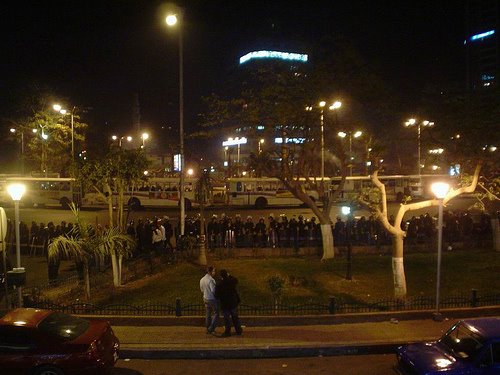
In a showdown played out during the first five hours of Friday, the protesters dismantled their plastic sheeting and cardboard, but most refused to leave on buses brought in to take them to camps elsewhere in Cairo.

Shortly before dawn, thousands of riot police encircled the camp, set up near the refugee agency to draw attention to the refugees' demands. Police fired water cannons at the protesters, then invaded the park when the Sudanese refused to leave.


20 are dead and many wounded. But Sandmonkey goes one better and points us to a first hand, eyewitness report with pictures from a vid phone (all hail citizen journalism):


I arrived campus at 11:00 pm to find State Security Trucks and plain cloth police filling and closing the roads of Batal Ahmed Abdel Aziz, Ahmed Orabi, and Gameet el Dewal streets.

Public white busses lined up all the way from Donuts House till Mustafa Mahmud square with a few number of state security soldiers sitting inside them. I was able to take down some of the public busses wagon numbers as I walked 4129, 3696, 4107, 4136, 4335, 3416, 3534, and 3416.[snip]

At 1:00 am, and it was really cold, security forced started flushing the Refugees with three water cannons from three different sides.[snip]

Refugees met the water floods with cheer and dance. We won’t go was their message.[snip]

The few civilians who gathered to observe the scene from far were mostly quiet amused. I painfully heard comments such “let them take a shower to become clean”, “Egypt has been more than patient with them”, “security forces should’ve got rid of them from day one. They (Sudanese) are disgusting”. Laughs interrupted such comments as the refugees were sprayed with water. Few stood silent with eyes wide open at the scene, while only one objected and explained that Sudanese have demands and rights to be met by UNHCR.[snip]

I was able to step to the second security circle surrounding them. A public bus waiting in the area had five Refugees at the back seat while a sixth one was being brutally beaten by 5 state security soldiers. From my position next to the bus I could see and hear him screaming as they beat him on his head and back with hands and batons, kicked him, and twisted his arm and wrist behind his back as his screams went louder and louder. An officer standing next to us explained that he is trying to break the window and escape because he is drunk. At this point a man from the back seat opened the window holding a few months old baby girl as he cried “we are not drunk, I am not drunk, he is not drunk, and this baby is not drunk. Her mother died here in this park”. They beat him to silence as well and continued with the sixth guy. A young man videod the scene on his cell phone and later Bluetoothed it to me.


Go read the rest

Read More...

Friday, December 30, 2005

N. Korea cuts off U.N. food, ignites famine fears - Asia-Pacific - MSNBC.com

N. Korea cuts off U.N. food, ignites famine fears - Asia-Pacific - MSNBC.com

Why? Way down in the article, the truth is spoken:

"If you give the food through the WFP, it is more likely to reach vulnerable people," said Noland. "If you give the food to the North Korean government, it will distribute according to its own preferences, which are basically political."

Since the regime's priority appears to be its own survival, experts say, it will naturally favor loyal military and political elite, rather than the most needy.


Kim Jong asshole feels his power weakening. He needs to:

a) Make sure the people are starving with no outlet for relief but himself. The minute they feel a little strength, they might get uppity and think they can replace him.

b) Because he feels the power wavering around him, he needs to shore it up with perks and payments to the military and political leaders around him and the only way that is happening in the crappy world they live in is if he grabs the grain at the central level, distributes it to his political friends who will then give it to their people to keep them loyal or who will sell it on the underground market or throught third or fourth party entities to get cash.

Criminy, even China is better than this pig.

Dear Lord, out of all the leaders in this world that seem to keep on ticking, why can't you, all Mighty and Powerful, manage to drop a plane on this guy's head?

Read More...

Military threatens to move in on Fiji's seat of government - World - smh.com.au

I was only joking about over throwing the Fiji government.

Military threatens to move in on Fiji's seat of government - World - smh.com.au

Read More...

The Forgotten War - Afghanistan's New Day: A Promising Step for Afghan Women

Four years after the U.S.-led coalition and Afghan resistance overthrew the Taliban, Afghanistan is still stumbling on the path to peace and stability.

However, there are glimmers of hope everywhere.

The country is nowhere near as violent as it was before, although in the past few months there has been an increase in insurgent attacks. It has a new constitution that enables the establishment of civil institutions like an independent judiciary and human rights commission, and foreign investment is trickling in. The brightest developments have been the inauguration of the new Afghan Parliament on Dec. 19 after more than a 30-year absence from the political scene and the political involvement of Afghan women in the rebuilding of their country.[snip]

Afghan women are finding their voices in many sectors of society, including politics. They have started to become actively involved in the political arena of their country, demanding increased representation in government and legislatures. Out of the 5,800 registered candidates who participated in the historic parliamentary elections on Sept. 18, 565 were women.

The new constitution of Afghanistan, instituted in January 2004, mandates that at least a quarter of the elected posts be reserved for women—putting the country ahead of Australia, Canada, the U.K. and the U.S. in terms of female representation in government. This means that women are guaranteed 68 of the 249 parliamentary seats, and 26 of the 102 seats reserved for the senate, or upper house.


Read the rest:

FOXNews.com - Views - Afghanistan's New Day: A Promising Step for Afghan Women

Read More...

The Story You Won't Hear On Iraq Part I:

Casualties Are Way Down

I was reading this article:

The two new deaths of U.S. military personnel were announced Friday by the American military. A bomb killed one soldier when it struck his vehicle in Baghdad on Friday, while the second soldier was shot and killed in the western city of Fallujah.

Their deaths brought the number of U.S. military members killed so far in 2005 to 841, of whom 64 died in December. A total of 846 troops died in 2004 and 485 in 2003. The worst month in 2005 was January with 106 fatalities, followed by November with 96 and August with 85.


I thought, "Is this the story?"

It's true after all. 841 died. Not much of a decrease over last year. But looking at the numbers as a whole without any information about increased operations or any other activities always seems sterile. I'm sure, had our men and women stayed behind their barricades or simply held certain areas we'd have extremely limited casualties. But since November 2004, the important part of the story is that we have seen a year of continuous operations, one after the other. Compared to 2003-2004 when we were holding specific areas and being continuously attacked with only a few major operations over the same period, the highest being November 2004 when we stormed Fallujah. If you look at the month summaries, it's almost all IEDs which means that we are still working out how to overcome these dangerous munitions.

We are going to have to improve this, no matter what, because it's likely we are going to be confronting these kinds of operations wherever we go in the future.

Before I continue on that subject though, another story is missing. This from Gateway Pundit


These are civilian casualties. That spike in September is from the day that over 900 Iraqi Shi'ites were trampled or drowned on the bridge when a mortar group fired on a religious procession and then rumors of a suicide bomber caused the group to panic more. Without that day, every day has been a safer day in Iraq for the civilians, though I'm sure it's still scary. But, our men and women have traded their lives for the lives of civilians by taking the fight to the enemy. That makes them true heroes, doing what we expect of them, not gung ho, trigger happy idiots trading their lives for nothing.

I'm reminded of Jeffrey Starr's words:

"Obviously if you are reading this then I have died in Iraq. I kind of predicted this, that is why I'm writing this in November. A third time just seemed like I'm pushing my chances. I don't regret going, everybody dies but few get to do it for something as important as freedom. It may seem confusing why we are in Iraq, it's not to me. I'm here helping these people, so that they can live the way we live. Not have to worry about tyrants or vicious dictators. To do what they want with their lives. To me that is why I died. Others have died for my freedom, now this is my mark."


It wasn't for nothing.

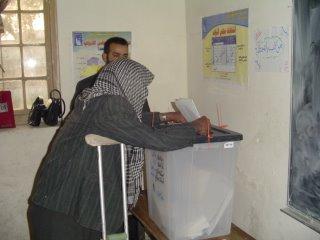
It was for this:


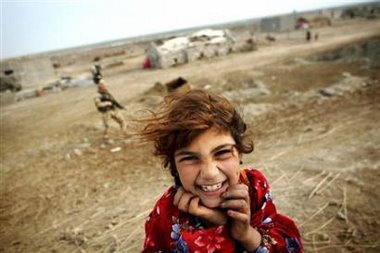
And, for this:


That's the story of Iraq 2005.

Read More...

Iran: The Younger Generation's 'Tehran Blues' - RADIO FREE EUROPE / RADIO LIBERTY

Iran: The Younger Generation's 'Tehran Blues' - RADIO FREE EUROPE / RADIO LIBERTY

The Hejab Wars

Although the hejab wars have been a constant feature of the past two decades, not all youth are openly defiant to the Islamic codes of appearance. There are still many young girls, particularly in smaller towns and cities, that choose to wear the chador in public; many boys who dress in the bland, traditionally religious uniform of plain shirts and trousers. However, as it becomes more and more difficult to forestall youngsters' exposure to what is happening beyond Iran's borders, this is undergoing a rapid change, even among strict traditional religious families. Parissa, a 16-year-old high-school student whose parents have brought her up wearing the chador since the age of nine, told me how every day in her life was a constant show.

"On my way to school, as soon as I get far enough from home, I turn into a back alley. I carefully fold my black chador and stuff it in my schoolbag. I daub my cheeks with some rouge that I have stashed away in my bag, and then I walk towards the school. At a safe distance from the school, I wipe off the rouge and put on the chador again."

Being a relative of mine, she confided in me that she sometimes saw a young boy and that they walked together a short distance hold hands.

"Do you call up each other?" I asked.

"Why, of course not. My parents have their eyes and ears glued to the telephone!"

"So how do you communicate?"

"Why, of course, through the web. Whenever I'm allowed to log on to the web for some research work, he comes into the same chat-room as I do."


Just because the president is crazy, doesn't mean everyone else is.

Read More...

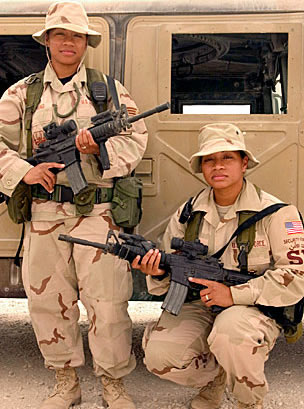
Air Force Sisters Take Names and Kick Butt

U.S. Air Force Senior Airmen Levina Sumang and Levana Raum volunteered to deploy here together to provide security for the base. The twins are with the 379th Expeditionary Security Forces Squadron and deployed from the Hawaii Air National Guard's 154th Wing. U.S. Air Force photo by Senior Airman Cassandra Locke.


SOUTHWEST ASIA, Dec. 28, 2005 — U.S. Air Force Senior Airmen Levana Raum and Levina Sumang have been brought closer together by sharing their deployment experiences at a forward-deployed location.

The twin sisters volunteered to deploy together so they could get an opportunity to catch up on quality time after once going their separate ways.

“It’s been nice to spend some quality time with my sister without the distractions you would get at home,” said Sumang, who is the older twin by one hour and 14 minutes.

Airmen Raum and Sumang enlisted in the Air Force through the buddy system. They went through basic training and technical school together.


Read More...

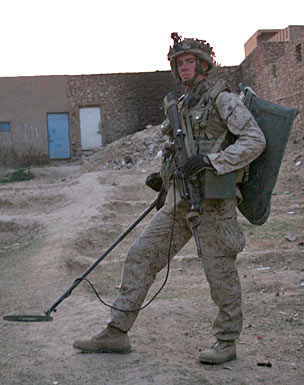
Marine Searches for IEDs in Haqliniyah


HAQLANIYAH, Iraq, Dec. 29, 2005 — In the town of Haqlaniyah, the “Raiders” of Company I, 3rd Battalion, 1st Marine Regiment, continue to patrol the streets every day, keeping the area safe from the ongoing insurgency.

Lance Cpl. Darin J. Wittnebel, a native of Oconomowoc, Wis., goes on many of these patrols. He has a very important duty that helps him keep the “Raider Nation” safe from improvised explosive devices and find abandoned weapons caches. He carries the PSS-12 metal detector on every patrol.“The detector can pick up lots of stuff underneath the ground or under piles of garbage,” said the 20-year-old rifleman for the company. “We bring it with us because you never know when you will find a weapons cache or IED.”

Recently, Wittnebel and other Marines in his squad were out on a routine patrol providing security and talking with local people in the area. On their way back to the base, Wittnebel was sweeping the curbs when a loud beep came from the detector signaling the presence of a large metal object.

“I wasn’t sure what it was picking up, but I found out when I moved some trash away from the area and there was a bunch of wires attached to a battery assembly,” he said as he smiled. “As soon as I saw that I didn’t waste any time getting away from there. I just couldn’t believe that I found an IED just like that, and it was right outside the base.”

Read More...

82nd Airborne Returning From al Anbar

After the task force's convoy to Iraq from Kuwait, "we almost immediately started combat operations," Swift said. The "Wild West," as some paratroopers called it, was a hotbed of the insurgency. The task force used intelligence to target insurgent leaders, deny terrorists safe havens and protect the people of the region from the insurgents. The task force operated in Haqlaniyah, Habbaniyah and Ramadi. [snip]

Once the action was over, the paratroopers were able to relate to the Iraqis in the area. A D Company medic, Pfc. Dustin Lehmann, said he was surprised and pleased that when the unit moved into an area, people started bringing their sick children and other family members in to see him. "They rely on you and trust you to take care of them," Lehmann said. "And knowing you can help was an amazing feeling. We treated lot of small children with malaria, a lot of burn injuries and bullet wounds." [snip]

All in the unit were surprised at the level of insurgent intimidation. "In one town, this man wouldn't cooperate with them, so they kidnapped his son and left his headless body on the street in front of his house," Swift said. "In another, they kidnapped this woman's husband and raped her son right in front of her. [snip]

"(The insurgents) have nothing to offer," he said.

The paratroopers noticed quickly what effect they were having in these cities, towns and villages. "The first few days, no one would come out," said Army Sgt. Abel Peterson, a fire team leader with A Company. "But then you would see folks start coming out into the street. They felt safe seeing us around."

In one instance, his company cleared a street and one woman came out and hugged his platoon sergeant. "She had lost her husband to Saddam's thugs; her sons had been run out of town by the insurgents," he said. "But that night she knew she was safe. It sticks in my mind."


Read the rest

Read More...

An Interesting Series from the NYT:

Happiness, Acceptance, Pride and Loss

I caught this series while reviewing news on the Iraq election and wanted to share it as I was so surprised that it was not laced with "bad Bush war" rhetoric, but were follow ups to previous stories.

Hapiness, Acceptance, Pride and Loss

Juliet Macur of the Times follows up on six soldiers from past articles in the series about the role sports play in the lives of American soldiers deployed to Iraq and of their families.


Dawn Hafker: Staying busy with work, new love

In June 2004, First Lt. Dawn Halfaker, who had played basketball at West Point, was riding in an armored Humvee in Baquba when a rocket-propelled grenade tore through the vehicle. It burst through her upper right arm, shattered her shoulder blade and broke five ribs that bruised her lung. Doctors amputated her right arm.


Danielle Green: From Grand Marshall to Coveted Sports Job

Specialist Danielle Green, a former basketball player at Notre Dame, was sitting atop a police station in Baghdad in May 2004 when a rocket-propelled grenade tore off her left arm below the elbow. For months afterward, she was angry and self-conscious about losing her dominant hand, and she was still struggling to cope last spring. But she said she had come to terms with the injury


Phil Sorenson: Football Not the Same

Phil Sorenson and his best friend, Cody Wentz, joined the North Dakota Army National Guard for college money. In February 2004, they were shipped to Iraq. On Nov. 4, 2004, the two were arguing inside a Humvee about their favorite football teams - the Detroit Lions and the Minnesota Vikings - when a roadside bomb exploded. It killed Mr. Wentz, and tore off Mr. Sorenson's lower left leg.


Partnership Brings Trained Soldiers and Optimism

American and Iraqi soldiers lived together at Camp Normandy, 60 miles northeast of Baghdad, and the two battalions competed in sports to strengthen their relationship. Now Lt. Col. Roger Cloutier's First Battalion, 30th Infantry of the Third Infantry Division is about to leave Iraq.


Mother Deals With Son's Death At Home

On Aug. 29, he returned home to Nashville for a 15-day break. He called his parents, Dorothy and Mozell, for directions to their new house but never showed up.

Late that night, Sergeant Rayner, still in his desert camouflage uniform, was stabbed to death in the apartment of his 19-year-old girlfriend. He was 37, and had a 10-year-old son from a previous marriage. William K. Gillum, who had been dating Sergeant Rayner's girlfriend, was charged with first-degree murder and is out on bail. His arraignment is set for Jan. 6.

Read More...

Thursday, December 29, 2005

The Harsh Truth About Honor Killings

It's the Money, Stupid

The honor killing noted by Michelle Malkin is interesting for several reasons, one of which is not in its barbarity nor that it was claimed as "honor", but in fact, the lengths to which it was carried.

Nazir Ahmed appears calm and unrepentant as he recounts how he slit the throats of his three young daughters and their 25-year old stepsister to salvage his family's "honor" — a crime that shocked Pakistan.

The 40-year old laborer, speaking to The Associated Press in police detention as he was being shifted to prison, confessed to just one regret — that he didn't murder the stepsister's alleged lover too.


He killed not only the original "sinner", but he killed her younger sisters as well, ostensibly to prevent them from committing the same "crime". However, the true motive is buried far down in the story and is more often than not the reason why such murders are carried out:

The independent Human Rights Commission of Pakistan said that in more than half of such cases that make it to court, most end with cash settlements paid by relatives to the victims' families, although under a law passed last year, the minimum penalty is 10 years, the maximum death by hanging.[snip]

Despite Ahmed's contention that Muqadas had committed adultery — a claim made by her husband — the rights commission reported that according to local people, Muqadas had fled her husband because he had abused her and forced her to work in a brick-making factory.


Let me explain a few things that you might not be familiar with. When a girl marries, her husband must pay a bride price or dowry to the family who must also provide a small cash settlement, houshold goods and possibly some farm animals. Should the marriage go south, usually and largely blamed on the woman, then the bride's family must give back the bride price and will not receive back in return any of the goods that were provided. Further, the woman or girl will be wholely unmarriagable again, unless the family can convince some poor guy to accept her with an even larger dowry from them and a much smaller bride price from the groom (which no family in their right mind is going to allow their son to marry any such woman without this payment no matter how much the son may want to do so for purposes other than the money). Finally, lacking marital prospects, the woman now becomes a drain on the resources of the family.

However, if they charge her as an adultress and kill her, there is no return of the bride price, but possibly a small compensation to the other family (much cheaper) for the loss of a pair of hands and a baby maker in the family. The other compensation that the article speaks of is for the male "adulterer" whoever that is (if he exists at all) who may be killed and is worth quite a bit more money than the woman. so, despite the father's "lament" not having killed the "lover", he is most likely full of crap since it was cheaper to simply kill his daughter.

Now, the question why, if not honor, that he killed his other daughters. Since the sister has "brought shame" on the house, these daughters are going to be much more difficult to marry off and he certainly has no desire to have them around forever. To marry them off, he is going to have to provide additional incentives and possibly take less bride price for each of them. On top of that, he has a young son (less than a year old) who, when he is old enough, will choose a bride and will need to have money to pay for his bride and make an advantageous marriage when he grows up. By the time his son would have been old enough to marry, its very likely that the family would have been beggared or forced to borrow money from their relatives in order to provide him with a suitable bride.

Basically, this is not about pretty sentiments of "honor" or even women as things in extension to men's honor, but it is about women being things or commodities, much as fuedal Europe once saw a woman's virginity as a commodity to barter for wealth and power (it wasn't paticularly about honor back then either).

This man is worse than a serial killer because he has made a cold blooded financial choice knowing that he will spend little time in prison, will pay little in the way of a fine, will most likely have his herds or farm cared for by other family members while he spends what little time he has in prison and will come out, in all actuallity, in a far improved financial condition.

It's not about "honor", it's the money, stupid.


Read More...

The Forgotten War:

Now I Find Myself Waiting

This morning I heard the news:

BAGRAM AIRFIELD, Afghanistan – One U.S. service member and one Afghan local national employed by the Coalition were killed and another two U.S. service members were injured Wednesday when their vehicle was struck by an improvised explosive device in eastern Afghanistan.


I have a friend who is an "Afghan local national" that works as an interpreter for our forces whom I met via chat through a mutual acquaintance there who I speak very little about on this website because I feared disclosing too much information that might lead to his identification and thus endanger him.

We speak of little things like how many magazines are now printed in Afghanistan. He told me that he could go to a news stand and count at least 50 in different languages including women's magazines on fashion, clothing and food, though he said 90% are political. He told me that the men he worked with (US soldiers) had given him dirty magazines to look at and taught him some inappropriate phrases, which I helpfully reminded him would not be appropriate to use in front of or to women, though I am sure he already knew that he should not speak so in front of his mother.

I was laughing later thinking that this is, after all, one of the things that does not change when we go to war. Wherever an American soldier goes, so you will find him sharing his culture in the way that soldiers know best how to do.

We spoke in general that he wants to come to the United States and open a business. He already had a supply line set up and waiting, but he had to save money and wait to get a visa which is not easy, even for a man working with the coalition. He thinks he will only be safe if he leaves there and it is probably true, though he also said that there are many like him who must stay so if he must he would find away to keep working with the government since it may be the only way he will ever be safe.

Several times he said to me that he was a marked man and that he did not go home regularly because he did not want people to know who his family was or where he lived since it made them marked, too. I suppose it is these conversations, though I knew little what to reply accept that he should be careful then and always vary the way he went home, which make me understand war from outside the position of an American or even a supporter of our troops reading blogs and news reports.

My friend despised the Taliban, but feared sometimes that his country beyond the progress of Kabul would be forever plagued by the affliction not because all of Afghanistan was ideologically radicalized or even "Islamic", but because, as in many places, these people were simple people trying to eek out a living, with little education and with little opportunity to go beyond their ancestoral lands so they would deal with whomever came in strength in order to survive. He said that there was little Afghan nationality nor national pride, that it had been beaten from them in 25 years of war.

I've thought that about Iraq as well and something we should always understand in all future wars with small, failed states, that national pride is not created simply by borders or government, but is created over years and requires the ability to simultaneously create a new way forward while accepting all things that have come in the past to create it. It's a very long process which I suppose means that if we are to deny territory to those ideological radicals it means that wherever we go, we must be prepared to stay a long time and support them for a long time lest we find ourselves returning again.

I believe our little conversations may have helped him improve his english beyond the phrases that the soldiers taught him. I found myself explaining slang terms to him that I never realized before were slang at all. Those little cliches that we sprinkle in our conversations which we in our every day lives pay little attention to are quite confusing to English as a second language speakers.

I suppose that I should tell the funny part of our conversation because our mutual friend was teasing him about finding him a girlfriend and he was worried when we first spoke that his friend was trying to set him up. Of course, I am 14 years his senior so I assured him that was not the case that our friend simply provided a person as a pen-pal since he knew that our Afghan friend was largely cut off from his friends and family due to his occupation. He then told me that in Afghanistan, the age of the woman and man did not matter and that many men his age had married older women. He said that the concern over such age differences was strictly a western occupation.

Of course, in a world of tribal relations and marriages for dowry and property, like the old European fuedal system, that would be correct. It is amazing the little things you learn that you take foregranted as common social behavior which has no bearing in a land far away.

Still, I was nervous and wanted to make sure that my friend understood I was only a friend. I was even more nervous when he asked several times if I had a boyfriend because he was sure that, if I had a boyfriend, I would not be allowed to write him. I was hard pressed how to explain firmly that we were simply friends while at the same time assuring him that a boyfriend on my part would not change my mind about writing to him. I think that is another cultural difference. Then again, maybe he understood relationships between men and women better than my own illusions of independence? In either case, we got that sorted out without trampling too much on each others feelings or destroying a fragile friendship.

He had no girlfriend (he explained that no matter how much western influence they imbibed, any such prospects were extremely limited in their culture and would likely result in him getting his butt kicked if not worse) and he had no girl which he wanted to court. He did not want to marry an Afghan girl I think because he felt that doing so meant that he had given up his dream of leaving there.

You see, contrary to popular belief, in many places, America is still the land of dreams.

I last heard from my friend on Christmas Eve when he wrote to wish me Merry Christmas and told me that he had received some small gifts from the men that he worked with. I wished him Merry Christmas and Happy New Years in return.

This morning I heard the news that an "Afghan local national" had been killed along with a Coalition soldier which I knew meant a US soldier and my heart skipped a beat. They never say the Afghan's name and I only hear from my friend every few weeks while he is out on patrols or operations.

Now I find myself waiting like many others must wait to hear from my friend again.

I do not write about Afghanistan often, but it is not a forgotten war here.

Read More...

Pray For Peace, Prepare For War

I was reminded this morning of the schizophrenic nature of war. Its strange dual face that most do not recognize as existing and many feel that, to profess to one means that you cannot believe in or hope for the other just as fervently. It may be that this season brings it on more than any other time of the year. It may simply be the realization that we are heading into the fifth year and we must recognize that this low level war may indeed continue for years to come at a higher or lower pace, but war it will be whether we see it nightly on our news or simply hear a weekly update on activities beyond our borders or if it reverts to an occasional "special report" on the evening news.

We will eventually slip into that twilight where we hear and see little until the next flare up turns hot enough for full force intervention.

In the meantime, it is still hot enough to warrant the attention and the dual ideology that one can understand the necessity for war and the preparation, yet pray regularly and hope even more diligently for peace. While it is not millions of men and women serving in harms way nor tens of thousands wounded and dying in major battles, nor the whole sale destruction of civilian centers daily that was seen during my grandparents' days of WWII, the ability to see and read daily the reports of both progress and set backs, the daily casualty reminders and, even on Christmas Day, to note the deaths of the young, aspiring and inspiring soldiers or the casual note of "four civilians killed or wounded", has reminded me in a small way, what it must have been like to sit at home during those much darker days and wait.

While I have routinely prayed to God to give our men and women strength to carry on, to protect them in their endeavors, have mercy on those that are wounded and dying and to comfort those that have lost, strangely (or not), what I find myself praying for even more passionately is that God will move men to see reason, to stay the sword and desire peace above all other things.

I suppose, at heart, I am truly a pacifist. I can imagine, with all honesty, that around this country and around the world, there are more people who dream of peace whatever their nationality, race or religion, than who beat the drums of war. Yet, man is man, hardly perfect or pure in his wants and needs, thus war seems to be an equal and unending act of man. Man's duality, his natural state.

Having studied these last two years the conflicts around the globe, one can see that war, in one shape or another, has gone on unending for centuries. Sometimes I wonder if, in some strange way, the proclivity to war is natures way of culling an ever expanding population of men where the only predator capable enough of "herd control" is man himself? That is neither logical science nor comforting since we are raised up to believe that man, with his superior reasoning capabilities, is supposed to be able to overcome natural inclinations seen in the animal kingdoms.

I think that we are fooling ourselves in that regard because we do reflect the wild beasts in the jungles, on the mountains and on the plains. We struggle for territory and resources, to protect our own from outsiders, particularly from a different species. And, as our own grows, we continually come into contact with those that "do not belong" who feel equally threatened by our existence or expansion.

I suppose that one could blame modern globalization for this continual friction when in modern man we should have developed a more sensible approach to addressing differences and resolving problems with "dialogue". Maybe that is why many despise and loath modern globalization because they see in it the destruction of their individual cultures and ideas? Yet, for any true scholar of human expansion and achievement the modern globalization trend and its unceasing abuttment to many small wars, is nothing new nor is it a process which can be stopped since the first true "globalization" began the first time that a caveman went to the next cave over and traded his flint blades and the knowledge on how to capture and skin an animal for clothing for the berries, fruit and wheat the other tribe had collected. From that moment on, each caveman and his clan were changed irrevocably in diet, clothing, language and even culture.

At the same time, each cave clan had to know that now they had rivals for their resources and that they were in danger of extinction or forced to leave or join forces with the new clan should those resources be over used or the next clan over decide that they should have what the others have either through trade or violence. From that moment on, every interaction of man, every advancement, every movement, was leading to this moment and is unavoidable.

In which case, our society will be changed in many small ways while other cultures will be changed in extremely large and sometimes threatening ways. However one protects against it, it cannot be avoided which often makes such ideological wars as those proposed by the current rash of irrationalists (ie, the Islamists) seem futile and pointless.

I suppose I am also often surprised by people who say that we should "disengage" from one area or the other as if this would reduce the friction created by global expansion when one cannot stop a speeding train by placing a penny on the track anymore than one can stop the intermingling of cultures and people by pretending that an invisible wall exists through which no outside culture could penetrate through cable or air waves, much less global trade.

So, here we are. On the one hand desiring peace and prosperity and on the other understanding that man's continual expansion will always create friction and that, even as one culture may rise above another, soon will come another and another to change it yet again and create friction which lends to war.

A question that every generation must ask itself even as it sees the end of one great conflict which seems to signal a new and lasting peace, only to see arise a new conflict:

Are we forever to be praying for peace, but preparing for war?

Read More...

Sunday, December 25, 2005

To My Friends and Web Pals

Merry Christmas!
Sorry I'm so late. Hope you all are enjoying the holidays with family and friends.
Joy to the world, peace on earth good will towards men.
Luke Chapter 2
25And, behold, there was a man in Jerusalem, whose name was Simeon; and the same man was just and devout, waiting for the consolation of Israel: and the Holy Ghost was upon him.
26And it was revealed unto him by the Holy Ghost, that he should not see death, before he had seen the Lord's Christ.
27And he came by the Spirit into the temple: and when the parents brought in the child Jesus, to do for him after the custom of the law,
28Then took he him up in his arms, and blessed God, and said,
29Lord, now lettest thou thy servant depart in peace, according to thy word:
30For mine eyes have seen thy salvation,
31Which thou hast prepared before the face of all people;
32A light to lighten the Gentiles, and the glory of thy people Israel.
33And Joseph and his mother marvelled at those things which were spoken of him.
34And Simeon blessed them, and said unto Mary his mother, Behold, this child is set for the fall and rising again of many in Israel; and for a sign which shall be spoken against;
35(Yea, a sword shall pierce through thy own soul also,) that the thoughts of many hearts may be revealed.
May the thoughts in your hearts be only joy.

Read More...

Friday, December 23, 2005

The Best Propaganda Ever - Truth:

Osama's Niece

Her uncle is the world's most wanted man and a byword for zealotry. Which makes these poses by Osama Bin Laden's niece either very brave or extremely foolish.

Wafah Dufour, 26, is seen sprawled on a bed in lingerie, a feather boa and high heels.

She stretches out her long limbs and throws back her hair in an attitude seemingly calculated to outrage Islamic traditionalists.


Does that make her an infidel or an apostate?

Click on title to read the rest.

H/T Blonde Sagacity

Read More...

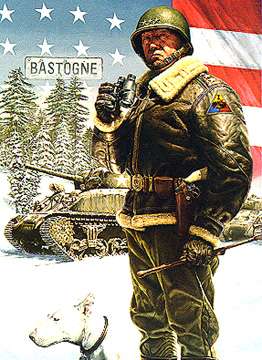
Patton's Prayer and Training Letter 5

In conjunction with Castle Argghhh!'s recounting of the Battle of the Bulge over Christmas, I bring you the story of General George S. Patton's "Prayer for Weather" and "Training Letter 5":

The incident of the now famous Patton Prayer commenced with a telephone call to the Third Army Chaplain on the morning of December 8, 1944, when the Third Army Headquarters were located in the Casene Molfir, in Nancy, France: "This is General Patton; do you have a good prayer for weather? We must do something about these rains if we are to win this war." My reply was that I knew where to look for such a prayer, that I would locate, and report within the hour.

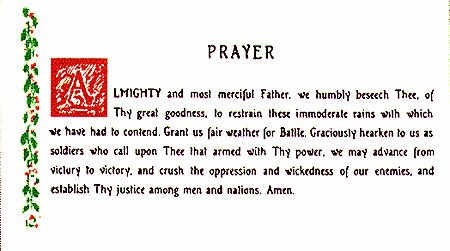
As I hung up the telephone receiver, about eleven in the morning, I looked out on the steadily falling rain, "immoderate" I would call it - the same rain that had plagued General Patton's Army throughout the Moselle and Saar Campaigns from September until now, December 8. The few prayer books at hand contained no formal prayer on weather that might prove acceptable to the Army Commander. Keeping his immediate objective in mind, I typed an original and an improved copy on a 5" x 3" filling card:

Almighty and most merciful Father, we humbly beseech Thee, of Thy great goodness, to restrain these immoderate rains with which we have had to contend. Grant us fair weather for Battle. Graciously harken to us as soldiers who call Thee that, armed with Thy power, we may advance from victory to victory, and crush the oppression and wickedness of our enemies, and establish Thy justice among men and nations. Amen.

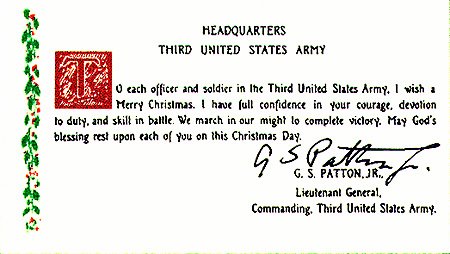
[snip]If he intended it for circulation to chaplains or others, with Christmas not far removed, it might be proper to type the Army Commander's Christmas Greetings on the reverse side. This would please the recipient, and anything that pleased the men I knew would please him. "To each officer and soldier in the Third United States Army, I wish a Merry Christmas. I have full confidence in your courage, devotion to duty, and skill in battle. We march in our might to complete victory. May God's blessings rest upon each of you on this Christmas Day. G.S. Patton, Jr., Lieutenant General, Commanding, Third United States Army."

This done, I donned my heavy trench coat, crossed the quadrangle of the old French military barracks, and reported to General Patton. He read the prayer copy, returned it to me with a very casual directive, "Have 250,000 copies printed and see to it every man in the Third Army gets one."[snip]

"Chaplain, how much praying is being done in the Third Army?" was his question. I parried: "Does the General mean by chaplains, or by the men?" "By everybody," he replied. To this I countered: "I am afraid to admit it, but I do not believe that much praying is going on. When there is fighting, everyone prays, but now with this constant rain - when things are quiet, dangerously quiet, men just sit and wait for things to happen..."

The General left the window, and again seated himself at his desk, leaned back in his swivel chair, toying with a long lead pencil between his index fingers.

Chaplain, I am a strong believer in prayer. There are three ways that men get what they want; by planning, by working, and by praying. And any great military operation takes careful planning, or thinking. Then you must have well-trained troops to carry it out: that's working. But between the plan and the operation there is always an unknown. That unknown spells defeat or victory, success or failure. It is the reaction of the actors to the ordeal when it actually comes. Some people call that getting the breaks; I call it God. God has His part, or margin in everything. That's where prayer comes in. Up to now, in the Third Army, God has been very good to us. We have never retreated; we have suffered no defeats, no famine, no epidemics. This is because a lot of people back home are praying for us. We were lucky in Africa, in Sicily, and in Italy, simply because people prayed. But we have to pray for ourselves, too. A good soldier is not made merely by making him think and work. There is something in the every soldier that goes deeper than thinking or working - it's his "guts." It is something that he has built in there: it is a world of truth and power that is higher than himself. Great living is not all output of thought and work. A man has to have intake as well. I don't know what you call it, but I call it Religion, Prayer, or God.

With that the General arose from his chair, a sign that the interview was ended. I returned to my field desk, typed Training Letter No. 5 while the "copy" was "hot," touching on some or all of General's reverie on Prayer, and after staff processing, presented it to General Patton on the next day. The General read it, and without change directed that it be circulated to the 486 chaplains, but to every organization commander down to and including the regimental level. Three thousand two hundred copies were distributed to every unit in the Third Army over my signature as Third Army Chaplain. Strictly speaking, it was the Army Commander's letter, not mine. Due to the fact tat the order came directly from General Patton, distribution was completed on December 11 and 12 in advance of its date line, December 13, 1944. Titled "Training Letter No. 5," with the salutary "Chaplains of the Third Army," the letter continued: "At this stage of the operations I would call upon the chaplains and the men of the Third United States Army to focus their attention on the importance of prayer.

"Our glorious march from the Normandy Beach across France to where we stand, before and beyond the Siegfried Line, with the wreckage of the German Army behind us, should convince the most skeptical soldier that God has ridden with our banner. Pestilence and famine have not touched us. We have had no quitters; and our leadership has been masterful. The Third Army has no roster of Retreats. None of Defeats. We have no memory of a lost battle to hand on to our children from this great campaign.

"But we are not stopping at the Siegfried Line. Tough days may be ahead of us before we eat our rations in the Chancellory of the Deutsches Reich.

"As chaplains it is our business to pray. We preach its importance. We urge its practice. But the time is now to intensify our faith in prayer, not alone with ourselves, but with every believing man, Protestant, Catholic, Jew, or Christian, in the ranks of the Third United States Army.[snip]

"Urge all of your men to pray, not alone in church, but everywhere. Pray when driving. Pray when fighting. Pray alone. Pray with others. Pray by night and pray by day. Pray for the cessation of immoderate rains, for good weather for Battle. Pray for the defeat of our wicked enemy whose banner is injustice and whose good is oppression. Pray for Victory, Pray for our Army, and Pray for Peace.

"We must march together, all out for God. The soldier who 'cracks' up does not need sympathy or comfort as much as he needs strength. We are not trying to make the best these days. It is our job to make the most of them. Now is not the time to follow God from 'afar off.' This Army needs the assurance and faith that God is with us. With prayer, we cannot fail.

"Be assured that this message on prayer has the approval, the encouragement, and the enthusiastic support of the Third United States Army Commander.

"With every good with to each of you for a very Happy Christmas, and my personal congratulations for your splendid and courageous work since landing on the beach, I am, " etc., etc., signed The Third Army Chaplain.


The timing of the prayer story is important: let us rearrange the dates; the "Prayer Conference" with General Patton was 8 December; the 664th Engineer Topographical Company, at the order of Colonel David H. Tulley, C.E., Assistant to the Third Army Engineer, working night and day reproduced 250,000 copies of the Prayer Card; the Adjutant General, Colonel Robert S. Cummings, supervised the distribution of both the Prayer Cards and Training Letter No. 5 to reach the troops by December 12-14. The breakthrough was on December 16 in the First Army Zone when the Germans crept out of the Schnee Eifel Forest in the midst of heavy rains, thick fogs, and swirling ground mists that muffled sound, blotted out the sun, and reduced visibility to a few yards. The few divisions on the Luxembourg frontier were surprised and brushed aside. They found it hard to fight an enemy they could neither see nor hear. For three days it looked to the jubilant Nazis as if their desperate gamble would succeed. They had achieved complete surprise. Their Sixth Panzer Army, rejuvenated in secret after its debacle in France, scared through the Ardennes like a hot knife through butter. The First Army's VIII Corps was holding this area with three infantry divisions (one of them new and in the line only a few days) thinly disposed over an 88-mile front and with one armored division far to the rear, in reserve. The VIII Corps had been in the sector for months. It was considered a semi-rest area and outside of a little patrolling was wholly an inactive position.

When the blow struck the VIII Corps fought with imperishable heroism. The Germans were slowed down but the Corps was too shattered to stop them with its remnants. Meanwhile, to the north, the Fifth Panzer Army was slugging through another powerful prong along the vulnerable boundary between the VIII and VI Corps. Had the bad weather continued there is no telling how far the Germans might have advanced. On the 19th of December, the Third Army turned from East to North to meet the attack. As General Patton rushed his divisions north from the Saar Valley to the relief of the beleaguered Bastogne, the prayer was answered. On December 20, to the consternation of the Germans and the delight of the American forecasters who were equally surprised at the turn-about - the rains and the fogs ceased. For the better part of a week came bright clear skies and perfect flying weather. Our planes came over by tens, hundreds, and thousands. They knocked out hundreds of tanks, killed thousands of enemy troops in the Bastogne salient, and harried the enemy as he valiantly tried to bring up reinforcements. The 101st Airborne, with the 4th, 9th and 10th Armored Divisions, which saved Bastogne, and other divisions which assisted so valiantly in driving the Germans home, will testify to the great support rendered by our air forces. General Patton prayed for fair weather for Battle. He got it.

It was late in January of 1945 when I saw the Army Commander again. This was in the city of Luxembourg. He stood directly in front of me, smiled: "Well, Padre, our prayers worked. I knew they would." Then he cracked me on the side of my steel helmet with his riding crop. That was his way of saying, "Well done."


Read the rest in the inner sanctum...


Read More...

What Did the Three Kings Bring Jesus?


Test your knowledge.

What three gifts did the Magi bring to Jesus and what did they represent?

Music to prompt your memory

Answers in the expanded post


Matthew Chapter 2

1Now when Jesus was born in Bethlehem of Judaea in the days of Herod the king, behold, there came wise men from the east to Jerusalem,

2Saying, Where is he that is born King of the Jews? for we have seen his star in the east, and are come to worship him.

3When Herod the king had heard these things, he was troubled, and all Jerusalem with him.

4And when he had gathered all the chief priests and scribes of the people together, he demanded of them where Christ should be born.

5And they said unto him, In Bethlehem of Judaea: for thus it is written by the prophet,

6And thou Bethlehem, in the land of Juda, art not the least among the princes of Juda: for out of thee shall come a Governor, that shall rule my people Israel.

7Then Herod, when he had privily called the wise men, enquired of them diligently what time the star appeared.

8And he sent them to Bethlehem, and said, Go and search diligently for the young child; and when ye have found him, bring me word again, that I may come and worship him also.

9When they had heard the king, they departed; and, lo, the star, which they saw in the east, went before them, till it came and stood over where the young child was.

10When they saw the star, they rejoiced with exceeding great joy.

11And when they were come into the house, they saw the young child with Mary his mother, and fell down, and worshipped him: and when they had opened their treasures, they presented unto him gifts; gold, and frankincense and myrrh.

12And being warned of God in a dream that they should not return to Herod, they departed into their own country another way.


We three kings of Orient are;
Bearing gifts we traverse afar,
Field and fountain, moor and mountain,
Following yonder star.

Refrain

O star of wonder, star of light,
Star with royal beauty bright,
Westward leading, still proceeding,
Guide us to thy perfect light.


Born a King on Bethlehem’s plain
Gold I bring to crown Him again,
King forever, ceasing never,
Over us all to reign.

Refrain

Frankincense to offer have I;
Incense owns a Deity nigh;
Prayer and praising, voices raising,
Worshipping God on high.

Refrain

Myrrh is mine, its bitter perfume
Breathes a life of gathering gloom;
Sorrowing, sighing, bleeding, dying,
Sealed in the stone cold tomb.

Refrain

Glorious now behold Him arise;
King and God and sacrifice;
Alleluia, Alleluia,
Sounds through the earth and skies.

Refrain


Written by John Hopkins Jr, 1857 Yes, that one.

Read More...

Marine Corps News> Azerbaijanis watch over Haditha Dam

HADITHA DAM, Iraq (Dec. 21, 2005) -- Iraq’s infrastructure is a constant target for terrorist attacks throughout the country. This is no different at the Haditha Dam, which is the power source for many cities in Iraq.

Keeping the massive dam and more than 1,000 Marines operating here safe for the past five months is 150 Azerbaijani Army soldiers.

Located on the Caspian Sea, Azerbaijan is the host country of the guardian soldiers who left their country in July to spend six months supporting Operation Iraqi Freedom. They worked alongside the Marines with 3rd Battalion, 25th Marine Regiment and 3rd Battalion, 1st Marines since arriving.

Catch the rest.
Marine Corps News: Azerbaijanis watch over Haditha Dam

Don't forget we have a ton of allies in this thing with us. The Azerbaijanis are there getting real time experience since they are pretty close to Dagestan and Chechnya where Islamists have taken over the rebel factions and occasionally bleed over into their country. This war is bigger than Iraq and Afganistan, just remember that.

Read More...

THREE TERRORISTS CAUGHT EMPLACING BOMB

BAGHDAD, Iraq ©¤ Three terrorists were captured as they were caught emplacing a hoax roadside bomb in east Baghdad Dec. 21.

At about 6 p.m., a patrol from 3rd Squadron, 7th Cavalry observed a civilian vehicle dropping cement blocks in the median of a major thoroughfare. The patrol intercepted the suspicious vehicle and detained three suspected terrorists.

Additional elements of 3-7 CAV secured the site surrounding the suspicious items and an explosive ordnance disposal team investigated the objects and found them to be hoax roadside bombs.

¡°These suspected terrorists were not placing cement blocks in the road for any other reason than to terrorize and intimidate the population. They are currently being detained at a military detention facility,¡± said Maj. Paul Reese, operations officer for 2nd Brigade, 3rd Infantry Division.

¡°Anyone found guilty of emplacing a hoax roadside bomb is a terrorist ¨C make no mistake about it; the good people of Iraq are disgusted by these types of games.¡±

Hoax roadside bombs are commonly used by terrorists to check how Iraqi Security and Coalition Forces will react.


The lull in violence is over:

Iraqi troops and civilians attacked.

One Soldier Killed by IED

Two soldiers killed, rocket factory discovered


THREE TERRORISTS CAUGHT EMPLACING BOMB

Read More...

MOSUL MEDIA EMIR AND ADMINISTRATOR CAPTURED

BAGHDAD, Iraq – An Ansar al-Sunna of Mosul Media Emir and Administrator were captured by Coalition Forces during raids on suspected terrorist safe houses near Mosul.

Muhammad ‘Amir Husayn Mar’I al-Sufi, known as Abu Naba, was an Ansar al-Sunna media emir in Mosul and ‘Adnan ‘Abd-al-Wahab ‘Abdallah Mahmud al-Badrani, known as Abu Hudayfah, an Ansar al-Sunna administrator, were captured Nov. 23 and Dec. 5, 2005 respectively.

Abu Naba was responsible for disseminating propaganda - in this capacity, he produced propaganda fliers and compact disks focusing on military operations, anti-voting messages, Jihad messages and prayers.

He also facilitated videos of attacks on Iraqi and Coalition Forces to be posted to the Internet. He purchased cameras for terrorists to film violent acts including bombings, kidnappings and executions. Abu Naba helped produce the final video products and delivered the videos to other Ansar al-Sunna leaders for posting on the Internet.

Based on information Abu Naba and other detained terrorists provided to Coalition Forces, Abu Hudayfah, allegedly in charge of logistics and support for Ansar al-Sunna of Mosul was also identified and captured.


I imagine that there was no "torture" involved, just pleading for a life sentence instead of a death sentence at the hands of the infidel or apostate Iraqi government.

MOSUL MEDIA EMIR AND ADMINISTRATOR CAPTURED

Read More...

Thursday, December 22, 2005

Victor Davis Hanson Why Not Support Democracy?

Victor Davis Hanson on National Review Online

Why still no big-font, front-page headlines screaming, “Millions Vote in Historic Middle East Election!” or “Democracy Comes At Last To Iraq” or “America’s Push for Iraqi Democracy Working”?


I'd read the rest.

Also, not to jinx it or anything, but anybody else notice that it's awful quiet on the Iraq front? Last reported casualty was December 19. No giant bombs. No beheadings. What's that mean?

I think it means that the Sunni rejectionists are now waiting to see which way the wind blows on the elections. That means that they have control over the insurgents/terrorists much more than expected. It means, if things go right, this could mean a real peace.

But, as I've said this entire year starting on New Years day, Iraq is a done deal. It's free. It's democratic.

They win.

We win.

And, as I said way back when, you know we've won because Iraq and Afghanistan have slowly drifted off the news to a few minute clips on the daily activity.

No news here. Move along. Nothing to see.

However, don't think that doesn't mean the Moronic Muslim Trio (OBL, Zawahiri, Zarqawi) aren't planning anything big and nasty for the new year. It just means that they've lost in Iraq and Afghanistan and will be looking for a new place to sit down.

Read More...

Rob Long on the Claus Break-Up on National Review Online

Rob Long on the Claus Break-Up on National Review Online

CALLER: “Hi, Larry. Hi, Mrs. Claus.”


LARRY KING: “What’s your question, caller?”

CALLER: “I just want to know if there’s been any reaction to the book so far from her ex-husband?”

LARRY KING: “Good question. So? Did Santa ring in?”

MRS. CLAUS: “His lawyers did, Larry. You know, after all those years I really felt that he’d at least want to talk to me directly. Instead, I got a very threatening letter from his attorneys basically saying that if I went through with the book they’d sue me and ruin me and all like that.”


Even jolly couples have their down times.

Read More...

Castle Argghhh! Nuts!

I have been very remiss in not linking to John these last few days as he recounts the Battle of the Bulge in 1944.

Today is a special day in the story. It's the day that Brig. General Anthony McAuliffe sent back a one word message to the Germans upon their demand for US forces to surrender at the besieged town of Bastogne:

Read More...

Our Polish Friends

POLISH PRIME MINISTER VISITS CAMP ECHO

The Prime Minister was welcomed by an honor guard and the commander of MND CS, MG Piotr Czerwinski. The Prime Minister and his delegation celebrated Christmas Eve with the Polish Soldiers by sharing a wafer.

Prime Minister Marcinkiewicz wished his troops safe service in Iraq and a happy return home. Marcinkiewicz emphasized that he is very proud of his Soldiers and the meeting with them made him much stronger. [snip]

Marcinkiewicz commemorated Polish soldiers who paid the highest price for Iraqi freedom by lighting two, white and red, candles in a military chapel.


They've paid a price, too.

Read More...

Heroes of the Forgotten War

Rumsfeld Pins Medals at Bagram

“I wanted to tell each of you personally that the American people are proud of what you’re doing and grateful to you and your families,” he said.

Then, Rumsfeld pinned the Distinguished Flying Cross on three Army aviators for heroic actions during an April 11 battle with enemy forces in southeastern Afghanistan. Chief Warrant Officer Steven Burr, Sgt. John Irick and Sgt. Ryan Pummill were part of a UH-60 Black Hawk credited for fighting off an enemy attack with their aircraft, which helped a U.S. Special Forces team on the ground below.

The secretary awarded Capt. Jason Thompson, an A-10 Thunderbolt II pilot, the Air Medal for his actions during 20 combat missions this fall. Rumsfeld also oversaw the re-enlistment of two CJTF-76 Soldiers, Staff Sgt. Joseph Villar and Spc. Eric Betts.


Don't forget to send this along to your friends and others. Remind them there are heroes in this war.

Read More...

Results - News Release Generator

Results - News Release Generator

BAGRAM AIRFIELD, Afghanistan – Afghan National Police and Coalition forces repelled an enemy attack near Ghazni on Dec. 22, and then discovered a cache of munitions.

“This attack by enemy forces, like many of their attacks, was a failure,” said Brig. Gen. James Champion, deputy commanding general of Combined Joint Task Force-76. “They initiated the attack, and in response, Afghan and Coalition forces responded with deadly and accurate firepower.”


Read the rest.

Don't forget the forgotten war.

Read More...

Philadelphia Inquirer | 12/20/2005 | Blinq | In the blink of an eye, blogs became big

How big have blogs become?
Bigger than Jesus. Bigger than sex.
More than twice as big as sex, actually, the CEO of Blogpulse found when he typed the words blog and sex into the Google search engine. That big.[snip]

Corporate America also felt blogs' sting. When Jeff Jarvis, frustrated over the purchase of a laptop lemon, headlined a post "Dell Sucks," thousands of bloggers joined in the conversation, and the computer maker's slow response cost it a swarm of unwelcome attention.
Bloggers from the left and right united to appear before the Federal Election Commission to argue to get the same exemption from campaign-finance laws as print and broadcast media. The bloggers, represented by Philadelphia lawyer Adam C. Bonin, won.

While there was no national election, activism didn't sit out the year. Campaigns hired bloggers, such as that of Jon S. Corzine for New Jersey governor with Matt Stoller of MyDD. Conservative bloggers magnified the heat on ill-fated Supreme Court nominee Harriet Miers. Millions of dollars were raised for victims of Katrina. A conservative budget-cutting effort called pork busters identified excessive federal spending.


As they say, read the rest. Philadelphia Inquirer | 12/20/2005 | Blinq | In the blink of an eye, blogs became big


Read More...

Spain Seizes 15 Linked to Al Qaida in Iraq

Spain Seizes 15 Linked to Al Qaeda in Iraq - New York Times

MADRID, Dec. 19 - The Spanish police arrested 15 people on Monday on charges that they had formed a recruiting network linked to Al Qaeda that sent Islamic militants to Iraq, the Interior Ministry said.

The ministry said one man, a 25-year-old Iraqi identified as Abu Sufian, had close ties to Abu Musab al-Zarqawi, who is the American forces' most-wanted man in Iraq.[snip]

He said there was no evidence the group was planning to carry out an attack in Spain. But he said the group had materials to make explosives and was clearly capable of an attack.


Is it me, or does this sound like a serious case of denial considering Spain pulled their troops out of Iraq after just such an attack hoping it would spare them future pain? Don't these folks get it yet? They are "Al-Andalus".

One of the men, a Belarussian identified as Sergei Malyschew, also known as Amin al-Ansari, is considered an expert in chemical weapons, the ministry said.

A 36-year-old Ghanaian identified as Muhammad G. appears to have helped Africans travel to the United States under false identities, but it is not clear if they had any ties to terrorist groups, ministry officials said.


Yeah, right.

This is why I am a) amazed at all the hoopla about the NSA "spying" on "American citizens" and b) that anyone thinks that people who discuss possible terrorism inside our borders is a "fear mongerer".

I also should mention Sergei Malyschew the chemical weapons expert. Obviously a Chechen related member of AQ and a reminder of how AQ operates. Since bomb makers and good operations planners are limited resources, these folks usually travel to a location, train the individuals and then disappear to their next location to set up a new cell. Secondly, the bomb and chemical weapons makers often hold "roving classes" since they no longer have a static location in Afghanistan in which to train.

My guess is that this is the "fly in, set up a group, train and fly out" situation for al-Ansari. Muhammad is a "facilitator". These men don't necessarily "recruit", but people who want to join the jihad, self-identify, ask around for directions to an appropriate person to ask, get vetted by outside members who only know Muhammad and then send the men on their way or recommend contact by Muhammad.

This is probably all occuring around a few specific mosques and it is highly likely that this is an "open secret" among the attendents. Which may be one of the reasons the Spanish are able to round these folks up, though it's just as likely that the tip came from captured jihadists in Iraq who gave up the information. Or, it could be that we have the "Africans" in the United States under surveillance and we tracked down a call from here to Spain (through that nasty NSA thing, invading our rights, etc), though I len towards the captured jihadist in Iraq.

It would be too much to hope that somebody has figured out how to infiltrate these groups.

UPDATE:

Zarqawi Networks in Europe

A wave of arrests across Europe has thrown new light on a European terrorist network being developed by Abu Musab al-Zarqawi, the most prominent insurgent in Iraq.


Abu Musab al-Zarqawi
A growing number of terrorism investigations in Britain, Germany, Bosnia, Denmark and most recently Spain and France are linked to the man who has masterminded countless suicide bombings in Iraq, personally beheaded hostages and bombed three hotels in his native Jordan.

Some of the suspected networks appear to be involved only in supporting his operations in Iraq. But counter-terrorism officials are worried that Zarqawi could be planning to use his base in Iraq to start attacking Europe.

Security officials are particularly worried by indications that he wants to recruit white extremists who will be more difficult to detect than Arabs or Asians.

"Zarqawi thinks he is bigger than Iraq," a British source said. "He is spreading his tentacles in Europe. There is a sense that attacks are inevitable.

"Even before the invasion of Iraq, Zarqawi had a network in Europe that provided funds and recruits. The same pipeline will sooner or later pump the other way, from Iraq to Europe."[snip]

Last month Germany's leading intelligence official, August Henning, said that extremists in Europe increasingly admired Zarqawi and were trying to make contact with his network.

"We are seeing increasing noises in Europe and that causes us great concern," he said.

It emerged this month that a white Belgian woman, Muriel Degauque, had been recruited by groups linked to Zarqawi and blew herself up in an attack on an American convoy in Iraq.


In an email discussion with Athena at Terrorism Unveiled last week, we discussed the probablilities of how and why Muriel Degauque became a suicide bomber. As a reminder, she had married a Morrocan and had been married for several years before this incident. Also, what seems to get lost is that her husband also died in Iraq on the same day. The truth is, this is probably less about who Zarqawi wants to recruit (in regards to women volunteers) as it is a matter of the dynamics of interpersonal relationships between two people from extremely different social, cultural and religious backgrounds.

In the case of Muriel, obviously, non-religious factors may have driven her to seek this type of commitment. First, the fact that she married outside her faith. Not to be discriminatory, but generally, this is an existent grouping that people tend to stay in unless of course they do not feel part of the group or they feel that the group has denigrated them in some way. We are all always looking for acceptance and we frequently go to places or do things we think will get it. Secondly, once she married some one who was Muslim, she must have felt that she could not fully achieve HIS acceptance and love because she could not fully participate in his life either through culture or religion. Since HIS acceptance was paramount in order to achieve her mystical idea of "love" and he belonged to this group, then she must become its embodiment.

The man, for his part, may not have actually planned it from the get go nor even implied or directed verbally at first. It may have simply been the nature of the relationship and his own cultural beliefs about women that excluded her through no original intent. However, the ego is a powerful thing and once she determined her path to acceptance he may have found it extremely gratifying to find such a willing follower when he himself has always seen himself as simply a follower. further, because the nature of the cult behavior which precludes living for today and always looking or doing something for tomorrow (ie, the Islamist ideology of planning always for paradise or the future caliphate which none are likely to see in their life time - if ever), he may have eventually indoctrinated her into the idea of this future and seen it as a way that they could both achieve their desires: she to be finally accepted and in a perfect relationship with him and he achieving paradise.


I originally explored the three concepts of how terrorism originates in three parts:

Part I: Terrorism By a Group As Part of a Rational Strategy and Tactic
PartII: Terrorism As Second Generation Evolution from Existing Movements
Part III: Terrorists Self Select

In part three I wrote in reduction of the book "Origins of Terrorism":

The originating group may have a political agenda that drives their terrorist acts, but subsequent members do not always start out at the same political view or even care about the political view except that some of its agenda coincides with their ideas or that it allows them an outlet even if they do not or did not believe 100% in the movement's agenda. As a matter of fact, it appears that the subsequent members may drive the terrorist organizations to commit even greater atrocities as the morality or lack there of of these subsequent members changes the organization over time. Further, and even more interesting, those that join later have often suggested or participated in even greater acts of terror in order to prove their devotion to the movement.


The Telegraph report goes on to discuss other individuals that have been arrested and their nationalities:

Last month Bosnian authorities arrested a Swedish national of Bosnian origin, Mirsad Bektasevic, and a Turkish man, Cesur Abdulkadir, in a Sarajevo flat where they allegedly found bomb-making materials, a suicide vest, weapons and extremist propaganda.


These gentlemen probably fall under both Part II and Part III as it is very likely that the Bosnian and Turk had both been part of other organizations prior to moving towards the Islamists.

Read the rest.

H/T: Captain's Quarters

The truth is, terrorism will never be gone from society because the motivations for terrorism are different among all the actors. Terrorism as an act continues to find those groups and people who are willing to act using whatever different ideology or claim of persecution or injustice to validate their actions. This is why the "War on Terror" identification of the current conflict is inappropriate since it does advocate, in light of the history of terrorism, an unending war. What we see now is that Islamist ideology is the most prevalent and largest draw for malcontents. Eco-terrorism coming in an extremely lame second, but still a path and idea that allows people to act out their discontent.

Islamist ideology being the most prevalent, it is, in fact, a war against Islamist terrorism. There is little that can be done to stop individuals from self selecting, but there is much that can be done about eliminating the avenues through which they can act. In this case, discrediting and dismantling Islamist ideology and leadership. Eventually, even as it spreads for a short time, as the most experienced and capable are captured or killed, the ability to actually undertake large scale or multiple attacks with a direct strategic or tactical purpose will be diminished.

At the same time, as the core leadership breaks down and the groups become more disseminated, less command and control means that groups will undertake activities outside of the original strategy or plan of the core group. Less command and control also means that the individual groups will most likely be motivated to act out in even more extreme, fantastic and murderous ways that will result in mass casualties. It will also have a catastrophic effect on the organization or ideology itself as such activities often serve to unite opposition groups as well as act as a catalyst to move society towards disclaiming, disowning and generally denigrating the ideology and any of its claims since such actions will seem counter to the idea that the group is fighting for "justice". That means that groups that nominally support or at least sympathize with the terrorists claims will most likely be affected (see Jordan bombings; also history of Bader-Meinhoff Group) and will most likely be the group that rejects the ideology even stronger than the original opponents and moves to irradicate by any means necessary.

Read More...

Wednesday, December 21, 2005

India Defends Nuclear Deal With US

India defends nuclear deal with US - Yahoo! News

WASHINGTON (Reuters) - India on Wednesday defended a controversial new civilian nuclear cooperation deal with the United States and rejected demands by American critics that New Delhi accept curbs on its atomic weapons program. [snip]

Saran, who later met Secretary of State Condoleezza Rice, said a fissile material cutoff halting India's production of bomb-grade nuclear fuel, and other changes suggested by nonproliferation advocates, would be "deal-breakers."

The agreement, which must be approved by the U.S. Congress, would give India access to nuclear technology, including fuel and reactors, that it has been denied for 25 years.

Experts fear that as the deal is now written, India would acquire nuclear fuel from the United States for civilian use, thus freeing up its own stocks for more weapons.

Carnegie experts say India has enough weapons-grade plutonium for 75 to 110 nuclear bombs.

For more than two decades, Washington led the fight to deny India access to nuclear technology because it rejected the nuclear Non-proliferation Treaty and developed nuclear weapons.

But President George W. Bush, aiming to build an alliance with the world's largest democracy, reversed that approach.


Read this in conjunction with my original piece on Russia-Iran Matrix.

This is us clearly understanding that Iran is going to go nuclear, that Russia is going to be the one that builds it and gives them the fuel (probably the technology for nukes as well) and that we need to have an ally and counter part in the area strong enough to offset both Pakistani and Iranian nuke power.

Did you really think the Cold War was over?

Read More...

Teen Pleads Guilty After Blog Confession - Yahoo! News

Be very careful what you write in your blog...

TAVARES, Fla. - An 18-year-old passenger who caused a fatal crash by pulling on the steering wheel pleaded guilty to DUI manslaughter after prosecutors discovered a confession on his online blog.

Blake Ranking wrote "I did it" on his blurty.com journal three days after the October 2004 crash that caused a friend's death and left another seriously injured. He had previously told investigators he remembered nothing of the crash and little of its aftermath.[snip]

It was me who caused it. I turned the wheel. I turned the wheel that sent us off the road, into the concrete drain ..." Ranking wrote in the blog. "How can I be fine when everyone else is so messed up?"

Ranking later retracted his words, deleting them from the blog and penning an explanation.

"People say I 'contradict' myself since I 'already admitting pulling the wheel.' I didn't 'ADMIT' anything. I went on a guilt trip, and I posted the story that I WAS TOLD . . . Nicole told me I pulled the wheel, I believed her," he wrote.


Read More...

Operation Christmas Basket: A bit of home for the holidays

Operation Christmas Basket: A bit of home for the holidays


By Ahmad Al-Khaled
KUWAIT: In 1994 Sheila and Lionel Gittens, residents of Kuwait, lost their son Donny to complications from a kidney ailment. Later that same year, large numbers of US servicemen and women were stationed in Kuwait to deal with the ongoing threat Iraq posed as Saddam Hussein continually challenged UN forces and was not cooperative with UN weapons inspectors. The Gittens were moved by the strength of heart and dedication to serve, they witnessed in the young service men and women who had come to Kuwait. They, along with the help of other local expatriates, organised a Thanksgiving dinner for 3000 service members in memory of their son Donny, and Operation Thanksgiving Kuwait was born.


The next year, Operation Thanksgiving became Operation Christmas Basket and 11 years later, an ever expanding tradition has evolved. Since its inception, Operation Christmas Basket has wrapped over half a million individual Christmas gifts and distributed almost 122,600 gift baskets to US military and Coalition Forces stationed in Kuwait, Afghanistan and Iraq.

Read More...

US prosecutors to seek courtroom restrictions for Hamas funding caseWorld

Speaking of Hamas:

Federal prosecutors say they plan to call at least four Israeli officials, including two members of the Shin-Bet, at a hearing for a Palestinian man accused of laundering millions of dollars for terrorist activities.

Assistant US Attorney Joseph Ferguson wrote in a court filing late Friday that the witnesses' appearance at Muhammad Salah's hearing would require special courtroom restrictions.

The hearing scheduled to being in March is to determine whether statements made by Salah during a 1993 interrogation by police can be used at his trial.

Salah is charged with taking part in a 15-year racketeering conspiracy to provide money and weapons to Hamas. He and others are accused of using bank accounts in several states to launder money used for murders, kidnappings, assaults and passport fraud. Salah has said he has no connection with Hamas.

He claims police tortured him to coerce a 1993 confession. Prosecutors contend Salah's statements were voluntary and his stories about the interrogation have been inconsistent.


Read More...

Al-Qaeda militant resurfaces in internet statement

Asharq al Awsat, London- One of four prisoners who escaped from Bagram airbase, north of the Afghan capital Kabul, in July, warned that militants would “sully the United State’s pride in the sand”, in a statement posted on the internet.

Yahya al Libbi, whose real name is Mohammad Hassan Qayid, indicated in a 20 minute videotape message entitled “The sermon of Eid al Fitr”, marking the end of Ramadan, which fell on 4 November this year, “We will humiliate the United States. Either we live proudly or our fate will be to enter paradise”.

“Signs of victory can be seen on the horizon, in Iraq, Afghanistan, Palestine and Chechnya. Victory is forthcoming in spite of the wishes of all enemies, infidels and aggressors,” he added.


Signs of victory? For who?

Read More...

Saddam Says He's Been Beaten in Detention - Yahoo! News

Saddam Says He's Been Beaten in Detention - Yahoo! News

BAGHDAD, Iraq - Saddam Hussein launched into an extended outburst at his trial Wednesday, alleging he had been beaten and tortured by his Americans captors while in detention after a witness testified that his agents had tortured people by ripping off their skin.

Chief prosecutor Jaafar al-Mousawi said he would investigate and that if American-led multinational forces were abusing the former Iraqi leader, he would be transferred to the custody of Iraqi troops.

"I want to say here, yes, we have been beaten by the Americans and we have been tortured," Saddam said, before gesturing to his seven co-defendants around him, "one by one."


Aren't you sad for him?

Read More...

Tuesday, December 20, 2005

A War Without Heroes?

A War Without Heroes?

DO YOU KNOW WHO PAUL Ray Smith is? If not, don't feel bad. Most Americans aren't familiar with Paul Ray Smith. He is the first and only soldier awarded the Medal of Honor for extraordinary courage in the war in Iraq. Five days before Baghdad fell in April 2003, Sergeant Smith and his men were building a makeshift jail for captured Iraqi troops.

Surprised by 100 of Saddam Hussein's Republican Guards, Smith and his men, some of them wounded, were pinned down and in danger of being overrun. Smith manned a 50-caliber machine gun atop a damaged armored vehicle. Exposed to enemy fire, he singlehandedly repelled the attack, allowing his men to scramble to safety. He killed as many as 50 of Saddam's elite soldiers and saved more than 100 American troops. Paul Ray Smith, 33, was killed by a shot to the head.

The war in Iraq is a war without heroes. There are no men--or women, for that matter--known to most Americans for their bravery in combat. There are no household names like Audie Murphy or Sgt. York or Arthur MacArthur or even Don Holleder, the West Point football star killed in Vietnam. When President Bush held a White House ceremony to award the Medal of Honor to Smith, posthumously, the TV networks and big newspapers reported the story. The coverage lasted one day. The story didn't have legs.[snip]

It gets worse. In a study of over 1,300 reports broadcast on network news programs from January to September of this year, Rich Noyes of the Media Research Center found only eight stories of heroism or valor by American troops and nine of soldiers helping the Iraqi people. But there were 79 stories, Noyes said, "focused on allegations of combat mistakes or outright misconduct on the part of U.S. military personnel."

Who is responsible for the lack of heroes?


Read the rest

I'm trying to do something about that in a small way. I hope everyone who has a blog or simply reads here and can email friends and family, will start talking about our heroes, passing the news around, sending the stories that are highlighted or ones you find yourselves.

Read More...

MONG News - Local Soldier Receives USO Honors

1st Lt John Gooch, of Gerald, was honored as one of 11 award recipients at the 2005 United Service Organization (USO) Salute to Heroes Awards Gala held at the Chase Park Plaza in St Louis.

Gooch, platoon leader for 1st Platoon 1221st Transportation Co. located in Dexter, joined the Missouri National Guard in 2000 after serving six years with the United States Navy.[snip]

In December 2003, Gooch and the 835th Corps Support Battalion were deployed to Tikrit, Iraq in support of Operation Iraqi Freedom II. During his tour in Iraq, Gooch volunteered for every combat logistics patrol he could. Some of his accomplishments include: leading a newly deploying unit from Kuwait to their operating base in Iraq, officer in charge of an emergency fuel push in support of combat operations and being detached from the battalion for four months.

Gooch is also the recipient of several military awards including the Purple Heart and the Army commendation medals. He is the son of Paul and Carol Gooch of Owensville and the husband of Angela (Racherbaumer) Gooch of Rosebud.

Read More...

U.S. Troops Bring Gifts to Kosovo Orphanage - Yahoo! News

PRISTINA, Serbia-Montenegro - U.S. soldiers laden with carefully wrapped gifts made an early Christmas visit to a Kosovo orphanage on Tuesday, piling presents in the corner of a room trimmed with balloons and ornaments.
Some of the 46 orphans stretched their hands out for hugs from the troops in military fatigues, and others shied away from the attention.

"It's a great feeling," said Chief Warrant Officer Eric Manchon, 39, who will spend Christmas away from his three children in Mechanicsburg, Pa. "I miss them, but being here with these children ... it's a wonderful feeling at this time of the year."


Read the rest

Read More...

St. Mary, Kan., native earns Bronze Star

MARINE CORPS BASE CAMP LEJEUNE, N.C. (Dec. 16, 2005) -- Gunnery Sgt. Adam J. Taylor, a native of St. Mary, Kan., was awarded the Bronze Star Medal here Dec. 16 in recognition of his contributions in support of Operation Iraqi Freedom.

Taylor served as a team leader with a Special Collections and Survey Team, 2nd Radio Battalion, II Marine Expeditionary Force, during combat operations from April 2004 to Feb. 2005. Taylor is credited with re-writing the tactical signals intelligence concepts of employment and enhancing the capability of his Marines to provide cutting-edge intelligence when they needed it most. [snip]

According to his award citation, Taylor’s leadership, expertise and team building abilities also brought together national level intelligence agency support to his team’s tactical training requirements, which directly contributed to the success of his team.

“As cheesy as it sounds, I want to give a piece of this to all the Marines who were with me,” said Taylor. “I couldn’t have done it without them. They all had a direct hand in our success, and I wish I could convey that to them better.”

Read More...

Chef gets Bronze Star for convoy rescue

Chief Warrant Officer 3 David J. Longstaff, manager of the U.S. Army culinary team, has been awarded the Bronze Star Medal with Valor for rescuing five Soldiers pinned down in an ambush.

Longstaff was serving as Division Support Command food service technician for the 1st Armored Division, when he went on a procurement mission in the Al Rasheed district of Baghdad on Aug. 7, 2003. [snip]

This particular mission had proceeded as normal, but while driving through a shopping district along the route back to camp, he spotted a burning Humvee in the center medium.

“The Humvee was hit by an RPG and an ambush was in progress,” said Longstaff. “We just happened to be coming down the road, so we got in there and supported them.”


Read the rest.

You know you've got the best trained army when even your everyday FOB Chef can run a mission and kick enemy ass.

Big Hoo-yaah!

Read More...

The Russia - Iran Matrix

Ripples From Iraq to Afghanistan

Russian Intelligence Chief: U.S. Bases Near Russia a 'Threat'


MOSCOW — Russia's foreign spy chief said military forces from other countries deployed at bases along Russia's periphery are a threat to the nation, a Russian news agency reported Monday.

In comments that appeared directed at U.S. forces deployed on bases in former Soviet countries, the Interfax news agency quoted Sergei Lebedev, head of the Foreign Intelligence Service, as saying that Russia no longer had a "main adversary" as during the Cold War.

But "Russians cannot help but be concerned about new military bases and military contingents being deployed around our country," he was quoted as saying.


Why does Russia consider US bases in the Caucuses a "threat" to Russian Security if we are no longer a "main adversary" as "during the Cold War"?

The United States has no plan or desire to invade Russia, so the threat is not "physical" in nature. The problem revolves around three issues:

1)Land
2)Resources
3)Economy

Which equates to stability in Russia.

Quite simply, Russia fears losing influence over these nations that are quickly being integrated, not only into NATO related nations, but economically towards the west.

These maps may explain the situation more succinctly:


On the map, the Ukraine is outlined in orange and has recently oriented to the west and NATO. The area outlined in red is actually Chechnya, Ingushtiya and North Ossatia, all of which have Islamist activity. Dagestan has also made some noise towards independence with some bleed over of Islamist movements from Chechnya. Georgia in lime green is also a US and new NATO oriented country. Azerbaijan, shaded red, has made several democracy noises, though weak, which has made Russia nervous as well. Kazakhstan, Turkmenistan, Kyrgyzstan and Tajikstan are all having democracy movements. Turkmenistan, Kyrgyzstan and Tajikstan are all hosting US forces, assisting with Operation Enduring Freedom in Afghanistan.

The most important aspects of this area are the oil deposits in the Caspian Sea and access to the Black Sea which allows access to the Mediterannean Sea through the Bosporus s Straits in Turkey for import and export of goods including oil and natural gas. This access also includes ports on the Sea of Azov (black circle, Crimean Peninsula) and the Black Sea for the Russian Navy, also providing access to the Mediterranean and out to the Atlantic or down through the Suez Canal.

Oil exports are a major source of revenue for Russia:

EIA Analysis Russia -In 2004, Russia’s real gross domestic product (GDP) grew by approximately 7.1%, surpassing average growth rates in all other G8 countries, and marking the country’s sixth consecutive year of economic expansion. Russia’s economic growth over the last five years has been fueled primarily by energy exports, particularly given the boom in Russian oil production and relatively high world oil prices during the period.

This type of growth has made the Russian economy dangerously dependent on oil and natural gas exports, and especially vulnerable to fluctuations in world oil prices. Typically, a $1 per barrel change in oil prices will result in a $1.4 billion change in Russian revenues in the same direction—a fact that underlines the influence of oil on Russia's fiscal position and its vulnerability to oil market volatility


Click to enlarge.

This map shows the oil drilling and distribution of deposits in the Caspian Sea between the bordering nations. The EIA analysis continued:

in 2003, Russia was the world’s second largest producer of crude oil, behind only Saudi Arabia. From March to May 2004, Russian crude oil output actually exceeded that of Saudi Arabia.[snip]

Although Russia produces almost 7 million bbl/d of liquids for export, only about 4 million bbl/d can be transported in major trunk pipelines; the rest must be shipped by rail and river routes. Most of the 4 million bbl/d transported via alternative routes are petroleum by-products (see Fig. 2b).


After Russian oil flows through the various pipelines described above, some crude oil and products are shipped onward to Europe, the United States, and Asia via tanker. The bulk of Russia's oil is shipped to the Mediterranean and to Asia via tankers in the Black Sea, mostly from the port of Novorossiysk. With the opening of the BTC pipeline in 2005 and the higher export aspirations of the CPC consortium owners (see the Caspian and Kazakhstan briefs, respectively), it is now unclear how much oil will still be shipped out of the Black Sea ports. Since the economic viability of the BTC pipeline is as of yet untested, some analysts expect Novorossiysk (along with Batumi, Supsa, and Odessa) to remain at current levels (approximately 1.7 million bbl/d in 2003). Other analysts expect that if Azerbaijan does actually divert all of its oil shipments via BTC, the exports from Novorossiysk will decrease


While the sea ports and access to the Mediterranean were the reason that Peter the Great and Catherine the Great both waged war against the Ottoman Empire and Tsar Nicholas I fought the Crimean War where he sought control of neighboring Bulgar Ottoman states, later discovery of petroleum put a whole new emphasis on the importance of the region to Russia's survival. During WWII, Hitler attempted to drive to the Caucuses in order to both bolster Nazi Germany's control of oil resources and reduce Russia's resources to commit war. The Battle of Stalingrad (now Volgograd on the map above) ended in defeat.

Stalin accused Chechens of collaborating with the Nazis during this time and proceeded to massacre and relocate the population; one of the many remembered assaults that continues to fuel the Chechen insurgency which began in 1991 when Chechnya attempted to declare independence with other former Soviet Republics. Moscow claimed that the Chechnyan constitution did not provide for seceding from Russian and began a long and costly war to hold on to the area. However, the main rejection of independence for this area was related to the oil deposits, pipelines and railroads vital to Russian economic stability. It is believed that the Islamist movement in the rebellion did not begin until approximately 1996 after Russia's failed attempt to take Grozny that resulted in thousands of deaths among civilians (as the result of fighting and ethnic cleansing by both sides).

The status of Chechnya is still in limbo as both the rebels and Moscow attempt to control the politics and elections.

For the Islamists, the hope was to begin an Islamic revolution throughout the 'Stans, including Dagestan as well as Azerbaijan, to connect with Afghanistan, creating an arch of Islamist countries through out the Caucuses, taking control of the oil fields and seaports, in order to build the first stage of the Islamic Republic, encircling Iran and pushing down through the Middle East to the heart of the old Caliphate and eventually down to the Arabian Peninsula and North Africa (Egypt). This was probably based on a calculation that Russia was too weak militarily and economically to put up much of a fight. Destabization or control of the region would have completed the economic destruction of Russia and seriously damaged western and Asian finances and energy stability.

In short, the Caucuses represent both "national security" constructs for Russia:

1) Protecting borders, citizens and internal resources

2) Protecting the international interests including access to trade routes, ports, resources, trade agreements and allies.

Land + Resources = Economy = Survivability

Russia's relationship with Iran is more than a question of revenue from building a nuclear facility although, building nuclear power plants for nations has been a vital source of income. However, the Iranian paradigm includes:

1)Protection of Russian interests in the Caspian Sea
2)Economic partner in the transportation of natural gas and oil through Russian pipelines, railroads and sea ports.
3)Non-energy trade
4)Cooperation in the production rate of oil, stabilizing or increasing the price of oil to help maintain the current Russian growth rate (which in turn promotes investment in the nation and helps offset the economic vulnerability brought on by reliance of energy exports). This also gives Russia a foot in with the OPEC nations when making decisions on oil output and controlling prices.

This last item also explains Russia's concerns with the orientation of the former central Asian Soviet Republics towards the west since loss of cooperation and increased western drilling threatens to decrease the price of oil through increased production and export, stunting Russia's GDP growth, weakening the state, instigating economic failure and possibly resulting in additional "republics" breaking off. All of which would precipitate a continuing downward spiral to a failed state.

A failed Russian state is not in the interest of the United States however their continuing relationship with Iran and insistence on providing nuclear material and assistance to build nuclear facilities might vex us. However, the United States continues to move to closer relationships with many of these states as well as Georgia, Ukraine and the former Warsaw Pact nations of eastern Europe while simultaneously pushing the European Union to allow Turkey to join. All of these movements are made to open up and liberalize export of energy resources to slow the inflation of oil prices; offset the impact and control of OPEC nations on oil supply and prices; and offset the growing consumption of oil by emerging economies in the Balkans, Eastern Europe and Asia (namely China). This also provides additional emerging markets for import and export of non-energy products.

For Russia, the liberalization of these markets presents a major problem since their influence on production and export, thus, price, helps maintain current oil prices and GDP growth. Russia will continue to need the revenue from high oil prices to stabilize their economy until they can improve "other than energy" industry and imports, balancing their economy and not be constantly on the brink of disaster by potential or continuing war with rebel provinces or economic crisis in China (slowed growth), East Europe (eventual slowing growth) or Europe proper (currently suffering poor economic growth) that would decrease demand of oil and send Russia's economy crashing.

Further, democratization and liberalization may spark independence movements in its remaining Caucus states that will cut off access to the Caspian and Caucus energy reserves and access to ports, pipelines and railroads. Again, sparking an economic crisis.

The United States has made continued overtures and efforts to get Russia to liberalize and privatize its energy sources. After the fall of the Soviet Empire, the Russians did that with disasterous results, which it is not keen on repeating. The main problem was that corruption was so rampant, and the judiciary so weak and on the dole from crime bosses (or just plain afraid of assasination by the Russian mob), tax law could not be enforced, state revenues went out the window and the Russian economy collapsed. Putin is now using laws to prosecute the "oil pirates" and renationalize energy businesses.

Unfortunately, the use of state control as seen in the Communist period is a vicious circle:

Privatization "did not markedly improve the efficiency" of domestic Russian firms in the past decade, conclude three University of Michigan economists in a recent paper. Those firms are not catching up to world standards and are falling further behind.

"It's saying that privatization didn't work," says Katherine Terrill, one of the coauthors. "That's depressing."

By contrast, those firms with some foreign investor involvement have increased their productivity faster than those owned and managed by Russians alone, the professors' research shows.

This leaves Russia's economic leadership in a quandary. Nationalistic and political sentiments call for retaining or winning control of key elements of the economy. Yet managers of purely domestic firms appear to be slower than those running foreign-influenced firms in learning the skills and technology that can keep them in the economic race.[snip]

Progress may be difficult. The
Yukos-Khodorkovsky affair has damaged Russia's reputation as a place to invest, despite Putin's efforts to reassure US and German executives. So far, foreign direct investment remains relatively tiny. The Organization for Economic Cooperation and Development counts only a $16 billion inflow over the past four years.


Of course, Mr. Putin's tendency to nationalize any industry that seems to be performing above expectations would also make investors extremely leery since nationalized industries mean these investors do not get their investment or expected profits back. Which means other non-energy industries do not get needed investment, cannot improve efficacy or profits, thus, Russia's economic growth continues to fluctuate:

Putin has announced the goal of doubling Russia's GDP in 10 years. That would require 7 percent annual growth after adjusting for inflation. If achieved, that goal would lift Russian living standards to that of Portugal - one of Western Europe's poorest nations.[snip]

More ominously, the growth in oil production has slipped. After a 13 percent surge in 2003, growth slowed to maybe half that pace last year and is even slower so far this year, despite prices around $60 a barrel.


Although Russia is not alone in its concern for the amount of foreign investment or ownership in energy sources, its clear that some sort of privatization and stronger laws protecting property rights will be necessary in order to develop Russia's economy fully.

Operation Enduring Freedom provided an opportunity for the Central Asian states and the United States to begin to work together on security matters. Once that was in place, these nations could feel comfortable that the US was not going to abandon them while they moved towards democracy and liberalized markets. This cooperation in security also provided mutual economic benefits in regards to energy and other imports and exports. At the same time, the continuing overwhelming presence of US forces has made Russia uneasy. The United States has made efforts to obtain increased NATO troops and reduce its foot print in the area while still guaranteeing security and economy to the Central Asian states.

Operation Iraqi Freedom has resulted in similar concerns for Russia, but are more reflective of its concerns that Iraq, allied with the United States and a member of OPEC, would be able to apply more pressure on other OPEC nations, influence production of these states or increase its own, influencing the price of oil. This also plays into the Russian-Iran matrix where Russia is willing to provide technical assistance to build nuclear facilities and provide fuel in order to build additional influence with Iran as its influential partner in OPEC. Further, this partnership, with Russia controlling the nuclear fuel rods means that, even if Iran vacates its obligations under the Non-Proliferation treaty, Russia is willing to bet that Iran's ability to produce enough nuclear material or weapons to threaten Russia or its interests will be extremely limited by its own arsenal and economic MAD (Russian imports in Iran are 10 times Iranian exports; pipelines to Europe go through the Central Asian and Russian pipelines).

At the same time, the existence of a nuclear Iran means that US oriented Saudi Arabia as the highest producer and most influential partner in OPEC will be undermined as Iran becomes the military power in the region. If the Iranian influenced Shi'ite parties in Iraq are able to form the governing power and maintain power, then Iran, thus Russia, will have the major influence in OPEC. The French, German and British understood this as well and hoped to complete similar influence with Iran within Opec and open oil production in the state to help increase their own revenues and energy resources, but with guarantees of non-proliferation. However, both Russian offers to provide fuel and the EU3 were rebuffed by Iran who responded by electing a hardline President,Mahmoud Ahmadinejad, who has now called for Israel to be destroyed, insisted that the holocaust of Jews was a myth and stated uncategorically that it was Iran's right to have nuclear power. There are numerous reports that he has also insisted that Iran has the right to nuclear weapons to protect itself from US or Israeli aggression.

Some experts see this as political posturing in order to strengthen Iran's position and shake off constrictions by increasing pressure from Russia, EU3 and the presence of the United States on two of its borders. This continued friction has led some to claim that Iran is supporting the Shi'ite political parties and militias responsible for killing many Sunni leaders and citizens. This same concern of Iranian power has most likely led to Syria, Jordan and Saudi Arabia being lax on security, who enters and leaves their country for Iraq, in order to shore up their own positions with the Sunni and offset Iranian power.

These underlying currents are what drives some critics of the Unites States and the Bush administration to claim that both Afghanistan and Iraq were "war for oil" and that the terrorist threat was conflated in order to take advantage of the situation. However, the administration has repeatedly reminded people that the 9/11 attacks were unprovoked, killed 2987 people and required a response. Further, Gen. Tommy Franks in his book, "American Soldier", indicated that contacts with the Central Asian nations had been extremely limited (if not non-existent) until approximately six weeks prior to the opening of the war and that it took a lot of effort, a lot of guarantees and even a lot of money to convince the Central Asian states to assist by providing secure bases in their countries.

Further, the administration believes that, after 9/11, the fact that Saddam Hussein's regime had broken numerous UN resolutions, had continued to break cease fire agreements, had been believed to posses WMD by many nations, was known to have used it and known to have ties with terrorist organization, that Iraq presented a threat to the US on its borders through supporting terrorists physically, materially and monetarily and that he presented a threat to United States interests by threatening US allies and "interest" (ie, oil, gas and control of trade routes). All other activities and political issues are "fallout" requiring diplomatic solutions as opposed to pre-planned activities for a specific outcome. Further, the United States believes that liberalization, not just of markets, but of governments, will lead to increased stability and evetually decrease extremist ideology.

In any case, from Afghanistan to Iraq, the United States' efforts have created a ripple across the entire Eastern hemisphere, both economically and politically, by supporting liberal democratic movements and liberalization of markets, not only in these two states, but surrounding neighbors and allies from the Central Asia, to the Gulf States, to Saudi Arabia, Egypt, Palestine and Lebanon.

The question is whether this will be enough to stabilize world oil production and prices, offset consumption, improve and open liberal markets, increase accountability, increase self rule and freedom, stabilize the region and increase security both within the borders of the United States and the interests of the United States.

It's a tall order for two ripples in the ocean.

Maps courtesy of University of Texas Library


(click "read more" to "read more")

Read More...

Monday, December 19, 2005

Uplifting, Literally

KABUL, Afghanistan – Khatol Mohammadzai, a senior officer in the Afghan National Army, recently became the first Afghan woman inducted into the International Women’s Forum Hall of Fame in Washington D.C., where she was recognized for the impact she has made on the lives of Afghan women and men.
“Being invited to America is something I never thought would happen. I broke all the chains women have faced in my country to be here today. I am honored to be here with other strong women from all over the world,” Mohammadzai said.[snip]

Mohammadzai , Afghanistan ’s only female paratrooper, serves as the deputy head of the Afghan Ministry of Defense Education Department.
She was only 16 when she took her first leap for Afghan women by parachuting from an airplane. In 1982, after her husband’s death, she quit her studies in law at the University of Kabul and joined the army, eventually leading to a career spanning two decades. [snip]

She has always championed the underprivileged, taking every chance to bring light to their situation. During a recent celebration marking Afghanistan ’s New Year’s Day, Mohammadzai parachuted into the event carrying a sign that read: “We want education, employment and salaries for widows, orphans and handicapped people.” It was her first parachute jump in more than six years and she was greeted by cheering crowds that showered her with flowers.
Under the rule of the Taliban, when many Afghan officers escaped to neighboring countries, Mohammadzai stayed and continued to serve her countrymen and women. The female paratrooper was forced to give up her passion and earned a living working from home through approved women’s tasks such as sewing, weaving scarves and making mattresses.
She had to hide her uniform under the floorboards of her living room, but that didn’t stop her from trying to educate women. With her mother acting as a lookout, she taught local women how to read and write by candlelight in her home. She knew she was putting her life at risk by defying the Taliban, but she didn’t care, she said.
“Education is important. Never stop learning and educating yourselves. You can become the future doctors, lawyers, teachers, engineers, technicians, policewomen and soldiers of a new Afghanistan . If I can do it – you can do it too,” she explained.
After the Taliban were removed from power, she very promptly dug up her uniform, dusted it off and “reported for duty.”


Go Read The Rest

As they say in the United States, you go girl!

Read More...

Now This Is Just WRONG!

WELLINGTON (Reuters)
Forty drunken Santas rampaged through central Auckland, stealing from stores and assaulting security guards, the New Zealand Herald reported yesterday, in a protest against the commercialisation of Christmas.
Police said some of the Santas threw beer bottles, one tried to climb the mooring rope of a cruise ship and a security guard was punched during the fracas.

Read More...

Update on Tammy Duckworth

(AP Photo)

Former Army Major L. Tammy Duckworth, right, gets a kiss from her husband Bryan Bowlsbey after announcing her candidacy for Illinois' 6th Congressional district at her Lombard, Ill. headquarters, Sunday, Dec. 18, 2005. Duckworth, a Democrat and Iraq War veteran who lost both legs when her Blackhawk helicopter crashed in Iraq, is running for the seat being vacated by longtime Republican Congressman Henry Hyde, who is retiring after this term. (AP Photo/Brian Kersey)

As seen at Blackfive

Good luck!

Read More...

Why the War Effort Doesn't Sell At Home

The biggest problem is the military and DoD themselves. We can say all we want about media slant or even talk about the general distrust of grunts on the ground for media types and thus general avoidance, but the real problems start with the military hierarchy and winds their way down until the message is gone.

Before I start listing off the major issues, pointing out the obvious and generally destroying the military information effort, let me make a few general points.

There was a time in America when people actually knew who their neighbors were. They went to church with them, had barbecues, their kids played ball, were in the cub scouts, went to the local fair and actually knew many people walking around there, not just the few people they came with. When they went to war, they went to war together. Units were "local" and everybody knew somebody who went to war. They knew their mail man, the dry cleaner and the guy who ran the gas station.

It doesn't work that way anymore. Even if National Guard Units are pulled from the local populace, if the populace is over 50,000, it's highly likely they've never met a serving member. If the population is over 100,000, there's a large possibility that people don't even know there is a national guard armory in their town. Forget it if the town is over 500k.

Then again, it doesn't mean that "community" has been completely lost. Community pride is expressed in various ways. Even in a city of 500k, people are familiar with the different areas of their city and definitely know how to get about, so they are connected. In older cities, the local community is actually as tight as some rural communities because people have lived there for generations.

In short, in some way, people feel connected to their city, towns and neighborhoods.

People know locally where the best place to get a Pizza is, or which video stores carry the movies they want. They know if grocery store A has better produce than grocery store B and that grocery store C has a butcher department that prepares meat fresh everyday. They know if the garage down the street has a "real mechanic" that can actually fix cars or if its some franchise with a technician barely out of tech school that only knows how to put the diagnostic machine on the car, charge an arm and a leg and still not get their car fixed.

People are connected and buy locally.

Conversely, companies sell locally. National and international corporations might have a great product, but how they sell it in New York is not going to get the same product sold in Marysville, KS. While big media campaigns might go on for many products on national and international channels, much advertisement is done at a local or more drilled down demographic.

For instance, a guy in New York City will buy a truck if it looks like a car, has a CD player with subwoofers and shiny chrome parts with the option to get the smaller engine for better gas mileage, a bed liner because its cool and the short bed that will allow them to park somewhere, but the guy in Oklahoma wants a long bed, with lots of passenger room, a strong engine, major towing capacity, strong shocks and a bed liner in order to protect the bed when he throws rocks in the back or to insure the lumber he just bought doesn't go sliding around.

On top of that, he wants to buy it from the dealer down the road that he bought his other truck from before, not some guy from New York City where he can't go touch it, look at it and test drive it.

In short, you might have a national product, but you have to sell it locally.

Every good businessman knows that.

But, apparently not the military. They are too pre-occupied with controlling information and battling out with the national media for some sort of decent coverage when the national media's market is across the whole nation and, in trying to sell to the whole nation, must make certain decisions about what and how long they cover a story. They are a commercial product, after all. Thus the military completely neglects the local markets. An extremely bad business decision.

How do you get the local market to buy your national product?

There are a few proven methods, but the best method is to brand it locally.

Why does GM provide funds and marketing video to local car dealerships? So the local dealership can create a local commercial, complete with his location, any local deals available and a local character who, by far, is perceived more trustworthy than some CEO up in Detroit.

Why does grocery store C in West Town advertise black angus beef steak or hamburger instead of the National Black Angus Cattle Association? Because consumers are shopping at grocery store C in West Town and have developed a relationship with the store. They don't know jack about the members of the National Black Angus Cattle Association.

In short, the product has to be perceived as local. Local=trustworthy. Or, at least, if it breaks down or is rancid when they get it home, they know where to go to, who to complain to and that they are going to get a response because local car salesman A does not want a bad reputation in the community. They know that this guy is going to be responsive because he depends on their local good graces to keep buying from him and not hurt his business.

So, even though society has growen apart in many ways, local is still the way to go.

A recent poll indicated that people with close ties to the military, either a serving family member, part of an auxillary or support group, tends to support the troops more, be more knowledgable about and support the missions more. They are less likely to be taken in buy two minute clips on TV or three paragraphs in the print with all the bad news that's fit to print.

If the DoD wants to get the message across, they need to stop spending so much time arguing with the national media and go local.

How can they do that, one may ask?

Let me make a few more observations before I make a few simple, though apparently earth shattering suggestions.

In the last three weeks I have spent a considerable amount of time trying to pull together open source information on locally deployed units to Iraq and Afghanistan. Information which I was hoping would be timely and worth linking to excite some local interest in our serving men and women, thus connecting them to the war and giving them a view that was less than 30,000 feet. 30,000 feet can be good sometimes for decision making, but usually you can't see the cars, the people or the local impact. You can't relate.

What I found is, besides two or three extremely short paragraphs mentioning deployments, redeployments, death and injury, there is very little reporting on local units, whether from the city or the state in genral. There is little coverage of local soldiers. Nothing about missions they are involved in or that Sgt Johnny Smith who hails from 94th and Sycamore in Shawnee, KS from the local national guard engineer company was on a mission last week (see picture) clearing mines, or a mission to track down insurgents or had received the bronze medal with a "V" for valor.

Now, we could blame this on the media alone, but that would be short sighted and wouldn't solve the problem. The best coverage on local soldiers was in very small local markets, largely small print papers where the readership might reach a few thousand readers. It was reported because they had ties with the local community, all of whom had probably provided care packages, wrote letters or had a serving member themselves. They also had little big news going on so they could devote time to interviewing Sgt. Johnny Smith's wife and parents as well as call up Johnny Smith over seas and get a few quotes from him. He's a home town guy after all.

Still, the readership of these markets are extremely small. On top of that, they can't afford the people to spend on searching war coverage on local service members and units anymore, maybe less, than a bigger out fit. And, believe me, they would have to search very hard and even then they might come up empty or with information so dry and old, petrified oatmeal looks better. So, these are nice long items printed about once every two months or so.

Even larger papers and local network news do not cover these things because they can't afford to put a reporter on it full time and they also have finite space. Worse yet, it is my firm belief that the military does not help them with it and believe me, the local newspaper and television stations know that they are losing circulation and viewership to national news agencies on the net, cable and print. They also need to budget their time and personnel to try and compete. Local papers and television news organizations are only viable if they can present important, timely, compelling and relevent information about local events and people. Yet, they cannot afford to embed a reporter or even send one to Iraq or Afghanistan more than once a year, if that, to get information on their local units or goings on in either of these countries. Instead, they have to rely on AP or Reuters or filtering information/film from their larger affiliate cable stations. They have to rely on their editing and search capabilities.

In short, they get the information handed to them and it often ends up being a repeat of the national news which anyone can get 24 hours of the day.

It seems like this is a match made in heaven. Both entities need to undercut the national media's strangle hold on information.

Here's where the problem comes in. The Defense people are going to say that they put out press releases every day, they are put on the AP wire, they are put on the defense link, DoD link, and in various other military websites and papers. Yet, there is still a problem.

I tried to search all these sites for relevent and timely press releases for our local units. I had actual unit names and couldn't find it. I found "similar" press releases that actually had nothing to do with the units I wanted to feature. So, I widened it out a bit and indicated "Missouri National Guard". That was too wide. I tried "Kansas City Missouri National Guard". Still not right. I tried "soldier Missouri". No go. I got 67,000 "related" sites that I did not have time to go through to complete my project. Particularly when the first ten pages were bunk.

It seems that, if the unit is not featured on one of the front page releases and you are not staring at the Defense link and Defend America link all day long, you are going to miss it and never find it.

Then I thought I was going to get crafty and look up the National Guard website for Missouri. I figure they must have an "in the news" section that would have some information. Very bad. Not only were the sites junky looking, the news they were reporting was old. Very old. The last piece up was dated around early October. Actually, it wasn't dated at all, I could only tell the time period because I knew when the unit had deployed and the press release indicated they had just got on station. Not to mention the information was "petrified oatmeal".

The rest of the news was equally old or petrified.

I tried to go to the base websites through which these units were affiliated, trained or were deployed from. Equally bad. The websites ranged from servicable with little news to down right ugly in a 1992 "I just learned how to do HTML" way with no news what so ever. (Frankly, if I was a soldier re-locating there or thinking about joining a branch of the service that was stationed there, trying to look up information, I would immediately immagine the worst podunk area that had base housing with peeling linoleum and large cockroaches; this is the part about "marketing" for recruits when you fail miserably because you have to compete with higher paying corporations and only the most stalwart, optimistic individual is going to give Ft. Leonard Wood the benefit of the doubt.)

I realize that there are some concerns about OPSEC, but we're talking about not even being able to find a simple, pre-approved press release about on going missions or personnel. Not even a link to a local paper that might actually take the time to report or have information on the locale and benefits on the location.

Some units did have their own websites and those were slightly better with "Chaplian Blogs" and monthly news letters from the commanders (some of these were not updated often). But, if you haven't gotten the picture yet, I spent hours looking for this information. That is something that the military simply cannot expect a time driven, competitive news organization to do when they already get the filtered prepared information from AP.

I went so far as to load units in "google" and other search engines hoping to catch an AP or Reuters regurgitation of a military press release. The results were equally thin (if not non-existent) and unappetizing.

There is the question about whether the military really wants to put a lot of information out. OPSEC vs. information war. And, make no mistake, this is an information war, not only with the enemy, but with our own media as to whose version of the war is going to shape the war, its continuing efforts and public opinion. Further, every soldier deployed or in a support position back home is a foot soldier in the battle. Even Don Rumsfeld and the DoD has recognized that, but the most they are pushing for is to get their men and women to go speak locally. Important, but how the heck is the media going to know somebody with knowledge is speaking if its not publicized?

I've also seen reports that the DoD is putting up local billboards to highlight local heroes and promote recruitment.

Good start, but I think that is like trying to sink a nuclear carrier by a shot from the Merrimack's cannon.

Before I make my list of suggestions to improve this situation and jump start improved local coverage, let me talk about the very product I am using to convey this message. It's extremely popular. Why? Because it not only provides more information than the media (sometimes, not, just the musings of a soldier and not any indepth information about missions and outcomes), but it is also "personal" which equates to "local" (even if the guy is really from California) which helps people relate. Plus, they can ask questions, give or get immediate feedback. The military nearly flinched from this valuable tool, issuing what could be perceived as highly restrictive OPSEC orders (though it was certainly required in some cases). Yet, the real mistake here is that the military is not taking advantage of this tool to its fullest and most valuable capacity.

Now, the question is, what can be done about this? I have a simple list of immediate problems, examples and, hopefully, simple suggestions (disregarding the long introduction).

1) Websites

    -Poor design, asthetics and often not user friendly
    -In order of usefulness and asthetics (local bases and units, probably could look at a wide range of Websites and get an even wider array of results)
    Ft. Riley, KS
    Ft. Leavenworth
    Fort Leonard Wood
    Missouri National Guard

    -Information that would be useful:
      a)Links to Unit Websites and approved blogs
        -Look at creating unit blogs for PAO, Commanders or designated person in the unit.
        -Blog posts can be set up to not post until given approval, but approval must be somewhat timely
        -These blog posts can be limited to some report on daily life, activities of the unit, commander's short comment on outcome and linking to news stories about the unit. Very similar to the unit news letters that usually go out, but more timely and accessible by citizens and media.
        -Links to approved personal blogs would need to state that links to these blogs do not constitute agreement or support of opinions expressed there in by the DoD, Branch of Military, or other government entities

      b) News Releases from the DoD (all) regarding units and their activities abroad and at home
      c) Searchable engines with ability to drill down to unit, state, and region (not specific location) of deployment and date range
      d) Sections for awards and ceremonies directly related to the base
      e) Insure all sites are updating their websites with the most timely information regarding units and people that relate to their organizations

    Keeping in mind that there are concerns about making information too easy to obtain, of course these suggestions are limited to approved websites and press releases. Things that could be searchable on the DoD website anyway with enough time and effort. What we are talking about is giving this same information locally and more speedily available to organizations who do not employ people to sit around and research all day long and who need to present timely information to their consumers as well as giving consumers direct access to by pass, if necessary (and isn't it?) usual media and information conduits. Cut out the middle man or make the middle man only as relevent as their own need to get and distribute information to be competitive.


2) Press Releases
    a) Review how press releases are distributed
      - Is this done through general conduits only?
      - Are these designated by unit and state affiliation to state news organizations (like the Missouri Associated Press) so that local units are specifically given coverage by their local papers and television news?
      - Are these press releases given directly to local news organization, television and print?
      - If organizations or consulting groups are used to push this information down, how effective are they?

    We are not talking about paying for placement or arm twisting, just providing the right information to the right conduits and giving them better access to relevent information. This may result in a few changes or improvements to how PAOs for bases and units operate.

    b) Flood the zone
      - If a soldier from Kansas City gets an award for bravery, it needs to get to Kansas City.
      - More than just the basic "soldier gets a medal", but the PAO or other should arrange that statements from the soldier and commander or relevant personnel are sent, not just to the general press release process, but to the local market where that soldier is from and/or resides.
      - If a local unit or unit with local personnel participates in significant action and there are press releases, this information must be sent to specific, local conduits


3) PAOs need to become publicists
    a)PAOs should have cultivated contacts in local media, not just in the small news papers or stations that surround the base, but in larger towns or cities near the base or within its "region" that would be relevant in reaching larger audiences
    b) PAOs should like the media (that's their jobs)
      Additional training should be provided on how to deal with hostile press, how to answer questions and how to frame information

    c) PAOs should be more active in relating back to these organizations freely instead of just being a name for "reference or questions" that can be contacted if the press wants to.
    d) PAOs should be prepared with background informationa and freely provide it (without being asked) on the unit, its past operations in relation to current activities, the history of personnel involved
      In short, in some ways they need to do the leg work and make it easier for the local press with limited resources to compete with larger organizations


Issues to be addressed:
    - Not every PAO needs to be active in this activity, but certainly further down than DoD press spokesmen and women.


The military, rightly or wrongly, is afraid of the impact of the spread of information on their operational security and of the information that might not match their message. Part of every war is controlling the message because it not only impacts how the home front feels about the war, but how neutral parties AND the enemy acts. However, the military, DoD in particular, but even further down the line to commanders and officers in the field who see war in its traditional lines, are more than a little shy, if not down right hostile, to using information warfare to shape the battle field and the perception of war. They feel that there mission is in strategy and movement on the actual field.

In my opinion, this is a very wrong perception. Particularly in small wars where, in fact, the message and information has as much of an impact on how the battle goes as any actual physical activity. In fact, based on the stumbling efforts of the DoD in the information war, such as overt attempts to place news in local media abroad instead of simply providing the information in a better, quicker and more relevant way, shows that they are still unsure and possibly undesiring, of entering this fray. They've lost the lessons of the past where the Department of War Information in World War II was much more active in pressing information.

I am not advocating lies or inappropriate propaganda, but, in fact, I am advocating using already available resources and information, simply using it better and using resources that are already available that the DoD has actually been extremely remiss in using.

As a final example, the military should be aware of the importance of Civil Affairs units and psy-op operations actually working at the local level, interacting with local leaders and making it personal. Again, I am not advocating inappropriate or false messages as some form of inward propaganda meant to fool the American populace. I am recommending that the military, and any administration from this day forward, understand why this process works and how to use it in getting the message out when a petrified and fearful media (fearful of becoming a propaganda machine, which, by refusing the message of the administration, but freely representing the message of the enemy without any real criticism or analysis, is in fact acting as a propaganda machine).

In summary, Go Local. Use information as a tool beyond the immediate battle field.

While the military is slowly beginning to recognize and evolve in other areas of warfare, it is not giving much time, space or resources for this one area of necessarily evolving warfare.

Read More...

Saturday, December 17, 2005

KC Soldiers Weekly Edition III

Welcome to the third edition of Kansas City Soldiers Weekly. KC Soldiers Weekly is posted every Sunday to give a face and a voice to soldiers, their families and support organizations in and around the Kansas City area, including bi-state coverage of our largest bases in Kansas and Missouri.

If you have information about local soldiers, units, deployment, redeployment, family or events, please contact me at kehenry1 at hotmail dot com.

Iraq

Tankers of Task Force 2/34 AR., Ft. Riley, Kansas return safely to Camp Warhorse on December 5, 2005 after assisting Iraqi Forces in the blocking and securing of Rt. Cheyenne leading into the city of Udaim, Iraq. Udaim was evacuated and secured the evening prior. (U.S. Army Photo by Spc Danielle Howard) Centcom

6 nabbed in UdaimAn IED discovery along a road near the village of Udaim north of Baqubah, resulted in the capture of six suspects. A patrol from Task Force 2-34 Armor discovered the IED and cordoned off the surrounding area. After an explosives ordnance disposal team conducted a controlled detonation to destroy the IED, the six men were searched and IED-making materials were found among them.


2-34 Armor Ft Riley
2-34 Armor Ft Riley Gives Gifts KAN’AN, Iraq – Families of 25 Iraq army soldiers piled into the small conference room at the IA Headquarters in Kan’an, Iraq, Nov. 7, and seated themselves across from 6 boxes overflowing with a rainbow of presents.

The multicolored toys and shoes in the boxes were dim compared to the smiles on the children’s faces as they sat in anticipation of what the American Soldiers had brought them. The majority of the families attending the event were representing one of the 14 IA soldiers who were killed in an attack on a traffic checkpoint within
the city limits in January. The remaining were families of soldiers who were killed in action in various incidents around the Kan’an area.[snip]

Capt. Salman Hasonay Abdulla, from the Iraq army, and Nasir Ridha Majeed Aswad, a leader in the Kan’an community, faced the crowd as Lt. Col. Richard Creed, operations officer for 2nd Battalion, 34th Armor Regiment, offered words of support for the families losses.

2-34 Partners with Iraq Battalion for trainingWe are also thankful today that we have partnered ourselves with an Iraqi Army battalion that has observed, listened to and learned from the example we have set. They have made tangible, noticeable improvements and have taken great strides towards taking charge of responsibility for their country and taking the fight to the enemy.

For example, last month, the 4th IA Battalion conducted a cordon and search of a densely populated part of Baqubah to apprehend suspected AIF cells planning to disrupt the Constitutional Referendum scheduled for October 15th. With minimal presence from TF 2-34 AR soldiers, the Iraqi Army soldiers of the 4th IA Battalion executed the mission flawlessly and apprehended several suspected insurgents. [snip]

In another operation earlier this month, Iraqi Army soldiers detained six suspected insurgents in a raid based on actionable intelligence targeting an AIF cell near Baqubah. Shortly after that, an Iraqi Army Commando Brigade conducted a series of point raids with one of our partnered Iraqi Army companies that netted over 20 individuals suspected of AIF activity.

2-34 is Capt. Ziegenfuss's Battalion.


Big Story Missed by MSM Dec 5, lead up to Iraq Elections 52 suspected terrorists nabbed

MO 1438th National Guard in IraqJust a day before the 1438th Engineer Multi-Role Bridge Company arrived in Mussayib a suicide bomber initiated an attack that took the lives of over 100 residents in that community, marking it as one of the largest casualty losses. As the 1438th arrived on site early the following morning, having no idea of the preceding day’s events, unit members stood on the bridge assessing their task. Anti-Iraqi Forces (AIF) had damaged the bridge seemingly using a Vehicle-Borne Improvised Explosion Device (VBIED).


Springfield, MO - Ryan Lenz embedded with 101st blogBEIJI, Iraq.

The radio had crackled just minutes before with a soldier screaming that his Humvee had hit an IED planted on the side of the road near Sharqa.

No one was injured, a tire was destroyed, and soldiers from the 33rd Cavalry Regiment's Bravo Troop had begun searching nearby homes for someone, something, anything that might have been used as a detonator.

Photos Iraq - AP


Home Front

Little PatriotsWASHINGTON, Dec. 17, 2005 - A Missouri-based nonprofit organization uses the power of teddy bears to comfort young military family members with one or both parents deployed in the war against global terrorism.

Little Patriots Embraced Inc. was incorporated in 2004 "to show support from the American people to the immediate family members of military personnel," according to the organization's Web site.

The group solicits donations from individuals and corporate sponsors to buy and assemble gift packages, including teddy bears, that are distributed to service families at military bases, said Michelle Williams, president of Little Patriots Embraced for about a year.

Ft Riley, KS - Annual March of the ToysAt the Operation Santa Claus Headquarters, Bldg. 261, volunteers wrap the sacks of toys that are dropped off at the building and collected at distribution points in the area.

"Even if I cannot donate to children, I enjoy giving to the children through the program," Bonneau said. "At least I know they will get something."

Bonneau's husband, Sgt. 1st Class Cory Bonneau, is deployed to Iraq as a part of the 2-34 Armor Battalion.

This morning approximately 25 soldiers with the 70th Engineer Battalion's Rear Detachment along with Morris Hill Elementary School students participated in the annual toy march. The route was from King Field House to the Operation Santa Claus headquarters.

Gardner Woman Mades CD for the TroopsAfter Laura Moyers' husband's U.S. National Guard unit was activated to Iraq, she had to find a coping mechanism.

The longtime Gardner music teacher turned to her musical talents to express her emotions. The result is "Soldier's Tribute," an album expressing gratitude for the sacrifices soliders and their families make in serving our country. [snip]

Proceeds from the album, available at Borders Books and Music in Olathe, will go to the Army Emergency Relief fund. "Every dime is going to go to the soldiers," she said. Moyers produced another benefit CD in 2001, "Christmas in Red, White and Blue," which raised funds for an infrared imaging device for the Gardner Fire Department


Welcome Home!

Kansas National Guard, Home for the Holidays!
Iola, KS -- A happy holiday homecoming for members of a National Guard unit based in Iola, Kansas.

The 891st Engineer Battalion has been in Iraq for a year. Its duties included military and civil engineering projects, and handling missions to locate roadside bombs and explosives.

On Saturday, members of the unit will head home from Fort Sill, Oklahoma, where they're receiving briefings and medical exams.

Welcoming ceremonies are planned in Pittsburg, Coffeyville and Iola. WDAFTV4

Iola, KS - Spouses Await 891st ReturnFor the better part of 18 months, Angie Linn and Debbie Jones have served others as their husbands were in Iraq serving their country.

As director and co-director of the 891st Engineer Battalion's Family Readiness Group, respectively, Linn and Jones have organized a number of meetings and activities for family members left behind as the 891st was de-ployed the better part of a year in Iraq. They've also served as liai-sons, disseminating information about the 891st's doings, and in recent days about the battalion's return.

Come Saturday, they get to shed those duties, if only for a while, as the community welcomes home the 891st, which returns from its deployment in support of Operation Iraqi Freedom.

"All I'm going to be on Saturday is Sean's wife," Linn said. "I don't want to have to worry about anything else."

Digging at site of suspected IED Nov 2005

Hard to do stealth with an audience Nov 2005


Controlled Detonation of IED

Sgt Paulsen gets Army Commendation Medal 05-05 for fabricating gun mounts and protective steel shells on unit's trucks contributing to the safety and survival of many 891st Guardsmen and Women.

Megan L. Widner, 891st Engineer Combat Battalion, awarded the Army Commendation Medal.


See 891st in Action

891st Preparing to Deploy 10/04Fort Sill, Okla. — Crackling gunfire, a thunderous explosion from a dummy grenade and curses. The men and women of the Kansas-based 891st Engineer Battalion were having a rough morning.

"I do believe we're dead," Sgt. Jason Lane of Manhattan muttered as green smoke cleared.

891st in Iraq 02-05His soldiers are responsible for some of the most dangerous work of the war, clearing insurgents' makeshift bombs from the roads where American troops and Iraqi citizens travel.

"There's a lot of debris and trash around a lot of the road areas, so we find them in a lot of different places," Tafanelli said. "But mostly we see where they've been dug" into the road.

But the engineers are also responsible for some of the work that might leave a positive American legacy behind when the war is over -- rebuilding bridges and roads and meeting with sheiks to fix up old schools and build new ones.

The truck that Sgt Paulsen built.


Fallen CommradeA Kansas Army National Guard soldier killed in Iraq will be remembered Thursday at a funeral in Goodland.

Sergeant Derrick Joseph Lutters, 24, died May 1, a car bomb exploded near his armored Humvee. Lutters and other soldiers from the the 891st Engineer Battalion had been inspecting a Baghdad bridge for sabotage.

891st Re-enlist 22 at Ur, Iraq 8/05Early this year the 891st Engineer Battalion, Kansas Army National Guard, held a special reenlistment ceremony at the Ziggurat, near the ancient city of Ur in southern Iraq. BG Jimmy Welch, Commander of the 194th, read the oath as 22 members of the Battalion held up their right hands and repeated it.

What the soldiers of 891st Say On the Return Home
Sgt. Shaffer, though, had other activities.

“I’m going to go out with the boys,” he said of his sons. “Hunting, fishing, feeding the cows and taking care of the farm. Things America takes for granted.”


UPDATE

As Seen On Michael Yon's blog "Americans Among Us", Sgt Walter Gaya in his own words and photos.

In Memorium

Four Ft Riley Soldiers Die in IraqFORT RILEY, Kan. (AP) -- Four soldiers from Fort Riley were killed Tuesday northwest of Baghdad when a roadside bomb exploded near their Humvee.

The soldiers were part of the Army's 2nd Battalion, 70th Armor, 3rd Brigade, 1st Armored Division. Their deaths bring to 65 the number of active duty soldiers from Fort Riley killed in Iraq since the war began in March 2003.[snip]

The casualties were identified as Spc. Peter J. Navarro, 20, of Wildwood, Mo.; Staff Sgt. Michael S. Zyla, 32, of Elgin, Ore.; Sgt. Brian C. Karim, 22, of Talcott, W. Va.; and Spc. James C. Kesinger, 32, of Pharr, Texas.

1st Lt. Debra Banaszak, 35, a resident of Bloomington, Ill. and a member of the 1035th Maintenance Company, died of a non-combat related injury while serving in Operation Iraqi Freedom on Oct. 28.

"I am deeply saddened by the loss of Debbie Banaszak," said Brig. Gen. King Sidwell,
Missouri National Guard adjutant general. "My thoughts and prayers are with her family and the members of the 1035th Maintenance Company as they struggle in their
bereavement." The 1035th Maintenance Company, based in Jefferson Barracks and DeSoto, is currently stationed at Camp Victory, Kuwait. The unit was mobilized in late January and arrived overseas in April 2005.


Things Military

Liberty Memorial RevitalizationKANSAS CITY, Mo. -- The association governing the nation's largest World War I memorial says it has raised the full $26.6 million needed to pay for the expansion of the monument's museum.


Now under construction, the Liberty Memorial's museum will rely heavily on audiovisual elements. It also will feature large and small historical objects. The memorial towers above parkland on a hill at the edge of downtown. On Armistice Day in 1926, leaders from five allied powers, Belgium, Italy, France, Great Britain and the United States, gathered in Kansas City for its dedication.

Shut down in 1994 because of deterioration, the memorial was restored and rededicated in 2002. During the restoration, an area was created beneath the monument for the new museum, an auditorium, an education area and research space.

KC, MO - John Lewis Barkley WWI Medal of HonorOn October 7th, 1918 near Cunel, France, Barkley was stationed in an observation post half a kilometer from the German line. Using his own initiative, Barkley repaired a captured German Machine gun and mounted it in a disabled French tank near his post. Shortly afterward when the enemy launched a counterattack against our forces, Pvt. Barkley got into the tank, waited under the hostile barrage until the enemy line was abreast of him, and then opened fire completely breaking up the counterattack and killing or wounding a large number of the enemy. Five minutes later an enemy 77 millimeter gun opened fire on the tank point blank. One shell struck the driver wheel of the tank but Barkley remained in the tank and after the barrage ceased broke up a second counterattack, thereby enabling allied forces to gain and hold Hill 253.

After hostilities had ceased, there were over 4000 expended machine gun rounds found in the tank.

For these actions, John Lewis Barkley was

Residents at the Eudora Nursing Center honored eight men Dec. 7 for their work and sacrifice during World War II.

The veterans' combined experience spanned across battlefields and bases on different sides of the world.[snip]

The memories were especially strong for Kermit Broers.

Broers was in the Army and stationed in Hawaii around the time of the attacks. He said he helped with the aftermath.

"I helped clean all the explosives from the docks, and we put them in caves in the mountains in Hawaii," Broers said.

Broers also said he remembered his time as war raged in the Phillipines.

During that time, he worked with General Douglas MacArthur becoming "his right hand man," Broers said.

Springfield, Mo - Making a Marine

Opinion - Atchison, KS American troops winning war, doing a fine job in Iraq
The American troops are winning the war in Iraq. So politicians should be saying positive things about the war, and also about President Bush.

This Christmas, let’s pray for the American troops in Iraq. The American troops are doing a good job in Iraq.

Dec 18 Lawrence, KS War Protestors Chain Themselves to Recruit Station DoorsLawrence Police arrested seven protesters Saturday morning after they spent hours chained by their necks to the doors of a military recruiting office.

Protest organizers said members of the group locked themselves to the doors of the Army-Navy recruiting office, 2223 La., in honor of others who have faced more serious consequences(?) for opposing the war in Iraq.[snip]

On the sidewalk next to the protesters, a group of military recruiters waited to get into the office, where they said they had planned a Christmas party. They said they could not comment beyond that, and recruiters did not return a message left for them later in the day.


Outside the MoKan Area

IED School Eglin, FlaEGLIN AIR FORCE BASE, Fla. (AP) -- A new town has sprouted on this military base, with businesses, a well-stocked library, even its own airport passenger terminal. It's part of a new school the military hopes will help bomb squad leaders detect and disarm the deadly improvised explosive devices, or IEDs, that kill American soldiers in Iraq and Afghanistan.

The Advanced Explosives Device Disposal School officially opens next month, and on Friday the military showed off its X-ray cameras, chemical sensors and advanced robotics.

Read More...

Friday, December 16, 2005

Torture Bill

I don't like it. Not because I think we should torture people. Not because I think we should leave an "out" for the ticking "nuclear/bio/chem bomb in NYC", but because the bill is flawed from the get go.

1) This bill is all inclusive of all prisoners taken during military efforts. It assigns all prisoners the same protected status as "prisoners of war", a protected status that is not assumed by any treaty, not even the Geneva Conventions. The Geneva Conventions do not assign these prisoners, also referred to as "sabatouers" and "terrorists", any protection because they operate outside of the laws of war, practiced by world militaries that govern their behavior, protect citizens from undue damage, pain or death by their acts, and prosecute those who violate those acts through a code of conduct and law, none of which a "terrorist" practices, all of which they violate because, by nature, they purposefully attack, cause death, pain or undue damage to civilians and do not prosecute any violations (again, why should they, they are terrorists whose sole purpose is to harm people) by "subordinates".

In which case, the Geneva Convention does not protect them. If men without uniforms commit acts of war against a civilian population, they are not protected by civilized law.

That simple.

McCain's law seeks to eliminate that clause and pretend that all men are equal and all acts are equal.

Which is the second part of the problem with the bill. He enshrines the words "humiliation, degradation and torture" as equal in the bill as if all acts are equally applicable to all prisoners, equally repellent and equally punishable. Further, because the language is so wide and the law will now be congressional law, it means that the government is not recognizing any set precedents or existing law to validate existing established limits. Which means that every time a prisoner has their razor withheld, their skittles taken away, is forced to sit through 8 hours of John Stewart or Janine Garafalo, or thinks that his time in solitary confinement was overly long, the case will be brought up in front of the judge for review, to drag out forever, while the prisoner is exempted from interrogation pending a decision about the legality of the actions since no precedents will exist to guide the JAG or civilian lawyers or judges.

IE, make it up as they go along while national security is endangered, particularly since cases heard before the court means all information is out in the open or at least whatever information the prisoner or their lawyer could let slip.

Third, I believe this is grandstanding with a major cop out at the end. In the constitution, Article III gives Congress the power to make laws about "captures on land and sea". Which, on the off hand, this is what this proposed bill is doing, fulfilling their obligations. However, the fact is, by making the bill so broad, they've effectively handed the definition of "torture, degredation and humiliation" over to the judicial system.

This is a bunch of folks who want to be seen as acting appropriately to secure civil liberties, making nice with the "world figures" they might have to deal with some day if they ever want to be the President or on the Senate Foreign Affairs committees and, all at the same time, selling our national security and our men and women in service, right down the river.

It might have seemed like a good idea to make this law, but the reality is, these folks should have stuck with simply revalidating the field manual that governs these activities and that they already approve. They could have simply made a resolution re-affirming its status as the book that governs treatment of prisoners. Further, they could have made statements on the record that also re-enforced the the UMCJ, without making a new law, that would remind officers that they are to govern the actions of their subordinates, that all people in the military are subject to the UMCJ and that they expect the military to act accordingly. Any new prohibitions on activities could have been codified in the UMCJ.

Last, if it is a matter of the CIA, it is the Senate oversight committee's job to review and set the parameters of operations which includes CIA employees being subject to existing civilian laws, sanctions and being terminated from the CIA.

In short, while I am no lawyer, this seems like making bad law for the sake of appearances and abdicating responsibility by congress to over see these matters, giving the power to civilian courts, and, instead of validating our adherence to conventions, actually undermining the purpose of these conventions.

I'm sorry, but, as much as I understand Sen. McCain's history, the actions of the military and CIA do not equate to any treatment that he received by the North Vietnamese nor are they in danger of going there when existing law and appropriate oversight protects against it. However, the bill implies that it has happened.

This is one mistake that I believe sinks any possibility of me supporting McCain as President in '08 unless his opponent is actually OBL or Michael Moore or John Kerry. Even Hillary, I believe, would not have made such an error.

Read More...

Some Thoughts on God and War

First, I am going to repeat something that I've said here many times.

We have already won Iraq.

It's a done deal. It will be a peaceful and democractic state. The only way we could lose Iraq is if we literally pulled all our troops home in 2006.

You know, we won the war the minute that Saddam's statue fell. There was no going back. The only question was the exact condition of Iraq's political structure. I am always surprised by people talking about winning the war and losing the peace yet they advocate the thing that is most likely to make it actually occur (instead of the nervous nellie bet heding that has gone, it could be a real live mess).

Let me put it bluntly. We leave in the next year, the next thing that will happen is that a corrupt (more) Iraq will continue to suck up money as they slowly devolve into civil war with different states supporting one faction or the other. Then, within a year or two, the same Senators that are advocating that we leave will put in a bill to cut off funding to Iraq.

Within five, ten years top, we will be at war, both physically and economically, as the Syria, Iran client state Iraq and Iran partnership uses their power in OPEC to strangle us economically and then, we will see real war for oil, while terrorists are supported more fully through this tri-fecta and carry out even more devestating attacks while we try not to notice them. Just like the old days.

That's what I think about the "loss" of Iraq.

Christmas is under attack because people have lost God. It's that simple. The truth is, if 96% of Americans call themselves Christian yet we believe that, what? 4% of people are forcing their views on us and making us change to the "holidays?".

You lost it. That's all. We've lost God. People claim to be a Christian, but people don't go to church.

It's not a new problem or theory, people have been saying that the crass materialism of the last 3 decades has really beaten the stuffing out of faith which has pretty much left Jesus, God and Christmas lying in the dust on the road to Hollywood.

We don't have to accept, "Happy Holidays" and I don't have to sue anyone to change it. The worst thing about our new suit happy world is that people have forgotten how to fight their own battles.

Want to hear "Merry Christmas"? say it. A lot. this is about social tipping points and we, who have lost our faith, lost it because of our own machinations, not the ACLU. If we were stronger in our personal relationship with God and our community, they wouldn't stand a chance.

Maybe the whole "guilt" and "Christianity" thing has just gotten to us so much that we decided it was easier to give in? Or maybe God was too easy to replace with Jerry Springer, cable TV and I-Pods?

This is my campaign. I will wish everyone a Merry Christmas, no exceptions. I don't need a lawyer.

Of course, if they arrest me for saying Merry Christmas down at the court house, then, and only then, will be really pissed.

Read More...

Wednesday, December 14, 2005

To Lighten up the Mood

Jihad Jane Supports the Troops in al Anbar

In response to this, this:

Jane: "Okay, boys. We need to get the best photo op, so why don't you all stand under that banner. The black thingy with the pretty gold writing. Okay. That's good. Jean-Pierre, are they all in the frame?"*affirmative mumble from behind a gag*"Guys, is that really necessary? I mean, jihad chic is all the rage, but orange is just not Jean-Pierre's color."

Do we have all the props? Mo', Mo'. That sword is in terrible condition. What have you guys been doing with it?

We don't have much time before the satellite is over head. Does everybody have their script? Where's the guy with the sheep? We're going to show the American people that you guys are human. We're going to show them some tribal flavor: halal butchering in Al Anbar. Nothing to be afraid of here.

Farouq, hon, do you really think the orange jumpsuit was necessary? I mean, it kind of clashes with my hair and everything. I know I've never been to a halal sheep butchering before, but can't you guys point the head away so the blood doesn't spray on me, or something? And the handcuffs are sooo abu graihb. Are you sure this is the image that you want to send the American people?

I mean, I think we could do wonders for your image if I, like, stood between you all with my silk shirt undone a little and channelle skirt with the split up the front left leg to mid thigh, showing a little leg you know, let people know that you're not all uptight like people say you are. I could be wearing a balaclava, pulled up so they could see my face, you know, can't cover that up. And, I could be holding the sword and admiring it, you know, sending a message to the American people, a-la hanoi and stuff, that you guys are really just nice guys from the village around the corner and there's no reason to be scared if you take over Iraq. Or, hey, you know, the world for that matter.

You know, I think we need to soften your image up a little. Maybe a little bit of my specialty make up around the eyes to lift the corners and stuff? Kind of give you that "smiling eyes" thing. No? Alright. Two minutes until show time.

G-d, that always makes me feel nervous. Does that make you feel nervous Saddiq? Can I call you Saddie or deeq? That whole Saddiq thing just reminds me of "Sad diq", you know, that whole marriage to Ted Turner. Um..yeah, it was kind of sad and everything.

Oh, G-D, I feel nervous. I always feel like I'm just going to go...blaaaghh..you know...blaaagh...right before the cameras start rolling. Does that ever happen to you? I mean, blaaagh? great way to loose weight and everything, but tough on the teeth. Best thing is, I make a killing off of videos where I stand around and show how skinny I am and do a few leg lifts and stretchy things with a rubber band. Just goes to show you that Americans will buy anything they see on TV.

Serious! I mean, that whole Nick Berg thing looked, like, so real, but I knew it wasn't real because, you know, I've been in the business and everything for a long time, well, not that long, anyway, I've seen how that stuff gets done and I've got to say your make up artist was just, you know, fabulous. And the special effects of the screaming and begging? Just gave me goose bumps.

I mean, that was way better than Barbarella and everything. I mean, the screaming and begging that is. It was just...wow..you know?

Okay. deep breath *heeehh---hhhooooh* I'm ready. Where's my mark? Right here? You want me to kneel? I don't know...oh...okay, I get it, we all have to fit in the picture with that beautiful banner. Any chance I can take it home? I'd love to wear it with my silk channelle suit. It would make a great scarf.

Maybe you can tell me where I can get some of these for my friends? I mean, they're all going to just die as soon as they see this video. they're all at home with the rest of the jet set crowd and I'm roughing it in Al Anbar with the people, you know? Power to the people!

Okay, okay! I'm getting on my knees. Sheesh, it's worse than working for that director...what's his name, Jean Pierre? Oh, never mind.

Alright. I'm ready. Come on, guys, let's get this message out and maybe we can all be home by next Christmas. Er...Hannuka? What's that thing you guys celebrate that time of year? Id? Ed? Oh, right Eid, Eid. Got it.

Alright, here we go. Oh! Hey! Is that necessary? I mean, you're gonna mess up my hair. Ruby, my hair dresser, you know? She was just so inconsiderate and wouldn't come out here with me. I told her we needed to do something to show our support and everything, but she wouldn't even come to the airport. Said something about her son in the marines.

You know, I think it is just all wrong how the poor men fight the richman's war. I'm rich and everything, especially after that sad diq thing...*giggle*... I really like that. Sad Diq...Anyway, I don't want our poor men and women to die for some richman's war. If they want poor people to die, they should just stay out of these countries' business, then all the poor people they could want will die. Then, you know, I won't actually have to come here, I can just, you know, make speeches and stuff with the Dalai Lama about world peace and everything. You ever been to one of those do's? I mean, the canapes are so dry and the faux gras is kind of rancid, but you meet, like, all the right people and it's great for your career.

Ow! I mean, OW! That really hurts. I think you should lighten up on that whole "tough guy" image thing, it's just so... Hey! That's not in the script! What is that? A-la...a-la-who? A-la-who Ack-bar? What's that? Guys, we really need to stick to the script, you know: American soldiers are committing war crims, terrorizing women and children in their homes, in the manner of Jengis Khan, like this, see? You gotta hold your top lip like this and make a long face. You know Jengis Khan? I mean, he is like one of you guys, right? I mean, how hard is it to remember those lines? John sent me his whole speech for you guys to just read...

OW! Okay, really, I think we need to take a break. I'm really not feeling it... Ow! That sword is really sharp. Don't you think we should wait for the sheep to get here? Maybe we can do this some other time. Guys, guys.. I know, I know, a-la-who ack-whatever. Wow! That sword is just huge up close.

What's that written on the blade?

Made in Damascus?"


See also, Lilek's Peevish 2005

Read More...

Defeating Insurgency: War of Words Part II

The Declaration

Continuing the project from Tuesday, exploring the war of words in an insurgency and ways to defeat the insurgency using words, today we will explore the meaning of "the declaration." Very few insurgencies go on without the combatants stating the purpose of their actions. Before the "declaration", there are usually books and speeches that outline their general grievances and expectations of the future. Few, if any, actually read these books or treatise until after the "revolution" begins and they must furiously catch up to where the insurgents stand, trying to identify similar trends and statements from other groups to determine their connectivity and operational cooperation.

Once the insurgency begins or the group feels that it is strong enough to act, the insurgents will typically issue a "declaration" that gives a brief outline of their cause, list of grievances and expectations. However, the crafting of the message, the words they use, also have meaning, in and of themselves, and are used to lend confidence to their members, attract additional followers and to identify both those that they are at war with and those that they would like to stay out of the war.

The declaration can be split into five main parts and actually reflects similar political statements by states in the lead up of state on state war:

1) Establishing moral authority to commit war
2) Establishing who the war is on behalf of
3) Establishing the opponent
4) Establishing the neutral parties
5) Establishing the list of grievances

The linguistic style of the declaration is usually written or stated in a manner that will appeal to all three parties involved: the people; the opponent and the neutral parties. Although, it can be said that the declaration is mostly directed inward towards the insurgent group and the people they hope to rally. By the time an insurgency has committed itself to a declaration it has already decided that words or dialogue with the opponent is useless.

It is an accepted fact that insurgencies are never defeated by military means alone, but requires political solutions. It should be accepted that the use of the military is solely for the purposes of attriting the insurgency to negate its voilent power. That attrition cannot, by itself (unless you consider the totalitarian method of reduction through ethnic, religious or other cleansing or extermination), bring insurgents to the table for negotiations, but must be accompanied by political manouvers, wars of words, that also attrit the insurgents ability to attract followers, attrit the ability to maintain peripheral support of sympathizers and demoralizes the insurgents, making them believe that "war is not the answer".

In short, preparing the field for politics to resume.

Clausewitz, On War, Chapter 1, Part 11

11.—The political object now reappears.

Here, now, forces itself again into consideration a question which we had laid aside (see No. 2), that is, the political object of the war. The law of the extreme, the view to disarm the adversary, to overthrow him, has hitherto to a certain extent usurped the place of this end or object. Just as this law loses its force, the political object must again come forward. If the whole consideration is a calculation of probability based on definite persons and relations, then the political object, being the original motive, must be an essential factor in the product.


Insurgencies are not born in a vacuum. Neither do they rise up out of thin air or even begin with an extreme amount of power or force. Typical insurgencies wax and wane depending on their successes on and off the field and how well their political message is accepted over the course of action. Some insurgencies have risen up and created the necessary power to over throw the opponent immediately, but this is only possible if their original message was allowed to circulate unchallenged, inducing large migration of followers to the cause and inducing the forces of their opponent to reject orders, to either join forces with the insurgency or remain "neutral". In either case, whether a long insurgency or a quick overthrow, the insurgents message must attract sufficient followers. The largest influx of supporters occurs at the beginning of an insurgency. After that, the attraction will depend very much on the actions and words of the opponent, the capability of countering the insurgency militarily, but equally, the capability to counter their words and prevent them from shaping the field of battle.

Recalling that the "declaration" of an insurgency has three audiences, each with varying degrees of importance, then the message of the opposition must be aimed at all three of these audiences as well in basically the same degree. Since the "declaration" of the insurgency is the first act to attract the largest amout of possible followers, the opponent's first message must likewise aim at "the people" and must be constructed to immediately counter the insurgents ability to attract.

In order to do so, the opponent must understand all parts of the message, not just the declaration of war and the list of grievances.

Establishing Moral Authority

War is typically seen as a state on state act. In state on state war, the parties declaring war are usually the government and leaders of the state. These governments and leaders obtain their power over the state through various methods. However they obtained power, the fact that they have the power of the state automatically assigns them the power to declare war.

Since insurgents are automatically assigned the role of "not in power", the insurgents do not have the formal power of the state to declare war. Therefore, they must assign or attribute a power to themselves through some other authority, real or perceived. But the secular, physical power to declare war is only one aspect. Not only must they have the secular power, but they must have "moral" authority, or righteousness of cause to do so. Since grievances about power sharing, wealth and land are secular, they cannot be the purveyor of "morality" or "rightousness". There must be an outside source.

"God" as the "Moral Authority"

Using one of the most widely recognized "declarations" as an example, we can ascertain the use of "God" in declarations:

[snip]to assume among the powers of the earth, the separate and equal station to which the Laws of Nature and of Nature's God entitle them[snip]

We hold these truths to be self-evident, that all men are created equal, that they are endowed by their Creator with certain unalienable Rights,


  • "God" is intangible, unassailable by acts of war and unchangeable
  • "God" is the ultimate purveyor of "morality"
  • "God" as the moral authority for the insurgent movement, implies the immorality on the opponent, regardless if the opponent believes in God or not
  • "God" and faith is shared in some form by most cultures
  • "God" expressed in the widest terms as "Nature's God" and the "Creator" seeks to be inclusive of all expressions of faith, thus finds the widest possible audience
    • "God" was not expressed as the trinity, "father, son and Holy Ghost"
    • "God" was not expressed as "through Jesus Christ, the savior"
    • "God" was not expressed through the recognized terms of any church

  • The power of "God" trumps the power of "man"
  • Takes the power of "God" from the opponent
    • Most state actors were queens and kings who considered their inheritence of the throne to be "ordained by God"
    • Queens and Kings are crowned in the church to seal this ordination
    • The state controlled the church and thus expressions of faith and "God"
    • State control of the church was used to abuse and persecute
    • Rejecting the Queen or King as a power or representative of the church or "God"
    • The act of declaring "God" as a moral power for "all men" rejected the king or queen as ruler by ordination of "God"


    All of these statements were conveyed in two sentences containing an expression of "God".

    Most insurgencies that declare "God" as the power of moral authority do so for most, if not all, of these reasons. In fact, the use of faith as an aggregator and the church as a tool to spread revolution was not new in the time of the American Revolution and has been used even more effectively in the past 230 years.

    The Polish Solidarity movement was greatly assisted by the Roman Catholic Church by providing a unifying presence, a place to express opinions about the government and, with the visit of Pope John Paul II, a protected place in public under international media watch where they could let others know that the movement was huge, the people were not alone and the power of their numbers trumped the state.

    Lech Walesa wrote in a 2003 tribute to Pope John Paul II:

    During his first pilgrimage to Poland, the Holy Father uttered two sentences of great significance: "Be not afraid" and "Renew the face of the earth." The pope showed us how numerous we were and showed us the...power we had if we joined together as one. We stopped being afraid and gathered together 10 million people in our trade union, Solidarity, which changed the face of this earth.


    Not all insurgencies that invoke "God" are successful. By invoking "God" as the moral authority, there are certain expectations of conduct. In fact, "immoral" behavior on the part of the insurgency, such as gratuitous violence against non-participating entities and citizens, can destroy or greatly diminish the "moral authority" of the actors in the eyes of the two audiences that the insurgency hoped to address in their declaration: the people that they want to attract and the neutral states that they hope will abstain from interfering or even help them by providing smuggled funds, materials and weapons.

    Therefore, the first act of the opposition is to destroy or diminish the moral authority of the insurgency by highlighting every act that is "immoral". The opposition should be careful to assign immorality based largely on the actions against the primary audience, the "people". Trying to assign immorality to acts against the opponent's own forces or government is difficult, particularly if it is violence against police or military. The only time immorality against these entities can be assigned is when any of the members of the group do not die in "direct action", but are bound and executed. The execution of "helpless" victims, even if they are associated with the government or the opposition, can invoke fear of similar treatment as well as a subconscious withdraw based on personal morality.

    This method requires that the opponent attempt to abide by moral standards as well, even if the insurgents continue to act "immoral".

    Most cultures also revere the "warrior", largely perceived as a heroic figure that stands and fights his enemies. The fact that most insurgencies now rely on complete stealth, hidden bombs, assasinations and quick retreat with little face to face battle can work against them. So, it is also important that the opposition avoids extrajudicial executions of prisoners and shows its soldiers or police as standing in the open, the epitome of the "warrior", taking pains not to attack the populace, inflict undo "collatoral damage" and, in fact, seen as helping the "people", which not only invokes morality on the part of the opponent, but plays to the audience of the "people".

    Words are equally important. The state or opponent of the insurgency should describe the acts in words that imply "immoral" even if they do not use that word itself. Extreme caution in using the word "immoral" directly since the insurgency can use the word in return for any act that is perpetrated by the opponent. It also implies that the state is the arbiter of "morality" instead of "God" and the opponent should avoid relinquishing the moral power of "God" to the insurgents if at all possible.

    Appropriate words would reflect the actions such as:

  • Cowardly
  • Dastardly
  • Sneaky
  • Merciless

    Words describing behavior that most cultures abhor in daily behavior.

    The opponent would do well to describe their own actions as the opposite:

  • Brave
  • Heroic
  • Honest
  • Compassionate

    An insurgency that invoked "morality" that was not a complete success was the Provisional IRA in Northern Ireland. The failure of this insurgency to reach its widest goals, withdrawal of British Forces and union of North and South Ireland can be attributed to several factors. In regards to this topic, two of these factors include:

  • The narrow definition of the divinity ("God" as the Catholic representation)

  • Gratuitous acts of violence against "civilians"
    • Even accidental deaths can be detrimental
    • Lack of remorse for the gratuitous acts of violence


    The role of the church and faith in insurgencies has been an important factor in providing a place to voice opinions, meet others who have similar faith and political leanings, provide cover for messages to pass and even provide sermons that either overtly or covertly promote the ideology of the insurgents. It is not limited to the "church" as a Christian entity. Mosques have been used in Iraq, Afghanistan, Pakistan, Saudi Arabia, the Caucuses and many European nations to spread the word of Islamic revolution through "jihad" or promote a more localized insurgency and their message.

    The fear of the church or mosque as an aggregator for political and social change has convinced many governments to share power with or enact controls over the organizations or to ban them completely.

    Azerbaijan
    Pakistan
    Saudi Arabia
    Prompted by the government's arrest of two dissident Wahhabi clerics for anti-government preaching, several thousand protestors staged demonstrations in the Saudi town of Buraida. The clerics had accused the monarchy of corruption and of betraying Islam by allowing U.S. troops on the Saudi peninsula. While the government admitted it arrested over 100 protestors, opposition groups claimed thousands were arrested after the demonstrations.

    The incident forced the government to cede more control to the Wahhabi clerics, but only with the promise of their support. The clerics were quietly released from prison in 1999.

  • China
    Aikman: During the Cultural Revolution (1966-1976) every single church building (and mosque and temple as well) was closed in China. The formal, permitted structures of Chinese Protestantism and Catholicism had also been dissolved by Mao's Red Guards.[snip]
    Lopez: Are democracy advocates in China more likely to be Christian than not?

    Aikman: No. There are plenty of pro-democracy secular activists in China. What has happened, however, is that some intellectuals who were dissident within China and then came to the West and became Christian, have integrated their faith with proposals for a new democratic governance in China. It is nevertheless true that all of China's Christians would strongly support democratic change in China.


    Further discussion of the church or faith in insurgencies and whether these entities can be cooped or neutralized in fighting an insurgency needs to be addressed. For this discussion, it suffices to say that the imparting of moral authority by the invocation of the divinity is a difficult obstacle to overcome, but can be addressed, largely through the implication of immoral behavior on the part of the insurgency. Particularly insurgencies that commit gratuitous acts of violence, that are not remorseful and even those who are not influenced to moderation in their acts by faith, but insist their faith allows them or demands them to commit such acts. It is also made easier if the insurgency claims a specific invocation of the divinity as a representation of their religious sect instead of an all encompassing divinity.

    The important part is to not cede morality to the insurgents.


    Rejection Of the Divinity In Declarations

    Other insurgencies have actually been successful by rejecting "God" as the moral authority. This tactic has worked best in situations where the church is complicit in acts against their adherents, where the church is seen as an arm of government or, at least, has been largely ineffectual in alleviating the suffering of the masses.

    The most widely recognized insurgency rejecting a divinity is the Russian Bolshevik revolution in 1917. The complete rejection of the church did not occur until five years after the revolution. In the 1920's the Soviet government had instigated and directed wide spread persecution against the church, killing many believers, priests and Bishops. The rejection of the church by the base revolutionaries was the result of their belief in social justice through the work of the common man and not the church which, even in European nations, was seen as a tool or arm of the government and a part of the system of repression. The Russian Orthodox Church was no exception.

    The rejection of the church or a divinity can also result in the rejection of any moderating force on the act of the insurgency. Another example would be the French Revolution and the Reign of Terror. During this period, Robespierre rejected the church and its representation of the divinity, creating the Cult of the Supreme Being:

    If the satellites of tyranny can assassinate you, it is not in their power entirely to destroy you. Man, whoever thou mayest be, thou canst still conceive high thoughts for thyself. Thou canst bind thy fleeting life to God, and to immortality. Let nature seize again all her splendor, and wisdom all her empire! The Supreme Being has not been annihilated.


    This rejection was also based on the church as a state entity, arm of the government and the long history of french kings declaring themselves "absolute" rulers by ordination of "God". The revolutionaries eventually abolished special privileges of the clergy, annexed their land and forced the clergy to swear allegiance to the state. The split with the church also led to the persecution and death of priests.

    In both cases, the church and faith as it was known at the time were rejected.


    Summary on Morale Authority

    The most important concepts to carry away from this review are:
  • Insurgencies issue declarations of intent
  • Words within the declaration have intent above the declaration of grievances and war
  • Declarations usually include the method of moral authority
  • Moral authority can only be defeated by implied or actual immorality
  • Do not allow the insurgency to own "morality"

    Next discussion, parts 2-4 of the declaration, their meaning and methods to combat the message.
  • Read More...

    Monday, December 12, 2005

    Defeating the Enemy: War of Words

    In the Beginning

    Ft Leavenworth Combined Arms Center is sponsoring a writing competition: "Countering Insurgency"


    The Combined Arms Center (CAC), Fort Leavenworth, Kansas, is pleased to announce its first annual Commanding General’s Special Topics Writing Competition. This year’s focus is counterinsurgency operations.
    Anyone conducting serious research on issues related to counterinsurgency is invited to submit papers for consideration.

    CAC will announce the competition results in May 2006, to coincide with graduation of summertime enrollees in the Command and General Staff College.


    My plan is to do an informal research and writing project to coincide with this competition which gives a list of possible subjects. It does not specify "information war", but has some related topics listed such as:


    4. Influence of military pundits on political and military decision making.
    11. The role of political culture in counterinsurgency warfare.


    My subject is "War of Words". This is unofficial, but I hope visitors here will feel welcome to add their thoughts or ideas on how the "war of words" impacts shaping the battle to come, the battle in play and the definition of the outcome. I believe that, as consumers of information, we are uniquely situated to take stock of the words we have heard, its effect on public opinion (both here and abroad), and how it will change how the war will be viewed in the future. Any thoughts on how the media has effected this message and ways that it can be combatted would be appropriate.

    No idea at this point is too wild.

    If you quote anyone, please provide a link or a book and author. It does not have to be military related links or books, but we do need to attribute the words.

    My first topic under this subject will be:

    "In the Beginning..."

    continue...

    Before war, there are words. No insurgency is born in a vacuum. Even insurgencies that are born in a post-Major Combat situation, begin with words. These words will not only define the five "W's" (who, what, when, where and why), but are meant to shape the battle field before battle has been engaged.

    Choosing A Name

    Organizations tend to choose a name very quickly to identify the group, their cause, their political or ideological beliefs or their association with other movements current or historical. These organizations may change their names through out the insurgency effort when they combine forces (Al Qaida in Iraq) or in order to attract more attention and supporters if their original name does not resonate. Some of the reasons that an organization chooses their name include:


  • The name of any political or military wing of an insurgency is meant to define the insurgency.
    • Who, What, When, Where, Why

  • It means to provide a legitimate cover, either politically or ideologically.

  • By choosing a name, the insurgency has said that there is more than one member, possibly many like minded members
    • Choosing a name is the first act of subterfuge.
    • Choosing a name such as "The Red Brigade", "brigade" conveying "many", when there are only three or six members

  • Names that include words like "army", "brigade, "world" are meant to instill fear in the opposition and confidence in their target supporters

  • Choosing a name to evoke emotion by referencing a person, place or an event:


  • Choosing a name that resonates with the people or their grievances and invokes the "many" to attract supporters


  • Choosing a name that invokes moral authority


    Defeat the Name

    The first act a power may invoke against an organization is destroying or "owning" the name of the organization. "Owning the name" means that the opposing force must consistently provide the loudest and most recognized "definition" of the name. Whenever the name is mentioned, people must associate the opposition (your) description with the name. Three ways this can be accomplished:

  • Take back the name literally - particularly if it is a name that refers to a shared historical experience or person
    • Name a government or military organization with the same or similar name
      • Example - Insurgency: The Army of Desert Lions for Jihad
      • Government/Military: Desert Lions Brigade

    • Insure the government/military entity is associated strongly with the government.
      • Military organization should appear at many ceremonies and be well publicized through the media
      • Military organization should be well equipped and strongly disciplined to provide a juxtoposition against the ill equipped and undisciplined insurgents
      • Every action and medal should be well publicized
      • The leader of the military organization should denounce publically any actions by the insurgents and publicize the actions of his own forces
        • Which should be public works or actions that are well associated with the government and benefit the citizens
        • Show the citizens who has the power behind the name to do works for them

    • Name a government or military place with the same or similar name
      • Example - Insurgency: The Martyrs' Brigade
      • Government: Build a mosque, church, building, street or monument, name it "Martyrs for Democracy" or "Monument to (fill in the country) Martyrs For Freedom"
      • Must be well publicized and continuously associated with the government by flying a government flag or emblazoned with a government flag
      • Must be well publicized in the media with regular government officials making statements or eulogies to impress upon people who the "real martyrs" are.
      • Routinely talk about or issue statements about the brave actions of these martyrs who: protected the citizens; built schools; served as election officials; etc

  • Make part or all of the name "illegitimate"
    • If the insurgency uses words like "army" or "world" or "people's", the government's language should indicate just the opposite
      • Army: They are not an army. Differentiate an "army" from the actions of the insurgents.
        • We have good information that the "Army of Jeda" is a very small group of people (size)
        • This is not an "army". An "army": does not runaway; is disciplined and the insurgents are not; does not target civilians but fights face to face with a realy army;

      • People's: They are not the "people's" anything. The "people's" army does not (provide list of activities harmful to the "people" that the insurgency claims to be fighting for) blow up bridges, destroy homes, randomly kill citizens, kill police or military that actually protect the citizens

    • If they claim "moral authority" by including the name "God" or any holy person, all of their acts must be labled immoral
      • An actual representative of the "moral" authority should make statements about the immorality of the insurgents acts
      • Reject their acts on behalf of the entire religion
      • Again, people tend to drift towards large groups for "protection" when expressing their views. Those that do not directly participate in or literally support the insurgency with funds, but may have some sympathy for their cause, need to know that the "larger" group rejects the insurgents. This will, at least, keep them from acting directly for the group if not help foster rejection.


  • "Branding" the insurgents
    • Replace their name with a derogatory, insulting or other descriptive word in all press releases, speeches, etc.
      • Anything that implies "bad" such as "terrorists", "killers", "mass murderers", "destroyers", "cowards", etc


    The most important step is to not let them own their name without challenging the message in the name or the name or shape the message regarding the legitimacy of the insurgency. All language should be appropriate to reach "the people" inside and out of the country. It is also important to insure that when approaching the name of a religious figure or an important event (particularly a shared event in the past lives of the people) that the message is not insulting or degrading.

    Please Add Your Ideas

    Please add any ideas or thoughts that you have regarding how and why organizations choose their names and what can be done to degrade the name.

    The next topic will be reviewing an insurgents "Declaration of Intent", what it means and how to combat it.

  • Read More...

    Defense of Freedom or Evil Empire?

    Another interesting conversation around the net, talking with a fellow in Lawrence, Kansas about whether all wars, even ideological wars or wars where we claimed to be "defending freedom" are for land and resources and whether that equates to national security and defense of freedom or just a cover for empire.

    I'm putting his opening posts here:

    I'm currently speculating on the similar issues, but to finish up this bit of speculation:

    While I think that the threats posed by the Axis powers in WWII very well may have warranted military intervention on the part of the US, if so it was made necessary by some very stupid decisions on the part of the winning side after WWI, and the claim that our soldiers were "protecting our freedoms" is debatable, at best. If they had stayed at home, instead of dying by the 100's of thousands, our freedoms very likely would have remained intact, although that might not have been the case for those living in Europe and Asia.

    There is no other foreign military adventure in US history where US freedoms or security have been at stake, including the current wars in Iraq and Afghanistan.


    My responses and his response below the fold as they say (read more):


    I'll jump in on the WWII protecting freedom question. Though, this is suborning total comment drift.;)

    One of the main confusions has always been about what constitutes protecting the United States and "freedom". Here are the two points which arguably would represent the two views:

    1) Protecting the land of the United States (ie, within its contiguous borders including the Islands of Hawaii and the state of Alaska; all citizens therein)

    2) Protecting the INTERESTS of the United States (ie, protecting its allies physically who in turn protect the United States physically; protecting allies who the United States trades with thus protecting commerce, economy and the survival of its citizens; protecting sea and land routes around the world which allows raw materials and finished products to be imported and exported protecting the economy; protection of these routes, resources and allies insures free trade and commerce among all nations which in turn maintains the peace avoiding costly wars for resources)

    It may seem strange that protection of interests have such a long list, but then as now, the US was experiencing huge population booms and even more so had seen the rise of totalitarian governments across the globe. While there may be a question in Bozos mind about whether the United States needed to be concerned with those nations is a matter of perspective.

    65 years of perspective. First, Japan had already been at war with China for many years and had taken several islands, all of which would control the Malacca straits and the China sea. Once the straits of Malacca and China sea were controlled, all trade coming in and out of Asia, India, the middle east and africa would have been cut off or greatly hindered (ie, take many more days, possibly months considering the technology and shipping of the day, to reach the US or any allies).

    Which of course is why we had flying tiger "volunteers" fighting with the Chinese nationals to push back the Japanese.

    Now, I would argue that it was inevitable that war would occur with Japan because we did have marines stationed on islands in this area and naval ships that patrolled it. In order for Japan to consolidate control of the area, they would have had to confront us, which is what they did, but they decided to do "pre-emptive strike" to take out the largest most threatening force, the Navy at Pearl Harbor.

    Add to that Germany, which was pushing down towards the Balkans and the Mediteranean, allied with fascist Italy, which would have controlled the westward routes from the Asian, Indian, ME and Africa.

    Germany and Japan, having made a pact already, would have controlled, between them, all of the eastern trade.

    Posted by kat_missouri (anonymous) on December 11, 2005 at 5:35 p.m. (Suggest removal)

    This means that Germany would have confronted us directly, sooner or later, too. We in turn, in order to avoid direct confrontation and because people assumed the war was just another European state power struggle and did not want to be involved with questions of European Sovereignty (in general, being less conected to the ideas of international trade and its effect on economy), were fighting a proxy war to insure our economic survivability which in turn insured our physical survivability.

    Don't forget that cutting off these routes would have isolated, not only the US, but Australia and Europe (if it survived) leaving two very large powers on earth, Japanese Empire, German Reich controlling all others. And, since both empires had expressed their goals to see their empires from sea to sea, then the next logical would have been for one or both of them subjugating all other nations on the globe.

    It might seem far fetched, but, if the US had not provided support to Europe and Russia and China, these nations would have fallen very quickly. Once they were gone, who then would have provided the US with assistance to fight off an invasion, particularly after oil, rubber and other materials had been cut off (all things necessary to field a military)? Keep in mind that Japan and Germany were both eyeing the western region where south america supplied beef cattle, agriculture, gold, silver, precious gems...etc.

    You can't look at wars through a single dimension of whether your borders are actually physically threatened or not at the time. You have to consider all facets AND using available information, make a reasonable deduction about the future prospects. Which, with Japanese and German aggression running rampant, didn't look to favorable to a futue of peace, prosperity and freedom. That was a pipe dream the minute large steam and diesel fueled ships could make the Atlantic crossing in five days carrying hundreds of passengers and thousands of tonnes of goods, all of which was adapted to the military to carry soldiers, supplies, arms, artillary and air craft.

    In the isolationists fantasy, the US would be secure in its borders, using largely the resources that it can obtain from within the borders or trade within the western hemisphere and would, in real politics, not care whether any country was oppressing its people or murdering whole nations, so long as we could maintain good trade relations (of course, this is surmising that any such nation would not want to expand or decide it was ticked at us and cut us off).


    Bozo replies (that's his name he chose, not my implication):

    I agree with most of your analysis, kat. But it doesn't contradict at all my contention that our wars have never been about "protecting our freedoms."

    I believe all wars are almost exclusively over economic issues and control of vital resources, although they are usually dressed up in religious, nationalistic, and/or ideological costumes. The current war in Iraq is mostly a war over oil, but that would be a hard sell. BushCo can't be honest about the real reasons for this war (even to themselves) because that might encourage a look at the alternatives, which in a rational world would include a crash program to drastically reduce our dependence on all fossil fuels rather than resorting to war gain control of rapidly dwindling supplies.

    Finding and developing these alternatives would also mean that we could curtail our meddling in the affairs of other countries in order to gain favorable access their raw materials and cheap labor, the main causes of terrorism.


    Then, knowing me, my giant reply which I placed here to avoid using up the entire band with of the LJW, but explaining the complete interaction of Islamists, international trade and basically how protection of resources and trade = economy = survival = defending freedom:

    Bozo..I disagree.

    First, to survive, you need more than to protect your borders. Even if you want to drill it down to protect your borders, there are many more things that go into creating a viable military than having men and the will. You need raw materials, minerals, metals, rubber and yes, even oil. In those days, alternative fuel and the technology was barely a pipe dream. Thus, protecting resources equated to protecting integrity of borders equated to "defending freedom". It really hasn't changed today except the shape of the threat.

    So, in order for freedom to survive, you must be able to protect it. Protecting it requires a military. A military requires much more than men and we do not have the other resources in the amount that is required in the US or even in the western hemisphere.

    So, yes, it was to protect resources, but resources mean surviving. Surviving means freedom remains. So yes, it is about "protecting freedom". What you disagree with is that it was presented in such simplified terms. yet, in the end, that was the final outcome.

    I also disagree that developing an alternative fuel and "disengagement" from the ME would be the end of it. First, you assume that the Islamist movement would be happy if we no longer supported the Saudi or Arab peninsula regimes or no longer supported Jordan or were even willing to sacrifice Israel and no longer confront Iran.

    Based on the organizations own words, this limited goal hardly describes more than the first volley. Second, I would ask if you have looked at a map and viewed the wide spread locations where Islamist movements are attacking or are in power. From north Africa (including Egypt) down to the horn of Africa (Somalia, Sudan, Ethiopia and Eritrea) across to the Arab Peninsula (controlling the Red Sea and Suez Canal), up to the Caucuses (cutting off the black sea outlet to the Mediterranean to Russia), across east Asia and Indonesia (controlling the Malacca Straits).

    In all of this area is the major maritime routes for trade from the African/Asian/Indian area. Did you know that Japan is the major producer of steel? 20% of the world's steel as a matter of fact. That South American nations are the largest consumer of Asian steel? Or that the Balkan states are the second largest consumer? That India imports 14% of the world's cotton of which they purchase 6% from the US? Any idea how much produce, minerals and finished product traverses this area on any given day?

    You are correct that it is highly unlikely that Islamists could actually invade and conquer the US directly today or in the next 10 years. But, they don't have to. Nor do they have to necessarily take over a country with oil or even all the countries with oil. They only need to control two points on the globe and these are actually NOT on the Arabian peninsula.

    why do you suppose that Zawahiri believes the first place they need to control is Egypt and the Sinai? Does Egypt have oil? Who suffers first and most if the Suez and Mediterranean are cutoff or hostile to energy sources like oil or trade of other raw materials? Don't believe me, believe Zawahiri who wrote in Knights Under the Prophet's Banner that Egypt was the heart of the battle and further confirmed it in his letter to Zarqawi directing him, ever so politely, to take the battle to the Levant (a triangle of land that includes part of Egypt and the Sinai which covers the Suez, Israel, Lebanon and Jordan). Afghanistan was just a base of operations, never the final destination.

    Now, you are correct that wars, even wars of freedom (even the revolutionary war) are about land and resources at its base, but it does not change the fact that without those two things, nations do not survive. If the nation cannot survive economically, then it will fall into anarchy, rebellion and likely tyranny (witness failed nations around the globe). Thus, freedom as we know it would die.

    Military defeat nor conquering land is required to destroy a nation. Economic destruction is just as terrible and just as definite. (Why did the USSR fail?)

    We prefer, as a nation, to have open and free trade to secure such resources. Wars are costly and it is much cheaper to make free trade agreements. You cannot deny that fascist or totalitarian expansionist ideologies are a threat to that free trade. You also cannot deny that oil is barely the tip of the iceberg when discussing the danger to US interests. Nor what would happen if free trade was cut off from other developing nations. Because, you have in fact made an extremely important point, that wars are for land and resources.

    Yes, I am re-enforcing your position, but a reminder, when countries go to war for land and resources, one or the other is always defeated and often that defeat means that country no longer exists. Remember also that defeat does not have to be physical combat, but economically.

    Let us say that, your position of creating an alternative to fossil fuel allows us to withdraw from the ME. the first question that must be answered is, what raw materials would be required to create the energy source, transport it and maintain it? What would the components be made of? Silicone (with a base that includes an oil by product), zinc, copper; coal? How much will be needed and how much do we have?

    And, if we no long bought or traded oil (remember, this is not direct, this is on an open market), what raw materials or by products of raw materials would we use to replace the materials we currently get and receive from oil? Plastic; synthetic rubber; synthetic cloth for clothes, coats, etc that keeps it cheap and allows even our poorest to be better clothed than a Sudanese national, surviving all sorts of weather extremes; protective gear for fire men; fire resistant insulation for buildings? Those are just a few things (extremely few) that would be jeopardized and require an alternative raw resource to create (not to mention time, re-engineering factories, etc).

    One does not have to be an eco-warrior to know that the US does not have an infinite supply of materials within its borders (some even less than others). Nor do you have to be a greedy, power mongering capitalist to know that survivability of the nation, no matter what we create, when that nation has an expanding population (one that cannot be reversed when you consider the expanding populations of the world and which cannot be reversed without cataclysmic war or event), will need raw materials to do so and free trade to obtain it.

    It is not simply a matter of oil or no oil. It is a matter of trade routes, raw materials and products. Resources. Resources=economy=survival=freedom.

    It's difficult to ferret out all the permutations and effects of every action. I cannot say with any authority that I have even written 1000th of the problems that exist. Most Americans do not take the time to think it through to any depth, but only reach a plateau they feel comfortable with and stop there, though, somewhere in the back of their minds they must understand how the synthetic cloth shirt from China or India gets on the rack at Wal-Mart and only costs them $10 even though it has come half way around the world.

    Still, I would agree that an alternate fuel development is important. There are differing views of how long the current oil reserves will last or how many undiscovered possible oil reserves are waiting for drilling in international or unexplored places. What seems obvious, however, is that the pace and ability to extract it does not seem to be matching current consumption. Further, that the nature of oil is a finite resource. Consumption is not just the US, but in developing countries with expanding populations and economies like China or India or the Balkans or South America.

    China is the fastest growing consumer of oil, by the way.

    With this in mind, as a matter of securing a resource or ability to maintain our current level of production in non-oil related industries and thus the economy, in order to secure at least a similar level of existence for future generations in an expanding population, in order to maintain our strength economically and militarily, thus to maintain our survivability, thus to maintain freedom for our future generations, this country will need to develop a science and resource that is viable.

    Viability must be more than "not oil" because to replace oil as an energy resource, it must be able to not only heat houses or make cars go, but must be able to be used in every facet of transportation and energy development, such as long haul trucking, replace diesel engined trains and diesel engined ships and jet engined planes, just to name a few. Further, it must be cost effective, easily manufactured, and renewable and we must have time to replace or upgrade engines of every sort to accept this resource before we go whole hog and reject oil importation.

    As for Iraq, the condition of containment was failing. Now it is true that we did not find more stockpiles of WMD ready and waiting to be used. But, if ever anyone had read the unmovic reports and remember a little history from the 90's, ready stockpiles was only one facet of the equation. We continue, even today, to discuss "duel use" materials and equipment. Of which, through the Oil For Food Scandal, Iraq was able to obtain. Many of these items could be used for legitimate manufacturing, but history of actions is important to evaluate future actions.

    In 1995, Saddam's son in law had defected to Jordan. He gave information about a factory at el Hakayim. It was a factory that the unmovic (then unscom) team was not aware of. Using duel use technology that had originally been purchased and approved for sale for a veterinarian drug manufacturer, Saddam had built a factory for manufacturing VX at el Hakayim. All during the period of inspections that was to contain his abilities.

    Now, today, the most meaningful discoveries in Iraq in a post war final review are not stockpiles of WMD but duel use technologies and materials that were prohibited. Whether they were being used or would be used for WMD is a good question. Whether we can say that Saddam had effective or extremely minimal and inoperable relations with Al Qaida can be questioned.

    However, I believe that it would be naive for any leader of any country to ignore the activities of a nation when that nation has avowed retribution or even destruction of your nation. Particularly in a world where war by proxy, either through states or non-state actors, has been rather well perfected through the period of the Cold War. More so, in a world where it does not require an army of hundreds of thousands to defeat a country, but only the ability to deliver weapons or destruction to specific high value targets or control resources to destroy economy.

    Imagine, if you will, on 9/11, that, not only the WTC had been destroyed, but the Pentagon had been destroyed, not just damaged and last, that the last plane did not crash in Pennsylvania but did in fact make it to Washington, DC and managed to destroy the house of congress with representatives and Senators from many states dying.

    The government of the US would have effectively shut down and, I would say, that the chaos and shock following the known attacks would have been magnified by some degree (possibly even have seen national guard in every state mustered and on the streets and internment of "other nationals" would have seen like a nice idea compared to the reaction of citizens; not advocating, just pointing out how each action creates a reaction). The entire dynamic would have changed.
    WE would have changed.

    I am not saying Saddam was involved in 9/11 by the way. My point is, we knew many other things at the time which included the fact that nuclear technology and other technology had been sold or leaked to other states and that Al Qaida was not simply a group of goat herders in caves, but included savvy business men who had used investment in the stock market to develop revenue and used proxy companies to move money around (not just charities) and had used this cover to purchase legitimate products (which it still does today, witness the many ieds and car bombs triggered by a virtual plethora of cell phone and infrared devices).

    Frankly, when two men, states or organizations have had a nodding acquaintance or even a limited exchange, and both men, states or organizations believe that their goal in life should be to destroy you, your state or organization (which Saddam regularly did on state television; he even had murals of himself painted with pictures of the WTC and planes flying into it around Iraq), do you take them at their word or do you brush them off? They both have history of mass killings of civilians.

    Now, the only difference is that one is a "secular" leader who had made great pains in the last several years before invasion to at least appear more pious and build mosques. The other has stated that his goals are of an ideological nature, yet has completely secular goals of conquering lands, controlling resources (for whatever reason he claims it is "Allah", securing the ulema, etc) and avowed destruction of "apostate governments" meaning of course, Muslim governments that did not meet their standards.

    There is, in fact, a line of thought which seems to govern many people's ideas on the viability of potential interaction between these two entities based on ideological differences and Bin Laden's offer to fight Saddam in Kuwait in order to keep US troops from being involved, that insists that there was no danger. No danger of a sanctionless Iraq developing again its WMD capacity (which, again, reading the unmovic reports and post war reports indicates that retention of expertise and duel use materials/equipment, allowed Saddam to develop the Hakayim project in just three years, right under our noses), no danger that it would consort with, even in its limited capacity, al Qaida and no danger of al Qaida, an extremist organization based on an extremist ideology, would allow themselves to consort with an apostate.

    But, again, I would say that line of thought is extremely naive. Consider that Al Qaida had no compunction about investing in businesses and stocks, surely secular and even non-Islamic interest bearing products (charging interest being against the fundamentals of Islam). Or that they had willingly taken assistance from the Pakistan government, secular in nature, to shore up the taliban and the "mujihadeen" in Afghanistan during and after the Afghanistan/Russo war. Or that during our own movement in Afghanistan, they sent 16 of their "leadership elements" into Iran, Shia by nature and an apostate in Wahabist doctrine, the base of Al Qaida ideology, these same elements enjoying the hospitality of the Iranian government (they are not in prison). Or even that Zarqawi was not so purist as to not accept hospitality, money and weapons from Iran.

    I could go on, but the point is, to imagine that either Saddam or Al Qaida were so absolute in their ideology that they would not have found a way to interact with each other, having already had multiple contacts, is extremely naive and tends towards the belief that a multi-layered, disseminated leadership organization that has proved itself very adaptable cannot adapt.

    Further, it tends towards the belief that Al Qaida is simply a violent proselytizing of wahabism and not an organization with purely secular goals of, you guessed it, land and resources. Since you and I have already agreed that all wars, whatever the ideological claim by the adherents, revolves around land and resources, doesn't that belief seem ultimately short sighted?

    In the end, the ability of a nation to create WMD and deliver it directly, nation on nation, to our shores as the only national security threat we need to be concerned about is the old Cold War construct. One that we officially nullified the moment that the USSR collapsed from economic destruction. While we cannot dismiss nations with nuclear weapons as a non-threat, we also need to get past it as the only threat. We know that we can nullify WMD total destruction by mutual assured destruction, not just from WMD but economically as well (ie, China as number one trade partner as an example). And that threat of economic destruction must be on our minds as well.

    Iraq, presented a threat by its very nature and by the fact it was a failing state. I do not believe that we falsified information about the WMD program so much as the Iraq disinformation program, continued blocking of unmovic inspections, Saddam's continued rhetoric avowing the destruction of the US and known contacts, however much they failed to produce an immediate operational cooperation, with Al Qaida, lack of internal viable intelligence, failing sanctions, broken ceasefire agreements and the history of the state itself served to create the impression of a much larger threat in a post 9/11 world full of willing proxies. Since all things could not be known, we had to take Saddam at his word, his word being absolute in Iraq, that he would attack us if given the opportunity.

    Addressing "pre-emptive wars", wars of ideology and wars of land and resources. Pre-emptive war seems like an oxymoron. The fact is, war is war, whoever instigates it and both parties, regardless of how strong or weak either is, have their role to play in creating the conditions. We have simplified the concept to mean that we have preemptively attacked another nation in order to forestall an attack on the US (again, knowingly not a direct attack by the state's armies, but a proxy war).

    In doing so, we have taken steps to meet the first rule of national security: protect the borders and the citizens from any and all attacks. Arguably, meeting the most strait forward approach of "protecting our freedom".

    Secondly, pre-emptive war means to pre-empt the possibility of greater and more catastrophic war. Again, keeping in mind the spread of wahabist doctrine, the places on the map where Islamists are a) in control of a nation; b) fighting for control of a nation; c) using a peaceful nation for a base of operations and the threat to the free flow of trade, not just to the US or effecting oil, but to every first world nation and every developing nation, effecting every type of trade and resource, means that every nations' survival would be affected. When that happens, nations tend to protect their survival by whatever means necessary and that, almost always, includes war.

    Its really a matter of a little war now or a big war later. Which is more costly? And, are people willing to take that gamble on the basis of over simplified morality: Saddam had no WMD we should have no war; No war for oil; etc, etc, etc. It feels good, but isn't necessarily practical or realistic.

    By taking out Iraq who we had been unofficially at war with for 11 years and presented a danger through proxies to national security construct 1 (borders and citizens), we have effectively changed the region and by pushing a contradicting ideology (democracy/freedom) this change has pre-empted the ability for the Islamist doctrine to seriously threaten or undermine nations. It has not, as yet, negated the danger of terrorism by these organizations, but has taken a major piece off the board (think of it like chess) and effectively moved to protect national security construct 2 (resources=economy=survival=freedom).

    We could lose it all. We have not actually put the opposition in check or checkmate. We continue to move against them on every place of the board. But the very nature of these organizations to be disseminated means that we have to continue to play the entire board and not concentrate solely on one big move that will end the game. That means, the idea that taking out bin Laden or Zawahiri will end the threat is ineffective. We would have to take out Zarqawi. Then, after him, whoever came next.

    In Iraq, we could lose whatever momentum we have by abandoning it to chaos where the government is unable to secure its land, citizens and borders. In which case, it would have gone from a threat of cooperation with such an organization with much more destructive capabilities, to a place where AQ/Islamists can meet a primary necessity, to establish a secured base from which to train and operate, surely a lethal threat to the people of the region and all other nations.

    I would hazard that, even such folks as Pelosi and Murtha do not base the demand for withdrawal on a simplified morality of "no WMD, no war"; "no war for oil" or even avoiding involvement in an internal civil war, so much as they are concerned that a continuing war would serve to continue to polarize the region and draw more fighters to the Islamist ideology creating this much larger threat anyway. I do not dismiss this fear as impossible because we know that it has in fact drawn in many fighters from outside the country.

    However, fortunately, the inability for AQ to declare a victory in Iraq or Afghanistan and the fact that they have over played their hand by attacking peaceful Muslims of their own doctrine even, has served to minimize the effect though not destroy it. So, we stay, because even if the larger part of the unrest in Iraq is sectarian in nature, collapse into chaos gives AQ a symbolic and real victory. Success breeding success, the next thing you know, many more people believe and the more people join. Then they will have a place to operate from, to train, to regroup and to attack, totally negating the purpose of the war in the first place and without a doubt surrendering national security constructs 1 and 2 as we and our allies are attacked more often and the region becomes unstable.

    I'm talking about this in a purely cold-blooded nature because, of course, there are people involved who just want to live and grow as we do. But, I don't ignore them either. As I noted before, its small war now or big war later. That bigger war could be simply regional as Islamists seek to consolidate their gains and actually move to take over other nations (surely many more people will die and suffer) or even bigger war where international players (not just the US; continuing to look at it through our eyes only is the height of arrogance) feel their interests are in danger and act accordingly (because every nation follows national security constructs 1 and 2).

    Not every nation is warm and fuzzy towards its own citizens. They do not necessarily believe in the "minimize collateral damage" war that we practice. Imagine if you will, as impossible as it seems, a Chinese intervention (China being a net importer, receiving 80% of its oil from the region and increasing its ability to project power by developing amphibious and carrier based assault troops and weapons).

    Those that advocate leaving in congress believe that we can effectively cool the region and minimize the threat, attacking al qaida in other places; those that advocate staying say that Iraq is on the verge of a tipping point, not just for Iraq, but for the region and leaving it will allow it to fall back.

    It's as simple as that. I believe that is why certain senators who were once simply calling for a time line for withdrawal have now changed their tune to "set parameters and verifiable bench marks" to set the condition because they believe that instant retreat is a mistake, but do not want to give up their constituency by saying the President is right. Now that they've beat the drums for withdrawal and elections are around the corner, it would be political suicide. Then you have the ones that continue to clamor for complete withdrawal on the side of isolationist ideology (such as you are expressing). In todays world, I see that as the least viable alternative.

    As for simplified slogans such as "defending freedom" or "no war for oil", humans have consistently developed means of communicating their ideas in the simplest format in order to be understood by the widest body of people, with few words as quickly as possible. Unfortunately, that also means that people tend to lend their own interpretations to the slogans, drilling it down as far as they understand the situation and making their decision as to which one best suits their understanding of the situation, often on limited knowledge.

    It is up to each person to decide which is the best representation of their understanding, and each side to explain as best as possible why someone should agree, but it does not mean that the definition of those slogans does not involve much more complicated situations that, in the end do equate to the simplified slogan: "defending freedom"; "no blood for oil".

    As you may well have understood by my explanation, I fall into the "defending freedom" category. Or, maybe in the world of Lawrence, Kansas dominated by the Universty of Kansas, surely a liberal institution, I would be known by the simplified label of "greedy, capitalist pig". ;) Whichever floats your boat.

    I believe that history has taught us not to ignore the little corporals with their seemingly fantastic ideologies. Particularly when they write them down in manifestos (Mein Kempf, the little red book, Knight's Under the Prophet's Banner, The Bitter Harvest, etc, etc). They tend to mean what they say and tend to do what they say. It would also be nice to think that withdrawal or protestations of understanding and peace would negate the worst or most threatening aspects of the ideology. But, when the first demand on a list is to "return you to Islam", "you" being you and me (1998 Declaration of War from the Islamist Front signed by Zawahiri), don't believe for a second that withdrawal from the ME, failure to support Israel or any other retreat would make us safe.

    Finally, the fact that Islamist organizations are extremely disseminated and appear to "cooperate" as opposed to having a clearly definable leadership, is at once a hindrance to our prosecution of war and continuing to have the support of our citizens and a powerful tool of evasion and fear mongering on their part. We cannot see how big it is, but must guess based on knowledge of the individual Islamist organizations (some of which we know little about). We cannot see how much cooperation they have, but guess that it is extensive since money, men, materials, expertise and tactics quickly moves from one area of the globe to another (of course, helped extensively by use of every form of media, including the one that we are using now). They are not a big army, with artillery and tanks, or men marching around in black uniforms, deaths heads emblazoned and torches burning singing Duetchland Uber Alles.

    The very fact that they use limited resources to make their attacks, but do it all over the globe using disparate organizations lends to the idea that they are both big and small at the same time. Its classic guerilla warfare on a global scale.

    And, you notice, that no one declares single leadership of the organization, but even bin laden styles himself as a simple warrior serving an unassailable commander (Allah) and the wide "ulema" which he hopes to convince is the entire Muslim population or at least as many as possible to join them. They, zawahiri or bin laden, has set themselves up as "one of the people" (picture Castro or any guerilla who eventually takes power) although, in the perfect utopia of the caliphate, there has to be a caliph (kalifa-ruler). Ostensibly selected by the "ulema", but we know how that works.

    You see, there are some things that we can know because history tells us so.

    For instance, why did they attack the United States? Instead of, attacking one of these apostate governments directly, surely a direct oppressor of the Arab ulema? Because they know that we would consider that a direct threat and work against them anyway? Or, did that estimation include the fact that, had they done so, they would have attacked the very people they were attempting to convince to join them, thus delegitimyzing them in the face of the very people they need to create their army?

    And, would that not include the fact that it would have made their movement too small and too easy a target?

    Why do they claim, without direct oppression, oppression of the Arabs by the United States? Why have they listed their reasons to include the Palestinian/Israeli conflict, the sanctions against Iraq (arguably over now) and all sorts of historical and current applications?

    Because they need to legitimize their claims and provide cover for their movement. This cover serves to both polarize people all over the region as well as give them legitimate political cover that would keep the wider world from interfering with their plans (see opposition to expanding NATO presence in Afghanistan, NATO or UN cover for the Iraq war, etc, etc, etc).

    In fact, by doing so, they have even effectively split our electorate.

    Again, classic guerilla warfare except that they are practicing it on a global front instead of regional or intra-state. Dissemination of organizations and leadership allows them the strange contrary position of being both feared and dismissed; allows them, in fact, to continue to consolidate people, land, resources and financial aid while we dither about correct actions or if any actions are necessary at all. Then one day, they stand up an army with much more than IEDs and VBIEDs (car bombs) or suiciders.

    I'll stop now. All of these things are in play and I haven't even touched on Russia, the Caucuses and the Iran situation or Europe, the Middle East and the Iran situation, or China, Taiwan and Iran, the ME, US and Iran with Nuclear weapons, which is just another layer of the same problem.

    Now, of course, I am not just a greedy, capitalist warmonger, but a fearmongerer, too. largely because most people do not spend their time thinking about these things. Mainly because we cannot live and operate in fear all the time. Fear paralyzes. Most people would prefer to get up, go to work, feed their children, drink their coffee, eat dinner and go to bed not thinking about it at all nor do they sit around drinking wine, eating cheese and planning to take over the world. And, because they know that's what they, tending to see people in our own image, they can't imagine some guy in a mud hut, sitting on a floor, sipping tea, watching a video of the murder of 3000 people, laughing about its success and planning, just that, how he could take over the world.

    They much prefer to see such a man as only a man who could be killed and then their world no longer threatened. At most, they recognize him as a murderer, possibly serial mass killer, with many followers yet, not enough to threaten their existence. Because he lacks a large, visible army, his ideology is null.

    People like me, on the other hand, are much more scary because we tend to look at projections based on known facts, history and patterns. We tell them that their existence is not assured. It doesn't match what they know and believe in their world today, going on as it is, so people like us are crazier than bin laden and scarier. Plus, they feel comfortable saying it because I am not threatening them physically. It's why the "message" from the government regarding the danger barely resonates. Further, they (government) make limited attempts to make it so because they do not want fear to be the by word or paralyze the country. And, in fact, all things that I mention are simply projections that may be turned one way or the other depending on actions or inactions of all parties. So, calling for a wider reaction than we have had so far may well be overwhelming paranoia that induces a massive reaction and precipitates the very thing we wish to avoid - big war.

    We may not need to fear for that future after all, but I wouldn't dismiss it either.

    In closing, while I have stridently opposed anti-war sentiment on other occasions and in different locations, I am not in fact fearful of their existence. Not because I think we can or should ignore the idea, but because the existence of polarized groups (ie, war/no war) tends to create tension and moderate the actions of either group. Thus, by having a moderating force we can avoid single polarity of ideology (see Nazi Germany, communist Russia, pre WWI and WWII) which could, in fact, lead us to an overwhelming reaction, turning us into the thing that we fear most (and which many a paranoid would have us believe - Chimpy/McHitler/Bush/Cheney/Haliburton/Military complex), a police state bent on (hard) empire. Conversely, we can avoid total paralysis and disarmament by anti-war that, in a dog eat dog world, means loss of resources or invasion, destruction of country and loss of freedom.

    Maybe someday, people all over the world will be more interested in interpersonal communications and understanding, improving their condition through interaction and market, rather than fear of the unknown, demanding that they remain unchanged in a rapidly global community, falling for every ideology that claims they will lift them out of their condition and spare them the inevitable “change” if only they kill or subjugate ALL people that don't look or think like them. That's a lot to ask of a world where 3/4 of the population lives in abject poverty and global communications can show them what they are "missing".

    Until then, small wars, moderation, pushing for freedom, free and open markets and vigilance.

    Until then, land and resources=economy=survival=defending freedom.


    Read More...

    Sunday, December 11, 2005

    Freedoms Ambassadors

    Freedoms Ambassadors

    A must see slide show.

    Read More...

    Kansas City Soldiers Weekly

    News and Views of Soldiers, War and Related Topics from Kansas City and Bi-State Area

    Welcome to Kansas City Soldiers Weekly, a weekly round up highlighting soldiers, the military or the war on terror from the Kansas City area and the states of Kansas and Missouri. The Middle Ground will feature this round up of local media, bloggers and general commentary every Sunday.

    Please see "Operation Local" for information about contributing to this weekly project.

    Thank you.


    Missouri

    Soldiers

    Units
    Ft Leonard Wood, MO - Dogs of War

    FORT LEONARD WOOD, Mo. (AP) -- Their training is intense, their deployment dangerous.

    They are sent to barren fields and dusty roads far from home to search for a major threat to U.S. forces in Iraq and Afghanistan: land mines and other hidden explosives.

    Increasingly, the U.S. military is relying on dogs to reduce war casualties.


    Operations

    Iraq

    Sending a Message Home
    NTC also had other exciting training. Soldiers trained in two live fire exercises. One was a convoy live fire and the other was an urban dismounted event. This training allowed the Soldiers to fully realize the importance of muzzle awareness and communication. Several Soldiers also took part in a learning exercise on how to operate high tech robots that have cameras mounted to mechanical arms. With the robot technology Soldiers can inspect cars and other suspicious objects from a safe distance. Though the days were extremely long and Soldiers averaged 4-5 hours of sleep a day, everyone stayed mission focused and took the training seriously. It was time well spent.

    We are currently at our forward operating base in Iraq. On behalf of the Soldiers of the 110th, we would like to thank our families and our employers for their support, and it won’t be long before we make it home.


    Missouri Democrat Rejects Timeline For Troop Withdrawal

    WASHINGTON (AP) -- Missouri Congressman Ike Skelton is rejecting the idea of a quick pullout for U.S. forces from Iraq.

    But he says the Bush administration must be clear about the conditions that will allow redeployment of American troops.


    "Graduation" The Iraq Army Way

    In the predawn shadows, a squad of Iraqi police officers in black ski masks and flack jackets rapped loudly on the metal gate of a walled-in compound. All around them, hundreds of other Iraqi police officers and army soldiers pounded on gates across this volatile Sunni village in northern Iraq. [snip]

    "It can be considered a graduation exercise for all the Iraqi forces in the region," said Lt. Col. Todd Wood, 42, of Indianola, Iowa, the 2-7's commander. "It's nice to see it all come together. A year's worth of work."


    Iraq's Version of the Hatfield and McCoys

    Three armored humvees rolled into the backyard of the al-Tair family compound and out poured heavily armed American soldiers. They handcuffed three al-Tair brothers and ordered the young men to kneel in the dust facing the wall of their rundown mud-brick house.

    "We're gonna do a little conflict resolution here," explained the soldiers' commander, Lt. Col. Todd Wood, 42, of Indianola, Iowa.

    The al-Tairs weren't suspected insurgents, or even insurgent sympathizers, so far as the American soldiers knew. Instead, they are engaged in a decades-old feud with the Fathuls, another poor farming family, who live just yards away in this small Sunni village.


    Iraqis In KC Fear Hussein May Go Free

    Imagine your brother was killed for escaping service in the Iraqi army.
    Or think of yourself as a Kurd, and Saddam Hussein attacked your people with poisonous gas.

    Picture having spent your teen years hounded by the secret police, locked in a prison and tortured by the dictator’s thugs.

    Then flip on the TV and listen to Hussein complain about having to take the stairs.

    “Since we have a new Iraq we are supposed to show the world that we treat Saddam Hussein humanely, even though he didn’t do that for anybody, not any body,” said Rizgar Hamawandy, a Kurd-ish Iraqi living in Kansas City.

    “I think we should use his type of justice against Saddam,” he said, “and then start the new way.”
    Joplin, Mo-Paying for Stories in Iraq(opinion)


    Afghanistan

    Middle East
    Assumptions take their lumps as West meets Middle East: Journalists: Comparing notes

    Take a dozen journalists, half from the United States and half from countries throughout the Middle East.

    Put them together for a week of workshops and reporting in war-scarred, volatile Lebanon.

    Then watch the sparks fly -- and assumptions die.[snip]

    Fran Quigley, a civil-liberties attorney and free-lance reporter from Indianapolis, was startled that Israel loomed so large in how the Middle Eastern journalists saw U.S. policies in the region.

    "Our colleagues viewed all U.S. actions in the region through the prism of U.S. allegiance to Israel," Quigley said - more important than talk of spreading democracy or even access to oil.

    War on Terror

    Secret Service Not So Secret

    Nevertheless, records compiled by human-rights organizations show that more than a dozen aircraft with links to the CIA have landed in Canada in the past four years. Some aircraft have repeated changes of ownership and registration numbers and most are painted white with no evident markings, all characteristics indicative of clandestine use. A few seem busily engaged in shuttling for the CIA, others seem to have made only one or two flights that raise questions.


    Returned

    Trying To be Me (Soldier Returned from Iraq
    This is kind of a odd thing to talk about for me. But it is something that is important. I am in my transition to being home.

    One thing I am that is new is clean air. The Army Medics warned us that when we get home we could find ourselves coughing for a couple weeks as our lung adjust to having air without dirt and dust in it. I have been coughing in the morning. I hope this doesn't last very long.


    Home Front

    Soldiers' Angels In Kansas City

    12/4/05 - Some local volunteers spent the day sorting cards, and stuffing stockings to send to our troops overseas. The Soldiers Angels is a nationwide organization that collects and sends letters, cards and gifts to the men and women serving in Iraq, Afghanistan, Kuwait and Korea. If you would like to get involved, visit Soldiers' Angels


    Jefferson City, MO - Toy soldiers invade National Guard headquarters

    Toys that have been a Christmas staple for hundreds of years return for a seasonal encore at the Ike Skelton Training Site in Jefferson City.

    The Missouri National Guard dedicated a large display case of military toys at its headquarters building. It is available for public viewing until the last week of January.
    History

    Dec 7 - Two ST Josephs Vets Remember WWII

    Bombs fell from Japanese aircraft onto United States Naval Forces 64 years ago today. The attack on Pearl Harbor launched the United States into World War II. KQ2 met up with two survivors who have been through a lifetime together, starting when they enlisted in St. Joseph`s Army National Guard and continuing through their time as prisoners of war.


    Congratulations

    Missouri Guardsman Takes a New Oath
    In a courtroom filled with friends and fellow National Guardsmen, Spc. Ruben Sustaita raises his right hand to give his Oath of Allegiance to the United States of America for the first time. His journey to become an American citizen began 13 years ago when he moved to the United States from Mexico.


    Kansas

    Soldiers

    Clay Center, Kansas Soldier Receives Medal


    1st Lt. Dennis Sewell, Clay Center, has been awarded the U.S. Army Air Medal for a special mission performed in Iraq.Army officials said Sewell "distinguished himself by exceptionally meritorious achievement in aerial flight."

    Sewell's recognition came while performing service for the United States as the Physicians Assistant of Forward Support MEDEVAC Team 5 during Operation Iraqi Freedom.

    On Sept. 12, Base Camp Adder in Iraq came under attack in the form of direct fire, consisting of multiple 107mm rockets. All personnel were instructed to take immediate shelter. Officials said the attack was initiated by an insurgent cell located just outside of the northeast perimeter of the base camp.(read the rest)


    Time In War Zone Makes LA Harpe, KS Soldier Appreciate Freedom


    LAHARPE -- It was a bittersweet moment for Maj. David Lee as he left the Middle East following his yearlong tour in Operation Iraqi Freedom.

    The Kansas Army National Guard officer in the Olathe-based 169th Corps Support Battalion was leaving behind friendships and working relationships forged by months of toiling shoulder-to-shoulder, and for a common goal, with American soldiers, Iraqis and contractors under intense, combat circumstances.[snip]

    Others at Log Base Seitz were from Fort Sill, Okla., Fort Bragg, Calif., Fort Benning, Ga., Fort Hood, Texas, and Hamburg, Germany, as well as private contractors and Iraqi troops and civilians. The latter were the source for Lee's early lessons in humility, he said.

    "These guys were doing what they were doing at the risk and expense of their own lives," he said. "If the insurgents identified them, they'd go to their homes and kill them."

    Another lesson was driven home the day the Kansas group arrived at their supply base. Iraqi insurgents staged a mortar attack, an every-other-day affair at the time, as they arrived.

    Ironically, Log Base Seitz was targeted again on the November day the 169th was leaving. "It was like they were saying 'hello' and 'good-bye,'" Lee joked. (read the rest)


    Ft Leavenworth, KS - Soldier's Family Attends Promotion Via Video


    Christmas came a little early for one Fort Leavenworth family.

    On Dec. 1, Master Sgt. Richard "Dickie" Shafer was promoted at U.S. Naval Station Guantanamo Bay, Cuba, while his family watched the ceremony through a videoteleconference in Sheridan Hall at Fort Leavenworth.

    "It's the best Christmas present," said Kristin Shafer, who viewed the ceremony with her sons Andrew, 15, and Eric, 6."We just feel very blessed that we had an opportunity to do it." Lamp photo by Prudence Siebert.


    Units

    Lansing, KS - Local Guard unit competes in national food service competition Every Job Supports the Mission


    The U.S. Army is known around the world for its war-making capabilities. What it is not generally known for are its culinary standards.

    An annual food service competition members of the Army National Guard 35th Infantry Division participated in Saturday aims to change that second fact.[snip]

    In camouflaged tents in a remote, wooded area of Fort Leavenworth, the food service teams of the Leavenworth-based 35th were evaluated as they prepared meals for fifty soldiers. The judges included two officers and one civilian, all of whom had worked in food service.[snip]

    He said the competition and its purpose was important because the food soldiers receive “does a lot for morale.”
    Operations


    Kansas City, Kan. native Staff Sgt. Christopher Wise and contractor Randy Dilbeck, 386th Expeditionary Communications Squadron, feeds cable for the base dormitory telephone system recently in Kuwait. The new cable is being installed for the 10 new dormitories currently under construction. Sgt. Wise is deployed to Kuwait in support of Operation Iraqi Freedom.
    Iraq


    Smaller Missions for Iraq Bound Troops

    The Pentagon's tentative plan to halt the scheduled deployment of Fort Riley's 1st Brigade to Iraq involves sending in smaller teams to support and train Iraqi forces, defense officials said Wednesday.

    Afghanistan

    War on Terror

    Military and the Media
    Training For the Media War


    Meet the press - Professor Doug Sudhff of Missouri Northwestern University, fires questions at Maj. David Snow, a student in the Command and General Staff School, during the end-of-course exercise last week. Press conferences allowed students to respond to reporters' questions concerning unit missions. Submitted photo by Michael Dye.


    Home Front
    Witchita Marines Reserve - Toys For Tots Find out where you can drop off toys in the Witchita area for the Marines Reserve Toys for Tots Drive

    Gov. Sebelius Returns From Iraq Nov 29

    TOPEKA — After visiting Kansas troops in the Middle East over the Thanksgiving holiday, Gov. Kathleen Sebelius returned with a pocketful of personal notes to deliver to family members and expressed admiration for the job that the soldiers’ were doing.

    “I am so proud of their efforts,” Sebelius said today.

    It was a whirlwind trip with three other governors, covering six countries in six days.


    JROTC Performs at Recruiting Assembly


    It may be a short tour, but members of the Leavenworth High Junior ROTC program will be able to reach hundreds of students as they visit local middle schools.[snip]

    "JROTC is a high-school class and it isn't any more difficult than any other, but it will definitely leave you with many more memories and skills that you will use for the rest of your life," Ian Tracy, a cadet command sergeant major in the program, told Warren students Tuesday.[snip]

    An armed drill team of male students performed a drill routine with rifles under the command of Cadet 1st Lt. Travis Jennings.

    King called the Leavenworth High School JROTC unit the oldest one in the nation. It was officially formed by an act of Congress in 1917. She also said Leavenworth High School has one of the largest JROTC programs in the nation. The Leavenworth High School program is said to have about 260 students.


    Honor the Soldier

    Fallen Neighbors: Staff Sgt. Gary L. Collins


    Staff Sgt. Gary L. Collins, 1st Bn., 16th Regt., 1st Infantry Division, Nov. 8, 2003

    Those close to Gary L. Collins remember a man with a strong sense of honor and personal duty, a man who chose a military career because he wanted to protect the world.

    "He was just a hell of a man," said his father, Don Collins. "Very dedicated ... felt like he was fighting for the just cause."


    Tonganoxie, KS - Ceremony Kicks off Holiday Season

    On a frigid night at Veterans of Foreign Wars Park, Kelly Frantz's words warmed a group of nearly 200 people who were gathered for the Mayor's Christmas Tree Lighting ceremony.

    Tonganoxie Mayor Dave Taylor invited Frantz to act as honorary tree-lighter for this year's ceremony at VFW Park, held last Thursday. Frantz's husband, Lucas, was killed in October while serving in Iraq.[snip]

    Fighting back tears, Kelly Frantz said the last two months have been the most difficult of her life, but added she was thankful for the community's response after her husband's death.

    "With your support, I can stand here tonight," Frantz said during a speech before lighting the tree.

    Frantz appreciated the community's support of the troops in Iraq.

    She spoke about Christmas and the symbolism of the holiday tree -- each light representing one person, but all connected to form the lighting of one tree. And those lights don't just represent citizens here in America, but troops serving overseas as well, she said.


    Witchita, KS - Never Forget Iraq War Wounded

    A few minutes spent talking to B.J. “Stumps” Jackson bring into focus one little-understood legacy of the Iraq war. As the double amputee from Iowa told The Eagle editorial board, injuries that would have been fatal in any other conflict are survivable now, and the troops are returning to their communities with life-changing disabilities. The organization that Jackson promotes, the Coalition to Salute America’s Heroes, is the designated beneficiary of the Amateur Texas Hold ’Em tournament today and Sunday at Century II. But all Americans should make it a priority to help these vets meet their unique and pressing needs, such as for job training and placement, as they move into civilian life.


    Witchita, KS - Phelps Clan Up Close And Personal

    My column today looks at the Phelps clan’s protests at military funerals and asks for more space for grieving families in the form of a no-protest buffer zone around funerals. I strongly believe in First Amendment rights, but I also feel strongly that mourning families trying to bury a loved one shouldn’t have to endure such harassment. Give them their space.

    A funeral protest isn’t free speech -- it’s cruelty.

    I went to the Phelpses’ protest this morning at St. Joseph Catholic Church in Wichita -- I wanted to see one of these protests up close. Believe me, it was way too cold for an outdoor protest.[snip]

    About 150 Patriot Guard members were there, too -- some had traveled many miles in bone-chilling weather to offer support and try to shield the family. I salute them.


    Ray Thomas of Patriot Guard Speaks Out

    As a member of the Patriot Guard, I can assure you that many of us would like nothing more than beating the &$^@# out of those people. With many combat experienced vets, you can be assured that we could make short work of them.

    However, that would play into their hands. They would sue and use the funds to continue spreading their hatred. We show up at the invitation of the family to shield them from that disgusting hate. And, we do. Nothing could be seen or heard by the grieving family.

    After the service as the casket was carried out, over 100 very young school children from the attached parochial school streamed out and stood along a fence across the street---all standing there with American flags.

    General

    Returned

    Testicular Fortitude soldier wounded and returned from Iraq)
    You know, once upon a time, Iraq had a nuclear (or was it nuculear?) weapons program. Realizing that it was a threat to their own security, Israel (the Jooos) bombed the Bejesus out of it, destroying the Osiraq Facility. The Arab world flinched, and did not counterattack Israel. So much for brotherhood. Or was it something else, perhaps? Maybe everyone in the region was secretly relieved that his utter batshittines, Uncle Satan, was stripped of his atomic toys. I'm sure that the course of Iran/Iraq, Persian Gulf I and II would have been MUCH different had the Israelis not stood up for themselves and the rest of the world. That takes Balls.


    Operation Push Back

    Witchita Prepares For Presidential Visit

    Wichita is preparing for a presidential visit. Former President George H.W. Bush will speak at Century II.

    More than 3,500 tickets had been sold by Wednesday afternoon.

    Along with President Bush supporters there will also be protestors. At least three anti-war groups will be outside of Century II. There message will be to bring troops home from Iraq.


    Economy Pushing Bush Ratings

    U.S. President George Bush's slumping approval rating got a boost based on economic performance in a New York Times/CBS News poll published Thursday.

    The survey, conducted Dec. 2-6, showed Bush's approval rating at 40 percent, up from 35 percent a month ago, which was the lowest point of his presidency, the Times said

    On the issue of Iraq, 32 percent want the number of U.S. troops reduced, and 28 percent want a total pullout.


    Other

    Justices push law schools to defend Pentagon recruiting ban

    Vigil to coincide with protests in Cuba


    The Mid-Missouri Fellowship of Reconciliation will hold a vigil Saturday in support of 25 U.S. activists marching from Santiago, Cuba, to the U.S. naval base at Guantanamo Bay. The marchers are protesting U.S. policy on prisoner detention, as well as alleged torture. Solidarity events are planned throughout the United States on Saturday, which is International Human Rights Day.[snip]

    The marchers want to draw attention to the U.S. military’s treatment of prisoners of war. The group, called “Witness Against Torture,” started its 50-mile journey Wednesday. Marchers are expected to reach Guantanamo on Monday. The marchers include members of Christian Peacemakers, an organization to which four U.S. hostages in Iraq belong.


    Operation "Local"

    The media, for various reasons, does not provide in depth news regarding soldiers, their families or on the ground information regarding operations of local units currently deployed or serving stateside. When it is covered it is often about the wounded, the dead, deployments, redeployments and general stories featuring explosions or politics. I have not found any local media source that aggregates any other news regarding local units and soldiers. Most stories are carried in small local papers with limited readership and availability on line.

    The goal of "Operation Local" will be to seek out information directly from or related to soldiers, family or units and give them a place to be seen and heard.

    I'm asking any readers to provide information or contacts that will satisfy the goals of this operation. If you know of any military or military family blogger in or from Kansas City or the Kansas and Missouri state area that I can add to this round up, please contact me by email with links to kehenry1-at-hotmail-dot-com.

    I will also consider featuring email, letters or other commentary from friends, family and soldiers. I would like to feature stories about individual soldiers and units including deployments, operations, redeployment, awards, promotions, life as a military spouse, parent or child, local support or charity programs for soldiers and their mission, adjusting to life as a civilian, recovery from wounds, and any other related topics.

    If any reader knows of any person that would like to contribute a story or would like to contribute a story or comment directly, please contact me at kehenry1-at-hotmail-dot-com.

    All emails or stories must be received by Friday 12 AM CST every week to make it into the weekly Sunday edition.

    Help me tell our soldiers' stories.

    Give them a face and a voice.

    Thank you.

    PS..Suggestions on formatting and where to find other information would be appreciated.


    Read More...

    KSHB: News Kansas City: Blogs In the News

    Colorado Gov. Bill Owens is warning state employees that they would be subject to disciplinary action if they use state computers to post comments on political Web sites.

    The directive came after the Rocky Mountain News informed the governor that anonymous and sometimes caustic postings from someone using the nickname "Real Deal" had been traced to a computer in the governor's office, which has more than 100 computers


    Oy..if you're gonna say bad things about your company or your co-workers or your boss, don't say them from your work computer.

    Read More...

    Saturday, December 10, 2005

    Conversations Around the Net Part V:

    Honor the Flag

    If you read here regularly, you already know that I believe that burning the flag is a protected form of free speech and I argued that here. I argued that the rights of the individual, protected by the Constitution and its amendments, outweigh the symbolism of a flag, even if that flag represents those ideas.

    I still believe it. At the same time, I believe, since the flag stands for those ideas and I believe in them so strongly, the reason we pay respect to the flag is for those ideas, not the piece of cloth, it's shape or those who carry it.

    In the Lawrence World Journal, a woman wrote a letter talking about how times have changed and people no longer stand or salute the flag. She also noted that a bystander yelled at her and said some rude things because, when the flag came, she stood up and blocked their view. Also noted, her son was in Iraq.

    As you can assume, having written the letter in a university town, the responses were less than stellar from the citizens. However, one in particular I felt was rather compelling and decided to answer it. He wrote:

    always wondered during my days of active duty why saluting was so important. Hitler expected the same response as do many Communist or other violent leaders. The president in a white shirt and tie being saluted by those in uniform seems a bit strange. The military taught you only salute if in uniform.

    As for the flag in my years of active duty and boy scouts standing up and or saluting it each time it came before me was never discussed. Not only that we were taught the flag goes up at sunrise and down at sunset.

    The fact is there is no one person anymore patriotic that someone else although some do imply otherwise.


    Since this above all others seemed to define the very reason the letter was written, I decided to respond.

    Want to read more?

    What does the flag stand for?

    Is it simply a piece of cloth that anyone and everyone can apply their own interpretation, too? Is the constitution simply a piece of paper with ink on it? The Bill of Rights meaningless drivel that no longer applies in our modern world?

    Each of these things are nothing and everything. They are on one hand symbols that can be discarded at will as have symbols of ideas been discarded through out history and on the other hand symbols of the eternal idea that men were created equal (however much we struggle to make it so even here); that man kind was not granted his right of freedom by a government, by other men, not even by right of arms, but by nature and an intangible Creator (whomever or whatever one may believe that Creator is), those rights being unalienable (ie, not taken away because a man said so, but inherent to man as a being with free will; capable of thinking for himself and granted it by a higher power than any law or man). Those rights being the simplest outlined in a piece of paper called "The Declaration of Independence" as "life, liberty and the pursuit of happiness".

    The act of honoring the flag is not about honoring a piece of cloth, nor a single office of government, nor the military as much as it may carry it before it. It does not represent a political party nor is it simply a decoration for national holidays. The flag is the symbol of an idea; the idea of "We the people...", however flawed we the people might be; however flawed the laws and leaders we the people with our varying ideas about government and leaders might be; the idea remains unchanged.

    When we stand to honor the flag, we do not honor a person, office or piece of cloth, but the idea that it symbolizes.

    Some here believe that the idea is dead and that the flag no longer represents it. Surely, that is your perogative as is protected, not just by the first amendment guaranteeing free speech, but by the very concept of free will as indicated in the words "endowed by our Creator" and "unalienable rights" and by men and women who have lived and died in service to it. Yet, at the same time, those who believe it still exists and is still symbolized by the flag, have the same right to their ideas and certainly, in a public space, have the right to voice them, unmolested in body, though it may not stop someone from complaining or voicing opposition.

    Posted by kat_missouri (anonymous) on December 10, 2005 at 2:02 a.m. (Suggest removal)

    Lori, in writing her letter about the lack of respect shown for the flag is actually asking if respect for or belief in the idea which it stands for is dead. Some here would certainly agree. From the comments of those who have chosen to comment rather stridently on her letter, I get the impression that they may still believe in the idea, but have in their minds that this perfect idea is ill represented by the government and our current laws, imagining what they believe would be the perfect leader, the perfect government and the perfect laws that represent this perfect idea.

    They will never attain this perfection because it is not available under a system that is chosen and governed by "we the people", we being imperfect. Frankly, I for one hope fervently that we never have a perfect leader, the perfect government or the perfect laws, because perfection is the unasailable pinnacle, unchangeable and unmoving. Whenever man has decided that he has achieved this perfect utopia, through out history, he has done some terrible things in order to maintain it.

    Certainly, in our imperfection, we the people have done some things that can be questioned and may be terrible in their own right, but, because we the people have not ensconsed any leader, government or law in perfection, we continually have the ability to change course, reel in our worst impulses and, inevitably, move forward a changed nation, sometimes better and sometimes worse, but moving and not moribund in a perfect utopia where free will, free thought, free speech and freedom itself inevitably dies.

    To Lori, please thank your son for his service and you for enduring his absence. Without those yesterday, today or tomorrow who have taken an oath to defend the constitution, not a flag or a person, the imperfect freedom we have, persuing a perfect idea, would have died long ago.

    May we live forever in imperfect freedom.


    So, you see, even though I believe the flag is just a symbol, a piece of cloth and can be burned in protest if I or anyone else feel the need, because it is a symbol of the best of our ideas, I believe that we should honor it when it goes by and I always will. But, if the day ever comes that a force of tyranny claims that flag and hoists it in its name (and, no, I don't mean when it flies over a Democrat White House; I mean real tyranny and oppression), I will, with all sadness and reluctance, tear that flag down and burn it to ashes.

    You hear that, Senator Clinton?

    To ashes.

    Read More...

    Conversations Around the Net Part IV:

    Strict Constructionists vs. Living Document

    I was searching the net for information on another post I was planning when I stumbled on to one of our local papers (okay, it's the Lawrence World Journal in Lawrence where the main campus of the University of Kansas resides) where a fellow wrote a letter arguing for (I believe) the removal of God from government invocation (a subject I will discuss on Sunday). As you should know by now, KU is extremely liberal and certainly has a number of shrill folks screaming bloody murder about the Christians and their plan to take over the world (or something) using this 234 year old practice of invocation.

    Of course, I couldn't stand by and let the shrill and largely single mindedly opposed folks simply have their say without getting in a reasonable argument for moderation (I often think I know what Nurse Goody felt like when all the hysterical girls were screaming and insisting she was posessed or indeed the devil incarnate). As I began to read, I noticed that the polarization and group think of the crowd had conflated this issue with the question of Constitutional Constructionists and Living Document advocacy.

    One commenter posted:

    Maybe someone can explain to me what a "strict constructionist" is when it comes to the Constitution.

    After reading the document multiple times over many years, I conclude that the Constitution says so very little about so many and broad topics that it cannot be strictly interpreted.

    It seems to me the bulk of Constitutional thought is based upon interpretation and precedent.

    I have a suspicion it was written with this in mind.

    Thus, I am puzzled when judges and nominees call themselves "strict constructionists" who will follow the original intent of the document.

    Empirically I conclude that what "strict constructionist" means is that the Constitution will be interpreted in a right-of-center, pro-corporate way (libertarian on economic matters; authoritarian on social matters).


    Feeling like Dr. Frankenstein, running after the mob of villagers with their pitch forks and burning torches, yelling for them to stop torturing the poor creature since he might get really angry and be induced to kill them, I begin explaining the difference between these two judicial concepts. And, the entire time, I never once (though sorely tempted) injected the words "leftist", "moron", "socialist", "ninny".

    Want to read more? ...

    Ask and you shall receive.

    Actually, I'll explain the idea of "strict constructionist" and the extremely open and broad constitution.

    One of the things that the founding fathers realized is that, there are only two kinds of laws: those that protect rights and freedoms and those that take them away.

    A law cannot do both.

    They also understood that words DO have meaning. When one considers writing a law, it may certainly start out meaning to protect a right, but since each individual's right stops at anothers and this boundary is invisible, it may inevitably protect the right of one and take away the right of another.

    In fact, because the founding fathers understood this, not only did they leave the first basic laws broad and capable of being widely interpreted, they actually wrote the ninth amendment that says:

    "The enumeration in the Constitution, of certain rights, shall not be construed to deny or disparage others retained by the people."

    A strict constructionist believes that this amendment is the guiding principle for deciding law because they understand that, with each case that is heard and every decision made, the increasing number of precedents becoming laws set by the decisions inevitably means a decrease in rights and freedoms.

    A strict constructionist also believes that the tenth amendment is the decisive amendment that limits the powers of the federal government:

    "The powers not delegated to the United States by the Constitution, nor prohibited by it to the States, are reserved to the States respectively, or to the people."

    They believe that the federal government should be limited to those powers expressly provided for in the original document under articles one through seven and all other powers and ability to set laws are delegated to the state as the local government, most closely chosen and representative of the citizens living there. (You may even refer to a strict constructionist as a "states' rights" advocate)

    A strict constructionist believes that the government should practice "hands off" government (whether citizens, corporations, cities or states) and that the workings of the law as it is now practiced has been used to give too much power to the federal government. They may feel under certain conditions that they will be able to reverse the over implementation of law and reduction of freedoms, but mainly they believe that the necessary laws and precedents already exist (particularly as provided by the already constructed constitution) so the judiciary should avoid as much as possible setting any new ones.

    by Mr. Leiker's comment(original letter):

    "Their religion is irrelevant because they acknowledged that societies change, thus they created a system future generations could amend."

    He is an advocate of the "living constitution" or "living document". The living constitution is based on article one which describes the legislative branch's power to create laws and designates the representatives as representatives of the people, thus, "we the people" being considered capable of deciding what laws we do or do not want, selecting said representatives, have spoken and they, in enacting them are expressing the will of the people. They see the role of the judiciary as largely "guidance" to insure that "we the people" in our continued search for:

    "a more perfect Union, establish Justice, insure domestic Tranquility, provide for the common defence, promote the general Welfare, and secure the Blessings of Liberty to ourselves and our Posterity"

    do not encroach on the basic principles of the 10 amendments of the bill of rights.

    They also believe that, as Mr. Lieks said, the fore fathers did not write the constitution as if it were the 10 commandments set in stone, but left it open and "incomplete" for the purpose outlined in the Declaration as a right of the people:

    "...to alter or to abolish it, and to institute new Government, laying its foundation on such principles and organizing its powers in such form, as to them shall seem most likely to effect their Safety and Happiness."

    This is further re-enforced by the fifth article which provides the process to change or amend the constitution. Unlike the strict constructionist, they believe that, if the will of the people is to give more power to the central government, then that is the right of the people and, again, their responsibility is to insure the government is "checked" or does not use the laws to oppress the people. They also believe that the laws can be written in such a way that avoids any inevitable slide towards reduction in freedom, though a constructionist believes that every additional law added is a reduction in freedom.

    Finally, the difference in a "living document" advocate and a "strict constructionist" may be best summed up as "central government" vs. "state's rights" or even “strong central government” vs. “federalism”, an argument we've been having since the founding fathers first sat down to hammer out the constitution.

    In this, a "living document" advocate believes that the legislative branch, expressing the will of the people, enacting laws, given additional powers or providing additional rights, guarantees or even limitations, takes precedent above the sovereignty of the state and is enforceable on all states.

    Strict constructionists believe, again, that the 10th amendment draws the line in the sand and says that all powers of the central government have already been outlined, the central government can make no laws governing anything beyond the powers already outlined in article one through seven or enforce them on the state. This does not presuppose that the legislative branch will not make laws or amend the constitution, but that those laws will be limited in scope to the pre-ordained powers. Further, that the people live in the states and that the government of the states most closely expresses the will of the people. Finally, because the power of the central government can be used to inflict “the tyranny of the majority” and that the entire reason the 10th amendment was included was to insure that the people living in less populated states, having less representation in congress, were not subject to laws, taxes or inversion of their ideas by much more populated states having more representation.

    It’s the entire reason we have two houses, one with equal representation and one with representative legislation.

    We have, in fact, gone to war over this very concept. Possibly, the first time we should have known it would come to that, and that it was going to be a never ending battle, was the day Hamilton and Burr met across a field with a pair of pistols. Or maybe it was when we first decided to ditch the Articles of Confederation?

    Or was it when Governouer Morris wrote, "We the people..."?


    Drop by tomorrow when I rip Mr. Lieks a new Liek-y hole for his not so original, and highly inaccurate, screed about Christians, God and the Constitution.

    That is all.

    PS...am I a Constructionst or Living Document Advocate?

    Read More...

    Friday, December 09, 2005

    Conversations Around the Net Part III:

    Iraq War and Polarized Media

    Over at the Castle, we were having a discussion about why the media doesn't report good news from Iraq. I made two points, one which was a bit of an analogy:

    First, by nature of being an open media that decides what it does or does not print, say, or show, it has been assailed by many people trying to get them to show their point of view. They are like the beautiful woman with millions of suitors each of them offering her diamonds, money or a life of adventure if only it will come with that suitor for awhile.

    Of course, the suitor had no intention of loving her, but only desired to screw her brains out and discard her. In response, the beautiful woman begins to develop a hard personality, supported by the scars on the heart and psyche of all the times she'd been taken in before.


    There's more you can read in the comments section. Then I point out the polarization effect:

    So, yes, I am saying that, while many a journalist will have individual ideas, they didn't drift into journalism at an organization like the NYT or CNN because they are simply a system of journalism but because those organizations most closely produce or resemble in thought their own perceived identity group. I mean that to be, not simply "journalist" but liberal (in what ever way you want to identify that). And, similarly, when these organizations (or any organization or corporation) hire journalists, they vet them for more than how well they construct a sentence, use punctuation or actually site verifiable sources, but the content of their writing and whether it matches whatever written or implied "standards and beliefs" that the organization tends to think of as its "identity".


    We go on to talk about how Fox broke the strangle hold of the liberal press, but actually still represents polarized press and how narrative and perception create "truth". You can read it in comments and either comment there or here.

    Read More...

    Conversations Around the Net Part II:

    Causes of the Female Suicide Bombings

    Athena at Terrorism Unveiled discussed the advent of increased female suicide bombers in the Islamist terrorism paradigm:

    More details on her relationship with her husband, a known Islamist, could be key to understanding this transformation. Converting to Islam from Christianity isn't in itself cause for concern or shocking, but to transform a female into an Islamist who chooses suicide seems bizarre. It's a taboo subject that most researches probably won't touch, but it would be interesting to have statistics on those converts from whatever religion to Islam and the level of their Islamist views. Meaning, what are the numbers for those who convert to a more rigid form?


    Read the rest and then read my full response below regarding possible reasons and the problem with profiling.

    I thought you would be interested in this website:

    http://home.datawest.net/esn-recovery/artcls/marks.htm

    The site generally deals with Christian extremist groups and other religious (non Islam) cults, but their analysis of both leaders, victims and tactics is quite good. See other links at the bottom of the page.

    In short, one of the things that happens is that these groups tend to maximize the cliche about "there are no believers like the converted". Generally, this is because the person converting wants to be part of the group very badly and so will try to live or exude even the most extreme dictates of the group to achieve acceptance. In this case, Muriel would become more "Muslim" than the average "Muslim" to prove that she is a worthy "Muslim".

    This doesn't have to be strictly about people who are outside of a group and then join it (like a Christian becoming Muslim), but also those who are already part of the group, but do not feel esteemed by the group. They may feel that the only way to achieve this great acceptance is to double their commitment to the ideas (like those young men who blew themselves up in London or any of the other young men that the Islamist cult attracts and turns into suiciders within weeks and sometimes days).

    In the case of Muriel, obviously, non-religious factors may have driven her to seek this type of commitment. First, the fact that she married outside her faith. Not to be discriminatory, but generally, this is an existent grouping that people tend to stay in unless of course they do not feel part of the group or they feel that the group has denigrated them in some way. we are all always looking for acceptance and we frequently go to places or do things we think will get it. Secondly, once she married some one who was Muslim, she must have felt that she could not fully achieve HIS acceptance and love because she could not fully participate in his life either through culture or religion. Since HIS acceptance was paramount in order to achieve her mystical idea of "love" and he belonged to this group, then she must become its embodiment.

    The man, for his part, may not have actually planned it from the get go nor even implied or directed verbally at first. It may have simply been the nature of the relationship and his own cultural beliefs about women that excluded her through no original intent. However, the ego is a powerful thing and once she determined her path to acceptance he may have found it extremely gratifying to find such a willing follower when he himself has always seen himself as simply a follower. further, because the nature of the cult behavior which precludes living for today and always looking or doing something for tomorrow (ie, the Islamist ideology of planning always for paradise or the future caliphate which none are likely to see in their life time - if ever), he may have eventually indoctrinated her into the idea of this future and seen it as a way that they could both achieve their desires: she to be finally accepted and in a perfect relationship with him and he achieving paradise.

    I think your analysis of terrorists finding another useful tactic is excellent in terms of explaining why they will be willing to use it even if it goes beyond their original ideology. I would add that, with the nature of relationships for those that live within the construct of traditionalist culture or "extremist" ideology, there may well be a very large contingent of potential female victims willing to be used by these groups that has little to do with the appeal of the ideology and everything to do with intra-personal relationships and the only apparent vehicle of the woman to gain acceptance by her husband, family or male peers.

    Those that have sought to advocate profiling based on race or perceived ideologies, those that insist on defining the probabilities of these factions making decisions or alliances or using tactics based on a black and white interpretation of what seems to be a black and white absolute ideology without taking into consideration all the permutations and influences of individual psyche, are stuck in a box that will see them forever behind and incapable of stopping the spread and danger of these groups.

    all done

    Read More...