Saturday, October 29, 2005

Blinded By the Sunlight

My apologies for the slow posting. I am reading Matthew McAllester's book "Blinded By the Sunlight". It's a great read.

I note on the Amazon sight that people either loved it or hated it. I think the people that hated it were looking for some sort of non-fiction analysis of Saddam's Iraq or the war. Instead, the book is about McAllester's personal experience in the prison system of Saddam's Iraq; what he saw and what he felt. It is what most of us imagined and possibly worse. I will give you more of a review after I read it.

Interesting points so far is that the mood of Baghdad Iraqis swings back and forth from rooting for the Americans (however, privately and quietly) to rooting for the regime when they feel that it is taking the American's too long to come so they decide that they will not be released from prison and it is better to root for the devil you know just in case he finds out you harbored secret joy for his over throw.

It thought this was interesting because it seems to be the same attitude that is repeated over and over even after the regime fell. Rebuilding is not quick enough. Insurgents are not stopping quick enough. Law and order is not quick enough. Jobs are not quick enough. Etcetera, etcetera...

Based on McAllester's take it is largely about people being free for once and believing that the regime change will magically change their lives, like a fairy godmother who sees, knows and does all with the flick of her wand. And, from this perspecitve, it is understandable.

McAllester was not the only reporter taken prisoner, by the way.

Read More...

Thursday, October 27, 2005

Freedom: Priceless

What is the value of freedom? Is it like a shirt that you see on a clothes rack and, seeing the price tag, you put it back, looking for a less expensive shirt? While you may make do with a less expensive shirt, can you make do without your freedom or with lesser freedom or none at all? If freedom is too expensive, is it better to live in slavery?

Our fore fathers understood that people in all situations put up with much in order to maintain what little comfort that they have:

Prudence, indeed, will dictate that governments long established should not be changed for light and transient causes; and accordingly all experience hath shown that mankind are more disposed to suffer, while evils are sufferable than to right themselves by abolishing the forms to which they are accustomed.

Does the value of freedom go up and down depending on who’s freedom is in question? Is the freedom of one person more valuable than the freedom of his neighbor? If you were free and your neighbor was not, would you pay the same price for his freedom as you paid for your own? If you were told that your freedom would cost you $100 and your neighbor $500, would his freedom be too expensive? If it cost you no money, but you had the key to your neighbors prison, would you risk your life to give him that key or would you place it somewhere near by and tell him that, if he can figure out how to retrieve that key from his prison cell, he can have it, the cost little or nothing to you?

What if you decided that you would risk your life for his freedom and, in the course of doing so, you died? Was his freedom too expensive? Was the value of his freedom diminished by the price of your blood or did it increase knowing what it cost? If three men gave their lives for one man to be free, is his freedom now diminished by their cost or increased?

What if it wasn’t your neighbor, but was you mother, father, sister, brother, wife and/or children? Does the value of their freedom increase with the proximity of their relation to you? Would you give more for their freedom than the man down the street, across the border or an ocean?

If we apply diminishing value based on proximity and relation, then what value is our own freedom to a man on the other side of the street, much less on the other side of the ocean?

They say that freedom isn’t free. I assert here that neither is it free nor can a value be placed upon it. It cannot be measured by money, possessions or even the amount of blood that is spilled to attain it. If we place a value on it based on any of these things, what then is the value of our own freedom? If we place a limit on the value of our own freedom or on another man’s, then we have declared a price that will surely sell that freedom cheaply.

They tell you that 2000 men and women have died in Iraq. They call it a “grim milestone”. Others have set up protests, pretending to mourn, yet seemingly counting the dead gleefully as if they were misers counting their gold in the window while men walk by in chains.

You may ask, what is the value of each man or woman who sacrificed his or her life? No value can be set because their lives were priceless. They had a value that no accounting method could ascertain. That value was increased by every generation that came before them that lived free or fought for and died for freedom, whether that freedom was their own or a man across the ocean. Whoever should die in that cause, from the first to the last, increases the value of freedom more than ever could be counted.

Do not be fooled by false accounting. Today, we walk free. We walk free because millions have given their lives over 200 years to buy it and keep it. Who among us would say that the cost was too high?

But, they say, this was not a war of liberation, but a war of aggression. By who’s accounting? The freeman walking in the street with an anti-war protest sign or the free woman casting her ballot for the second time in the place that was liberated?

Not only is the value of our freedom increased with the death of every freeman, it is increased again with every man that walks free. Tomorrow, 2001 men and women will have died to provide security to the free citizens of the United States and give freedom to 25million people, 9000 miles away. The value of their freedom will have increased by one more priceless life and the value of our freedom will have increased by 25 million.

Tomorrow, people will still be counting the dead. They will tell you that the price of freedom is too high when that cost is our best and bravest, especially if it is the freedom of a brown skinned man 9000 miles away.

I will tell you when the last man, woman and child are free and we count the dead, we will not say that the cost was too much.

I will tell you that freedom isn’t free; it’s priceless.

Read More...

Tuesday, October 25, 2005

Broken Chains

For every historical period, there is a person, place or thing that represents that moment above all others. It's the icon. And, when you say the name, everyone knows what you mean. In a nano-second, words and pictures are formed in our minds that instantly recall what it means.

Rosa Parks was an icon.

Woman
Black
Bus
Back
Boycott
Birmingham
March
Freedom

What has always inspired me the most about the Rosa Parks story is that she was no great politician, no activist; she did not spend a lifetime trying to change her situation. She was a woman in a moment in time where the physical shackles had been removed, but mental and social shackles remained. Still, she simply got up every day and went to work, doing what she had always done, until the day that she said, "No." That was it. No grand speech about freedom or rights or expensive rubber chicken dinners listening to the latest and greatest social change guru. Just the word "no" and it changed the world.

Social activists will search their entire lives looking for their own Rosa Parks moment, hoping to change the world. In general, one must admit that social activism can help move the world in a different direction, but it is a slow change. That sort of activism does not create iconic moments. Iconic moments require spontaneity, a deep fire that erupts from a common unexpected source.

Throughout the history of the United States, there are people, phrases, images and moments in time that expresses the penultimate moment when the next phase of freedom is recognized. They stir us to greater deeds and remind us to keep looking forward, never going back.

Give me liberty or give me death. We might not always remember who said it (Patrick Henry), but we remember his words and we know what he meant. Four score and seven years ago...every child learns that speech even if they don't know what "four score" meant (a score is 20 years; 4x20=80); they know that it was written in a war that freed the slaves. A day that will live in infamy, we know that day by the time we are adults we have internalized what day that was, who said it, what it meant to the future we live in and we know the images. Ask not what your country can do for you; ask what you can do for your country. JFK's inaugural speech. Mr. Gorbechav, tear down this wall. We know what wall Ronald Reagan meant. It was a physical wall that represented the figurative wall that imprisoned people.

These things, along with many others, we remember, we internalize, we digest and they have become the program by which we learn what it means to be free and to live in America. Always believing that this freedom is the greatest, not because we simply are born into and live it, but because we are reminded constantly and consistently of the struggle that it took to arrive here. These also remind us that the struggle for freedom is never done. There is always another step we can climb and there are always people living in slavery. We recognize the eternal struggle of the human race that there is always a person struggling to be free and there is always another who will struggle to keep him, or her, a slave, whether that is physically, mentally, economically or politically. This struggle continues because we are not, by our higher mental power, immune to Darwin's theory of survival of the fittest. We choose to struggle against it.

In his inaugural address in 2005, President Bush used a phrase: Freedom is the fire burning in the minds of men. I don't know yet if that will become the iconic phrase of our generation, but I know that it struck me as very important and very deep. From our American history, we know that this is true. We're raised to believe it. People from all nations look to this nation; come to this nation, sometimes at a great personal cost, in order to experience this freedom. That is even knowing that we were never perfect. They recognize that it is better to struggle in imperfect freedom than to be bound by chains.

It is a difficult concept for people to understand. We have been raised to look upon other cultures as new and wonderful places to experience. They are, but too often, this exploration is at best superficial. We are told that when we look upon these places and these cultures that we, having not grown up in these cultures, cannot apply our own experiences and judge whether that culture and that way of life is better or worse. It is only different.

Yet, people routinely leave these cultures to come here. Why?

I believe that there is something wrong with the idea that we cannot judge a social structure or culture because it is not our own. I believe that the failure in this concept is the failure to recognize, even in a culture where class, servitude and even slavery has existed for generations, a man cannot be chained to the side of the road watching another man walk down it freely and not recognize the difference in their condition, regardless of how long he may have been chained there or who has told him that is his position.

Conversely, a man walking down the road freely, seeing his fellow man in chains, must also be able to recognize the difference in their condition and consciously makes a choice whether he will act on the man's behalf or go on, enjoying his own freedom. I'd say that the man who walks by his chained brother finds his own enjoyment of freedom diminished because he may pretend otherwise, but he saw that man's condition and it is always a picture in the back of his mind, a reminder that, but for the grace of God, go I and he must, from that moment on, always fear that his condition may change and he will be the man chained on the side of the road.

As for the charitable soul that gives the chained man bread and water, a blanket to sleep upon and a book to while away his hours yet does not take the shackles from the man, what have they given that chained man but a moments relief and a reminder that he is not free? And that same charitable soul turns away and continues on, thinking he has done a good deed. Unless the book held the key to the shackles, the food, water and blanket only sustain the chained man longer in his prison. What greater deed could there have been had the free man simply reached out his hand and pulled his fellow man from his chains or, even if necessary, came back with a sledge hammer and broke the chains?

Some men have been chained so long in their condition that they do not recognize that the chains that hold them are rusted and weak. He does not realize that, today, he could get up and break the chains and walk with his fellow man down the road of freedom. But, as we have seen through out history, it only takes one man to stand up and lose his chains to inspire the people around him to do the same. Then, suddenly, whole peoples are free.

Rosa Parks, by refusing to leave her seat and go to the back of the bus, tested her chains and found them broken. She stood up and all around her men and women stood up and broke the mental chains that had held them there for so long on the side of the road.

We see that today, men and women all around the world are standing up, breaking their chains no matter how long they have lived in chains or who has told them that is their inherent condition. They defy this inherent condition. They defy the tyrant’s chains. They defy the free man that saw them chained and walked on doing nothing. They defy the charitable soul who only offered comfort, but left them in their chains.

Today, we have seen free men wield a sledgehammer and break the chains of their fellow man. All the while, other free men tell him that he should not do that. If they free all these men, the road of freedom will be clogged with people. They tell you that, because of their culture or because these men choose to live in chains that they do not want to be free or it is better that they learn how to free themselves, thus appreciating that freedom even more. From this perspective, it's a weak excuse to do nothing. It is an inability for the free man to recognize the difference in his and the chained man's condition. It is the inability of the free man to recognize that the chained man understands the difference in their respective conditions and would gladly trade places with such a noble culturalist. Or, it's simply an excuse to do nothing, conserving his energy for his own walk so that he can pretend that doing nothing is equal to the man who breaks the chains.

I am reminded, when I hear such culturalist speak, of the people from Rosa Parks' days who touted "separate, but equal". That there should be separation between the culture of the black and the culture of the white. Ostensibly so neither would be unduly affected by the other. However, we now know that their conditions were definitely "separate", yet they were never "equal". That is a lesson that we must learn over and over again as we pass by each chained man beside the road of freedom and decide whether we will walk on or give him our hand. We imperfect free have alternately chosen to do both at different times in history. Ultimately we have chosen to give a hand or wield a sledgehammer when we feel that the chains of tyranny have come to close, when we feel our own freedom is most threatened.

Is it not strange how free men have congratulated themselves for walking by and doing nothing? That's why we need icons like Rosa Parks, why we constantly need to be reminded of this lesson. There is nothing equal in a free man and a chained man's condition no matter where he lives in the world, what language he speaks, what God he worships, how he drinks his tea, wears his clothes or who tells us it is so.

Free is free; chains are chains and chains are meant to be broken.

On October 24, 2005, Rosa Parks broke her final chains. God's speed, dear lady. You will be remembered.

Read More...

Monday, October 24, 2005

Body Armor Part III:

Contours, Weight and Strength

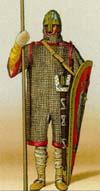
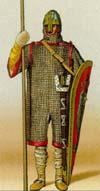
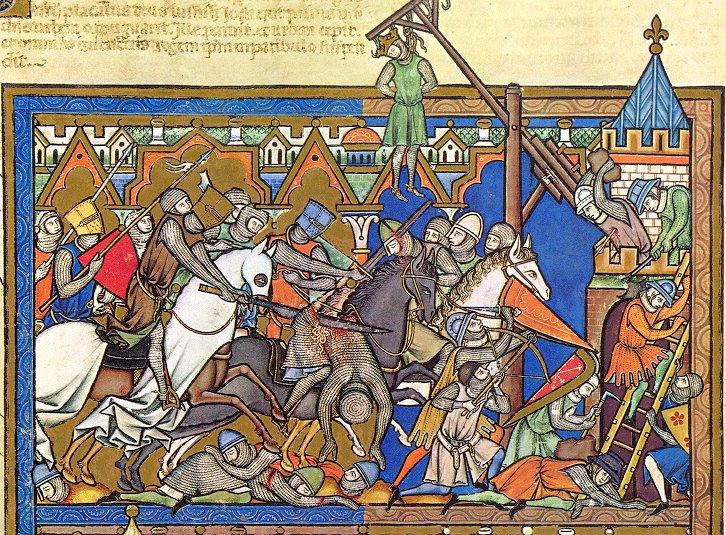
By 1066, Roman segmented armor had disappeared. What survived was the chain mail that the Romans had adopted from the Celts over a thousand years earlier. A chain mail hauberk, as seen on the left, could weigh between 40 and 80 pounds depending on the length and whether the chain was single or double. Chain mail gave good coverage against slashes and thrusts. It stayed close to the body so it allowed the widest range of motion for arms and legs.

Swords of the time were modeled after the viking sword. Knights had learned not to sharpen their swords into fine edges because the iron would not hold the edge and it routinely broke against shields and chain mail. Instead, the sword acted largely as a blunt object that could bludgeon a warrior to death or knock him down in order for his opponent to deliver the coup de gra' thrusting the pointed end of the sword in the face opening, into the groin area or simply bludgeoning his head in. Any amputation or deep penetrating wounds could be more contributed to by the heft of the sword and the power of the warrior swinging it.

The two main types of wounds that warriors suffered with this armor were blunt force trauma and penetrating wounds from arrows. Even with double chain an arrow could penetrate the coat of mail taking pieces of the armor with it. If the warrior didn't die of a direct wound to an organ, he would most likely die from infection caused by the material of his tunic, chain mail and any dirt that followed the arrow in. Then there was the open face of the armor itself. In 1066, King Harold was killed by a Norman arrow that struck him in the eye.


To combat the effects of blunt force trauma and penetration by arrows, armorers began to experiment with different armor techniques. First they added padding behind the chain mail hauberk. The padded, quilted long shirt was called a gambeson. This helped disipate the force of a blow by first pushing the chain mail out so that it was "stiffer" and the rings locked to add resistance. Then, the padding itself absorbed the energy of the blow. Of course, this added weight and had some issues with mobility. It also did not protect well against penetration by arrows.


Next armorers developed bar armor that was usually sown to a leather backing and covered with the cloth of a surcoat or leather. This was often worn over the top of the chain mail to provide protection against penetrating wounds from arrows, thrusts from swords and, along with the padded gambeson, eliminated some blunt force trauma injuries from swords. Appendages were still vulnerable though chain hauberks had been extended to cover the arms and legs.
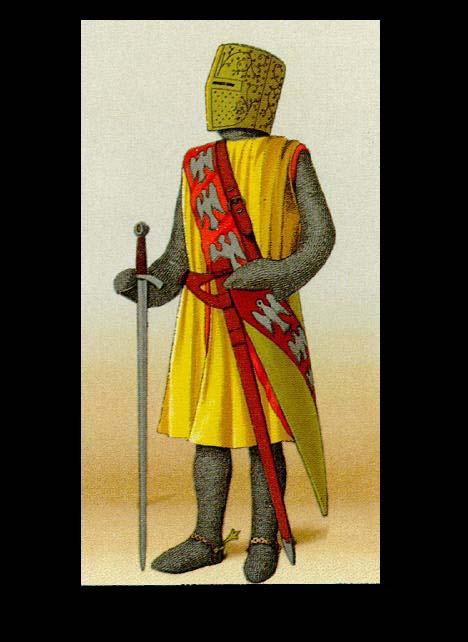
The bucket helmet no longer deflected blows, but the shape allowed the head to be hit without significant penetration, however, a knight could still be knocked silly. The "folds" in this knights surcoat aren't folds at all but bars of iron sewn vertically into the front of the surcoat to provide extra protection. Sadly, this knight saw new weapons enter the battle field.


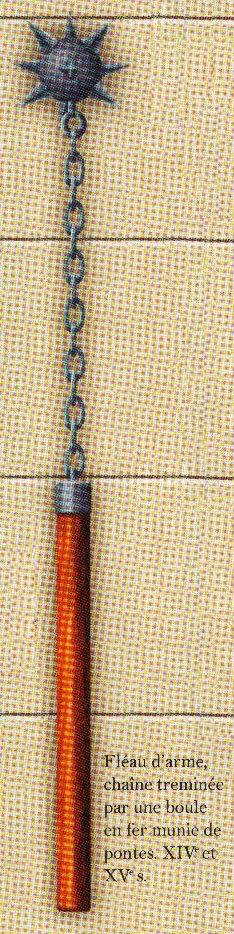
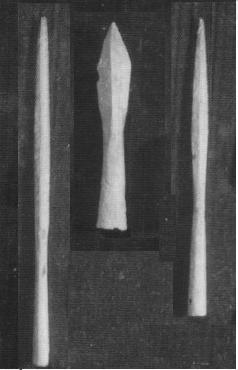
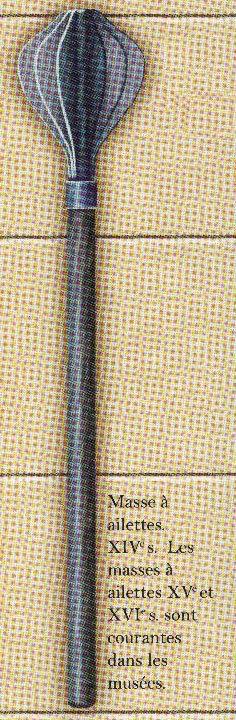
The bodkin arrow head was stronger and could penetrate armor. The mace and the flail could both cause extreme blunt force trauma even to the head covered by the new improved bucket helmet and the two handed great sword had new improved tempering and hardening methods creating a stronger sword. The "blood groove" allowed some weight to be removed from the sword while maintaining it's strength and balance. The sword could be between 4 and 6 feet. This sword could actually hack off limbs and heads. These new weapons meant that chain mail and bar armor had been out stripped by the weapons manufacturers once again.

What were the armorers to do? They needed better coverage without sacrificing mobility and strength. On the other hand, the weapons were now so dangerous that a small amount of speed could be sacrificed to gain survivability.

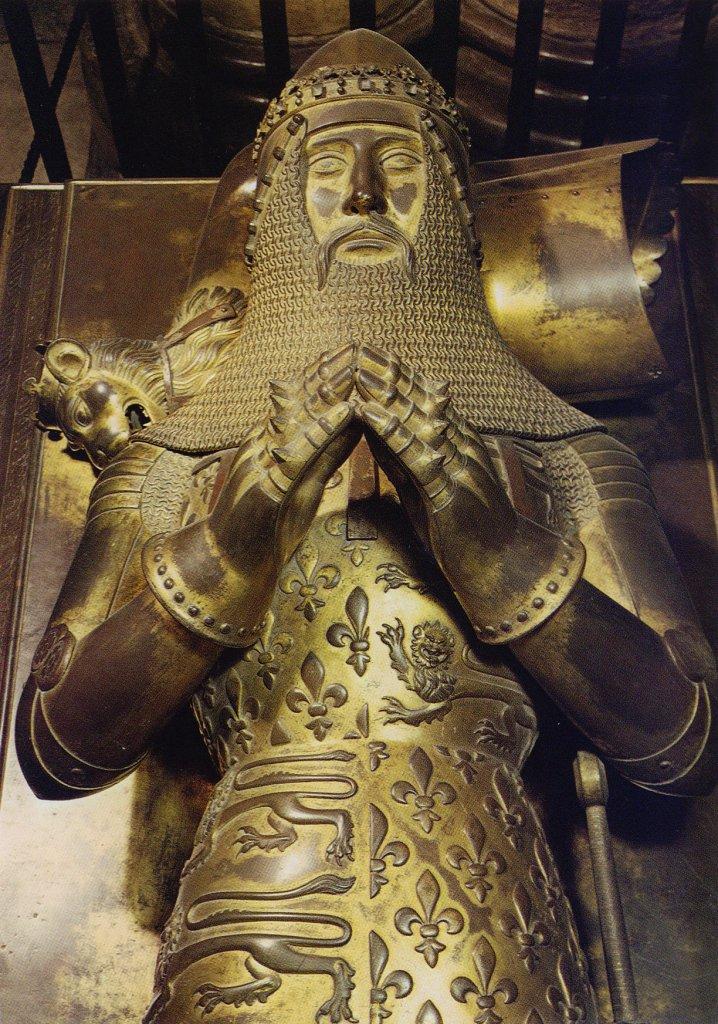
By the time of the Black Prince, plate armor had become a common site on the field of battle. Armorers began to use the hardening and tempering methods first used for swords, transfering the technique to plate armor. The armor was still quite heavy, but provided the most protection yet from arrows and blunt force trauma to the torso. To lighten the weight of the plate armor and add strength, armorers began to bend the armor. As can be seen by the armor in the prince's effigy, the breast plate created a shell that tapered in towards the waist. The curve of the shell helped deflect blows, disipated the impact (and energy) of a blow over a wider area and kept the impact at least two inches away from the knight's body. The tapering at the waist allowed some of the weight of the armor to be distributed from the shoulders to the hips. Beneath this tapered waist, unseen due to the surcoat worn over the armor, was an articulated bell "skirt" that protected the groin, hips and thighs. Plate armor was also used to develop vambraces for the forearm, gauntlets for the hand and articulated shoulder, leg and knee protection.

Certain areas still remained vulnerable to piercing: the under arm, the neck and the back of the leg. The helmet and coif did little to protect against blunt weapons like a mace or war hammer. The new improved great sword could still cut an arm or a leg off when wielded properaly and a short sword or dagger would be thrust into the other vulnerable areas.

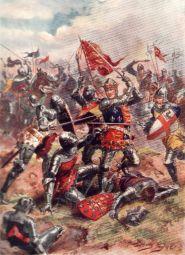
The English archers at Agincourt used this vulnerability to their advantage, unhorsing the knights by killing or wounding their horses and then knocking the knight to the ground if they weren't outright killed by an arrow. Once they were on the ground, the archers beat them upon the head or slashed the backs of their legs to immobilize them. Then, holding the knight's arm out and thrusting into the arm hole on the armor to puncture lungs, heart and cut arteries or pushing a dagger into the face opening of the coif, thrusting down until they had cut the carotid artery. Sometimes a dagger or sword would be thrust under the coif from the bottom or even under the bell hoop of the armor into the groin. In most cases, if the knight was not lucky enough to have his brains beat out with a mace or club, he bled to death in minutes, and occasionally hours, lying on a muddy, bloody field.

Two weapons on this field would turn the history of armor once again.

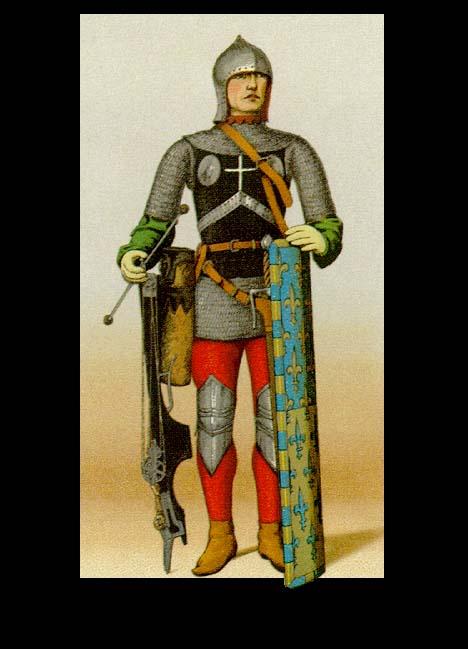
The French used crossbows on the field of Agincourt. The problem here was that the crossbow as not much for distance. At a hundred yards or less it could send a bolt through plate armor. At greater distances accuracy would fail but a bolt could still be lodged in the vulnerable neck, armpit and back's of legs not covered by plate armor. As an anti-siege weapon, it was very effective.
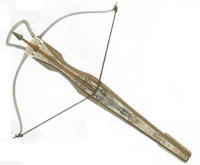
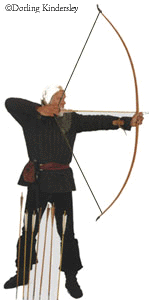
The English, on the other hand, made great use of the longbow. It had the advantage of distance and, fired en masse, 1500 archers could deliver an estimated 9000 arrows on target within a minute (6/min) at distances of 300 yards. At 100 yards or less, the longbow was as deadly as it's step child the crossbow. The only difference was that crossbowmen needed little training to operate their weapon and longbow archers perfected theirs over years. Crossbows also took longer to "re-load". The hoop like structure on the crossbow above was for the archer's foot. Holding the crossbow in place, he would pull the string back to lock, bring it up, place a bolt, bring it to his shoulder, aim and fire. A good crossbowman might get off 3 to 4 shots in a minute.

The danger lay in the penetrating power of these weapons. With new and improved arrow heads, they were absolutely deadly. For the armorers it was back to the drawing table.

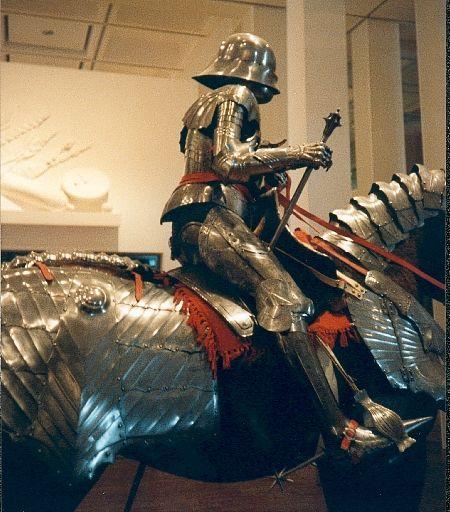
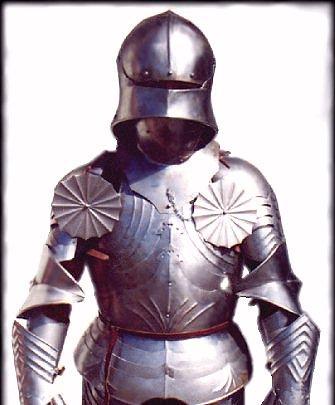
Enter the fully armored knight. Armorers were once again tasked with creating a stronger, lighter and more fully protective suit of armor. By the time of this late 15th century armor, the techniques of hardening and tempering iron into steel were fully developed. The new armor plates were extremely strong. This meant the armor could be thinner and lighter. the armor plate on this suit of armor could be beaten into a 1/4" or less. To stengthen and lighten the armor even more, the armor was contoured and fluted. The convex shape of the breast plate distributed energy and force of the blow as well as kept the blow far away from the knights torso. The fluting provided additional strength while removing some of the metal from the plate, lightening the weight considerably while still maintaing good coverage from penetration.

It's at this point that the arms race speeds up considerably. This crossbow shows a winding handle used to pull the bow string back. That's because the cross section is now made of a thin, highly flexible steel that allows a bolt to be fired that can still penetrate the new plate armor at 100 yards or less. Unfortunately for the archer, he is lucky if he gets off two arrows in a minute or before the well armed knight cuts him down. Theopen field now belongs to the medieval tank. In response, the infantry develops long spears to use in a phalanx to break up charges. The halberd is equally dangerous. The hook on the back is used to grab an armored knight and pull him to the ground. The steel spear can thrust through the plate armor or into vulnerable areas (still around the groin and arm pit). Other hooked weapons of the period resemble a can opener for good reason. The only way the infantry is going to kill this knight is up close and personal.

Even a knight on the ground is well enough covered that a foot soldier will have to fight him to exhaustian or find a way to put him and keep him on the ground so the foot soldier or a compatriot can open up the armor or expose the two remaining vulnerable areas (armpit and groin). An ingenious tool for this chore is the attrape coquin, aptly translated as the "rascal catcher". This device will grab an armored man around the neck and then the foot soldier uses the length of the staff as a lever to pull the man down. The footsoldier is still at a distinct disadvantage until he gets two new weapons:

The arquebus...

...And the cannon.

In the beginning, cannon are largely used as siege machines to break down walls of cities or fortresses. They aren't particularly accurate and the exploding round has not been developed. Use against infantry or knights is relatively useless until the mid to late 17th century. The arquebus has a similar problem. It's accuracy leaves much to be desired, but it's impact will change the face of warfare forever.

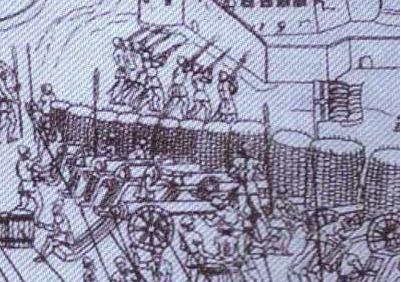
Within 100 years of the siege of Boulogne (pictured on the right), the fully armored warrior disappears forever.

Or, does he?

In 1942, an English Major proposes providing bomber crews with chain mail armor covered by cloth to protect them against AAA flak. In 1943, a flight surgeon, Col. Malcom G. Grow is awarded the Lefion of Merit for his role in developing the flak jacket that will protect American bomber crews. This flak jacket is comprised of steel plates covered by canvas. Bomber crews wear modified steel helmets and heavily padded jackets, pants, gloves and boots to protect them against the cold.

The military "discovers" fiberglass and the new armored vests are sent to Korea. The quarter master reminds everyone that the vests are for stopping fragments and shrapnel, not bullets. There are no "bullet proof vests" because they would be too large and bulky.

In 1965, Dupont creates Kevlar16. A new vest is created using 24 layers of kevlar and is reported to stop magnum size loads. Unfortunately, it still cannot stop a high powered rifle bullet. In 1982, a ceramic aluminum oxide plate is added to the vest and the layers of kevlar are reduced, reducing the over all weight to approximately 25lbs.

enter the interceptor. It weighs 16.5lbs including 8.5lbs of kevlar vest and 4lbs each (2) of Spectra re-enforced boron carbide ceramic plates (not including groin and arm protection). It can take between 5 and 7 AK 47 7.62mm rounds before shattering the plate.

What can modern armor manufacturers and the Natick Soldier Systems Center learn from this history?

It's not necessary to re-invent the wheel to provide good protection for a warrior. In reality, only the materials change. The practical shapes and engineering remain the same.

New materials can often allow new designs in creating armor, but old engineering of past armor can play a significant role in speeding up the process of creating new armor. In this case, convex shapes, contours and fluting can improve the strength of hardened materials while simultaneously decreasing the weight through reduction of materials. It may be possible to decrease blunt force trauma and increase the durability of modern ceramic plates by exploring new shapes. These new shapes, contouring and fluting, could be transferred to leg and arm protection. It may even allow the helmet to change and allow additional armor to be carried by the soldier.

Considering some of the issues confronting the ceramic plates, it might be an opportune time to investigate these techniques.

Or, they can ask...


The Greeks


The Romans


And the knight.

Or maybe they should ask...

...Batman. His armorer seems to know what he's doing.


Stay tuned for part four: What the Greeks, the Romans and the Medieval knight knew about saving Ryan's privates.

Read More...

Friday, October 21, 2005

Body Armor Part II:

Romans, Weight Distribution and Armpits

In Part I we reviewed the historical evolution of body armor with images of body armor over the centuries. In this section I wanted to review why body armor changed and what those historical changes might mean to developing body armor for the modern warrior.

With each successful attempt at reducing harm to the individual warrior, the opposing force has always spent an equal amount of time figuring out how to defeat that protection.


Equally, armorers spent as much time trying to counter each evolution of new or improved weapons. Of equal import was the type of injuries that could be sustained in battle:

Third, the type of wounds that can be suffered do not change. They can be broadly classified into three types: blunt force trauma, penetrating wounds and amputation of limbs.


Along with each of these advancements in armor and weapons, additional advancement in general tactics and even in medicine or treatment of wounds and their perceived survivability had an effect on what was deemed most important for effective protection of a warrior. At some points in history, armor nearly disappears and then reappears again only to be "re-invented" with new materials, making the same long and sometimes agonizing journey to it's last, latest and greatest form. This was alternately (and sometimes simultaneously) due to collapses of civilization which forced technology back centuries; the advancement of weapons and tactics that warriors felt precluded effective armor; the cost factor.

Take for instance the period between the French Cuirassier and the World War I soldier with a simple steel plate in a bag around his neck to protect his chest.


That is one hundred years without any real advancement or use of personal body armor for soldiers. Why? Weapons and tactics. By the time of the Napoleonic Wars, hundreds of thousands of men could be amassed in lines with muskets with a ball or amunition size and velocity that could now easily and relatively cheaply penetrate armor. Add to that volley fire en masse and even an armored cavalry charge could be devestated. Why go to the expense of armor if it was not effective? Instead, the cavalry changed it's tactics to include flanking manouvers and charges timed with artillery and infantry. The same went for the infantry: no need for armor when muskets at close range made it moot.

By the time breachloading and repeating rifles and pistols came on to the field, any consideration for armor had been all but relegated to a past time for military equipment research and development. Most of the time was spent on how to make weapons even more effective. In short, the arms race seemed to have left armor far behind. Why did it make a reappearance in World War I?

There were multiple reasons. During the Napoleonic Wars, the first real ambulance and field hospitals had been created. By the American Civil War (post Crimean Conflict), the idea of a dedicated medical corp was being advanced. With a dedicated medical corp came information in the form of reports back to headquarters about the number and types of injuries. Quite possibly, the Civil War period may have seen the first real attempt to collect data and develop better medical care and procedures on a mass scale.

By the time of the "Great War" (WWI), the concept of a dedicated medical corp had been refined to the point where they were separate units within the military and wore recognizable insignia generally respected by all sides as non-combatants. Even more reports and data were generated regarding numbers and types of casualties. Further, surgery had advanced to the point where a bullet in the leg or arm didn't necessarily mean amputation, soft tissue wounds could be easily sutured and even wounds to the torso that did not effect major organs might be survived. However, repairs to vital organs and arteries would mean death and so would traumatic head wounds.

Weapons had advanced to the point where men could be killed from a munition fired a mile away. A single three man team on a machine gun could be responsible for the deaths of hundreds of opposing forces. At the beginning of the war, men would just as likely die from a bullet as from any other munition. By mid war, the most likely wounds were from shrapnel from the far flung bombardment of trenches or other hand held shrapnel devices. Since the men were in trenches, the most likely places they would suffer wounds were the head and upper torso as these were the exposed areas of the body.

Finally, World War I saw casualties the likes of which had never been seen before. War no longer meant the death or wounding of thousands or tens of thousands or even hundreds of thousands, but millions of able bodied men. These casualties were both strategically and politically damaging. Training, equipping and transporting soldiers was expensive. People, both military and civilian, began to realize that everything, including soldiers, had a finite limit. No matter how advanced the weapons were, you still needed men to operate them and men to hold the land. Otherwise, war was futile. The man who created the modern machine gun was credited as saying that he had created the machine, not to help win wars and make it more efficient, but because he hoped that it would be so devestating people would think twice about going to war (the same reasoning for nuclear weapons?). He greatly underestimated human nature and ingenuity.

Another period in time when armor seemed to go backwards, though not disappear, was the beginning of the dark ages. Like much technology developed through the Greco-Roman period, once the empire collapsed, so did certain advancements including running water, sewer drainage, math, writing and even armor. This loss can be contributed to the steady decrease in the flow of information from the civilized centers of the empire. Roman roads were no longer protected by vast armies patroling or securing them thus traveling, which precipated the spread of information, tradesmen and technology, could no longer be safely undertaken, slowing the speed of dessimination. This also meant that advanced materials, such as iron ore, were no longer able to move freely, limiting the amount and inflating the cost.

Secondly, without the fiscal power of the state, it was no longer economically feasible to equip and maintain large armies. It became the responsibility of individuals to provide their own weapons and protection. Third, the value of a foot soldier's life, and life in general, was greatly depreciated. Thus, the cost to benefit ratio equaled little armor for the common fighting man called up out of his field to form the untrained foot soldiers of a fuedal lord. Peasants, which formed the foot soldier ranks, were easily replaced.

Obviously, modern defense spending has a lot in common with it's predecessor; armor must be effective AND inexpensive to be procured for individual soldiers.

So, what can we learn from body armor of the past that can be useful to a modern body armor manufacturer and the soldiers they serve?

Romans, Weight Distribution and Armpits

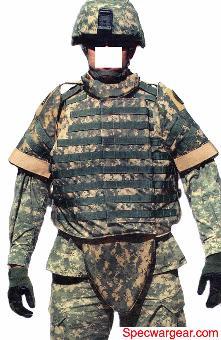
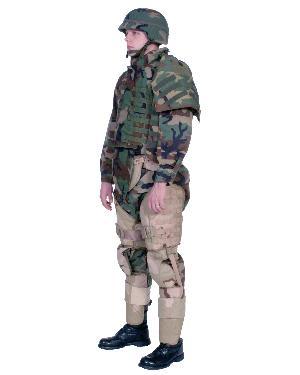
This is a set of modern body armor called the Interceptor. Like it's Roman predecessor, it has a front closure that makes it easy for the individual soldier to remove by himself or by another soldier/medic who may have to treat him. It is a full vest that protects the front, the back and the sides. However, the most protection is found in the front and rear ceramic plates, unlike the Roman armor which provides the same protection all around. The Roman armor uses metal strips or "lames" (pronounced "la-mays") to provide protection and maintain flexibility. The Interceptor uses layers of Kevlar or Spectra armored clothe to provide similar protection and maintain flexibility. However, the areas not covered by the ceramic plate can still be penetrated by fast flying shrapnel from an IED, the 7.92 AK 47 bullet or larger rounds preferred by snipers, particularly at close range. The extremities are largely unprotected, but the fatal areas are the face, neck and around the arm areas where the armor ends. Recent reported deaths include soldiers that have been shot in the armpit area, having the bullet travel through the chest damaging heart, lungs or severing major arteries. Snipers in Iraq and Afghanistan are learning the strengths and vulnerability of our body armor just as opposing forces in the Greco-Roman and Medieval period took the time to learn how to defeat their armored opponent.

The Romans had a similar problem and corrected this by adding several articulated "lames" (pronounced la-mays)over the shoulders, long enough to hang down slightly past the arm pit and provide additional protection at the shoulder joint where limbs could be severed. The articulated shoulder maintained mobility, provided layered protection to the joint and allowed the shoulder "lames" to cover the armpit even when the arm was fully extended overhead. Medieval armorers addressed this problem by adding padding, chain mail and rondels (round metal armor) to the arm pit area. This had it's own problems since the leather straps holding it in place could become damaged and the placement of the rondels could hinder the mobility of the arm.


Modern armorers may want to investigate the use of "lames" or "rondels" (using modern kevlar, spectra and ceramic materials) to add this protection. Several issues may arise from this addition. First, the segmented "lames" would add bulk to the shoulder area that is used to stabilize a weapon for accurate shooting; a problem the Romans did not experience. Second, they may cause some arm mobility issues though it is widley known that Romans had perfected the art of javelin throwing in battle, so this may be minimum. Last, the added weight may be one more impediment to the speed of the infantry. Although, it may surprise you to know that the Roman armor is approximately the same weight as the modern interceptor including upper arm and groin protection devices.

The added weight issue could be minimized by improving weight distribution and the materials used to make the "lames". The lames could be made of layered kevlar and/or spectra that lays over the shoulder like the Roman model, but would be more flexible and possibly less heavy. The layering of the "lames" (aside from the layered kevlar) could act as a sufficient deterence without actually making these items from a metal alloy or the ceramic materials used in the SAPI plates. Or, for added protection, small ceramic plates could be added at the ends of the "lames" to cut down on the general bulk, distribute the weight and provide additional coverage over the open areas of the arm pit/joint.

The Romans understood the impact of weight on their infantry forces. They needed to be able to march hundreds (sometimes thousands) of miles and still be fresh for battle. The battle itself could last from 15 minutes to three hours not inlcuding multiple small skirmishes along the way. Looking at the modern interceptor armor above, the same weight distribution problems can be seen throughout the development of armor.
The interceptor, like other armor of it's kind, rests on two muscles close to the neck: levator scapulac and the trapezius. Continuous weight on these muscles can lead to neck and back pain from strained muscles or compressed spinal discs.

Romans combatted this problem by adding the subarmalis. Just as it sounds, the subarmalis was worn under the armor. While the leather vest provided protection from rubbing, an equally important part of the vest were the shoulder pads. These shoulder pads "squared up" the shoulders and provided equal distribution of the weight across the entire shoulder area. Simple velcro shoulder pads could be attached to the modern soldier's uniform (inside or out) or under the shoulder piece of the interceptor armor itself to produce the same effect without adding another layer of clothing. Adding the shoulder pads to the soldiers uniform would be the easiest and least expensive method to achieve this. It would be a simple issue of "sewing glue", velcro strips and the pads with a directive to add it to the specified area. It may even be the best method, sans tailor, to insure that the shoulder pad is "custom fit" (placed) since every soldier has a different shoulder width.

One problem with this concept may be the narrowness of the shoulder interface of the current interceptor. This does not appear to reach the point of the shoulder joint where the shoulder pad would be located for weight distribution (based on the above image). This could be overcome by one of two methods:

1) Adding the segmented "lames" to the shoulder would act as the levering device, resting on the shoulder pads and helping to distribute the weight.

2)

The shoulder interface could be lengthened just at the top to meet the point of the shoulder blade. The shoulder interface or strap would look like a bell curve with the top of the curve meeting the shoulder joint or ending just before.


This would mean that the upper arm protection would need to be slightly modified to allow the shoulder a full 360 degree range of motion. This modification would mean simply shortening the top of the bell curve on this upper arm protection by as little as half an inch.

In summary, the Romans could teach us a thing or two about weight distribution of armor and protecting vulnerable areas. They may even have used fancy words like anthropometric compatability to explain how they reduced cost by standardizing shape and size.

Update: Researching modern sports "armor" I came across a few items that reminded me that even I may be re-inventing a wheel that has already been created and simply needs to be adapted to modern body armor for the warrior.

Modern Day Subarmalis (football undershirt with pads):
Under armor shirt with shoulder pads to support vest and upper arm protector. The shoulder pads on this model might be a bit too much, possibly needing to eliminate the last "lame" (la-may). Also, missing the rib belt and would need to be modified to provide the blunt force trauma protection in the rib and chest area. The other important aspect of this under armor is the moisture wicking material of the shirt, killing two birds with one stone since the military is moving towards moisture wicking t-shirts.


Another football "subarmalis" with light shoulder padding and a rib belt that could provide blunt force trauma protection. Although, the rib belt may be too thick to fit under modern body armor and would also need to be modified. Additional shoulder padding would be needed to help raise the armor a little more and distribute the weight across the entire shoulder.


Motocross subarmalis. This also provides an articulate spine protection. This model may present a problem with additional weight.


And idea for shoulder protection that is articulated, allows for full rotation and, looking at the arm pit area we can see how a simple addition of a small pad of kevlar, sown to maintain articulation, could provide extra coverage in the area without adding bulk that could interfere with bringing up a weapon or accurate aiming or even throwing a grenade. This could also be added to the modern interceptor with velcro or a strap as is being used to connect the upper arm protection currently used. That upper arm protection could part of that assembly.

In Part III, Body Armor: Re-inventing the Wheel, we will review the problems experienced with the modern SAPI boron carbide plates and explore how Greco-Roman and Medieval armorers used contoured armor to overcome similar problems with weight, strength and blunt force trauma.

Read More...

Thursday, October 20, 2005

Body Armor: Re-Inventing The Wheel PartI

As I was reading an article from Euphoric Reality called Saving Ryan's Privates regarding new armored shorts, I was struck by their similarity to medieval armor from Europe and even Japan. As can be seen in this image of a knight circa 1066 and the Battle of Hastings, warriors had long determined the necessity of adding protection to their upper legs and groin area. This knight is wearing a one piece chain mail hauberk that includes leg areas that are not simply a product of a split skirt on a long shirt, but actually complete enclosed legs.

Several other thoughts percolated as I looked at images of armor, both modern and ancient:

War, however technologically advanced materials or weapons, still depends on man to wage it. Regardless of advances, in order to win a war, there are only two options, completely destroy the enemy population (as in exterminate; nuclear) or occupy territory with men. Since even modern war requires this manpower, it is imperative that the aggressive parties retain a ready supply of men along with munitions. Since a dead man can be of no further assistance and it takes somewhere between 15 and 18 years to develop a human being that can actually serve strategic purposes (as opposed to just being cannon fodder which still needs to be replaced and cannot occupy land), it is even more imperative that the individual soldier be protected as a priceless commodity, particularly since his war experience provides the basis for future successful tactics. To this end, man has forever been attempting to create individual protection, more recently referred to as armor, since man figured out how to skin an animal and tan it's hide. With each successful attempt at reducing harm to the individual warrior, the opposing force has always spent an equal amount of time figuring out how to defeat that protection.

Second, the vulnerable areas of the body have never changed even if medicine has advanced enough to repair certain injuries, other traumatic injuries to the same areas are still deadly.


Third, the type of wounds that can be suffered do not change. They can be broadly classified into three types: blunt force trauma, penetrating wounds and amputation of limbs.


Fourth, with every evolution of armor, weapons and tactics, the armorers responsible for creating personal protection for warriors continuously "re-invent the wheel".

Roman circa 182 BC


Rome circa 200 AD


...............................Saxon-Norman circa 1066


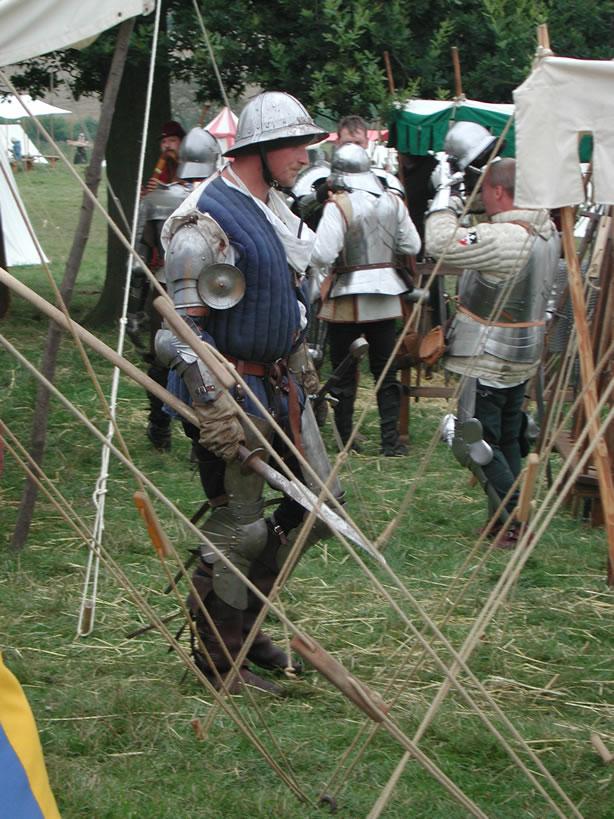
Circa 15th century


Italian circa 16th century


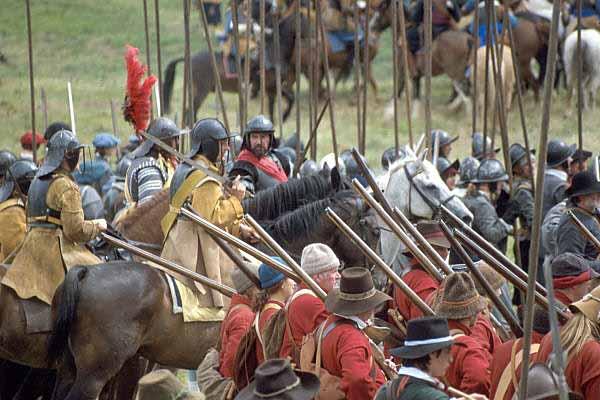
..........Cromwell's Cavalry circa 1644


French Cuirassier Napoleonic Wars


WWI Soldier w/simple chest plate and helmet


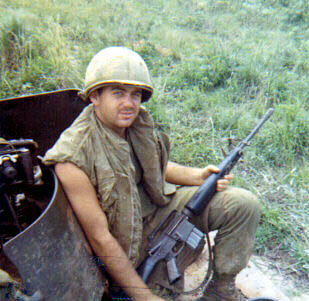
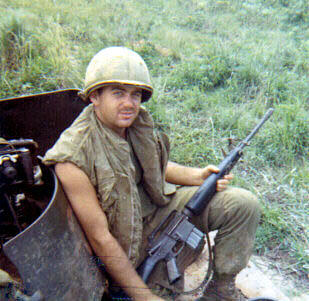
Personal Body Armor Vietnam also referred to as a "flak jacket"


Interceptor Body Armor 2005


.........Armored shorts


This man would recognize his modern counterpart.


This man would certainly recognize his.


There are problems with "up armoring" men in modern manouver warfare. Mainly, the weight and the configuration can greatly reduce speed and mobility. On the other hand, when your infantry forces now rely on vehicles to speed them to their destination and the most deadly force that they will face is not necessarily a bullet but thousands of pieces of shrapnel, close up and personal, some of which actually may be derived from the vehicle they are riding in, that type of personal mobility maybe secondary to survivability. Even more so, as the enemy adapts and learns how to defeat the armor on mobile units, it becomes even more necessary to protect the individuals. Add to that the cost of casualties, not just in tactical or strategic significance, but political as well, the need for appropriate body armor becomes even greater.

New technologies may be developed to protect or defeat. New materials can be stronger and lighter. However, the wounds and the biophysics of a human remains the same thus the type and places of protection do, too. There is something that can be learned from the evolutionary history of armor even further back to the Greeks and Trojans, much less Roman or Medieval periods. Each evolution had a specific design feature meant to defeat a specific type of weapon advancement or wound whether that be from blunt weapons, sharp heavy swords or projectiles. Based on the apparent slow and painful re-invention of modern body armor, it seems clear that those involved in creating this armor need to go back and learn (if they ever did) these evolutions and reasons.

Or, the DoD or it's contractors need to hire a few historians, metallurgists and modern day metal armor makers to go along with their biophysics and engineering majors so they can learn this lesson a little faster. It's all good and well that we develop new materials to strengthen and lighten the armor, as the good armorers of the 13th and 14th centuries found when they were able to create steel plate armor beaten to within a 1/4th of an inch yet still able to perform it's primary duty. but, aside from articulation, the engineering and design of the armor itself provided additional protection.

In part II of "re-inventing the wheel", we will review the evolution in the specific design of both the armor and the weapon it was meant to defeat and how it might apply to modern body armor.

Thank you Mudville Gazette for the link.

Read More...

Wednesday, October 19, 2005

Chivalry Today And The Art of War

While researching another topic, I came across this interesting website discussing Chivalry Today. On the website it discussed the application of modern chivalry in war as more than a moral value or expectation of society, but as an applicable tool in combatting the psychological effects of war. Considering yesterday's post regarding Generation Kill, I thought this topic would be appropriate.

Why Do Warriors Need A Code?

Warrior cultures throughout history and from diverse regions around the globe have constructed codes of behavior, based on that culture’s image of the ideal warrior.[snip]


One way or another, it is carefully conveyed to each succeeding generation of warriors. These codes tend to be quite demanding. They are often closely linked to a culture’s religious beliefs and can be connected to elaborate (and frequently death defying or excruciatingly painful) rituals and rites of passage.

In many cases this code of honor seems to hold the warrior to a higher ethical standard than that required for an ordinary citizen within the general population of the society the warrior serves. The code is not imposed from the outside. The warriors themselves police strict adherence to these standards; with violators being shamed, ostracized, or even killed by their peers. One historical example comes from the Roman legions, where if a man fell asleep while he was supposed to be on watch in time of war he could expect to be stoned to death by the members of his own cohort.

The code of the warrior not only defines how he should interact with his own warrior comrades, but also how he should treat other members of his society, his enemies, and the people he conquers. The code restrains the warrior. It sets boundaries on his behavior. It distinguishes honorable acts from shameful acts. The Homeric hero Achilles must seek vengeance for the death of his friend Patroclus, yet when his rage drives him to desecrate the corpse of his arch nemesis, Hector, he angers the gods.[snip]

One reason for such warriors’ codes may be to protect the warriors themselves from serious psychological damage. To say the least, the things that warriors are asked to do to guarantee their cultures’ survivals are far from pleasant.[snip]

The combination of the warriors’ own natural disgust at what they must witness in battle and the fact that what they must do to endure and conquer can seem so uncivilized, so against what they have been taught by their society, creates the conditions for even the most accomplished warriors to feel tremendous self-loathing.[snip]

In a segment on the “Clinical Importance of Honoring or Dishonoring the Enemy,” psychologist Jonathan Shay describes an intimate connection between the psychological health of the veteran and the respect he feels for those he fought. He stresses how important it is to the warrior to have the conviction that he participated in an honorable endeavor:

    Restoring honor to the enemy is an essential step in recovery from combat PTSD. While other things are obviously needed as well, the veteran’s self-respect never fully recovers so long as he is unable to see the enemy as worthy. In the words of one of our patients, a war against subhuman vermin “has no honor.” This is true even in victory; in defeat, the dishonoring absence of human themis [shared values, a common sense of “what’s right”] linking enemy to enemy makes life unendurable(3).[snip]


By setting standards of behavior for themselves, accepting certain restraints, and even “honoring their enemies,” warriors can create a lifeline that will allow them to pull themselves out of the hell of war and reintegrate themselves into their society, should they survive to see peace restored. A warrior’s code may cover everything from the treatment of prisoners of war to oath keeping to table etiquette, but its primary purpose is to grant nobility to the warriors’ profession. This allows warriors to retain both their self-respect and the respect of those they guard.[snip]


Part II

This brings us back to my earlier line of reasoning. It is not enough to ask, “Can our warriors still get the job done if they do not have a code?” We must also consider the related question: “What will getting the job done do to our warriors if they do not have a code?” Accepting certain constraints as a moral duty, even when it is inconvenient or inefficient to do so, allows warriors to hold onto their humanity while experiencing the horror of war — and, when the war is over, to return home and reintegrate into the society they so ably defended. Fighters who cannot say, “this far but no farther,” who have no lines they will not cross and no atrocities from which they will shrink, may be effective. They may complete their missions, but they will do so at the loss of their humanity.[snip]

More parallels can be drawn between the way that societies should behave towards their warriors and how warriors should behave towards one another. Societies should honor their fallen defenders. Warriors should not desecrate the corpses of their enemies, but should, whenever possible, allow them to be buried by their own people and according to their own cultural traditions. Among his therapy patients, Jonathan Shay found several veterans suffering from “the toxic residue left behind by disrespectful treatment of enemy dead.(7)” And while societies must certainly show concern for the after-effects of war on their own troops, victorious warriors can also maintain the moral highground by helping to rebuild (or in some cases create) a solid infrastructure, a healthy economy, an educational system, and political stability for their former foes.


Part III

The warriors of today will increasingly find themselves pitted against adversaries who fight without any rules or restraints. Because they see no other way to advance their objectives, these desperate men and women are likely to employ methods that are rightfully viewed as horrific and appalling by the rest of the civilized world, such as terror attacks on civilian populations. They will take “fighting dirty” to unimaginable depths, and since they are already willing to die, they will not be deterred by any threat of punishment for continuing to disregard the laws of war. [snip]

It is easier to remain a warrior when fighting other warriors. When warriors fight murderers, they may be tempted to become the mirror image of the evil they hoped to destroy. Their only protection is their code of honor. The professional military ethics that restrain warriors – that keep them from targeting those who cannot fight back, from taking pleasure in killing, from striking harder than is necessary and that encourage them to offer mercy to their defeated enemies and even to help rebuild their countries and communities – are also their own protection against becoming what they abhor.

Everyone who cares about the welfare of warriors wants them not only to live through whatever fighting they must face, but also to have lives worth living after the fighting is done. The warriors’ code is the shield that guards our warriors’ humanity. Without it, they are no good to themselves or to those with whom and for whom they fight. Without it, they will find no way back from war.

Read More...

Tuesday, October 18, 2005

Thoughts on Generation Kill

As I was reading this book, several thoughts came to mind about a changing military and how it affects strategies in fighting individual battles and an over all war. It seemed on several occasions that the Marines Evan Wright was with either refused to perform a specific operation at the platoon or squad level or modified it as they went along. The overall effect of these individual actions did not significantly change the outcome of the major war (which was, in the case of this book, the drive towards Baghdad in 2003 and the toppling of Saddam Hussein). However, it did change specific operations that, on the face of things, might have impacted the war in terms of overall casualties and time lines.

War has changed significantly, not just in the last century, but over many centuries. In battles of the medieval period, while individual courage and prowess was celebrated and fuedal lords raised and often led their own forces, the over all tactics did not require an individual foot soldier or knight to be a "thinking" man. He did not have to ponder whether his small squad was in the right place or if he should attack or not attack a specific location. For the most part, what was required was that these men follow orders, march with the others, wheel, attack or defend with the mass of fighters he was with.

In the battle of Agincourt, as in many battles before and after, the men were formed up in lines based on the terrain and the forces opposing them using both to the best effect possible. Archers only needed to know when they should let loose their arrows which was largley directed by the over all commander. Individual squads of archers did not decide when they would or would not attack. The same went for foot soldiers and knights. It was prevalent largely on the top commander, in this case Henry V, to determine when to employ the different units en masse, to determine strategy with the consul of a few top commanders. Winnning or losing a battle was largley dependent on the top commander's ability to employ the forces and strategy. At most, during this period, light cavalry might have been used to interdict supplies, harrass opposing forces or provide reconnaisance on their movements. Important mainly to the manouvers of the larger force.

In short, medieval war did not require the foot soldier, archer or lesser knights (mounted men at arms?) to be "thinking" men.


Cromwell, Battle of Marston Moore 1644

This continues through history with few changes until possibly the 17th century where companies of soldiers or cavalry were given a little more leeway to manouver against opposing forces with some strategic decision making at this level, but still held at higher levels of command than squads or platoons and still more closely associated with the movements of much larger forces.


By the time of Napoleon, a form of manouver warfare had been advanced. Cavalry units had more freedom of movement and were tasked more often with harrasment, interdiction and reconnaisance. Armies were split and sent in specific directions to perform pincer movements or feints to draw away or confuse opposing forces. Still, the outcome of a battle was dependent on large forces meeting in battle, face to face, musket to musket and cannon to cannon over a chosen field.

By the time of Gettysburg in 1863, we begin to see that winning or losing a battle could be contingent on the performance of smaller units. One of the most important factors of Lee's loss at Gettysburg was his missing cavalry which he sent out to recon the Union forces, but had lost contact with Stuart for three days, leaving him largely blind about the size, condition and place of the opposing forces. Stuart, for his part, had been ranging rather farther afield than originally intended.

As Stuart approached Haymarket it was discovered that Hancock's corps, marching northward, occupied the road upon which he expected to move. A brisk artillery fire was opened upon the marching column, and was continued until the enemy moved a force of infantry against the guns. Not wishing to disclose his force, Stuart withdrew from Hancock's vicinity after capturing some prisoners and satisfying himself concerning the movement of that corps. This information was at once started to General Lee by a courier bearing a despatch written by General Stuart himself. It is plain from General Lee's report that this messenger did not reach him; and unfortunately the despatch was not duplicated. Had it reached General Lee the movement of Hancock's corps would, of itself, have gone far to disclose to him the intentions of the enemy as to the place where a passage of the Potomac was about to be effected.

It was now clearly impossible for Stuart to follow the route originally intended; and he was called upon to decide whether he should retrace his steps and cross the Potomac at Shepherdstown, or by making a wider détour continue his march to the rear of the Federal army. He consulted with no one concerning the decision, and no one is authorized to speak of the motives which may have presented themselves to his mind.


It is important to remember that the "smaller unit" that Stuart commanded was actually three brigades strong (appx 3,800 men). Thus, we are still talking about manouvers and outcomes of battles being contingent on company or larger size manouvers and strategic decisions. Foot soldiers were still not required to be "thinking men". A note from the officer making the above commentary on the final outcome of the battle:

At this day we read the history of the minutest events connected with this campaign in the light of the final result. Had General Lee gained the battle of Gettysburg, as he said he would have done if Stonewall Jackson had been present, the persistency with which Stuart held on to these wagons, and the difficulties he surmounted in transporting them safely through an enemy's country during the next three days and nights of incessant marching and fighting, would have been the cause of congratulation. But Gettysburg was lost to the Confederate arms, and not through Stuart's fault; and every circumstance which might have contributed to a different result will be judged in the light of the final catastrophe. Considered from this point of view, it must be acknowledged that the capture of this train of wagons was a misfortune. The time occupied in securing it was insignificant; but the delay caused to the subsequent march was serious at a time when minutes counted almost as hours.
>

At this point we should understand that there are significant advantages to using manouver warfare, but also disadvantages when it comes to communications over distance and relying on commanders to make strategic decisions that can (and did in this case regardless of the officer's defense of Stuart) effect the outcome of a battle if not the war.

Fast forward 80 years and manouver warfare has taken on a whole new meaning. While vast armies still smash at each other over large battle fields, the movement and success of those armies begins to rely heavily on the abilities of smaller units to perform specific tasks. Squads (10 men) and platoons (16-44) led by lieutenants or sergents are tasked with taking, holding and/or destroying strategic points, such as bridges, fuel dumps, cross roads and small towns throughout the European theater during World War II. Even more so in the Pacific where islands might be invaded by thousands of soldiers, but clearing the individual bunkers, taking a ridge and other objectives are tasked to company, platoons and squads. Which means that the thinking man's army was being created. NCO's had to know more than the command to march, charge or fire, but now had to read maps, use available technology, make a strategic plan on how to take a specified objective and deploy his forces.

Here we see the grandfathers and great grandfathers of Generation Kill, not only biologically, but in the creation of a "thinking man's army". In the book we see that the thinking man's army has certain advantages when it comes to manouver warfare such as being able to make quick tactical changes based on the realities on the ground and allowing officers and NCOs of the smaller units the ability to make those changes in order to meet the objectives. On the other hand, there are significant communication and supply issues as they move quickly through Iraq onto Baghdad. We also see that the thinking man's army, now fully capable of looking at a map and making some strategic decisions or evaluating targets, means that commanders and orders can be and are second guessed. In which case, individual units made decisions to change tactics or modify orders (though often still trying to carry them out) which affected other units and the pace of the war.

In a thinking man's army, the men and line commanders want to know "why" not just what and when. Unfortunately, either the desire to keep the overall strategy secret (still necessary, particularly in today's information rich world) or the pace of the war did not and does not always allow for such in depth explanations.

Marine First Recon, the unit that Wright was embedded with for this story, is the very pointy tip of the spear. From the outset, they wonder why they are being put out front to move so quickly through Iraq when it's expected that the Republican Guard with tank formations and other heavy weapons are in front of them. Even Evan Wright ponders this as nearly a suicide mission and several smaller missions give the same appearance. At the outset, they are told that they will be doing a standard mission normally done by Recon which is to race ahead and secure a specific bridge over the Euphrates. Every time they are tasked with a different mission or sent in a different direction than what they thought they should be doing, the questions arise more and more, not just within the leadership, but at the "grunt" level. Not uncommon in any army or war, however, Wright gives the impression that there is something wrong.

What the unit did not know was that they were part of a feint towards the east to make the Iraq army believe that they were not going to approach Baghdad head on, but perform a flanking manouver, hopefully causing the Iraq army to move forces in that direction while the main army attacked Baghdad head on directly from the south. Wright and the soldiers he is with, not knowing all the particulars of the battle plan, believe that they may be being used as decoys to simply bring out the ambushers and allow the heavy artillery and tanks to ride up behind them and take them out. In other words, cannon fodder.

No one tells them why they are really tasked with this mission and position. Wright gives the impression that this is a failure of command when in reality, it is a very smart plan. If the Marines are taken prisoner, they only know what they were told about their mission. They could not, by either documents or individual soldiers, provide an interrogator or intelligence officer with any real information about the invasion plan.

It's true that soldiers have always wondered why they were marching somewhere and why. They have also thought that their commanders were crazy, gung ho or plain stupid for making a decision. First Recon is no exception. However, they make two decisions which end up not to effect the war over all, but did point to the one problem in creating a thinking man's army: units that think they know better than their commander and act on it. In one case they believe that their mission will be to secure a bridge in a specific city. At the last minute, they receive orders to change that mission and, instead, charge through the city and secure the northern side while the main force comes behind them. One unit goes ahead and is on the other side waiting for the rest of the platoon to come through and re-infoce them, but those squads are still on the southern end of the city looking at maps because they think that the route chosen for them is suicide (they have lightly armored humvees and small weapons). They are settling on a different route when they discover that route is impassible so they are stuck going through via the route the other force takes. However, they delayed long enough that their sister units are now alone on the other side taking fire and casualties.

Afterwards, they are still grousing over "why" and Evan Wright falls into their concerns, writing phrases that make you believe that it is just possible that the commanders were a bunch of gung ho idiots.

Another incident has them coming up on an air force base that is reported to have heavy weapons and serious obstacles (berms, etc). At first, a tank unit is ordered to take the base, but, according to Wright, says it's too dangerous and refuses the order. First Recon is then ordered to take the field. They complain openly about how crazy that is, but, when they get there, there is no armor or huge barricades. Wright seems to contend, based on the grousing from the Marines, that this is simply luck. He actually uses this phrase very late in the book to indicate that winning that phase of the war was more about luck and the ineptitude of the Iraqi Army than any strategic superiority that the US may have had.

A last incident, that really made me think about the difference between old army warfare and the new thinking man's army was, when First Recon gets to Baghdad, they hold up in an old cigarette factory. The first or second night they are there, they are tasked with performing foot patrols in the neighboring community because the leaders are complaining of violent street gangs and other crimes, not to mention the Ba'athi loyalist. In which case the lieutenant forcefully declines that order as being unsafe for his soldiers (of which he was already missing two due to injuries). Obviously, this was not highly important because the officer in question was not reprimanded. Later, the lieutenant left the Marines and told Wright that he did not believe he would make a good officer because he "cared too much for his men".

To illustrate one last, seemingly silly incident that aptly highlights the fact that strategic significance is not always understood at the lower level, even in a thinking man's army, the commander issues a general order for all men to shave off their mustaches. This seems very petty to both Wrigth and the Marines. At no time however, did either group express any ideas or thoughts on the fact that their adversaries would most likely be dirty and darkskinned with mutaches (a cultural phenomenom) which may get them mistaken as an enemy combatant at some distance looking through binoculars or sites. This, even though later, he reports an incident where one of the soldiers was almost killed coming out of a field and mistaken as a sniper.

This led to my thoughts about how tactics and armies have changed and that has led to an even increased necessity for leadership at the lower levels to be professional and even more capable of understanding overall goals; a long way from the days when men smashed each other at sword point. A good commander does not necessarily want to always be surrounded by "Yes" men, but they don't want to have too many "NO" or utterly independent men either since this may lead to their own Gettysburg.

Read More...

Monday, October 17, 2005

Winds of War and Iraq Update

If you have not read these reports before, I highly recommend it.

Winds of War covering conflict issues around the globe during the last week.

Iraq Update gives an overview of occurances in Iraq for the last week.

Read More...

Sunday, October 16, 2005

The Things You Find At a Yard Sale

I had a yard sale on Saturday. It wasn't a great yard sale. It was largely a bunch of knick knacks and clothes I couldn't fit into anymore along with some clothes and house hold items left over from my uncle's apartment that no one in the family wanted. Aside from that I had four large pieces of furniture I was trying to sell. A barely used futon couch, a love seat (or sofa depending on your region of the country), a winged back chair and a king size, four poster bed of solid oak with a crest on the footboard and headboard.

The bed had belonged to my grandparents. The crest was Spanish (Castellan I believe). No, my grandparents weren't Spanish. They bought the bed at one of those fly by night import stores. No idea if it's "authentic" anything, but it fit into the house they owned 30 years ago. Now, both my granparents are dead, nobody has a place for it and it's been sitting in my basement for two years so I thought I'd sell it.

I set it out front. It was definitely a crowd drawer. I had about 20 people stop and ask after the bed alone. However, I never sold it. Why? Because people want something for nothing. It has ever been so and ever will, but I didn't need to get rid of the bed so bad that I was willing to sell it so cheap. Nor was I willing to separate the parts. Both things I had asked of me several times.

I wanted $200.00 for the bed. I priced a similar bed (sans crests) and it was nearly $2800.00 so I did not think my price was outlandish. Plus, I kept thinking, this is solid oak, not some cheap press board set up I would have sold for $20.00 (which somebody offered me --piffle). The "posters" or columns are six inches in diameter not those cheesy little spindle things that everybody else gets when they buy the latest "four poster" bed. Not that it mattered.

I had the $20.00 offer for "the frame" which, I kept trying to explain to the customer could not be sold separately because it is actually oak slats that slide into the head board and foot board, not a cheap metal frame that you can pick up at any second hand store (if you really were hard up for it). I pointed down to these slats lying next to the headboard at least twice during the discussion. He finally got it, but then promptly offered me the $20 for the whole thing. Call me sentimental or an Ebenezer, but I'd toss out my queen size bed and set up the king, even with the extreme loss of my already limited walking space, before I'd do something crazy like that.

Then somebody offered my $25.00 for the box springs (plural because they are two twin size box springs that make up the "king"). Nope, all together. That's part of getting the "whole bed" cheap. I'm thinking that most of these folks were just hoping for a steal and had no idea what certain pieces of furniture would be worth.

One gentleman stopped about the bed and then, upon learning the price, turned to go, saw my mom's car in the drive way and wanted to buy it instead.

Then another saw my riding lawn mower, pushed way back in the garage so no one got the idea that it was for sale, and asked if I'd take $150 for it. Please. I have 3/4 acre land that is highly terraced front and back. My push lawn mower is not self propelled. The riding lawn mower was not for sale. He did buy my hand held CB for five but not before trying to get me to sale my ergonomically correct rake (also back by the lawn mower and not for sale). Besides, the rake had, admittedly limited, sentimental value. The boyfriend I had when I bought the house (long story, or not, but I'll tell it someday), had given it to me along with some other lawn and tree grooming tools. The gift that keeps on giving. Long after they're gone.

The bed was good for business though. Plenty of people stopped to look at it and walked away with little knick knacks, books (even magazines - my "tattoo" magazines were extremely popular even if they were old - go figure), shirts, flower pots (I kill cactus so planting paraphernalia not related to the over all yard are not hot items in my house), a few "kids toys" my sister in law sent over to get rid of...you know, little things for a quarter to a buck. By noon I had enough to buy my mom and me a decent lunch.

What was really interesting were the people that stopped by.

I met a nice young Iraqi couple. They had two cute little children with them. The mom wore a simple colored hijab with a long sleeved shirt and a long vest like jumper over a pair of slacks. How did I know they were from Iraq? Aside from the hijab (which is common in at least 3/4 of the Middle East) which was colored (a slightly "progressive" Middle East country) and the fact that they were speaking Arabic not Urdu or Farsi or Pashtun which ruled out most of Iran and Afghanistan (if you want to know how I know when I can't speak a word of it myself and actually have no immediate Arabic speaking friends, I tune into radio Sawah once in awhile to listen to music and they broadcast the news in Arabic, plus, reading Iraqi, Bahraini, Kuwaiti and Saudi blogs, even an idiot can phonetically sound out a few essential words and phrases in Arabic). The man said to his wife and then his little girl at another point "Y'allah" (sp? sounds like Yaw-la) "come here" (also, "let's go", "you go" and a few other meanings we English speakers need a billion words and phrases to say). Still, that didn't say where they're from. They could have been Jordanian, Syrian, Egyptian, Kuwaiti, etc, etc, etc.

I learned they were from Iraq because, in my brash American way, I asked. Politely, of course, as I was admiring their baby. And, no, before you ask, I did not ask them their political views or views about the war or Saddam or anything else. I was trying to sell them a few more flower pots. My grandma told me you should never talk about politics or religion at the dinner table. I figure it is sound advice for a yard sale, too.

A little later, a van pulls up and out pops another young couple from Sudan and their three children. How did I know? Well, the husband was wearing a t-shirt that read "Free Sudan" and they were speaking an African language (not Arabized or German or French or any other romance or anglicized language - yes, I can tell the difference, can't you?). So, I must assume that they were Sudanese.

Then a lovely lady, also wearing a hijab, but her dress was, interestingling, a knit material that had a blue camouflage print. Her Hijab was a guazy blue thing with a few sequins sown ever few inches on the hijab. She was West Indian. Possibly Jamaican, St Thomas, Barbados or something like that. An Island that still retained it's softened, British accent over the lilting tongue of the native population.

Of course, I had your garden variety Americans and recent immigrants from Asia or Latin America show up, but these folks I noticed in particular. I was genuinely interested in their stories. But, alas, it was a yard sale, not a social tea, thus, while I had brief conversations about the weather, the items for sale, their children and on one brief occasion, a foray into direct nosiness.

It was quite an interesting day.

At the same time of the yard sale, I had lulls of no visitors or bargain buyers so I read two books. One was a only about 200 pages. Christopher Hitchens: letters to a young contrarian. It was published in July 2001, before 9/11 and before the Iraq war so it is not about that subject. However, I found the book very interesting. I did disagree with him once in awhile, but I found that I was holding to his general point of the book: being a free thinking, individual who doesn't follow the masses does not mean that you follow either the left or the right. He intimates, long before his current stance as a pro war Trotskyite, that the problem with the left was that they thought if they followed the dogma of the left that made them free thinking, non-sheep like people. Where as, following any dogma made you a lap dog and not a free thinker. He warns his young contrarian he is mentoring not to fall into that trap.

All in all, I recommend the book as an amusing read with a few points of good advice for anyone regarding "thinking" and that is the point of his book. Learn to think.

The second book was interesting as well: Generation Kill by Evan Wright.

I'll tell you what I thought about it later. In the meantime, I have two other books in the queue for this week, Karl Zinsmiester's, Dawn Over Baghdad and Matthew MacAllester, Blinded by the Sunlight. This last book is the story of Saddam's prisons written by the author who was an unfortunate inmate there during the lead up to the war when certain reporters were accused of being spies.

Read More...

Friday, October 14, 2005

Busy Saturday

I'm going to be busy Saturday so I cannot live blog the Iraq constitution referendum. Thus, I am going to point you to Iraq The Model. Keep checking the next few days for updates on the situation. Since I'm not sure that the cable shows will be doing coverage like the January election, I'll put my money on this site that they have the news first.

Don't forget the list of Iraqi websites on the side bar of ITM.

With that, since I will not write until Sunday, I will leave you a few words from ITM:

am so excited but a flashback from Saddam’s referendum three years ago still hurts; he wanted a 100% as the 99.96% of the previous one shocked the dictator. I was depressed that way and I decided not to go to the voting office and so did the rest of the family but my father was afraid that not going could be dangerous.

He said that maybe one member of the family could go alone and cast votes for the rest of us. We looked at each other thinking who’s going to volunteer to do this ugly job to protect the family. At that moment my father said “it was my generation that caused the misery we’re living in so I’m the one who should do this”.
I couldn’t stop him and I couldn’t utter a word but I felt sad for him; his sacrifice was big and I had teary eyes when I watched him taking our papers and heading out.

It is different this time father, no more 100% and a ‘no’ would make me happy just like a ’yes’ would do and no one ever will force us to do something against our will anymore.

Tomorrow will be another day for Iraqi bravery. May God protect you my people…you have suffered so much and you will still be suffering for some time but I am sure the future will be bright.

God bless you my people and all the freedom lovers who keep sacrificing to make this world a better place.


Good Luck, brothers and sisters. It is different this time.

There's a fire in the minds of men.

Read More...

Another Revolution...

...coming to a school near you?

Read More...

Terrorism in the Heartland

There's much speculation still surrounding the Joel Hinrichs case in Oklahoma City, but today we have another case of possible terrorist activity.

The Kansas City Star (free registration) reports that a local Kansas City cab driver is under investigation for transfering $1.4 million in incremental amounts through multiple bank accounts to an account in Geneva, Switzerland.

A Kansas City cab driver has been charged in federal court with illegally transmitting more than $1 million to banks in Minneapolis and Geneva.

Serar Ahmed Abdullahi, 41, made his first appearance in federal court Wednesday afternoon, after a secret federal indictment returned late last month was unsealed. Abdullahi, a native of Somalia and a naturalized U.S. citizen, did not enter a plea, which could come at a hearing this week.

According to the indictment, Abdullahi transmitted the money without a required license from the state of Missouri between 2000 and 2003. The charges also alledge that he structured deposits to three Kansas City banks to evade federal currency reporting requirements.


KCTV5 reported on the case (no link on their website at this time) indicating that he used amounts just under the $10,000 limit, depositing it in three bank accounts around the metro including the banks of UMB, Bank of America and one other bank that I missed during the report. He then transfered the amounts to an account in Minneapolis, MN where they were subsequently forwarded to the Geneva account, one at a time and under the $10k amount in hopes of by passing any regulatory laws.

Unfortunately for Abdullahi, he didn't know that the new banking regulations instituted around the globe and the JODs new data mining techniques would bring him to the attention of authorities anyway considering that his social security number and IRS tax filings did not report that sort of income for Mr. Abdullahi. The reporter also suggested that taxi cab operations were favorite money laundering companies for terrorists because it's largely a cash only business.

No additional information is known at this time, but the local federal prosecutor did indicate to the KCTV5 reporter that it was of interest for potential terror related money laundering.

Stand by for more information.

Read More...

Thursday, October 13, 2005

Pork Plant Explodes

Much ululating could be heard across the metro.

Just kidding.

In another non-story a news wrap with the president is rehearsed.

Or "staged" if you're al Rueters, AP or any other moronic news organization that supposedly has never submitted their questions prior an interview, went over the interview prior to taping or did anything else that might remotely resemble such an occassion.

I'm shocked (not).

Of course, I think that we'd all be better served if they taped the morning show and just edited out Katie Couric's moronic statements or had a coach work with her to insure that she didn't say it in the first place, but alas, we're stuck with her idiocy.

You know you can always tell when the news is running low on things to report. Apparently, not enough people died in Iraq today and Al Qaida, all claims to the contrary, have limited their head cutting to audio versions only.

I was trying to decide if I would laugh or yawn when I saw this headline.

And the organization doing the accusation? Operation Truth which I know that a blogger has joined that organization (wish I could remember who it was, but he shut down his blog and said that was who he was writing for). I'm not sure I have anything kind to say about them because most of the writers sounded like they were whiners and whiners don't make it well in the military. But, who am I...just some soldier's sister. I wouldn't know anything about that. ;)

Anyway, I read what was "staged" and taht was just about the most ridiculous freaking accusation I've ever heard in light of the "rehearsel". The DOD picked some soldiers to give answers on their area of expertise and the coordinator was confirming who would get the microphone if or when the question came up. OOOhhh...that is like...I don't know...common sense?

Anyway, that's the ho-hum of the day. The pork plant story was more interesting since, sadly, a local man died in the incident. Much more interesting.

Read More...

Nudity Ban Fails to Win Approval

I bet this is something you never thought you'd hear from the heart land. Apparently, a nudist organization has been putting on plays at the, of all places, Hussey Play House in Topeka and some people are uncomfortable with the lack of clothing. However, bizarrely, the Topeka council members wouldn't even second a vote for a ban on nudity in the council meeting.

Maybe they were too shocked that it existed?

Or they were worried that their participation in the naked plays would be made public?

Read the rest.

This is why the terrorist hate us. They hate our freedoms. The freedom to be naked in Topeka, Kansas. Not that I'm sure why anyone in Topeka would want to be naked or why they would want to be naked in Topeka. Maybe it's that scary picture of John Brown in the Capitol building? Who knows? Maybe that picture just screams "get naked" to some people?

Read More...

Two Views of the Wari Part III: Quantrill's Raiders

In Part II of this review, we discussed "connectivity" and how certain individuals are direct reports to the Al Qaida organization, how Zarqawi fits into the picture and where the first part of the confusion comes in concerning how big or disparate the Islamist movement really is.

The eight green pentagon shapes surrounding Zarqawi represent what could be best described as adhoc irregular militias. These organizations were not created by Al Qaida nor did they directly recruit them or their members. Taking a lesson from the Afghan/Russian war, these groups formed up on specific leaders within Iraq. These leaders may have affiliation with Al Qaida, may have fought in Afghanistan alongside other mujihadeen either during the 2001 campaign or even as far back as the Afghan/Russian war. Some may have become leaders because they went to training camp with al Qaida in Afghanistan during the 90's. Many of the leaders were most likely known to al Qaida prior to Iraq. However, some of the leaders may also have been charismatic students, influential tribesmen, businessmen or even clerics.

I titled this post "Quantrill's Raiders" because the development of these separate brigades seems to be along the lines of how Quantrill was able to persuade young men to join his irregular militia. Firt there were the members that he had met and personally convinced and then his group grew as the media printed his exploits and stories (sometimes "legends") were filtered by word of mouth to others throughout the south and they came on their own accord to join this leader who, with his oratory skills, was able to convince the men to burn down towns, shoot men, women and children, rape, pillage and sometimes mutilate along with general raiding of property for provisions, horses and weapons. This same group eventually broke apart and spawned other smaller irregular units including one led by "Bloody Bill" Anderson.

The brigades noted on Kohlman's chart started outside of Iraq and may have even began developing their structure prior to the Iraq war, coming into Iraq at Saddam's invitation to create the fedeyeen. In 2002, bin Laden had issued a statement that it would be appropriate for mujihadeen to fight with the Godless, socialist Ba'athi regime against the infidel and that the socialist Ba'athi would be dealt with later. This prompted many bored mujihadeen who had been languishing in Saudi Arabia and neighboring countries, unable to get to Afghanistan in time to contribute to the effort to resist the coalition, to make immediate efforts to go to Iraq. It was in these early stages prior to the actual invasion that some groups made contact with other devout Salafists in Iraq who gave them shelter and money and provided recruits from within Iraq to fill out these adhoc groups.

Zarqawi had been with the Ansar al Sunnah in 2002 and was greatly aided in his efforts to establish a jihadist movement in Iraq by al Qaida having already recruited from these organizations in Kurdish held northern Iraq. Some of the basis for his experienced brigades and technicians came from fighters who fled Afghanistan and returned to Iraq, particularly Ansar al Sunnah (the "group" or "army" of the sunnah).

Of interest is the comments by Zawahiri concerning making nice with the Iranians and the Shi'a or at least not killing them so indiscriminately and then announcing that it was on purpose. One can surmise that Zarqawi did receive the letter sometime in August considering his pronouncement against the Shi'a and for killing them and then back tracking to only include those that sided with the infidel (the United States).

In any event, the green colored brigades on the chart are individual groups who raised their own members and then came into Iraq, just prior to or after the invasion or were developed by returning leaders or fighters from the Afghanistan front. These groups' membership ebb and flow. Back in the home countries where these brigades originate from there is passive and active recruitment for members. Jihad propaganda is passed around including videos, magazines, directions to websites and sermons given at many mosques. The universities are also points of recruitment. In most Saudi universities, religious indoctrination or classes are mandatory and constitute something like 40% of the degrees given out. Here it is easy to convince young men to go on jihad.

The recruitment is relatively quiet. The men seeking jihad today generally "self select" and search out other men to talk to and get directions on hooking up with other jihadists in Iraq (or Afghanistan through Pakistan). These men then travel to intermediate countries where they are told to go to specific towns, mosques or other destinations and who they should ask for. There is no central recruiting station for these men. It is often the luck of the draw which organization (green pentagons) they end up serving. It may be that a particular Brigade is full of men from certain areas because that leader has tribal or other connections from there and that is where the most propaganda about their exploits is known and distributed. Other men seeking jihad may simply end up in the hands of any number of smugglers who will smuggle them across for a price and simply direct them towards a town where the jihadists are known to pool or select recruits. These men who end up in the "pool" without a direct recommendation are typically young, no jihad experience or unknown experience and can come from places as far away as Algeria, Sudan, Egypt, Indonesia, Yemen or as close as Syria, Jordan and Saudi Arabia. There have been some reports of Chechens, Albanians and Kosovoans, though these are rare.

The green organizations do not have any direct report lines to Zarqawi. The fact that he is a defacto commander of the operations in Iraq simply means that he has the resources for the media, the money to provide offsetting funds for the organizations, he has the name of Al Qaida behind him with the psuedo blessing of bin Laden and Zawahiri and he has developed his own legend to attract followers. This is about name, fame and charisma. Zarqawi's role is part diplomat and part military commander. In order to keep these separate "green" organizations functioning, on message and in line with the general operations planning, he must be able to convince the individual brigade commanders of his plan and to cooperate with one another. In general, these organizations lead, plan and execute their own operations while Zarqawi tries to provide guidance. Al Qaida through Zarqawi most likely offers specialized training for members of these brigades.

With the number of IEDs set around the country and the car bombings, it's unlikely that a huge number of technicians were available at the beginning of the war to set this number of ordinance. Instead, al Qaida operated as the base and provided technicians to train members of the brigade or may have trained some of them prior to the Iraq war in Afghanistan. As information is gathered on the success or failure of attacks, new strategies and ordinance development are created. Whatever is successful is passed around on Islamist websites or through direct teaching by technicians who travel to the brigade areas and pass their knowledge along. The individual brigades in turn train many of their own men to do so since it is a dangerous job both from self inflicted damage and capture or kill by the coalition forces. A steady flow of recruits is required to constantly replace missing members.

These organizations may cooperate on any given day with one another as individual brigades or as part of the movement at large, particularly when many IEDs or car bombs are let off on the same day in different areas. But, for the most part, they operate on their own auspices.

Before November 2004, the mujihadeen shura or council met regularly in Fallujah. This meant that the commanders or representatives of these brigades met regularly to discuss and come to a joint agreement on operational issues including planning attacks, dividing funds, administering their areas, propaganda, the flow of jihadists and their distribution, etc. This is how they were able to operate and cooperate while being separate organizations without a direct chain of command structure.

Their funding comes from specific "charities" or tithes provided to the mosque in the area where they hail from or have sent emissaries to convince them of assistance. They also fund themselves through robbery, kidnapping, hijacking and other blackmarket activities. This most likely includes drugs and slavery since several websites have given scholarly answers on what Islam allows in the process of jihad.

Each of these brigades has also taken part of Iraq as their areas of operation. These were not assigned so much as where they ended up at because of cooperative citizens or institutions that provided them with their original base of area.

Like all organizational structures, there is a good and bad side. With al Qaida's disseminated leadership and the ad hoc militia structure, these organizations can function on their own and have their own support bases, funding, recruitment, safe houses and immediate leadership. The problem is that without the central leadership, like Zarqawi, able to continuously meet with and prompt these organizations and leaders on the appropriate operations and providing a center for ideology or morale, the success and even continuing existence of these organizations fall back to the strengths or weakdnesses of the specific leaders. As I discussed here there is reason to believe that not all of these brigades are led by competent, seasoned and respected leaders.

These leaders may also have a limited view of the war. Some may consider that their main goal is to expel the coalition from "Arab lands" and plan to go back to where they came from once the job is done or once they feel they are no longer able to create this outcome. Without Zarqawi able to keep them motivated and on the path of the general goals to "create the caliphate", like a summer army whose enlistment is over based on certain strategic points, al Qaida and the Islamist movement may be without a significant part of their army to conduct the additional battles outside of Iraq that they are planning. Zawahiri is concerned about this matter and makes a specific plea to Zarqawi to keep this from happening in his recent letter.

In general, the organization and consistency of these ad hoc irregular militia not being directly related to or part of the command structure of Al Qaida is a significant reason that people opposing the war in Iraq or demanding withdrawal suggest that "terrorists are made" by the action there.

There are a few problems with this theory, however, I will stress one obvious issue: many mujihadeen who had been trained by al Qaida camps or had been part of the Afghan/Russian war were planning on going to Afghanistan had that war lasted longer So, instead of Iraq, we would have faced these same forces in Afghanistan, fighting large contingents in the mountains or experiencing many more suicide and IED attacks there. The reality is that there is no question that these groups would have existed without Iraq. They would have simply been in Afghanistan and part of a long drawn out guerilla war there.

Read More...

Wednesday, October 12, 2005

What Zawahiri's Letter Tells Us

I was going to review the letter today and make a similar post, but I find that centcom has been good enough to do it first.

I will add commentary later this evening, but I suggest that you read this brief, but enlightening analysis of the letter that goes beyond "Zawahiri said to stop killing the Shia and send money".

Zawahiri, who previously termed democracy heretical, is willing to exploit the political process unfolding in Iraq to advance the group’s goals. Zawahiri is advocating a modified strategy in an attempt to expand the group’s Sunni support base in Iraq . It is tacit acknowledgement that the political process unfolding in Iraq appeals to average Iraqis. Zarqawi’s recent pronouncements for all-out war against the Shia and recent rhetoric against Sunnis supporting the government and coalition stirred concerns among his advisers and allies and already have prompted Zarqawi to quickly adjust his rhetoric and some tactics.

o Quote: “We don’t want to repeat the mistake of the Taliban, who restricted participation in governance to the students and the people of Kandahar alone. They did not have any representation for the Afghan people in their ruling regime, so the result was that the Afghan people disengaged themselves from them.”

o Quote: “I stress again to you and to all your brothers the need to direct the political action equally with the military action, by the alliance, cooperation and gathering of all leaders of opinion and influence in the Iraqi arena. . . . [Y]ou and your brothers must strive to have around you circles of support, assistance, and cooperation, and through them, to advance until you become a consensus, entity, organization, or association that represents all the honorable people and the loyal folks in Iraq .”


Zarqawi, for the second time, rejected Zawahiri's suggestion concerning the Shia in a recent audio produced after the letter was received. It's the second time because he rejected the same suggestion earlier this year after the massive attack which killed so many children.

Centcom points out the isolation of the Al Qaida leadership:

Quote: “Likewise I would like you to inform us about the Iraqi situation in general and the situation of the Mujahidin in particular in [sufficient] detail. . . . At the least, we should know as much as the enemy knows.”


There is one other important point that Centcom does not allude to. Basically, in the same letter, Zawahiri notes twice that, if he were able, he would come to Iraq and see for himself.

Those of us who have worked in the business field know that the boss doesn't come to your branch to look over operations unless it is going very good and he wants to copy it or it is going very bad and he wants a first hand look and a face to face with you. In this case, given the other particulars of the letter, it seems that Zawahiri is concerned that it is going very badly in Iraq for the mujihadeen. We know this of course because we know how many of the Iraq AQ leadership has been captured and we've captured several letters between the groups complaining of the tactics and leadership.

I'll provide some additional thoughts in the near future. In the meantime, read the rest of Centcom's basic analysis.

LGF
Security Watchtower


Read More...

Two Views of the War Part II: Connectivity

In Part I of this series we reviewed the reasonable opposition to the Iraq war based on the legitimate opposition's strategic concepts of the terrorist threat to the United States. This opposition is largely based on a divergent view of the Islamist/Salafi movement currently posing the main and direct threat to the United States security. This opposing view sees the movement in two parts: 1) Al Qaida, Osama bin laden and his leadership which has attacked the United States and poses the main threat to the continuing security of the United States; 2) Indigenous regional organizations that are no threat or an extremely limited threat to the security of the United States. This view allows that the correct action would be to take out the leadership of Al Qaida, including Osama bin Laden and Zawahiri, thus immediately eliminating or severely limiting the direct threat to the United States.

This point of view is promoted based on the disseminated and informal organization of the Islamist/Salafi movement. This same disseminated and informal organization can be seen in the organizations currently operating in Iraq and should provide an idea of how the larger world organization (or movement) is connected.

To view the organization of Islamist/salafist terrorist groups in Iraq right click on this link(pdf) and choose "open in a new window".

This circular chart was provided by Evan Kohlman and noted at Bill Roggio's Fourth Rail.

The first thing to note is that Mr. Kohlman has properly chosen a circular "flow chart" for this organization. The second thing to note is that there are few "direct reports" to Zarqawi on this chart. This is because Al Qaida is not one giant militant organization with thousands of followers, but is, instead, a clearing house or, if you will, a contractor that has a very large and varied list of "subcontractors" on whom they call and cooperate with in order to complete a central project or meet specific goals. Al Qaida as the central contractor does have a number of their own "employees" with specific functions within the group, including leaders that over see different parts of the operations such as: Public Relations; Media (not to be confused with PR though playing a part in it, this section is made up of information systems technicians, communications, vidoe and audio, etc) Politics; Policy (ideology); indoctrination/education; civil affairs; operations planning; recruitment; security; military (not to be confused with security which is responsible for the protection of the leadership).

Evan Kohlman's chart for the Iraq congingent indicates a very similar organization where the only direct reports to Zarqawi are members of the immediate organization. Kohlman's chart refers to Zarqawi as "Deputy Commander of Al Qaida in Iraq". For our purposes of explanation, it may be easier to refer to him as the "Project Manager". Even then, Zarqawi can be best viewed as a "contract employee" who was not a member of the base organization of Al Qaida until he proved to be an able leader during his "probationary period" in 2003. In 2004, the Al Qaida group decided to become the major investor in the project where in Zarqawi received his official "contract" with Al Qaida and changed the name of his "project" to Al Qaida in the Land of Two Rivers in Iraq.

Another way to look at it is from the view of a construction project. The construction starts out under the auspices of a smaller agency, runs into issues or determines that it needs an influx of cash and/or more resources to complete the project. A larger organization contracts with Zarqawi to assess the situation, make recommendations on how to improve the project and a proposal for the larger organization to participate. The larger organization is prepared to lend it's name, money and resources to the project on condition that their name now takes precedent on the name of the project, any billboards or other advertisements. The prestige of the name and the contact list for investors and subcontractors is worth millions alone, even if the top organization is unable to invest cash. Once the deal is made, Zarqawi is taken on as the "project manager" and the larger organization leaves it to him to organize, subcontract, fund and manage the over all project with expectations of regular reports back to the investors and board of directors along with producing results.

The main organization has limited direct involvement in the project except to provide general guidance, subcontractor contact lists, general expertise from their immediate stable including military trainers, intelligence, media and explosives (to name a few), as welll as setting goals and peformance indicaters. As long as the project is going in the way that they expect and producing results.

In which case, it may be surmised that the Iraq project is not going as expected by Al Qaida based on this second communique from Zawahiri, (hat tip: Security Watchtower) the COO of Al Qaida, questioning the tactics Zarqawi is using, re-enforcing the over all goals of the organization and reminding Zarqawi that this "project" and future "projects" depends on getting acceptance of the general population who will be less likely to assist if they feel that the project would be detrimental to their over all existence. Much like trying to get the citizens to "buy into" a construction project that is supposed to bring in dividends to the community in the future, but will cost them dearly in additional "taxes" to finance the building of the project. These "taxes" come in the form of war, death, economic depravation and a change in religion. A fairly heavy burden on the populace in the immediate future, but is supposed to construct a utopic ulema for all "right minded" Muslims.

Zawahiri reminds Zarqawi that it isn't just "right minded" Muslims that need to buy into these projects, but the community as a whole. "Right mindedness" can be developed during or after the project development. Zawahiri provides the most recent example of this problem by pointing out why the Taliban failed to obtain popular support and, in essence, the failure of the Afghanistan project. Further, Zawahiri suggests, at least twice, that the view from where he is does not provide a good foundation for making decisions about the Iraq project and that, maybe, he should come to Iraq and see for himself. He was politely rebuffed by Zarqawi a few days later in a statement aired on international news where he justified his tactics and basically said all things are well.

That appears to be a matter of opinion for both sides.

Continuing with our review of the Iraq Al Qaida, the next point of reference in Kohlman's chart are the five red blocks at the top of the page that references five direct reports to Zarqawi. These are the military organizations that have directly pledged allegiance to Zarqawi and come under his direct operational guidance. These groups actively belong to Al Qaida and perform operations directed by Zarqawi or his military commander, Abu Usaid al Iraqi (an Iraqi who has pledged allegiance to Zarqawi and Al Qaida).

Read More...

Tuesday, October 11, 2005

Two Views of the War on Terror: Part I

We're all familiar by now with most of the arguments for and against the war in Iraq. In a simplified breakdown it would be three camps: the "no war for oil" refuseniks that are members of various organizations that still exist from the Cold War/Vietnam era - "counter culture"; the "legitimate" opposition that sees the war in Iraq as a separate distraction from prosecuting a "war" against Al Qaida and those that see Iraq as a second front or battle in the war (of which I am a member).

I am disregarding the first group entirely in this discussion because I see this group as the least logical, reasonable or bound to any sort of reality in our current world. At least, in my view of the world and humanity.

The second group, after many conversations with several fairly "reasonable" members, is the group I will focus on here. This group has often been referred to as the "9/10" people: those that still see terrorism and combatting terrorism based on a view of these organizations that we were familiar with prior to the 9/11 attacks. In some instances, I think of them as "9/11" people who do recognize that we were attacked by murderous terrorists, but view the war as something that should be persecuted against a small specific group of men. Mainly, Osama bin Laden, his closest circle of leadership and whomever we can scoop up through small efforts against individuals or small groups. In their view, there are limited states that would be considered an "enemy" of the US, if any. These folks see Saudi Arabia as the most reprehensible of these states and sometimes consider that, if we were going to prosecute a war against any state, why not Saudi Arabia?

The reason that I call this group of people the "legitimate opposition" is because some of their ideas are not completely rejected by the "pro-war" group who have often (even I) considered the prospect of going to war with the entity that has spawned wahabism across the globe. Wahabism which is the base of most Islamist terrorist movements across the globe. Although, I am not certain that this "legitimate" opposition is really anymore convinced than me that doing so would be a good idea. As a matter of fact, I believe that the legitimate left, had they received their wish and Kerry was elected, would still have been disappointed on this one point because I don't believe that Kerry would have been any harsher on the Saudis or would have considered going to war at all with this state, anymore than President Bush did. This is a simple deduction (besides Kerry's odd campaigning of following Bush's plan but would have "done it better") because no administration would have been able to avoid the fact that we are extremely dependent on oil from the region. Further, a Kerry administration would not be and could not be any further along in creating or supporting a drastic change in energy policy because, even if technology exists, it still has to be viable enough to make a quick change and support a massive transportation infrastructure from the ground to the sea to the air.

However, I believe that the real difference in opinions on how to fight the war on terror breaks down to how exactly each group views "the enemy".

I decided that I would explore these opposing views because, as I've mentioned before, legitimate opposition is helpful (sometimes) when we are actually able to consider some of their ideas as feasible, even if it is largely broken down on partisan lines and sometimes seems more like an attempt at obstruction or to win political points then to be helpful in the prosecution of the war. I believe that this often throws up a wall between the two groups and keeps either side from considering the ideas of the others and building from them to create a comprehensive plan to defeat the enemy.

Then again, as we see in congress, committee type planning and action often leads to no specific action at all. Gridlock. Good in government, sometimes good to be cautious in war, but, in war victory goes to the bold.

I digress. The view of the legitimate opposition is based on their view of the enemy and I believe that it breaks down to this:

1) Terrorims does exist around the globe
2) Not all terrorist organizations, even if they are Islamist in nature, are direct threats to the United States
3) Osama bin Laden and his direct cohorts and minions attacked us on 9/11 and these are the people and the one organization that poses either the greatest threat or only threat to the United States
4) Even if many terrorist organizations have some sort of relationship or affiliation with "Al Qaida" this does not create one large army with a single ideology and plan that we can or should confront (ie, this is not the Communist Russian army (or any state army) with a direct line of command, a nation state with assetts that can be deployed or destroyed in direct combat that can be used to effect a war or as mutual points of destruction that can pre-empt a war from occuring). Further, most organizations were regional or specific to a state and largely concerned with their own efforts to change their area as opposed to presenting a direct threat to the United States as part of a large organization with over all goals or strategies for effecting the world at large. It may also have been more politically and financially viable to allow the regional or state authorities to handle these organizations with minimal financial and material support or personnel allowing the greater burden to be spread out among multiple states.
5) Because al Qaida and it's affiliates are not a nation state with a direct line of leadership and command and because they cannot be linked directly to any specific state as having direction or command coming from the leadership of that state, state on state war is not necessary and may be "unhelpful".
6) If the leadership of al Qaida could be taken out, it would end or severely damage the ability of the organization or any other affiliate organization being a direct and immediate danger to the United States. The Iraq war was a distraction from this endeavor.
7) An al Qaida goal was to provoke an over reaction by the United States and other western countries, expand the war and thus bring to fruition their desire to expand the war into an Islam vs. the West war, causing Muslims from across the globe to make a decision to support "Islam" or support the West. Because this was an Al Qaida goal, we should not have played into this goal in any way. Instead, we should have done the opposite and maintained the war as "small operations" against small specific groups that could still be viewed as "terrorists", limiting the possibility of inflaming other groups that might otherwise stay out of the "war" and pose little or no danger to the US. The Iraq war played into this goal and now has extended the war into areas and peoples that we might not have had to deal with or be as concerned about in the past.
8) We are using assetts, money and soldiers that put us in a vulnerable position in other parts of the world and may keep us from meeting other obligations or worse yet may engender an economic debt which we cannot recover from.
9) It would be less expensive, less intrusive and easier to prosecute actions against individuals and work within the international community to interdict, arrest or kill these individuals than to committ war. Since nation states do not have a direct command structure over these organizations, even if they are funding them or supplying other material assistance, using them as proxies to committ wars the states themselves may not be able to do so or in order to serve their interests developing influence within other states, because the states themselves are not or cannot be linked to acts of war, legitimate cases for war against those states are difficult if not impossible to make. Also, these wars would, again, contribute to the over all instability of the area and provide the possiblity of these terrorist organizations to obtain certain objectives such as providing on the job training to commit other wars or terrorist actions, provide them territory where in they may create training camps or bases from which to commit other terrorist activities, provide them with propaganda or other resources which they may use to finance additional activities.
10) Declaring war or prosecuting a greater, more intense war against these organizations, instead of diminishing them, actually provides recognition and possible legitimization of their claims, making the organization(s) appear larger and more organized which, in terms of guerilla wars can lead to increased financial and material aid from the general population as well as increased recruits.
11) The "War on Terror" did not have to include Iraq, was a strategic mistake since Iraq would have maintained it's security and, while possibly providing some assistance at the state level to terrorist organizations, was not doing any more or less than certain nations that we may currently call an ally. Further, the police state of Iraq was less dangerous to the United States because the state would have acted in it's own interest to protect itself and would have controlled the ability of terrorists to work within the state, set up bases or recruit from inside. Also, the amount of weapons and financial aid from the state might have been far less in quantity as well as less direct. The cost of controlling these actors in state, in money, resources and blood would have fallen on Iraq itself. Without the control of these police and the brutal leadership of Saddam, the terrorists are now able to move freely in and out of the state, moves money, men and resources freely within that state and neighboring states and greatly destabilizes the area. While the leadership of Iraq was egregious, it mostly posed a threat to it's own citizens having little if any capability of prosecuting a war directly against the United States. The military and economic quarantine of Iraq was less costly and was generally effective.
12) Promoting "democracy" in the region may serve to destabilize more regimes at the same time during a time when the United States and most of the world is dependent on oil from this region. This may lead to civil wars or even peaceful changes in government that legitamize or bring to power the very Islamist terrorist organizations that we are combatting.

And, last but not least (possibly not last if others have additional comments), something I've heard from both the left and the right, is the idea that we should make all attempts to quickly disengage physically, financially and politically from the Middle East, allowing the course to run and leaving ourselves in a stronger position. This would include developing some sort of energy replacement for oil and natural gas either through new technologies or from development of energy sources closer to home or in other regions that are less volatile. We would, in effect, leave this region to develop as it would or, at worst or best, become the province of other nations to attempt to influence as many would still need the resources from this region regardless of any advancement in new energy technology that the United States developed. Further, if the development of the region included Islamist organizations coming to power that decided to act against the United States or other allied powers, then we would have actual states with which to interact and conduct state on state war which the United States excels at (as opposed to long term guerilla wars that are less successful based on the Vietnam model).

I've tried to present these concepts with little or no bias on my part (though I can't guarantee the subconscious since I disagree with some of these views) in order to take a look at them in the cold light of day with calmness and reasoning as some of the ideas are not exactly outside of the strategies that we are employing now and have some possible legitimate applications in the future.

As of today, the legitimate opposition (when flame throwing partisanship is less involved and not including the insane leftist conspiracies for beginning the war) generally has disisted in questioning the validity of starting the war and has moved on to arguments and ideas for leaving the current strategy and going forward with a new strategy that would, for the most part, resemble most of the concepts that the opposition considers appropriate for prosecuting action against terrorists.

One of the reasons that those who support the war and those that do not have such divergent concepts about prosecuting the greater war on terror is basically how each side views the enemy as represented in items 2 through 6. It is a question of whether one sees these multiple organizations as part of a greater movement that together threatens the United States and the World in general or whether they are individual organizations that should be considered and handled differently in each separate region or state.

Al Qaida and the Islamist movement's organizational structures, loose, informal cooperation with disseminated leadership that is not easily identified or defined, is the major factor in the divergent concepts of fighting a war on terror. It does not lend itself easily to a label or a box or even simple concepts that could be easily explained to a general populace that does not follow the war and terrorism as closely as others. The fact that major terrorist activities do not occur with large scale armies or on a regular basis within Western countries or the United States specifically ("regular" meaning daily, weekly, monthly or even once a year) serves to confuse the question of how great a threat a single or even multi layered organization could actually pose to the United States, engendering the idea that an actual "war" is not necessary and may even be a sign of hubris and hegemony.

In the next posting, we will look at how Al Qaida may be structured, how this fits in with affiliate organizations with some additional commentary on the points above opposed to the "pro-Iraq War" concepts. I believe that the first thing one should look at is this circular structure graph of terrorist organizations within Iraq.

This graph should give you an idea how the larger Al Qaida structure is set up and how the affiliate organizations around the globe fit in or belong to the cooperative that is the Islamist movement.

Read More...

Monday, October 10, 2005

You'll Get My Piglet...


...when you can pry it from my cold, dead hands. That goes for my brandied, rosemary porkchops, my barbequed short ribs, and bacon wrapped fillet mignon. And, anything else people think I shouldn't have because it might offend somebody.

They can have the chitlins and hamhocks though.

In light of this post by John on the subject, you would think that the British would remember what happened when they tried to take somebody's free speech.

Or maybe, it was the time after that...

In 1814 we took a little trip
Along with Colonel Jackson down the mighty Mississip
>We took a little bacon and we took a little beans
And we fought the dhimmi British in the town of New Orleans

Well, we fired our keyboards and the Dhimmi's kept a coming
There wasn't nigh as many as their was a while ago
We fired once more and they began a runnin'
On down the Mississippi to the Gulf of Mexico

Well, I see'd Mars Jackson walkin down the street
talkin’ to a pirate by the name of Jean Lafayette [pronounced La-feet]

He gave Jean a drink that he brung from Tennessee
and the pirate said he’d help us drive the Dhimmis in the sea.

The French said Andrew, you’d better run,
for bin Laden’s a comin’ with a bullet in his gun. (NSFW)
Old Hickory said he didn’t give a dang,
he’s gonna whip the britches off of bin Laden and his Friends.

Well, we fired our keyboards and the Dhimmi's kept a coming
There wasn't nigh as many as their was a while ago
We fired once more and they began a runnin'
On down the Mississippi to the Gulf of Mexico


Well, we looked down the river and we see'd the Dhimmis come,
and there must have been a hundred of 'em beatin' on the drum.
They stepped so high and they made their bugles ring
while we stood by our cotton bales and didn't say a thing.
Old Hickory said we could take them by surprise
If we didn't fire our muskets 'til we looked them in the eyes
We held our fire 'til we saw their faces well
Then we opened up our muskets and we really gave them...

Well, we fired our keyboards and the Dhimmi's kept a coming
There wasn't nigh as many as their was a while ago
We fired once more and they began a runnin'
On down the Mississippi to the Gulf of Mexico

Well, we fired our cannon til the barrel melted down,
so we grabbed another piglet and we fought another round.
We filled his head with cannon balls and powdered his behind,
and when they tetched the powder off, the pig lost his mind.

We’ll march back home but we’ll never be content
till we make Old Hickory the people’s President.
And every time we think about the bacon and the beans, (nsfw)
we’ll think about the fun we had way down in New Orleans.

Well, we fired our keyboards and the Dhimmi's kept a coming
There wasn't nigh as many as their was a while ago
We fired once more and they began a runnin'
On down the Mississippi to the Gulf of Mexico

Well, they ran through the briars and they ran through the brambles
And they ran through the bushes where a rabbit couldn't go.
They ran so fast the hounds couldn't catch 'em
down the Mississippi to the Gulf of Mexico.

We fired our guns and the dhimmis kept a'comin.
But there wasn't nigh as many as there was a while ago.
We fired once more and they began to runnin'
down the Mississippi to the Gulf of Mexico

Make sure you get to Ala's and leave your pig/pork recipes for good measure.

Famous last words of a bachelor:
To be a pig, or not to be a pig...that is the question

Say no to dhimmitude! Free Piglet and help save the world from terrorists.

Read More...

Sunday, October 09, 2005

Debased Coinage

I just caughtthis post over at Sgt Stryker about journalism having gone in a complete circle and returned to the days of old when "yellow journalism" was the norm and nobody thought anything was wrong with that. I found these last two paragraphs the most compelling:

Slightly buzzed, or completely sober, my conclusion is pretty much the same. The major media is debased coinage. I can’t take it as a given any more, that what I see, or read, or hear from them is true. My assumption is, that they have their own agenda, I will have to do a bit of fact-checking, and wait for a while before I can come to any sort of conclusion about what I have had put in front of me— make allowances, tease out the implications, come to my own conclusions from the jig-saw assembly provided to me.

It all kind of reminds me, in a minor way, of what people in the former Soviet Union had to do— and that is a sad comment on what the major media has become.
Eager young journalism majors used to burble that they wanted to be reporters so they could make a difference. So they have… but not a good difference.


Honestly, I don't think there wasn't a time when we needed to fact check the media, looking back on history. We just didn't have the resources to do it. That's why public discourse actually included people standing around at parties or outside the barbershop talking about the days events. I think that, if we are amazed now that the media gets anything incorrect or has a slanted view, we probably are just now waking up and have been buying what people have said all these years, assuming that the media was there to give us accurate information.

One has to finally come to terms with the fact that every body on this planet, even if they don't admit it, has an ideological slant and it effects everything they do every day whether that includes a subconscious buying "recycled" paper for the printer, buying an American car instead of a Japanese car, deciding where we go on vacation because we heard this or that about another destination that was unfavorable, all of these things exist and effect how we do business, live our lives, analyze and present information, even to our friends. It is too much, really, to presume that a journalist in a cubicle or even on the street does not bring with them their ideological mind set and frame an article or comment from that point. I also think that it is rather disengenuous for a reporter or columnist to claim that they only present the facts without adding their own slant to the outcome or tone of the column.

I believe that right now we look at the media differently because we really can look up the same information that a journalist used to present their case (largely, except for super secret CIA sources) and make our own decisions about what it means; and we can do that at the speed of light. I think, right now, if anyone believes that journalism has been or ever will be without ideological slant, they are fooling themselves. I think, at the same time, if you believe that media is inherently evil, you may be too far gone for your own good. It serves it's purpose. But we should be prepared to understand that today, information is limitless, that every piece of information can have 10 pieces of information that change it's meaning and our expectations, that every person, whether professional journalist or blog hack (like me) can find information to support their views; that it is truly a phenomenom to find someone that will write anything that does not support their views in some way shape or form; and that finding the truth is like looking for the complete picture in a 5000 piece puzzle with 500 pieces missing.

The odds are, if you stand back far enough and look at the entire puzzle, you can get a general idea of the picture, but the missing 500 pieces will still keep a few details forever hidden from us.

One thing I've always thought is that our system of education all the way to university is supposed to teach "critical thinking skills", but for some reason we still get people that can only focus on one side of the argument and are extremely myopic in many cases.

Maybe that describes all of us at some point or the other?

On the other hand, if you get all of the information that you can or think that you need and you make a decision to believe it or not, to support it or not, then you've done at least more than half the population catching the 6 o'clock news as they sit down for their evening microwaved meal. More power to you.

I know that I've railed against the MSM a few times. Usually because the information is presented without context. But then, context is about our individual collected experiences. Which is why I believe that blogs will not replace media, but may provide that additional context that cannot be produced in a three column article or a two minute sound bite.

That was what was compelling about the last two paragraphs of Sgt Mom's piece: the point is, journalism really hasn't changed, we've always needed to be able to put information together and give it context as it relates to our experience. This just may be the hundredth time we needed to be reminded of that fact.

Read More...

Women In Afghanistan: The Hard Work Ahead

I think back to the years of the Suffrage and Equality movements in the United States and other western nations and I am continually surprised at how, in comparison, calm it actually turned out. Yes, there were protests, preachers, reverends and other notable men of the period spoke out against women, tried to prove through bizarre scientific logic or scriptures or under the guise of protecting women from other men and themselves that women could not be equal. I say "in comparison" as in comparison to the movements of women in many Islamic nations.

This article may require registration, but it was an excellent read: Women's Work.

This article should help you understand in many ways what we are up against in the reformation of the Middle East and, hopefully someday, the removal of anti-liberal, violent ideas of the Islamists. Even in a country that has had three years to move towards democracy, it is still a very difficult path because we are not just overcoming a government or system of laws, but an entire way of living that is based on the medieval concepts of honor.

In this system, women are chattel. There are no other words for it. They are owned, controlled and bartered. They're still nameless and faceless. What these women are up against is the equivalent of Joan of Arc trying to lead forces in the service of the Dauphin in the 15th century and, when she has outlived her usefullness or caused such a stir among the "traditionalist" men that she was betrayed into the hands of the enemy who then found her guilty of "heresy" because she dared to say that she had a personal relationship with God, because she wore men's clothing, because she did a man's work. For these "crimes" she was burned at the stake.

In reality, what women face in Afghanistan and all over the Islamic world is tantamount to Susan B. Anthony showing up in the French court along with Joan of Arc, wearing a pair of pants, demanding that the peasants be given the right to vote and that she be allowed to run for the position of king. I'm quite certain she would have been imprisoned as insane or burned at the stake even sooner than Joan. That is what the women of Afghanistan face, even in the "modern" Afghanistan where democracy is now en vogue.

The problem starts, of course, with failed states. In failed states where the government cannot enforce laws and the economy is so disasterous, people automatically revert back to the systems that held them together and allowed them to survive for centuries. This is typically a form of tribal fuedalism. Look at any country that is teetering on the edge or has made the complete plunge and you will see that tribal fuedalism with all it's intended compulsions where men are needed to secure the existense of the immediate tribe so the birth of a boy is celebrated above a girl, where affiliation through marriages become a contract of fialty and marrying women young and "pure" becomes a matter of, not just honor, but the survival of the tribe which is bound up in the notions of purity, virginity and honor to ensure the bloodlines of the young.

This is an Islamic state. This is Afghanistan. Aside from democratic principles, a whole new idea of a "social contract" and must be able to see that survival is not endangered by other liberal ideas of equality.

I've long thought that the difference between Western culture and Middle Eastern culture was the outgrowth of the value of women based on ideas of chivalry. Not that medieval Western culture did not have it's problems with treating women as souless Eve's ready to lead men astray and only worth their value as virgins and child bearers with a dowry, even as chivalric love was being advanced, but the idea that they should be protected and were weaker played into the notion of knightly honor meant a strong man would not stoop so low as to beat a weaker person, much less a woman.

Not that beatings didn't happen. I simply mean that the idea, the concept, eventually became more than just an idea, but had been repeated often enough that it became a part of the social structure that eventually led to the ability of women to confront inequality in public without fear of being hung or stoned in the public square for losing an imaginary honor. For sure, our ancestresses got a lot of flak and were called whores among other things, but I believe that the protection of law and the advancement of the social contract helped protect them.

Possibly other contributors were women during the pioneer period literally became their husband and father's helpmates in a struggle for survival where your nearest neighbor was a day's ride and any other help might have been further. In some respects, this may have leant to a change in men's attitudes considering the need to cooperate between the sexes to survive harsh winters on a prairie or long treks across a nation where the next bend in the road could take you face to face with hostile forces.

Maybe it was the "age of reason" where the idea of a capable man changed from simply brute strength to a man that used his mind? Maybe this was only possible through advancement of machines, scientific theory and the dessimination of printed books and pamphlets which allowed more leisure time, more time to learn and more time to associate?

Maybe because strong women continued to stand up and say that they were worth something? Because they proved that they could think "like a man"? Because women like Queen Elizabeth I or Czarina Catherine pushed men out of the way and actually ruled entire empires? There must be something said for women with power who can have your head cut off at their leisure that makes a man ever slowly change his mind about the ability of women.

I can't say exactly what thing or what mix of things, if not all of them, eventually led to women being able to campaign for equal treatment without fearing for their lives? Not that even today can a woman campaign against foul treatment by men without men accusing her of being unfeminine or something worse, but there is a unique difference since we do not have to fear public stonings or (largely) being assassinated for our views.

Whatever these things are, it has not developed the same in Middle Eastern and East Asian countries. After brief spurts of social growth and women's rights in these nations, as soon as they became failed states, every inch of advancement was quickly gone and tribal fuedalism was quickly re-instated.

Leaving that will be a long road.

Please read this article. I hope that you find it as interesting and informing about the social structure we are trying to build democracy in and inspires you to support these women even more because, in many ways, they exhibit a bravery beyond the ken of men.

Read More...

Saturday, October 08, 2005

Where Is The Al Qaida Leadership Today?

Bill Rogio at the Fourth Rail links to Evan Kohlman's organizational chart of Zarqawi's Al Qaida organization in Iraq. There are continuing discussions about who is who in the leadership and why there are so many "#2" guys being captured. Aside from the capture of replacement leadership, which probably accounts for a number of these "#2" captures, I believe this chart is very helpful in understanding how the organization is set up and the fact that it does not follow any specific hierarchy for succession, but is loosely based on a typical gang like structure where there are many "capos" and the successor will most likely be the strongest, with the most resources, soldiers and political clout as opposed to anyone that is officially designated with a title that says "second in command".

A commenter wrote and asked Bill what he thought the disposition of the top leadership was considering we came close to, but were unable to capture Zarqawi (and OBL and Zawahiri) directly. I made a long comment in reply and thought I should post it here since it plays into the next subject I want to discuss on Sunday: why the legitimate opposition has a different idea on the strategy to combat terror.

This was my long, but hopefully helpful, comment on the disposition of the Al Qaida top leadership:

Some thoughts on the leadership question and why we are unable to capture them:

1) First to understand their strategy. Zawahiri wrote in Knights Under the Prophets Banner that protecting the leadership and ensuring it's survival was paramount to the continuation of the movement. He literally wrote that, should they be confronted that the best tactics were to a) withdraw as much of the force as possible to safety; if that was not possible b) to put a large force together to fight the enemy, keep them busy and distracted and pull the leadership, as much as possible, out of the fight, leaving the fighters in place. This we saw in Tora Bora, Mosul, Fallujah, Qaim and numerous other places within Iraq. better to sacrifice the foot soldiers and local commanders than to lose the entire command structure.

2) In a recent letter captured from Abu Zayd when he was killed, he wrote that the mujihadeen had poor morale and said that they missed when Zarqawi used to come and visit with them directly. It gave the impression that they had not seen Zarqawi for many months, not just a few weeks. Zarqawi was reportedly seriously injured in May 2005.

3) In the same letter and one captured from Abu Azzam, both letters complained of the lack of money, the poor conditions for the mujihadeen and the spendthrift ways of the leadership that they felt were in effective and wasteful.

It is very probable that Zarqawi is in hiding somewhere that makes it very dangerous for him to come to the other areas of Iraq. He may even be out of the country like in Syria or Iran. Most likely Syria since his last known location was near the syrian border being treated by a physician for his serious wounds. We also know that when we attacked Qaim and other border towns in previous operations there were somewhere close to 500 fighters, largely foreign, and that many of these were captured or killed when they chose to stand and fight.

This says that those forces were holding a blocking position, keeping our forces busy while the leadership contingent moved away from the area. Considering our own blocking positions, there were limited directions to go in, although, it is very likely that they had much fore knowledge of our attack and had moved the leadership elements well in advance of our own actions and blocking movements. This actually happened in Fallujah and Tora Bora.

The money issue I believe is significant since the way to move money for the organization typically are human carriers who are given large amounts of cash, like $3000 or so to an individual, withdrawn from bank accounts in Syria and Jordan and then physically carried over into Iraq. Even Zawahiri complains that funds are short and asks Zarqawi to provide funds to them. Further, a recent announcement by Saddam's family in Jordan indicates that they are "broke" and unable to pay for Saddam's defense team.

All of this adds up to smuggling rings being broken, border security is tighter and Zarqawi and the other movements are having a tougher time moving cash to their commanders.

Another way they were making money was by kidnapping and ransoming, not only workers from other countries, but Iraqis themselves. Recent news indicates that many kidnappings have been thwarted or the kidnappers captured because the civilian populace is now providing much more information. I think another indicator of the poor going for kidnappers is that the process was local gangs or brigades would do the kidnapping on commission or to sale their victims up the chain of command. Both Woods and the most recently released victim (I apologize I can't remember his name) were not with the mujihadeen, ansar al Sunnah or AQ in iraq but still being held by what amounts to the local tribal kidnapping ring. This says to me that the upper chain could no longer pay the going price for these victims and the local cells were forced to try to do something, get some money by their own efforts instead of selling them for head chopping videos. Also, the head chopping was making the top leadership unpopular with their support base (thus Zawahiri keeps admonishing them, once in video and now on this memo, to stop using those tactics).

Lastly, Zawahiri has pushing Zarqawi for several months to expand his attacks against America and Europe, which he has.

Oh, the letters also said that commanders were not sending Zarqawi truthful reports on the situation. Which means that Zarqawi not only cannot physically be with them, but is far enough away from the ground situation that he has no real idea of his ground forces capabilities and real successes.

all in all, this says that it is likely that Zarqawi is not in Iraq at all but somewhere where he can only get certain information, where movement is restricted, either by US forces, area or his physical condition and that he does not have as much command and control as he did in the beginning of his efforts. Probably the reason why we are able to round up much of his leadership and why it is probable that some of the leadership was betrayed by either subordinates or peers in order to consolidate their position behind Zarqawi should he be unable to return.

We can use this same logic on Zawahiri. He asks for news and money which means that he is likely in an extremely remote location without access to satellite television or broad band radio. Anything that he is currently getting maybe only VOA broadcasts with the information we chose to give out, if that. Where ever he is, there are no banks, no businesses to process halwa transactions (sort of arab version of western union) and little access or contact with others accept through a strict courier service which is limited due to security and probably location.

This was further exemplified by the letter Zawahiri wrote which was about a week or two after the July 7 bombings, which means that he did not have access to live feed on the events and had to rely on couriers with messages or older newspapers to provide the information. It then took several weeks for the memo to get sent to Zarqawi, prior to being captured (probably on or about the same time that Hakim, director of Taliban communications was captured). Which is a good indication that Zawahiri is in Waziristan.

Another indicator was the state of his clothing, the location of his last video and the condition of the recording compared to a video of OBL released shortly after.

while Zawahiri appeared clean and presentable, in contrast, OBL's clothes appeared to be crisp, clean and new, his location was comfortable, indoor, clean and appeared well cared for. I recall that the large brown square that was behind him did not cover the entire wall, but instead a specific area which means that somethng on that wall would have given his location away. Something like a map, or a seal or someother image, even a picture, that someone would have recognized immediately. The quality of the video and audi was even better than Zawahiri's. Further, OBL's last video and words seemed to indicate that he was much more aware of recent events in a more timely matter and the video was released within days, not a week or so later.We had some indication of this during last years election when OBL seemed quite aware of the Democrat talking points and expounded on several of them.

My favorite was his mention of the little goat book referred to in Dem talking points and MM's F911. Which reminds me that it was right about that time that the video was being shown in Iran. Coincidence? Given the fact that his son was there and he had sent several of his wives and children their with some trusted lieutenants, I believe that it doesn't take much of a stretch of the imagination to believe that that is where OBL ended up.

OBL and Zawahiri are most likely not in the same location. In past videos they appeared together. Now they are apart and they issue separate statements. meaning that they are not in contact with each other regularly either.

Lastly, I expect that there must be some sort of chatter amongst the mujihadeen on forums and other websites that are wondering exactly where OBL and Zawahiri are and why they think that they are in a better position than a commander on the ground to direct the tactics and strategies. Particularly when Zawahiri has twice now told Zarqawi that behadings and blowig up children are hurting their cause and twice now either a Zarqawi religious leader or Zarqawi himself has responded negatively to these directives. The other give away is the President's speech.

While I recall him saying that OBL was wanted dead or alive in the days after 9/11, since then he has been rather circumspect about mentioning OBL directly as a single target. In his latest address he specifically points out that OBL grew up wealthy and privileged, that he has no compunction about telling young men to blow themselves up and stand and fight to die while he does neither.

A good indication that OBL, having once shared the conditions and danger of his mujihadeen, no longer does. A good tactic to put a wedge between the leadership and draw out OBL. As a matter of fact, I am expecting that he or Zawahiri will make some sort of reply in the next 30 days or less since that was a direct challenge to their leadership (Zawahri's recently released letter doesn't count since it was written well prior to the speech and does not address it).

That I believe is a good indicator of the condition and position of the top leadership that we are unable to nab.

Read More...

Even Jihadis Agree: Fight in Iraq, Center of Islam

Two days after I posted Why al Qaida Is Fighting For Iraq, a letter from Zawahiri to Zarqawi was finally released by intelligence sources. The complete letter has not been released, but Gateway Pundit has more of the translation. In it, Zawahiri informs Zarqawi:

The letter of instructions and requests outlines a four-stage plan, according to officials:

First, expel American forces from Iraq.
Second, establish a caliphate over as much of Iraq as possible.
Third, extend the jihad to neighboring countries, with specific reference to Egypt and the Levant -- a term that describes Syria and Lebanon.
And finally, war against Israel.

U.S. officials say they were struck by the letter's emphasis on the centrality of Iraq to al Qaeda's long-term mission. One of the two excerpts provided by officials quotes Zawahiri, a former doctor from Egypt, telling his Jordanian-born ally, "I want to be the first to congratulate you for what God has blessed you with in terms of fighting in the heart of the Islamic world, which was formerly the field for major battles in Islam's history, and what is now the place for the greatest battle of Islam in this era."


This letter was written some time shortly after the July 7 London Bombings. In my own post on the subject I wrote:

Not only was Baghdad the near physical heart of the medieval caliphate, it was, during several dynastic rules, the literal heart of the caliphate being the seat of numerous Caliphas, or rulers, after the demise of Mohammed. Later Ottoman rulers made their seat of rule in Constantinople, but, Baghdad has long been considered the jewel of the empire. [snip]

In Islamic history, he who holds Baghdad, holds the caliphate.


I listed two important battles for control of Baghdad. Two battles that turned the tides of Islamic history. There are several more. What we already know about this enemy is that they base their ideology, strategies and even individual operations based on historical figures, battles and dates in Islamic history. They are slightly predictable because they like to use the same techniques that have worked before. They like historical concepts because many of their followers and simple foot soldiers are very familiar with this, having been largley indoctrinated from youth with the information, and, therefore, can more easily identify with the organization and operation. They also receive motivation believing, not only that they are walking in the footsteps of martyrs to the gates of paradise, but that they are following the great warriors of Islamic history.

I'm more than positive that the government will have recognized this and have strategists and analysts that know this as well and use it to predict operations, goals and suggest counter measures. My point being:

...if you know what will do the most physical and symoblic damage to his cause, you don't sit around and do nothing about it. You stick a dagger in the heart of his strategic goals, twist it good and seat it deep, making sure that he can never pull it out without bleeding to death.

And, right now, that is what OBL and Zarqawi are trying to do: pull the dagger out of the heart of the caliphate. Just as we cannot give up this strategic and symbollically valuable piece of realestate to the terrorists and other civil insurrection, they cannot but come there and fight for it because, if they withdraw, they will have conceded the fight and seriously damaged any future where they can meet their strategic goals (if not destroy their movement for many years to come).[snip]

...we must stay in Baghdad and Iraq until democracy and security is established for the most important reason: because it will kill the caliphate.


The president and his speech writers obviously already had fore knowledge of this memo or letter before preparing his speech to the National Endowment for Democracy where the president basically re-iterates a number of points in Zawahiri's letter.

What is very important about this information is that, while individual attacks may not be predictable, over all strategic goals and the line that they will follow are predictable. Further, they literally spell it out for us in their own modern literature, letters and audio tapes.

For instance, why has Al Qaida now moved into Gaza and attacked Sharm El Sheikh in the Egyptian Sinai? It gives them access to two important cities with historical, symbolic and strategic importance: Cairo and Jerusalem. In his book, Knights Under the Prophet's Banner, Zawahiri discussed the importance of the Islamic movement in Egypt and his disgust with the Muslim Brotherhood for making political arrangements with Mubarek, promising to fore go terrorist attacks and changing their goals to include participating in elections, part of the quasi-democratic movement in Egypt which we know the Islamists, particularly, OBL, Zawahiri and Zarqawi, based on the teachings of Sayyid Qutb (also, Qutbh, Quttib), which states that this is a sin against true Islam, that freedom and liberty means decadence, literally suborning sin in the Islamic body politic and what they fear will be the demise of "true Islam".

We know from Zawahiri's book, while he outlines how he ended up joining bin Laden after the assassination of Sadat and their vision for global jihad, that his heart has always been set on the Islamization of Egypt.

Historically, Egypt has a significant importance for Islam and the caliphate. I mentioned Sal ah Din (also, Saladin, Sal al Din, etc) before. There were several leaders with a similar name. In 1168, Saladin was sent with his Uncle by Nur ed Din to capture Egypt which had become rebellious and had made a deal with the Christian crusaders whom they felt were somewhat kinder than the Seljuks (Saladin's tribe). Saladin had come to Egypt with his uncle, General Shirkuh. After driving out the Christians, Shirkuh was made Vizier, but died soon after. Saladin took his place. When the Caliph al Adid died, Saladin was the strongest candidate with familial connections, many resources from Egypt and a strong army. He became the next Caliph. From Egypt in 1172, he drove the crusaders out of Palestine, capturing Jerusalem, Tyre, Antioch, Acre and many other strategic places. His last stop was Damascus, having driven out the French, where he died in 1193 having greatly expanded the territory of the Caliph and prepared the way for the Ayyubid dynasty of the Caliphate.

Zarqawi also mentions Saladin in his letter captured in early 2004. Zawahiri refers to him briefly in his book, but largely concentrates on the last 50 years of the Islamist movement in Egypt.

With current activity in the Sinai and Gaza strip, along with the historical record, we can largely surmise that Egypt, specifically Cairo, will most likely be the next front of the battle. Zawahiri conveniently tells us in his letter to Zarqawi:

Third, extend the jihad to neighboring countries, with specific reference to Egypt and the Levant -- a term that describes Syria and Lebanon.


Besides historical context, why would Egypt be the next logical place instead of Jerusalem, Damascus or even Riyadh/Mecca/Medina?

I said in the comments of my earlier post that there are three reasons to take a specific location:

1) Confront the enemy directly
2) Strategic value: some place that sets your forces up to be able to take other strategic points or confront the enemy directly on land of your choosing
3) Symbolic: it can sap the energy out of your opponent(s)

There are other factors as well such as your own strength. In the case of Jerusalem and Saudi Arabia, both areas present problems that require the jihadists to have significant military strength and support among the general populace before they can make any in roads to these areas. For instance, Jerusalem is guarded by the Israeli forces that are militarily light years ahead and have a long history of confronting terrorists. They are also supported by the US which will lend strong support if al Qaida attacks them directly. OBL and Zawahiri cannot but be aware of the humiliating defeat of the Arab armies when they were not as well trained or equiped as their IDF counter parts. Also, to do so without having a large base from which to operate, plan and carry out attacks would make them very isolated should they succeed. Lastly, Hezbollah is a client of Iran and Syria, is largely Shi'a and may confront them directly for possession of the city which might bring in much heavier support from Syria and Iran.

Saudi Arabia also has strong allies. It controls a lot of resources and two main sea going thorough fares. Unfortunately, it is not only the west that is involved here, but major players like China and Europe. He has to be wary of these players just as the US does. Any interruption in fuel to China may cause them to believe that their national security is in danger and bring them into some sort of tacit support for the current regime. On the other hand, the sale of resources, like oil, is a source of revenue for bin Laden and cohorts. It also provides many of his top recruits as well as large numbers of foot soldiers he currently enjoys. For this reason he has issued contradictory orders about attacking Saudi oil infrastructure and not to attack it because it will be a large source of funding later. Last, many are known to the Saudi government. If they tried an internal attack, as we see now, many of them would be found quickly, tried and probably executed. They need Saudi Arabia right now for funding and recruiting.

Egypt presents the best since the US gives a large amount of aide there, has business there, does military manuevers with their military, thus providing direct conflict. Strategically, it would control shipping through the Suez Canal and allow AQ to control or harrass shipping in the Mediteranean and Red Sea, specifically to the state of Israel and of Lebanon, putting a blockade of sorts into place, isolating and weakening Israel and Lebanon, his two next goals. Of course, the symbolic value of having ridden into town in Saladin's shoes. Other issues like Islamist organizations having popular support among the citizens, having infiltrated the highest ranks of government and the military would provide a receptive citizenry. Lastly, the resources and territory controlled will provide his militia units with weapons, money and a place to train.

After Baghdad, Egypt is the second most important place to al Qaida and is or will most likely become the next battle front. Because Zawahiri and Zarqawi said so, not because we choose it.

Thoughts:

March 11, 1917 Baghdad is taken by the British-Indian forces
March 11, 2003 Madrid train bombed by Muslims causing the election of Jose Zapata and Spain withdraws it's forces from Iraq.

September 11, 1941 Pentagon ground breaking
September 11, 1990 President George HW Bush delivers a nationally televised speech in which he threatens the use of force to remove Iraqi soldiers from Kuwait, which Iraq had recently invaded.
September 11, 2001 Attacks on the WTC, Pentagon and one plane headed towards Washington, DC crashes in Pennsylvania killing 2973.

July 7, 1799 Ranjit Singh's men take up their positions outside Lahore. He used European mercenaries to build his armies, eventually conquering Punjab, Peshwawr, Jammu, Kashmir, abolishing the Jizya tax and establishing Sikh control of the area, having driven out the Afghans.
July 7, 2005 Islamists, largely of Pakistani origin, bomb London Train System.

July 21, 1718 Ottoman Empire signs a treaty with Austria and Venice. The empire lost Serbia, Bosnia, and Walachia.
July 21, 1774 Ottoman Empire signs a treaty with Russia ending a six year war causing it to lose the Crimean Khanate, cede access to the Black Sea
July 21, 2005 Second London bombings I'm sure there is some other significant Muslim/Western interface on July 7 in history or another significant Islamic historic moment on this date. I'll let you know what I find.

Think about it. It is very much like replaying history, like serial killers that follow specific acts and choose specific victims based on an already preconceived time line and story. Every act has a preceptor. We may be able to unlock future dates. These dates may also be specific to or include current or modern events. The first London bombing took place several days after the WTO began to meet in Scotland. Were the attacks timed to coincide with a specific date that fell during those talks? This is purely speculation but we know that the second bombing of Bali was within days of the third anniversary of the first bombings. The second London train bombing occured exactly two weeks to the day of the first attack.

I wonder if all dates of terrorism specifically targeted at the west has any significant Islamic or Islam and the west significance? The most difficult to find has been July 7 because it did not seem to equate except that Rijhat was the third "Lion of the Desert".

I'll think about it some more. It is only the dates that seem to nearly rhyme in severa cases with others that makes me wonder: 9/11, 3/11 and 7/7.

Unless this was designed to keep us guessing, my guess is on a pattern with purpose.

Update:

Speaking of Saladin (Salah ad Din), the province covering most of the Sunni Triangle is Salah ad Din, encompassing Tikrit, Bayji and Samarra to name a few of the areas that we routinely hear in the news. Tikrit is also the home town of Saddam Hussein who liked to style himself as either Nebuchadnezzar or Saladin, depending on which day or mood he was in. (hat tip: Security Watchtower

Read More...

Friday, October 07, 2005

Propaganda Wars: The BBC Plays Jihadist Propaganda

Over at Sir Humphrey's, he's keeping his eye on the news. Earlier this week he posted on photos from Reuters and the AP which were from the same photogropher, Bilal Hussein, who was also the alleged "stringer" that reported alleged American atrocities against unarmed citizens in Fallujah. Bilal is still doing work for the AP and taking a page out of the Palestinian had book, snapping posed photos of "insurgents" allegedly holding a street in Ramadi. The BBC also has film of this same posing crew, in the exact same alley, wearing the exact same clothes from the staged photos. (hat top: Mudville

There are a lot of reasons to say that the photos are "staged". The people themselves are standing in what can only be referred to as "posed" positions. They are apparently in a back alley with no citizens or American forces around. The one with the RPG is aiming somewhere down the road at nothing. There are no bullet holes and no sense of urgency in the men's stances. As a matter of fact, one in the background appears to be casually standing behind the men, uncovered, looking at the photo shoot while the other men pose.

Sir Humphrey has a comparison of the photos and the BBC video.

Tell me we don't have a GPS locator in this guy's video camera? Wire tapped his house?

And, the AP, Rueters and BBC, as we already know, are not particularly discriminating when it comes to portraying the "truth".

Maybe I should send them pictures of my brothers, cousins and me playing paintball in the woods near by and tell them that we've taken over the Kansas City area. Our demands are simple, give us all the donuts in Kansas City or we paint the place.

Read More...

Zawahiri to Zarqawi: Life In The Cave Sucks

Security Watchtower reports that a 13 page report from Zawahiri to Zarqawi, written sometime after the July London bombings, was intercepted by the US. Details are still sketchy, but Zawahiri calls Iraq, "the place for the greatest battle of Islam in this era."

After admonishing Zarqawi for headchopping and blowing children giving their cause a bad reputation, he also complains about the difficulty of getting money and information while on the run and requests Zarqawi to send him info on the status of Iraq and some money.

Frankly, I'm sure the rest of the memo will be very interesting, but the fact that we captured the memo at all is extremely important, as well as the information this last request gives us. Where Zawahiri is, there is little access to news, this means, unlike bin Laden, who has appeared in separate videos without Zawahiri, Zawahiri is most likely in the Waziristan area of Pakistan or other extremely remote area where satellite dishes are not common, neither are newspapers or radio. Further, neither are their many banks or businesses where he can access other accounts or receive transfers via the halwa system (arab/muslim system of transfering money via regular businesses without interest or other large fees like banks or western union).

Lastly, the fact that he had the time and inclination to write a 13 page memo means that he did not feel under any pressure. He is either extremely confident he can avoid capture or he knows for a fact that we are no where near him. Considering we captured this memo, I'd say we have a finger on the communication line. Or, had one. For this memo to come out from our own government, it means that it's very likely all intel that could be immediately exploited has been and may account for the announcement that Hakim, the Taliban communications officer, was recently arrested.

I really don't think that the American public has any idea how important it is that we intercepted this direct communication or picked up Hakim (that was the Pakistani ISI, but I guarantee it was with some sort of inter-intel assetts). It literally means that we have more than just "luck" at nabbing these guys, but actually have assetts on the ground and excellent networks able to follow up on leads quickly and exploit them.

This is no mean feat. I'm not sure if this is military or civilian intelligence at work here or even a cooperative, but, for all malignment of these services, they appear to have something going on.

Update: Via ITM Zarqawi Responds to Zawahiri: Buzz Off, I Know What I'm Doing.

Read More...

Thursday, October 06, 2005

The President Finally Names The Enemy

In his speech at the National Endowment For Democracy, the President finally names the enemy and specifies their goals, which we oppose.

The images and experience of September the 11th are unique for Americans. Yet the evil of that morning has reappeared on other days, in other places -- in Mombasa, and Casablanca, and Riyadh, and Jakarta, and Istanbul, and Madrid, and Beslan, and Taba, and Netanya, and Baghdad, and elsewhere. In the past few months, we've seen a new terror offensive with attacks on London, and Sharm el-Sheikh, and a deadly bombing in Bali once again. All these separate images of destruction and suffering that we see on the news can seem like random and isolated acts of madness; innocent men and women and children have died simply because they boarded the wrong train, or worked in the wrong building, or checked into the wrong hotel. Yet while the killers choose their victims indiscriminately, their attacks serve a clear and focused ideology, a set of beliefs and goals that are evil, but not insane.[snip]

Some call this evil Islamic radicalism; others, militant Jihadism; still others, Islamo-fascism. Whatever it's called, this ideology is very different from the religion of Islam. This form of radicalism exploits Islam to serve a violent, political vision: the establishment, by terrorism and subversion and insurgency, of a totalitarian empire that denies all political and religious freedom. These extremists distort the idea of jihad into a call for terrorist murder against Christians and Jews and Hindus -- and also against Muslims from other traditions, who they regard as heretics.

Many militants are part of global, borderless terrorist organizations like al Qaeda, which spreads propaganda, and provides financing and technical assistance to local extremists, and conducts dramatic and brutal operations like September the 11th. Other militants are found in regional groups, often associated with al Qaeda -- paramilitary insurgencies and separatist movements in places like Somalia, and the Philippines, and Pakistan, and Chechnya, and Kashmir, and Algeria. Still others spring up in local cells, inspired by Islamic radicalism, but not centrally directed. Islamic radicalism is more like a loose network with many branches than an army under a single command. Yet these operatives, fighting on scattered battlefields, share a similar ideology and vision for our world.


Read the rest. Now if only the rest of the country actually heard this and if he had only done this the last three years, we wouldn't have about 50% of the population wondering why we're still in Iraq.

Here's my pick for the money quote:

Bin Laden has stated: "The whole world is watching this war and the two adversaries. It's either victory and glory, or misery and humiliation." The terrorists regard Iraq as the central front in their war against humanity. And we must recognize Iraq as the central front in our war on terror.


Really? I'm shocked, I tell ya'.

Or maybe this one:

Like the ideology of communism, Islamic radicalism is elitist, led by a self-appointed vanguard that presumes to speak for the Muslim masses. Bin Laden says his own role is to tell Muslims, quote, "what is good for them and what is not." And what this man who grew up in wealth and privilege considers good for poor Muslims is that they become killers and suicide bombers. He assures them that his -- that this is the road to paradise -- though he never offers to go along for the ride.


Or, hell, what about this one:

The rest of their grim vision is defined by a warped image of the past -- a declaration of war on the idea of progress, itself. And whatever lies ahead in the war against this ideology, the outcome is not in doubt: Those who despise freedom and progress have condemned themselves to isolation, decline, and collapse. Because free peoples believe in the future, free peoples will own the future.


Channeling Churchill:

On the contrary: They target nations whose behavior they believe they can change through violence. Against such an enemy, there is only one effective response: We will never back down, never give in, and never accept anything less than complete victory.


We're creating radicals? Not on your life. This speech writer must read blogs:

Some have also argued that extremism has been strengthened by the actions of our coalition in Iraq, claiming that our presence in that country has somehow caused or triggered the rage of radicals. I would remind them that we were not in Iraq on September the 11th, 2001 -- and al Qaeda attacked us anyway. The hatred of the radicals existed before Iraq was an issue, and it will exist after Iraq is no longer an excuse. The government of Russia did not support Operation Iraqi Freedom, and yet the militants killed more than 180 Russian schoolchildren in Beslan.


It's all good. I just wonder where they've been hiding this speech writer. Let's hope the President starts working this regularly in his speeches, because he has been too damned cautious and too damned quiet on this very issue since the beginning.

The President speaks my final word: "In Iraq, there is no peace without victory."

Read More...

Cpl Liberty - Fighting For Your Liberty


This is from Blackfive: Someone You Should Know.

Cpl Liberty was one of the Marines wounded in the giant IED that caused the most military women to be injured or killed, probably in American military history, in Fallujah.

Trying to recover from the concussion and the ringing in her ears, she looked over and saw the Seabee she had spoken too just seconds before the blast.

“She was lying next to me, unconscious,” Liberty added. “I tried to pull her away from ground zero, but there was a firefight happening at the same time, so a few guys pulled me off and threw me against the wall. I wanted to go back for her, but the way the truck was positioned, it rolled over on top of her before I could.”


I suggest the you read the whole thing and know this person. This is the caliber of our forces and why we will win the war. Something that Michael Yon says in his latest report on Mosul.

Guerilla warfare comes down to intelligence, quality of leadership and quality of the foot soldiers. Lastly, it comes down to staying power. We have the "insurgents" beat on the first three, it is only a matter of the last issue, "staying power".

On a less serious note, tell me who'd you rather fight for; this chic:


or this chic:


globalcop

Even injured, I think Cpl Liberty (what a name), has got the protester "anti-war", social liberation chics beat all to hell.

You know, I hate to say this since I'm a woman, but if the military wanted more men to sign up, they should seek out these women (without the neck brace; or, hell, even the neck brace, shame some of these guys into getting off their asses) and make sure that they are on recruiting posters and TV commercials.

Read More...

Wednesday, October 05, 2005

Why Al Qaida Is Fighting For Iraq

For most people who support the war, there is an idea that Al Qaida is fighting in Iraq for simplistic reasons like, "we are there, so Al Qaida is fighting us where we are." This is actually a true statement, however, there is more to it then that. The left actually buys into this argument as well, but from their perspective, the converse is also true. The converse being, "if we weren't there, al Qaida would not be there." This is actually a false statement. I will explain shortly. On to the second reasoning from the right: "Al Qaida wishes to defeat the US and other Western powers to force them to retreat from the Middle East, humiliate us in battle and make it harder or less desirable to attack in the future." This is also true on it's face value.

Now I will explain why the right is not entirely correct and the left is entirely wrong. First, I will post two pictures that represent the modern Middle East, South East Asia and Africa. On these maps you will see red dots that I have placed, largely based on memory, that indicate places where Islamist organizations are either active or have perpetrated attacks (click on pictures for a larger view):


These areas can be verified at any time from the State Department's website that has an interactive map and pdf showing all of these terrorist attacks and organizations around the globe.


Here is a map of the Ottoman Empire, the Caliphate, at the hight of it's power during the Timurid and Safavid dynasties. The olive green outline denotes the boundaries of the empire. Please note the blue dot that is Baghdad:


Not only was Baghdad the near physical heart of the medieval caliphate, it was, during several dynastic rules, the literal heart of the caliphate being the seat of numerous Caliphas, or rulers, after the demise of Mohammed. Later Ottoman rulers made their seat of rule in Constantinople, but, Baghdad has long been considered the jewel of the empire.

Aside from Saddam being a rather nasty dictator that murdered hundreds of thousans, possessed and used WMD, had direct connection with terrorist organizations and flirted with others, violated the first Gulf War cease fire agreement on numerous occassions and was definitely violating every tenet of the sanctions, Iraq is strategically positioned among all of the worst offenders that support terrorism or export extremist ideologies. Those things alone do not necessitate the holding of Iraq. What is even more significant, in a world where the US has declared it's policy to include "pre-emptive" war, is the historical and symoblic significance of Baghdad, Iraq.

In Islamic history, he who holds Baghdad, holds the caliphate.

An Najaf is a city to the east of Baghdad. In this city is the shrine of Ali, the son in law of Mohammed and the person that the Shi'ite believe should have been the next rightful ruler of the Muslim empire. On his way to Baghdad to consolidate and validate his rule, he was chased into An Najaf with his entire family and his remaining loyal army. There they were starved and denied water until the opposing forces of Bakr killed Ali, his son, most of his men and then, finally, enslaved his family. Bakr being the second "rightly guided caliphate" recognized by the Sunni.

That was just the first of many battles for Baghdad. Nearly 900 years later, as Sal ah Din pushed more and more into the west and was attempting to take Vienna, a Shia uprising that threatened Baghdad and attempted to place their own Calipha on the throne, caused Sal ah Din to turn back and put the rebellion down, which kept Sal ah Din and his successors from attempting to conquer the west then and, basically, forever. One of the reasons that Zarqawi despises the Shia and believes that their current cooperation with the US in Iraq is just one more of many such betrayals. In his own words, they are dogs (unclean) and thus extremely worthy of death at the hands of the "true believers" and new warriors of God intent on establishing the caliphate.

Thus, when your enemy's number one goal is to "return you to the path of Islam" and worshipping Allah and his second stated goal (in his declaration of war 1998) is to re-establish the caliphate, you do not abandon the heart of the empire to the enemy. You hold it, put your boot on it and remake it into a condition that is inhospitable and untenable to the enemy. Namely, creating a free and democratic state that will, hopefully, not be interested in joining the caliphate, will protect Baghdad as it's capitol and will forever deny him the strategic and symbolic seat of a primary objective. Like sowing salt in the fields of Carthage.

There are many, even on the right, who believe that, after no WMD was found, the administration "changed" their reasoning for Iraq to be "spreading Democracy". This is simply not true. The president had said during many speeches after September 11 that the way to combat this archaic, repressive and violent ideology was with freedom. Most people think of this in a strictly ideological concept. In reality, it has a physical manifestation: free and democratic Iraq that will never again be the seat of the Caliphate.

There will be some that believe that it was not necessary to take out Saddam to insure that Baghdad was forever denied to the jihadists. However, that would necessitate ignorning Saddam's increasing appearances as "Sal ah Din", increasing attendance at mosque for a man who ruled via a secular party and modeled himself after Stalin, the supreme atheist, who gave money to families of suicide bombers, used money from the broken sanctions to filter to questionable charities and business fronts for terrorist organizations, harbored terrorists and made multiple attempts to ally himself with bin Laden. Add to that the weakened state post Gulf War I and sanctions and you have a cherry ready to be picked.

Irregardless, when your enemy's number two strategic goal is to re-establish the caliphate AND his number one complaint about the west is it's cultural infiltration, it's immoral "freedom" and turning away the young from "true Islam", if you know what will do the most physical and symoblic damage to his cause, you don't sit around and do nothing about it. You stick a dagger in the heart of his strategic goals, twist it good and seat it deep, making sure that he can never pull it out without bleeding to death.

And, right now, that is what OBL and Zarqawi are trying to do: pull the dagger out of the heart of the caliphate. Just as we cannot give up this strategic and symbollically valuable piece of realestate to the terrorists and other civil insurrection, they cannot but come there and fight for it because, if they withdraw, they will have conceded the fight and seriously damaged any future where they can meet their strategic goals (if not destroy their movement for many years to come).

Afghanistan destroyed their base and denied them territory to operate from. Setting up democracy there was the first stab at their ideology. Yes, Iraq will spread democracy; yes, if we leave it will leave Iraq to the terrorists and former regime; yes, Iraq has significant value in denying resources and territory to the enemy; yes, it is in the middle of every terrorist supporting nation of the ME; yes, al Qaida is there because we are there; yes, the more they send the more we kill; and, yes, we have spilled much blood there which makes the battle even that much more valuable, but we must stay in Baghdad and Iraq until democracy and security is established for the most important reason: because it will kill the caliphate.

For the record, I never expect the administration to own up to the strategy considering actually specifically saying so would quite possibly precipitate the larger war with "Islam" that we are trying to avoid. Some may say that it was a mistake or that the administration was not smart enough to figure this out, but that would mean that all of the strategists and military advisers were stupid, too and I just don't see that happening.

In short, this is the allies marching through the Champ d'Elyss in Paris after beating back the Nazis. This is the flag raising on Iwo Jima; Sherman's march to the sea; the burning of Atlanta; the taking of Tripoli the sacking of Rome; the salting of Carthage; and every other significant symoblic and strategic act meant to suck the heart out of the enemy's resistance.

That's why al Qaida fights us there and that is why we must stay.

Read More...

Tuesday, October 04, 2005

Bad News for Racial Profilers: OU Student, White, Non-Muslim, Suicide Bomber

This just in, OU student that exploded on Saturday found to have TATP and Jihadist materials in his apartment.

Shockingly, he was white and his last name was Hinrichs. No information at this time that he had ever converted to Islam. The real question now is, was he really a "suicide bomber" or did he simply explode do to a mistake on his way to place the explosives?

Enquiring minds want to know.

Maybe he was just a disgruntled commentor that took the DailyKos seriously?

The police are playing this one close to their vest, probably at the behest of the federal government who still quakes over what will happen in this country if their "fighting them over there so we don't have to fight them here" strategy fails. I'm not sure if that will create mass demonstrations to withdraw or incite a serious backlash against the Muslim community.

Neither is good. Either is likely.

Okay...killing my own title of this post, take a look at this and tell me your best guess, along with the materials found in his apartment, whether Joel H. Hinrichs III was simply a "troubled young man" or had significant violent religious affiliation. It's looking more and more like the FBI had better start recruiting people on campus to infiltrate these organizations.

Read More...

Why The Left Sympathizes With Terrorists

There are two sections of the left: those that dissented against the war in Iraq due to differences of opinion on the strategic value of Iraq in the war on terror and those that are out and out sympathizers, regarding terrorists as "freedom fighters".

The first group has some value since the long term strategy of effectively irradicating or extremely limiting an ideology and its many followers is still an unknown quantity.

The second group doesn't believe that there should be any war against terrorism or believes that the terrorists' claims and demands are right and should be considered. For most of us, this second position is highly untenable considering the spread of this ideology and the attacks it has perpetrated on this country and many others, largely killing innocent civilians. Civilians which terrorists believe are legitimate targets because they vote for their representatives that make foreign policy decisions or because it has strategic value.

The "extreme left" that sympathizes with terrorists and root for their victory over the west, particularly the United States, shares similar views with terrorists on the history of the world and the alleged sins of the United States. Of course, one wonders what excuse they find for their terrorist brothers when they bomb Bali, murder people in Thailand, explode bombs in Kashmir and arbitrarily blow up children in Beslan. Actually, it's the same excuse, these are just misunderstood freedom fighters trying to fight for their freedom from all of these other countries.

What ideology do the extreme left and the terrorists share?

  • The US and European nations are emperialists bent on securing influence if not direct holding of territory, suppressing people by supporting dictators and destroying cultures either directly or through the infusion of Western pop culture.

    Literally, both terrorist Islamist organizations and the extreme left use nearly the same language in explaining their despisement of the west and the US in particular.

    Then there is the question of morality. In Islamist terrorist language, the west is immoral because of alcohol, drugs, pornography, illegitimate child birth, abortion, divorce, scantily clad women, sex outside of wedlock, working women outside of the home, lack of religious faith (particularly the Islamic kind), etc, etc, etc. Oddly, the left believes that the west is immoral as well, but that has little in common with this list since most extreme left advocate all of these things as a sign of liberality which is supposed to impart leftist morality.

    Not that this little issue gets in the way of the main complaint of the extreme left, that being imperialist greedy western countries. As far as the extreme left is concerned, in the guise of multi-culturalism, it's perfectly fine if these people want to force everyone that lives in the countries they want to "liberate" under these repressive rules because at least it would be rules these people created. Never mind some other citizens of these countries would prefer it otherwise. The issue to the extreme left is that if brown people want to make brown people live in the seventh century, than it's perfectly fine because its the brown people doing it to themselves and we should be good multi-culturalists and understand that brown people may not want freedom. Of course, we should not even support the democratic minded brown people because, if we do, then, since we don't live there, the reasons we support them are hegemonic and emperialistic, thus, any action to support democracies is automatically negated and suspect.

    There is this one problem, though, which the extreme left refuses to acknowledge (which they refused to acknowledge about the Cold War) that Islamists just don't want to keep the US or the West from having military or economic influence, they actually want to expand their own influence over the area and control the economic and military power that would come from controlling the entire area once known as the Ottoman Empire.

    On the extreme left, they believe that this is just some made up argument used to hold on to power and make war as opposed to being directly the words and plans of the Islamists. In the view of the extreme left, it's quite plausible for the extremist Islamists to conquer the Middle East and East Asia without wanting to take it to the next step and conquer additional lands. Of course, to be able to hold this fallacy in their minds, they would have to avoid looking at any map that indicated the places under attack and the extent of the terrorism. They would also have to ignore approximately a thousand years of Islamic expansionist history.

    Not that that is too difficult for the extreme left because they pick and choose the history they want to support their ideology anyway.

    The extreme left also believes, rather naively, that Islamist control of these entire areas would some how not make a difference to their every day lives, that the oil generated from or moved through these areas would not be lost and, if it was, then all the better since it would force the West to create an alternative, hopefully cleaner, fuel for energy. As long as that's not nuclear or doesn't create any other waste by-products. A nice thought, but one wonders what they would do when the winter came and significant numbers of poor would freeze to death because the cost of oil, until such an alternative was created, would be prohibitive and certainly, the poor would suffer.

    Let's not forget that Islamist controlling the entire areas they contest would also prohibit shipping clothing, food and other raw materials that keep products cheap enough for the poor in this country and fuel the global economy, lifting the poor in other nations. For the extreme left, this is okay because the global market is a capitalist pig creation anyway. Still, one wonders what they would do when the poor are now hungry, cold and shoeless. Probably riot and accuse the government of not taking care of its citizens. And, since the lack of oil would cause gasoline and diesel fuel to be prohibitively high, with now immediate availability of an alternate fuel and the long period of time it would take to refit freight and tanker ships, the cost of their precious coffee beans for latte and cappucino would force millions of leftists to give it up and suffer from caffiene DTs. Then we'd have a real riot on our hands.

    Speaking of ignoring history, another thing that the extremist left and extremist Islamists have in common: they both believe that the use of atomic weapons in Japan was morally reprehensible. The Islamists because they disregard the attack on Pearl Harbor and believe that, like them, the Japanese had ample reason to attack the US because the US was already emperialist at that time. Most of the extreme left don't go that far since then they would have to disown their own claim to fight fascism, the premise of leftist socialist support for WWII. Of course, those are details. Details which can be over looked as long as they can call it the same thing: immoral.

    That's the problem with the left, the details. They have what they think are good ideas, but have no idea what will happen if they get what they want. The details are just pesky little things that get in the way of creating this fake utopia.

    Another thing they have in common with the Islamists: utopia. The extreme left believes that they can create some utopia where all of the premises that make the current world work and that they consider to be immoral can be thrown out and a utopia of love, peace and socio-economic equality can be obtained. Not that the Islamists really want the leftist's version of utopia, but they do want their own utopia where, once again, all of the economic and political grease that makes the world turn is thrown out and they can live in a beatific utopia where everyone worships God the way they do, no one entertains lustful ideas, jealousy or illegal substances and certainly, Islamic rule would insure that the poor are taken care. Of course, both believe that all of the natural tendencies of man will be negated in this blissful utopia. Again, the details get in the way. In the leftist utopia, sex, drugs, alcohol and generally extreme liberal practices would prevail while in the Islamist version, those things would be a big no-no. And, in leftist utopia, no one would want to go out and fight for utopia and they certainly wouldn't try to coop any countries. All these countries, including the Islamic utopia, would just live together in one big happy world.

    Until, that is, the Islamists, whose goal is to make one giant Islamic utopia, decided to expand into the leftist utopia. Then one wonders what the leftists would do since they would have been busy turning all the weapons into plow shares, singing kumbaya and re-distributing what little wealth and materials were left instead of preparing defenses against the invasion of the non-liberal Islamist utopia.

    In leftist ideology, that would never happen because they would just put flowers in the Islamists gun barrels and all the love and understanding they would show them until then would just make them not want to attack them. Never mind all that Islamist rhetoric about pornography, sex, drugs and alcohol being the calling cards of Satan and requiring irradication around the globe. Those Islamists will just be happy to do that in their own utopia.

    Speaking of utopias, there is one other thing that these two ideologies have in common: in their utopias, if you don't comply with the rules, you'll be imprisoned, exiled or executed. Still, there are those pesky details because in leftist utopia you'll be fined, thrown in prison or executed for even mentioning something like women think differently than men. Of with their heads! While in Islamist utopia, they'll be happy to cut off your head if you mention that women might actually be equal to men.

    Still, it's all about creating utopia. As long as it's in the Islamist utopia and we're not forcing our idea of liberty on brown people from a different culture, it's all good. Besides, the world is advancing and sooner or later an advanced world will let women vote, hold jobs, drive a car, dress how she wishes, listen to music (yes, nearly forgot, Islamist utopia does not include music of any kind and they will certainly be annoyed having to listen to the drums, out of tune guitar and bad singing coming from leftist utopia; that alone is grounds for war), go to universtiy, and pray to Gaeia if she wants to. It's inevitable. Well, except for that pesky detail where the Islamists already think that part of the horrible emperialistic nature of Western Culture is the bleed over of all these ideas infiltrating their culture, destroying it and causing their youth to turn away from God (Allah), is worthy of going to war over.

    Oh well, just another detail.

    Then there is that issue of supporting dictators. In the leftist world, there is no Cold War, the USSR was not hegemonic or emperialistic and, if they were, it is only because they had to protect themselves from the US. Same reason they created nuclear weapons. It's all the fault of the west. In re-engineered history, there were no reasons to support one regime or the other to create a sphere of influence and a buffer against Communism or the USSR trying to control as much of the oil, mineral and food resources by exporting Communism to Asia, South America and Africa. Communism was just another one of those peaceful ideologies that did not ever espouse or support violent revolution in other countries. If they did, it was only because the US and the west, those greedy capitalist pigs, did it first.

    The Islamist terrorists are angry about that because supporting certain regimes, including dictators, meant that they were oppressed and they couldn't get their own Kalifa into power. Of course, the details rise again, since the Islamists hated the Communists the most since they were Godless barbarians. Another detail the left chooses to ignore since most of the extreme left don't believe in God and thinks that the rest of Western Society, particularly the US, is trying to force religion on them every time the word "God" appears or is heard in public. Their Islamist freedom fighters prefer that everyone worship God and pray five times a day or have their head separated from their shoulders.

    In leftist ideology, the West should have been morally superior and never made a pact with dictators or other regimes that did not meet our exacting standards of liberty and morality since these dictators and rulers would often murder their people to stay in power, which makes the west complicit in these murders. Allies of convenience are wrong unless those allies hold the same exacting standards of liberty as we do. Unless, of course, it was Papa Stalin, a heroe of the left, who only did what he needed to do, killing all those peasants, because he had to insure the survival of the workers paradise. All important and negates several million deaths. Oops! Don't look at those irritating details where the extreme left's new ally of Islamic Extremist Terrorists are murdering people everyday and would continue to do so when they came to power since they would need to purge their ranks of the kufirs (unbelievers). Something the extreme left should be familiar with since their favorite heroes, Castro, Stalin, Che, Mao, Pol Pot and Saddam (to name a view), did that on a regular basis (Uncle Fidel is still doing that).

    Let's not forget "Zionist". If you have the temerity to believe that a holocaust occured between 1936 and 1945 that wiped out 6 million Jews, that Israel has the right to exist, has the right to protect itself against all enemies, foreign and domestic, that suicide bombers blowing up pizza joints and school buses is reprehensible, you're a Zionist. Something else that the Islamists and extreme left have in common. Except for that pesky detail thing again. The left adored Arafat and the Islamists hated him because he wrapped up an issue of "jihad" into Godless socialist slogans.

    Details, schmeetails. To the left, the important thing is that the right words are used: Emperialist, hegemonic, greedy, capitalist, God (non-Allah) worshipping, Zionist and immoral.

    Just don't look at the details.

    Read More...

  • Saturday, October 01, 2005

    Information War, Al Qaida and Power Struggles

    On May 25, 2005, reports surfaced that Zarqawi had been severely injured and possibly near death. This was based on a website that has been considered an unverified, but fairly accurate part of the Jihad Information War. The person "releasing the information" was Abu Maysarah al-Iraqi, an information/media coordinator . Al-Iraqi should be remembered as a tribal name or identifier, just as Saddam Hussein's tribe was "al-Tikriti". Either the Tikritis took their tribal name from the area of Tikrit or the area had been given its name based on the tribe. Additional historical information would have to be gathered to establish this.

    Some may imagine that "al-Iraqi" simply means "the Iraqi" or "of Iraq". This may be true, but it may also be true that "al Iraqi" is an actual tribal name that originates from Iraq.

    Why is this important?

    Abu Azzam al Iraqi was killed during a raid by coalition forces recently and was announced on September 26. Knowing how the military works on delivering information, it may be more responsible to state that his death was "announced" on that date than to assume that the death occurred on or around September 26. Particularly, when doing intelligence work, it would not be wise to let announce any such thing until identity is confirmed and as much intelligence gleaned from the raid can be correlated and exploited. Even Jihad websites were slow to announce his death until after coalition forces had done so.

    Bill Rogio at Fourth Rail posits the theory that Abu Azzam may have been leading the recent car bombing attacks in Baghdad prior to his demise.

    I want to step back from that theory for a moment and address another point that Bill made, but did not extend out to any other theory about the leadership of al Qaida in Iraq although he did address it in a May posting regarding possible "successors" to Zarqawi.

    We have already witnessed the struggle between Abu Maysira al-Iraqi and Abu Hafs al-Qarni (al Gerni), as the latter attempted to usurp command by issuing a statement via the web.


    This announcement was later withdrawn with a rather vehemanent denial that any such replacement had been considered. At the same time, the insurgency went strangely quiet for a few days before picking back up. The announcement and then withdrawal was a significant mistake in Al Qaida's information war, since it gave outsiders a peak into the issues surrounding the leadership struggles and what a "disseminated" leadership structure can suffer when the strong leader is gone. On the plus side, disseminated leadership allows for more and quicker decision making at a local level, capable of reacting more quickly to changes or intelligence on the ground. On the other hand, without a clear structure for successors or promotions, it can lead to in fighting within the ranks. Particularly, if the process requires much consultation to make such a determination.

    Not long after, Zarqawi made an appearance and personally announced the death of Al Rashid (Rashoud, Rashud), a religious mentor and propagandist for Al Qaida in Saudi Arabia, which put an end to discussions of "successors".

    However, in the Abu Azzam posting, Bill points out that three of the nine likely candidates for the replacement of Zarqawi after his serious injury had been announced, have been killed or captured. This includes Abu Azzam, Suleiman Khalid Darwish, and Abu Talha. Darwish was killed and Talha captured within 30 short days of this original power struggle. This may be related to separate intelligence asset's providing information or it could be from information gleaned from Zarqawis laptop captured in April that just took that long to process. One report did say that Talha was captured after information "pinpointed" his location. This was on June 16, barely two weeks after Zarqawi's grievous injury was announced and the "power struggle" was noted.

    One thing is certain, it is best not to assume that Al Qaida is some super structure where every commander agrees whole heartedly with strategic objectives, does not have ambitions of their own or believes in the "cause" with a single mind as to what that cause is and the expected outcome. While the top leaders of the so called "insurgency", needing to hide within the populace, may run a higher risk than a coalition Captain, Colonel or General in theater, and, improved intelligence networks on the ground can certainly contribute to improved actions against high value targets, some things need to be explored.

    For instance, the recent debate over whether the US Administration's often, seemingly unending claims, of killing a "top commander" has resulted in claims the US is overstating its success. Walid Phares indicates that this debate may simply be over semantics and a misunderstanding by many in the public of the nature of establishing "commanders" in Al Qaida and its power structure. However, these ambiguous claims on the intel networks part may be directly related to their information campaign to stir concern in the jihadist ranks over the status of their leadership as well as inject possible power struggles but giving one "commander" more status than another, may stir the power struggle pot. Jealousy and ambition are not simply "western" trains.

    Another issue I find interesting is that the Al Qaida battle plan usually calls for the withdrawal of leadership elements in the face of high danger and leaving "foot soldiers" behind to cover their escape. Zawahiri makes this plain in chapter eleven of Knights Under the Prophet's Banner:

    However, an extremely important and serious question arises here; namely, what if the movement's members or plans are uncovered, if its members are arrested, the movement's survival is at risk, and a campaign of arrests and storming operations targets its members, funds, resources, and leaders?
    In this case, the movement must ask itself a specific question and give a clear answer.

    Could it disperse in the face of the storm and pull out of the field with the least possible casualties? Or is patience not feasible and means total defeat and there is no room for withdrawal?

    Or perhaps the answer could be a combination of the two aforesaid scenarios, meaning that it could pull out some of its leaders and members safely, leaving some others to face the risk of captivity and brutality.
    In my opinion, the answer is that the movement must pull out as many personnel as possible to the safety of a shelter without hesitation, reluctance, or reliance on illusions. The most serious decision facing someone under siege is the escape decision. It is the hardest thing to leave the family, the position, the job, and the steady style of life and proceed to the unknown, uncertainties, and the uneasy life.


    We saw this played out in Tora Bora, Fallujah, Mosul, Qaim and Tal afar. So, how would three "top" leaders be abandoned to capture in the last four months, two of them within thirty days of the power struggle appearance on the web?

    Aside from the web apparent power struggle, another indicator may be this letter written by Abu Zayd, a coordinator for foreign fighters in Mosul, lamenting the poor leadership in his area:

    Abu Zayd informs in his letter to the "Sheikh" that, "This is a clarification of what has become of the situation in Mosul, and it is no secret to you the noticeable decrease in the attacks carried out by the Mujahidin, from not long ago when Mosul was in the hands of the Mujahidin..." Abu Zayd continues by listing the multiple reasons why the "Mujahidin" have been less effective recently.

    Abu Zayd claims that the Mosul Emirs are incompetent; attacks lack diversity; suicide bombings are focused more on quantity and not quality; those who are in the network are disobedient; a legitimate organization in Mosul does not exist; collaboration between the Emirs is lacking; "Muslim money" is squandered on petty expenses; numerous security violations occur; "inaccurate and blurred" updates to the Sheikh are reported; and foreign fighters endure "deplorable" conditions to include lack of pay, housing problems and marginalization.


    Chrenkoff also notes that a similar letter was received from the Baghdad office of Al Qaida in April of this year, presumably after Abu Azzam al Iraqi had taken over operations having fled Fallujah prior to the November 2004 assault.

    The Islamic nation is waiting for the establishment of an Islamic state that rules by God's laws and carries out his punishments and is waiting for the men who can protect its honor, which is being violated every day. This is the path, but where are the men? We ask God to guide them. What has happened to me (and to?) my brothers is an unforgivable crime. ...


    In other words, the new leader in town is very bad at his job. The letter goes on to say that there is favoritism in the ranks, the foreigners are being forced to perform "martyrdom" operations or "go home"; the immigrants (foreign fighters) are not being put up in the manner they were expecting and many are being jailed with no relief (legal or money for bribes). He goes on to say specifically:

    The most important thing is that you don't hear from (only) one side, even if it were the closest person to you. Hear from all sides so that the truth can become clear to you. We have found emirs who are not fit for leadership. We are not the ones who can determine who is fit and who isn't, but we are witnesses of God's people and we are the ones who have experienced and know them. ...

    Oh sheik, test those who are below you. Some of them are ... Oppressors and some of them are not so.

    This is my last request: to meet you, because there are many things that are secret and the truth is that I no longer trust any person who says that he is coming from the sheik's side. We are tired and we have suffered a lot. Thanks be to God.


    On September 11, Abu Zayd was killed in a fire fight with coalition forces.

    Abu Azzam was killed on or about September 26. It may be that the pyramid of information gleaned from previous arrests and intelligence found on the Abu Zayd raid led to Abu Azzam being located. However, the semantics used in these reports appear to imply that the specific information that led to the events were human intelligence. Another point is that Abu Zayd may have been totally correct in his assessment considering that, regardless of the attacks in Baghdad the last 10 days, prior to that, the attacks in this area had been decreased to something like 5 to 6 a day instead of 30 to 60.

    Zawahiri, in "Knights" chapter 11, also had this to say about the leadership of the jihad:

    The Islamic movement in general, and the jihad movements in particular, must train themselves and their members on perseverance, patience, steadfastness, and adherence to firm principles. The leadership must set an example for the members to follow. This is the key to victory. "O ye who believe. Endure, outdo all others in endurance, be ready, and observe your duty to Allah, in order that ye may succeed." [Koranic verse]

    If signs of relaxation and retreat start to show on the leadership, the movement must find ways to straighten out its leadership and not to permit it to deviate from the line of jihad.


    In context of the recent captures and kills, these words should take on a whole new meaning for the Al Qaida leadership in Iraq. If they do not perform they may suffer "permanent" termination from the job. Abu Zayd had the temerity to go outside his chain of command to complain and may have had his career ended through an inside leak. Abu Azzam may have had a similar fate, particularly since a jihad website posting concerning his death insisted that Azzam was not really a leader, but a simple "soldier" in the fight for Islam. Pharid Wales posits a theory that:

    A minimal understanding of the propaganda machine of the Jihadists would have realized that “they” don’t want to give any psychological victory to the infidels. From at least a significant leader in the structure, his terrorist companions reduced Abu Azzam to a “simple soldier among others,” so as to deny Iraqis and the Coalition any political victory.


    However, messages posted to these websites are often either directly to other jihadists or carry a dual message to both the outside world and their internal structure. Thus, it is possible to surmise that this was the Al Qaida version of the Godfather putting a horses head in the bed of its internal detractors: a warning about what happens when leaders forget their place and "deviate from the line of jihad". Al Talha may have suffered the same fate considering the April letter from Mosul, his place in the possible line of succession after Zarqawi's injury and the ensuing short power struggle. Darwish may have been more directly related to the power struggle itself.

    One important question to answer to validate this theory is the method in which these leaders met their fates: at the hands of coalition forces. The answer may lie in evaluating other gangland or similar organizations' power struggles. Typically, these power struggles can arise from three directions: top down; lateral; or bottom up. The two types of attacks are direct and indirect.

    Top down power struggles can be the result of: subordinates threatening the leadership position of a "commander"; subordinates continue to act outside the leadership guidelines and threaten the organization; subordinates are too independent and the leadership wishes to "consolidate" their control. A wise leader can pull off either a direct or indirect attack to suit his needs. For instance, a direct attack where it is obvious directions derived from the leadership is often for the purpose of projecting power and putting the other subordinates on notice. An indirect attack, allowing for "plausible deniability" can be used if the take out of a subordinate leader could cause an already unstable situation to worsen, deepen the power struggle among subordinates and top leadership or if a tactical gain can occur such as dumping the body in an opposing organizations territory or doing the "take down" in such a way that it appears the opposing force perpetrated the act. In such a way, the leader can not only deny involvement, but use it as a rallying point or reason to attack the opposing force to gain territory or simply weaken their hold. It also has the advantage of keeping possible loyal "soldiers" to the killed subordinate leader from seeking revenge.

    Lateral power struggles typically concern consolidating power directly below the top leadership or ending "shared power" situations with the top leadership. Consolidating territory and resources provide a wider base of support for take over of leadership or allows the establishment as the "real" second in command, having responsibility over a wide base and giving the appearance of personal sucess based on that larger group's activities, even if they weren't directly responsible for the set up and operations. It's possible that the type of attack could be "direct" for the same reason a top leader would do so, flexing muscle and showing other subordinates "who's in charge", however, it is probably more likely to be "indirect" in order not to anger the top leadership, not to give away moves that may alert other subordinate leaders to the prospect of their own take down and to keep loyal "soldiers" from seeking revenge. Again, plausible deniability is an important cover for this type of internal operation.

    Bottom up power struggles are the most likely to appear "indirect" or "stealth". Mostly because "soldiers" have not proven themselves, have a very small base of supporters and are generally not protected from counter acts should the upper leadership consider them a risk to their own positions.

    The deaths and capture of the three Iraq Al Qaida leaders would suggest that these are possible "top down" or "lateral" moves. Instead of a simply "concerned citizen" providing information, it's possible that a member of the organization was directed to provide such information. Not only could they deny responsibility, but they can perpetuate the myth of martyrdom, use it as a recruiting tool, keeping a weakened organization stable and rally existing troops against opposing forces.

    Losing a miniscule moment of the information war might have been a small price to pay to clean up the leadership and meet additional goals.

    Read More...