Friday, September 28, 2007

GWOT: Developing Effective Strategic Communications

In a previous post regarding information operations, I made the mistake of linking IO (military Information Operations) to PA (Public Affairs) and State Department. The Armorer rightfully rebuked gently in the comment section: "Doctrine, Doctrine, Doctrine". In essence, an age old discussion among those who look at current day domestic and foreign information as well as military operations: who is responsible for relaying information to whom.

To clarify, it's about law, area of responsibility and target audience. But, as the Armorer notes, as have other bloggers on the subject, with the advent of global communications and media, these areas have continued to drift closer together and even overlap. Thus, when we discuss the matter, we have a tendency to view the situation from the "nine thousand mile" perspective: it is all one giant field of operations and every organization is responsible for it.

Add to that, every organization affects the operations and outcomes of the others. Finally, also based on the Armorer's comments and previous discussions, while approaching the field of operations from different angles, each of these organizations have to have the same overarching message to achieve the ultimate central goal: United States' Policy.

Where to begin?

GWOT: Developing Effective Strategic Communications

Preface

Throughout history, man has sought to expand his ability to communicate over ever greater distances, using faster, more efficient and reliable methods. He has used these methods for a variety of reasons including personal communications, controlling an organization, economic growth, negotiating contracts, developing diplomatic relationships, affecting the outcome of battle and spreading ideas. The methods of communications have developed over eons as man has mastered his environment, available resources and quantum mathematics.

In the 20th century, the ability to communicate within days, hours, minutes and, finally, seconds has changed the way that communications effect every aspect of life. Humans are bombarded by information and ideas nearly every waking minute, from locations all around the world.

At the dawn of the 21st century, global, instantaneous communications have allowed people to collaborate on projects, develop life changing inventions, obtain wealth, perform surgery from half the world away and exchange ideas with people they may never meet or never previously had the opportunity to communicate with without the advancement in communications. As these advancements occurred, governments, businesses, private organizations and individuals have alternately sought to control and use this new resource for their own benefit.

The most effective use of these communication resources has been by individuals who have the least restrictions on time, content or relations and by corporations who have a long history of developing strategic communications to effect market growth among billions of potential customers. Corporations use market analysis tools to identify their target customers or audiences based on data points within selected communities.

Individuals use a less scientific though equally selective and sophisticated method of social networking. In exchanging emails, websites links and home made videos, they promote one idea over another, promote a relationship and shared goals to individuals and groups. However, opposite from the corporation "top down" method of searching for market share, individuals are often "self-selecting" or "bottom up" associating with a product, organization or an idea sometimes without another individual or organization ever reaching out.

In the Global War on Terror, a global war of ideas, this self-selection using global communications poses a unique problem in limiting participation in acts of murder, destruction and espionage on behalf of any state, organization or ideology in places all around the globe without direct relationship to a central conflict. This requires a new approach to developing communication strategies.

According to sociologists, the most common means of influencing individuals is through peers within a given community. Limiting the appeal of any organization or ideology that is contrary to the security of people or states will largely rely on the ability to persuade the greater community to reject and marginalize the ideology or any terrorist acts as unacceptable behavior. This includes communities in the real and virtual world.

Developing Effective Strategic Communications: Core Concepts and Working Theory

We have a tendency to look at effective communications from the top down. In other words, we tend to look at the organizations involved and try to decipher their responsibilities, appropriate message and correct actions from that perspective. Instead, we should begin this discussion from the bottom up: focus on "target audiences" and work backwards. In fact, from a "customer service" background, the most effective strategy is to first understand who the "customer" is, the needs and demands of the "customer" or "target audience" and then effect the delivery of message or product that best suits the "customer"..

Whatever the organization does to effect the "customer" and convince them to "buy" the message or product, in the end, it is to achieve the organization's over all goals. In business, it is to achieve majority market share, acceptable profits and the long term financial stability and success. In foreign affairs, national security and warfare, it is to achieve the goals of US policy.

Before we breakdown the "target audiences", develop messages, discuss methods of delivery and assign responsibility, we need to put forth a working diagram and a theory. That theory reflects our current and future adversaries: the use of global communications and media, the concepts of distributed networks, dissemination of information and recruitment of "actors" and sympathizers disregarding global borders. In fact, adversaries over the ages have sought to accomplish their goals using all of these methods. More so since the development of global communications and media. Our strategy must take this into consideration and develop around this core idea.
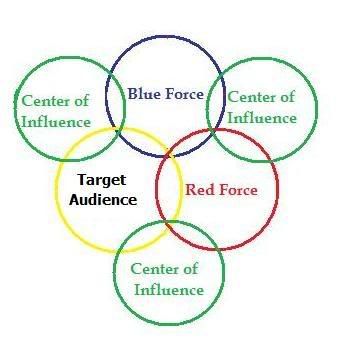
Recognizing Spheres of Influence


Photo Sharing and Video Hosting at Photobucket


That theory being that, in a global war against such an adversary, using all of the above methods and comprehending the effect of global development on information and interconnectivity of people, there is no such thing as a "neutral" party to the war. In fact, every nation and individual is a potential "target audience" as well as a potential deliverer of the message. Their importance, how the message is shaped and who delivers it is based on the "target audience's" geographical proximity to actual areas of combat operations, their ideological relationship to the adversary or even to the US, including their own national or ideological interests.

All of which indicates their potential acceptance to "blue force/red force" communications and ideas. It also indicates whether they are an effective conduit of either message to other "target audiences" to: pressure the adversary; to pressure his sympathizers, to influence potential allies of either force or even to influence "neutral" parties to act or not act on behalf of either adversarial party.

This theory and its "9000 mile" view of "target audiences" obviously makes a large and unwieldy matrix to work with and plan the message, the method of delivery and the responsible parties. That requires a breakdown and identification of the "target audience" and their geographic and ideological relationship to either entity as well as the most appropriate method of delivery and responsible party. However, this diagram could be used to drill down to each level and category of "target audience", overlaid on each successive group of communities from a global, state and local perspective.

Definition of the Diagram: Spheres of Influence


Photo Sharing and Video Hosting at Photobucket


The overlapping circles represent these ideas
:

1) Every entity has a relationship with the other, directly and indirectly, through geography, ideology, economy, security and polity, and through individuals, populations, states or organizations
2) Every entity has influence on the other, through actions or reactions, directly or indirectly, through geography, ideology, economy, politics, security and polity: through individuals, populations, states or organizations
3) Every entity seeks to increase influence on the other to act or react, directly or indirectly, through geography, ideology, economy, politics, security and polity: through individuals, populations, states or organizations
4) Every entity has its own set of goals that it wishes to achieve that is either aligned or in opposition to the goals of the other entities. Such goals include economic, political and security.
5) The importance placed on these goals by an entity; their alignment with any other entity's goals; their relationship with any individual, group or state; the amount of influence each has or can improve on another, will determine what position or sphere of influence the entity occupies on the diagram.

Individual circles:

1) Blue Force/Red Force represents the main protagonist and antagonist, whose goals are similar (such as achieving communications superiority), but directly opposite the other.
2) Green Centers of Influence represents outside entities that share a relationship, influence and some or all of the goals of any entity that it makes contact with. Centers of Influence have their own goals which they attempt to achieve by either supporting the goals of or attempting to influence any of the other spheres it has a relationship with. These spheres of influence are sometimes interchangeable with any other entity on the diagram, most often the "target audience".
3) Yellow represents the "target audience". The target audience depends on a community's direct or indirect relationship to the whole or part of the conflict, it's own goals and from what level it is being viewed and addressed (ie, global, state, local or individuals).

Global Community: Relativity and Friction

Due to the global nature of communications and media which facilitates the global distribution of ideas, the relationship of nations, organizations and individuals invested in global economics, politics and security, this connectivity continuously causes friction which simultaneously maintains those connections.

Achieving Communications Superiority And Limitations


An ideology that bases its primary activities on disseminated and distributed relay or outsourcing of its message and activities, eschewing national borders, a state, or physical assets that can be targeted, nor recognizing any neutral parties to the conflict, cannot be completely eliminated by physical interdiction. For such an ideology to be rendered ineffective, it must be equally marginalized within all public spaces and polities.

This requires the engagement of all parts of society, at all levels, within the global community.

However, we must accept that defeating an ideology does not necessarily equate to eliminating it. The worst ideologies of the 20th century still remain with us today in the form of books, movies, music, internet websites and organizations that continue to attempt to re-establish their organization and ideology. It is only through vigilance and continued influence of the greater polity that these ideas remain marginalized and unable to retain the power that they once held. That may be the most we can expect from any sustained effort against such adversarial ideologies as Islamic extremism where information is retained and reflected in a never ending state on the world wide web.

Read More...

Wednesday, September 26, 2007

Iraq: Winning, Disconnecting From the Matrix

Cross Posted At the Castle

What we got here is a failure to communicate. Some men you can't reach, that is they just don't listen when you talk reasonable so you get what we had here last week, which is the way he wants it, well he gets it, and I don't like it any better than you men. - Cool Hand Luke


History, they say, is written by the victors. Except for modern history, which is written by the media with all the snapshots, sound bites, so called expert analysis, and two minute pundit riffs trying to tell the story before the next commercial break or within the 1.5" x 6" column they were allocated in the news paper.

In this war, history is still being written by the media. They create a narrative that equates to the knowledge of the masses and trickles down to the polls. Yet, somewhere amongst the narrative is the true story of the war, written in "0" and "1" bytes on the world wide web. It was hidden except to the few who knew that the narrative on the air waves did not match the whispers of communications from the front. And we searched for the real story among the bytes, flashing around the world at the speed of light.

It was these flashes among the dark and gloomy midnight of the narrative that has kept us going, insisting that reality, like the interned in the "Matrix", was not reality at all. Becoming unplugged from the legacy media "matrix", we found reality. Still, we shout to people to believe and their eyes are blurry while the media "matrix" tries to shift reality once again, changing the story to meet the reality they can no longer hide.

The "surge" they say is working. A miracle in many quarters while in others it is still rejected. People are waiting and watching for the "next shoe" to drop. Another gigantic frenzy of bloody horror unleashed on unsuspecting people. Yet, if something does come, it will be little and in no comparison to the bloody orgy that the enemy in its death throws perpetrated on the Iraqi people throughout 2005-2006. And, any who will try to claim that it is the "resurgence" of the enemy with a possibility that they will "win" will be dead wrong, just as they have been wrong throughout the war.

Perceiving a victory when it is perceived by all is not the highest excellence-Sun Tzu


In a recently linked piece at Instapundit, Atlas Society noted that the media was "mugged" by bloggers. There is a lot of history that talks about how the media changed. A significant part of this story, broken down to the minimal, is that the conglomeration of corporatist media lost their independence and became subject to a singular editorial process governed, not by reality or the customer base they were serving, but by a hierarchy that that led to only a few at the top deciding what was newsworthy. It was these few that, through their relationship with "global" media and their outright ownership of much of the network and printed media, that controlled the story line, "shaping" American opinion.

Atlas Mugged talks about events such as RatherGate and September 11th, when the popular media servers went down and people were left with either repeating loops on the networks or blogs. It discusses the rise of blogs and the attempts of the mass media to take advantage of the phenomena. But, even Atlas Mugged misses one essential story that the centralized editorial practices of the "mass media" missed: the real story of how we won in Iraq.

Without taking anything away from Gen. Petraeus and those who worked hard in the last nine months to take advantage of the conditions set by all the hard work before and insure victory, victory was assured a long time ago. The truth of it was written in the blogs of military men and women and free lance writers who eschewed the "Matrix" of mass media for true independence.

Most of America is still wondering and looking for the miracle, the mythical moment that it all started going "right" in Iraq. Today's narrative is that the "surge" provided enough security to "finally" convince the Iraqis that it was in their best interests to join against Al Qaida and other extremists. Yet, the hard work that led to the ability of the "surge" to work has been being done over the last three years. The Iraqi rejection of terrorists and extremists of all stripes was written in the blogs.

It was only those of us who disconnected from the "Matrix" of the mass media who knew the reality on the ground did not match the "reality" perpetrated by the media.

We few, we happy few, we band of blogs, having looked beyond the Matrix, discussed strategy and pointed to successes long before the media ever knew who Petraeus was or anything about the new COIN manual that incorporated ideas written by Kilcullen and discussed at length on the blogs.

Victory, they say, has many fathers and defeat is an orphan. Some of us refused to abandon it.

Another truth that was missed until this year, is the horrific actions of the enemy that foretold his own defeat.

No miscalculations mean the victories are certain, achieving victory over those who have already lost - Sun Tzu


In war, there are no such things as "no miscalculations", but there is those who make the least miscalculations. In 2004, Zarqawi wrote how Al Qaida in Iraq would be defeated:

1 - We fight them, and this is difficult because of the gap that will emerge between us and the people of the land. How can we fight their cousins and their sons and under what pretext after the Americans, who hold the reins of power from their rear bases, pull back? The real sons of this land will decide the matter through experience. Democracy is coming, and there will be no excuse thereafter.

2 - We pack our bags and search for another land, as is the sad, recurrent story in the arenas of jihad, because our enemy is growing stronger and his intelligence data are increasing day by day. By the Lord of the Ka`ba, [this] is suffocation and then wearing down the roads. People follow the religion of their kings. Their hearts are with you and their swords are with Bani Umayya (the Umayyads), i.e., with power, victory, and security. God have mercy.


The truth is, their defeat was written by purple dipped fingers, smiling faces, singing and dancing. Their defeat was written when men and women stood on the line and insured that democracy, however ugly and however different than our own, went forward.

Democracy was coming and there were no excuses after that.

As for the bloody orgy of killing that came after, it was not a push for victory, but a desperate rear guard action. Like Hitler so many decades ago who proclaimed the German people unworthy of the Third Reich and thus deserving of total annihilation, Zarqawi and others put in motion what was to become their death throws; the seal upon their defeat written in the blood of young children.

Some may believe that it is too early to say that we have won in Iraq. Others will claim that it is only hindsight that allows anyone to believe that they knew all along we would win. But it wasn't hindsight that had bloggers across the world looking for victory. It was and is a belief that victory should be and could be the only end.

We almost lost the war. Not on the battle field, but right here at home. As General Lynch recently said, the reason people thought it was being lost and now appears to be miraculously won? The media, with its central editorial boards "shaping American opinion" told everyone it was so. And, at least half of the American population was unaware because they had no idea they were being sold a bill of goods. They didn't disconnect from the "Matrix".

Today, Iraq is still a troubled place and the political situation is rough. Yet, we see the light at the end of the tunnel and it is coming fast. How will we know we have finally achieved "victory"? Victory will not be written on a surrender document signed in front of a host of media with glaring lights and cameras blazing. No, victory will be like the silence after a harsh storm, war fading away while we are in our houses or going to work or welcoming home the troops. Most won't even know it happened.

And the only thing the enemy will do is what he said he would do if they lost. So long ago it has faded from some people's memories, lost in the spasms of blood and fire:

We pack our bags and search for another land, as is the sad, recurrent story in the arenas of jihad


Al Qaida in Pakistan has been working to stir trouble in Waziristan. Bin Laden declared war on Musharef and Al Qaida is picking up operations there.

As the war in Iraq fades away from the headlines and even Iraqi politicians are declaring victory, will anyone remember "the war is lost" crowd? Some people still talk like it is 2004 and the Iraq elections never took place, suggesting that Iraq should be partitioned. Sorry, that is a decision that the Iraqis will be making, thanks in no small part to the sacrifice of thousands of young Americans and many thousands more Iraqis who stood in the breaches while we fought a war of words at home.

The media is still trying to shape the narrative, including Hollywood who has never been more disconnected from reality than today. One wonders if either the mass media or Hollywood has discovered that they are irrelevant?

In Iraq, Kurdistan tries to rebuild economy, the Baghdad book market is re-opening, Iraqis are returning to music, and, instead of suicide bombers, it's teenage suicides due to an abrupt change in culture that is worrying the media.

Don't close your eyes, yet. We're still in Afghanistan and Pakistan is heating up while Iran talks like a petulant child demanding their seat at the adult table. Syria, a dedicated member of the axis of evil, still tries to have its say in Lebanese politics.

The battle for Iraq is all but over, but the war against tyranny, oppression, evil and fascist ideology continues.

Who will tell the real story of Iraq?

A note to the media, particularly the Dan Froomkin variety: you will, of course, ignore this post or the small voice here in the wilderness who is warning you of the future where the mass media begins to divest itself of the "mass" that is sinking it like a giant albatross around their neck and journalists begin to try to figure out where they belong in the brave new world of, once again, truly independent media.

The reason that you are failing, the reason the stock in your companies continues to dwindle, the reason that you missed the true story of Iraq in lieu of "the narrative", the reason that a sitting president invited bloggers to the White House, however limited in its actual journalistic moments that you claim as "real" journalism, is because you and your kind became "the Matrix"; alternate reality created by you and others like you. You are no longer independent. You are no longer individuals seeking "the truth".

You started believing your own press that you were the people that "protected" the people from the power of the government. You were 'objective" you said. You told the "truth" you said. All the while you abdicated your self-appointed responsibilities to foreign unknown, ideologically and ethically challenged stringers rarely ever telling your viewers and readers where it came from. You claim you don't bow down to powers, you bring them down, while all along central editorial boards told you what to write, what was acceptable. They stacked the deck with people like you to "shape the narrative" and "shape public opinion".

You're no longer independent, but a slave to the Matrix. What can you do but complain like petty demagogues who fear their throne has been threatened and belittle others who dare to disconnect from the Matrix?

You're lemmings, speaking with one voice, repeating the same line over and over again as you go down into the dark sea. Yet, you will keep asking yourself why this happened because you will never look past your own nose, self-congratulating prose and incestuous awards for "journalistic integrity".

The owner of this blog thought that maybe you were jealous of their invitation to the White House. I disagree. You are jealous of the one thing that they have that you no longer do:

Independence.

Believe me, if you believe nothing else: your lack of understanding of that word will be the "death" of you.

Read More...

Clinton "Hawkish" on War Holds the Center

Shocking news flash: We are winning in Iraq and conducting "mop up" operations.

Next election, as "hawkish" as Clinton is sounding, don't forget that she was moving with the wind of the polls and declaring the war lost while simultaneously insisting that there was no way to pull the troops out "after the disaster" that the President allegedly was presiding over. She was not prescient. She was an opportunist. That's no way to run a war and it is no way to run a presidency.

And don't let the rest of those slippery, weasel "the war is lost" people escape either. John Biden and the rest of the "hawkish doves" (Democrat or Republican) should take a flying leap.

Read More...

Monday, September 24, 2007

Ahmadinejad: I Am A Muslim. I Cannot Lie.

Interview with Ahmadinejad from 60 minutes. Seems like it was tough questions. However, while the Kos Kidz go crazy, Charles Johnson highlighted a section where Ahmadinejad says he has suggestions for President Bush on how he can help his party win the next election. He espouses every democrat talking point, but seems to leave out his favorites like paramilitary beatings of demonstrators, mass arrests, long term imprisonment, killing journalists, and hanging dissidents via crane in a public square. I haven't even watched it all and I'm getting the feeling I'm seeing Baghdad Bob has landed a new job complete with nose job and stupid grin. Can't wait to hear his UN speech.

What I'm saying, I am being very sincere here. I'm a Muslim. I cannot tell a lie."

"But when I ask you a question as direct as 'Will you pledge not to test a nuclear weapon?' you act, you dance all around the question. You never say 'Yes.' You never say 'No,'" Pelley points out.

"Well, thank you for that. You are like a CIA investigator. And you are…," Ahmadinejad replied.

"I am just a reporter. I am a simple average American reporter," Pelley said.

"This is not Guantanamo Bay. This is not a Baghdad prison. Please, this is not a secret prison in Europe. This is not Abu Ghraib," Ahmadinejad said. "This is Iran. I'm the president of this country!"


Go on, laugh. You know you want to. Tehran Ted. I kept imagining him banging his shoe on the podium. Journalist had big brass ones. Could have ended up in Evin like some of the other ones. Obviously why he can't stand real democracy and freedom. He wouldn't last two seconds with an Iranian Helen Thomas in the front row. Probably shoot her as soon as she said, "Mr. President..."

-Kat

Read More...

Iran and Syria: Brinkmanship in the Middle East

Cross posted at the Castle

Iran has lately become an even hotter topic than Iraq and, once again, Afghanistan has fallen off the radar completely. An upcoming push by the United States and France to enforce even greater sanctions against Iran is heating up the rhetoric from all sides of the ocean. Germany continues to struggle with the repercussions of joining the sanctions program. Democrats in Congress have been inordinately quiet since their last political push regarding President Bush's attempts to "escalate" the war by "implicating" Iran in the Shia insurgency in Iraq.

The silence in congress is not really surprising. Largely because they cannot deny certain intelligence backed up by hard evidence of the facts. Al Qods members swept up, facilitators singing and weapons with distinct Iranian markings that can't get anywhere into Iraq unless they are smuggled from Iran and can't get out of Iran unless they are intentionally released from Iranian armories. Particularly in the numbers that are being used and interdicted.

The same stands for Iranian weapons making their way to the Taliban in Afghanistan. The quantity of weapons being provided from a Police State cannot be done without willing, organized and directed assistance from the government and military of Iran, all denials to the contrary, unless security in Iran is worse than we imagine. This is one reason why the Democrats in congress are quiet. They might not want to go to war with Iran, but to pretend that Iran is not engaged in a proxy war and does not need to be confronted in some manner could boomerang on them, once again allowing the Republicans to smash them in an upcoming national election over national defense.

However, most congressmen of both sides of the aisle recognize, along with the President, that a terrorist supporting state who has provided money, weapons and political support to terrorist organizations of all ideological stripes around the globe and more recently against Coalition forces in Iraq and Afghanistan, is not a nation that can be trusted with nuclear technology. As long as the President continues to work towards a "diplomatic solution" through the UN or even without, using tough sanctions and other than war, the Democrats will be quiet and support strongly the efforts to prevent Iran from having these weapons. On the other hand, if the President starts talking like French Foreign Minister Kouchner, Democrats may be moved to strongly protest.

Iranian denials ring positively false as they proclaim no good interest in causing instability in Afghanistan or Iraq and insist on their good relations with both nations. However, this is clearly wrong as demonstrated by the number of weapons, men and materials being provided. Further, they do have good interests in insuring continued instability in both of these nations.

Iran's Interests In Instability In Iraq and Afghanistan

First, continuing low grade instability and the interdiction of oil from either terrorist attacks on the lines or through outright banditry and smuggling to Iran and Syria, keeps oil off the global markets, keeping supply tight and the value high. This increase in oil prices is extremely important to Iran where close to 70% of their state run economy is based on energy revenue, largely from oil. Instability in the region also keeps the market analysts valuing futures higher than ever before.

Second, instability leading to inability to fully develop internal infrastructure including, importantly, electrical plants, allows Iran to continue to provide huge amounts of electricity to both Iraq and Afghanistan contributing to Iranian state revenues. Hydro-electricity is the number three export of Iran. Other trade including food, clothing, concrete (for reconstruction) and appliances, to name a few, continues to be high since neither Iraq nor Afghanistan have developed the manufacturing capable of supplying any of its internal needs.

All of this equates to an economic windfall for Iran that needs the money to continue to support it's political ambitions around the region through organizations such as Hezbollah, Jaish al Mahdi and numerous organizations including Al Qaida in Iraq and Afghanistan. They also need the money to continue to develop the nuclear facilities and technology as well as buy weapons from China and Russia. Finally, while the money is flowing into Iran and growing it's GDP at what would usually be a phenomenal rate, inflation matches or out paces it regularly and sanctions and limited credit have forced the Iranians to start working on a "cash up front" basis to obtain imports of food (believe it or not, a upwards of 50% importer of food which is a serious national defense issue, but is directly related to Iran's export of food for economic gain since it garners more revenue on the open world market for the government, but simultaneously results in inflationary food rates for the common people), gas and other commodities. Making cash flow and management extremely important.

Third, while the world, particularly the US and coalition partners, is busy with Afghanistan and Iraq, Ahmedinejad can continue to consolidate his power in Iran, stacking election boards, sending contracts to the IRGC, appointing IRGC compatriots to important positions and using the possibility of war as an easy stick to beat any opposition with rhetoric accusing them of helping the enemy. While such calls within the United States may be part of the political rhetoric, in Iran, it could quickly spell disaster, political ruin, possible imprisonment and even execution.

In an interesting juxtaposition against the conservative power consolidation, Hashemi-Rafsanjani, once considered the leader of the reformist movement in Iran, was elected to chair the Assembly of Experts. The Assembly of Experts is responsible for selecting the "supreme leader" and over seeing the office, insuring that it adheres to Islamic law. While some see this as a part of the internal power struggle between the extreme, radical conservatives and the more "nuanced" members of the religious council to balance power, it could equally and easily be an attempt to co-opt Hashemi-Rafsanjani and mute any attempts by the reformists to mount an opposition to the conservative take over.

According to the link from Radio Free Europe, the Assembly of Experts is considered "conservative" and "a threat to any reform movement". It seems unlikely that Hashemi-Rafsanjani would be selected for his "moderate" views with an attempt to moderate the council. As one member noted, he didn't expect Hashemi-Rafsanjani as the Chairman to have much effect on the over all positions of the board since the position is about insuring proper procedures are followed and only meets once every six months. On top of that, the position is elected for eight years. The chance that Hashemi-Rafsanjani would have the opportunity to influence the selection of a Supreme Leader is minimal as there are few signs Ayatollah Khamanei is going to depart the world, thus the office, any time soon.

Hashemi-Rafsanjani's history with the reform movement has been checkered. He's a member of the conservative party, but, during his presidency from 1989 to 1997, he worked closely with the secularist reform party, promising changes that he was either unwilling or unable to make. The reformists later rejected him as a representative because they believed his "gradualist" approach to reform was a facade and they had been betrayed.

During the 2005 election, many "moderates" and "reformists", disappointed over his previous performance and the reform situation, boycotted the elections or were otherwise kept from voting. This allowed Ahmadinejad to be elected in a virtual landslide. All of this points to the possibility that political enemies are being kept close.

Internal Unrest

While down in the streets, Ahmadinejad has been knocking out any potential protests from less than enthusiastic citizens. Trade and labor unionist have been agitating for the right to organize as well as for salary increases and benefits (such as two pair of shoes for bus drivers) that they have not received in several years. In some cases, teachers and other service workers have not been paid for months or even a year. In a state where inflation is officially 14% and the outside estimate is 17-20%, this lack of commiserate pay is placing an extreme hardship on the people.

Historically, the labor movement helped bring down the Shah's Imperial Regime when whole sale strikes shut down the economy and workers took over the factories in conjunction with the Islamic Revolution in 1979. Soon after taking power and in the lead up to the Iraq-Iran war, the Islamic government broke up the unions, arrested thousands and destroyed the secular, socialist movement of the revolution.

Ahmadinejad, being part of the original revolution, must be aware of the dangers to the economic stability of the nation and, thus, his own government from such movements. He is once again instituting mass arrests and violent repression of the labor movements, arresting, imprisoning and executing dissidents; and expelling any "liberal" professors and students from university to insure his control. All this is in the guise of protecting Iran from "traitors" who are "assisting the enemy" (the US) as seen in the lead up to the Iraq-Iran War.

This, among the many signs, including defiance over continuing nuclear development, pronouncements of alleged breakthroughs in weapons, missiles pointing at Israel and US targets in Iraq, gasoline rationing, removal of the Chief of the IRGC (who is alleged to have suggested that they give back the British Sailors quickly to de-escalate the situation) to the military attache for the Supreme Leader, the emplacement of an even more hard line, Ahmadinejad compatriot to the IRGC, points to a possibility that Iran is preparing for war.

There are even suggestions that Ahmadinejad may stage some additional, literal confrontation with the US in order to bolster his position and finalize control of the government, forcing the recalcitrant population, assembly and clerical governing bodies to move to his position. This confrontation has been nearly realized on several occasions including incursions into Iraq in an attempt to kidnap or kill US forces or confrontation between IRGC gunboats and US ships or interdiction of US operations in the Persian Gulf. While many in the west look to the young and "liberal" Iranians as the last, best hope for Iran, Ahmadinejad is betting on a national crisis to force even this population to rally round the Iranian flag. The continuing fight over Iran's nuclear ambitions is one that has had even the "liberal" Iranians insisting on their "nuclear rights", swallowing their angst and supporting Ahmadinejad.

However, just to insure that everyone follows along, Ahmadinajad has begun to enforce the Islamic laws very strictly, arresting people for un-Islamic dress, women campaigning for equal rights, even taking away pet dogs from animal owners as "un-Islamic". Most of these actions are to remind the young, possible reformist liberals that he has the power to reach out and touch someone if they don't cooperate.

Regional Concerns

Regionally, instability in Iraq, at least, plays into Ahmadinejad's hands. With the Iraqi government's continuing weakness, it allows him to exert more control and ally Iran closely with their ideological compatriots in Iraq. Aside from economic issues and having to beg Iran to assist (or, more accurately "desist") in Iraq's stabilization by stopping smuggling of weapons, money and people to "terrorists", a weakened central government gives the Iranian backed parties control of major areas in the south where oil, agriculture and ports that control Iraq's economy exist as well as some direct "pull" in the existing government.

That area is also most highly populated with the majority Shia in Iraq. Whoever controls that area has an excellent chance of being the majority party that forms the Iraqi government for decades. This could put Iraq in Iran's pocket and change the economic and security dynamics of the region.

Iraq would represent an economic trade partner that would allow Iran to diversify and increase its trade in the region as it hopes to meet its stated goals of being free of "western trade" and the Middle East "self sufficient". It would also represent a partner in OPEC which controls production, thus, oil prices, for the largely Middle East cartel and is currently dominated by Saudi Arabia and the Gulf States that are western leaning. This keeps OPEC working on the Saudi vision that price inflation should be limited to insure the global economy stays strong and, therefore, so do OPEC nation revenues. To this end, they often agree to increased production or reduction depending on the market situation.

They are also concerned that, if oil becomes prohibitive, consumers will look for alternatives and ultimately oil will lose its value sending these economies crashing. Iran works on an all or nothing basis along with Venezuela who is desperate for the income and don't mind if the global market crashes and burns in the process. http://themoderatevoice.com/places/americas-n-s/latin-america/15187/the-salami-tactics-of-hugo-chavez/>Viva La Revolucion!.

Significant control or association with the Iraqi government would link Iran and Syria, strengthening their potential military power to put pressure on Israel, Lebanon, Jordan, Saudi Arabia and the Gulf States. Recent events indicate that Iran and Syria are jointly preparing for possible war.

Iran-Syria Military Matrix

A report from Jane's Defense indicates that at least 200 people, including Syrian and Iranian military, were killed when a missile being fitted with a Sarin gas war head exploded. The testing facility is a joint operations program established with Iran in 2005. Syria has a long history of developing chemical weapons. They were assisted willingly or unknowingly by German manufacturers and through an association with the Soviet Union in the 1980's. Some have even speculated that Iraq's chemical weapons and nuclear technology that are not on the manifest as destroyed and could not be found in large numbers after the invasion may have been transported to Syria in the lead up to the invasion (see also NY Sun Report).

Information continues to come out regarding the recent attack by Israeli commandos and fighter jets against what is now being claimed was a stockpile of nuclear material shipped from North Korea. The information was apparently conclusive enough to have the US put Syria on the nuclear watch list. Reports dating from 2004 by a refugee Syrian dissident indicate that North Korea has been cooperating with Syria in developing nuclear facilities and technology. Locations and details seem to match reports made by a top Iraqi official under Saddam Hussein, Georges Sada, in his book "Saddam's Secrets".

It is believed that the AQ Khan network, derived from Pakistan's nuclear programs, was responsible for providing nuclear technology to North Korea and possibly Iran. It may also have provided assistance either directly or through North Korea in developing similar programs to Syria.

In a seeming replay of Iraq's decade long delay and denial, Iran has recently decided to cooperate in a limited manner with the UN IAEA by providing it with historical documents regarding its nuclear development. While these actions have been welcomed by the IAEA, Russia and China, the United States and European allies have declared that it is not enough. Considering the recent attack on a suspected Syrian nuclear site, this may be correct.

Lebanon has implicated Syria in the latest assassination of an anti-Syrian politician. The motivation appears to be an attempt to shape the upcoming presidential elections by physically eliminating members of the majority in the Lebanon Parliament. According to the linked report, the death of Ganhem brings the majority down to 68 seats; only three seats above the absolute majority of 65. This is an obvious attempt to bring Lebanon back under Syrian influence and away from the west or any possible reconciliation with Israel.

Syria has long depended on Lebanon as a conduit for trade through its Mediterranean ports. Syria also realizes a large portion of its state revenue from fees garnered for oil and natural gas that passes through pipelines across the nation to conduits in Lebanese ports. Syria inked a deal with Iraq in December 2003 for an oil pipeline extending to the Mediterranean for delivery of oil to European markets. Syria wants to maintain access to these ports to realize their plans for the Iraq oil pipeline and other potential pipelines from other nations like Iran whose oil exports are limited to terminals in the Persian Gulf. These present a security issue for Iran who fears the interdiction or blockade of its trade through such limited access. Syrian leaning Lebanese government would also be willing to insure lucrative pricing for a similar taxation on the pipeline and transport of oil since Lebanon's take would eat into Syrian profits.

Ahmadinejad to America: Iran Wants Peace, Give Us What We Want and You Can Have It

Meanwhile, Ahmadinejad has traveled to New York to make his case before the UN and, according to a reported interview from the Iranian News Agency, make his case to American Citizens directly. He believes that US citizens have been given "incorrect information." His recently aborted (or not) trip to Ground Zero, he stated in a 60 Minute interview, was to pay respects and "perhaps air your views about the root causes of such incidents." Most likely it was an attempt to garner a third venue from which to lambaste US policy in the Middle East and expound on Iran's "right" to nuclear technology.

He insists that the US and Iran are not heading for war while US military intelligence continues to point out Iran providing weapons like anti-aircraft missiles, to Shia extremists. Adm. Fallon, in charge of US forces in the Middle East also stated that the continuing "drum beat for war" was not "helpful" in a recent interview with al-Jazeera, though it is unclear if he is speaking about outside governments, the media or the Iranian government. Prior to leaving Iran, Ahmadinejad presided over a typical "show of force", complete with signs declaring "Death to Israel" and "Death to America".

During his speech he declared:


"Those (countries) who assume that decaying methods such as psychological war, political propaganda and the so-called economic sanctions would work and prevent Iran's fast drive toward progress are mistaken," Ahmadinejad said.


Real Democracy In Iran Decades Away After Conservative Power Grab

Such "show of force" events are often provided for internal consumption. However, it is equally as likely an attempt to bolster Iran's position for negotiations and Ahmadinejad's public image both in the world and at home as a "strong man" for his upcoming speech. Beyond Iran's current external issues, Iran is continually racked with internal upheaval. Iranian resistance has recently stepped up its attacks and the IRGC is responding by attacking villages around Iran and even shelling into Iraq in an attempt to decimate the Iranian Kurdish resistance.

While many have hopes for the internal pressure to effect change in Iran's government, the "reformists" to date have been unable to organize effectively. Their 2005 boycott of the presidential elections split the reform party over its rejection of Hashemi Rafsanjani and gave the election to Ahmadinejad. Their fears over repression were soon met. Members of the reform party had stated that the elections are controlled by those with the money and the power in Tehran.

In an attempt to bolster democracy organizations in Iran, the US has included some $25 million in funding in the 2008 budget. Open Democracy, a Soros funded organization, believes that these funds are counter-productive because receiving them inside of Iran is against Iranian law and can have severe repercussions such as imprisonment. Senator Leiberman recognized the problem, but stated that the grants would be made available through different organizations if requested.

Iran has only recently released some suspected American-Iranian democracy advocates from the notorious Evin prison having already punished their families by confiscating their property and forcing them to pay exorbitant fees for food and medical treatment at the prison as well as huge amounts of bail. Iranian security claimed that the jailed activists were American spies and/or propagandizing against the Iranian government. Some speculate that their release was to spare an open trial while simultaneously sending a message to other activists that they will be jailed if they continue to act.

The release might also be construed as setting up a favorable view of the Iranian government prior to Ahmadinejad's visit to the UN. Iran has long been accused of human rights abuses. Iranian security forces were implicated in the death of a Canadian-Iranian journalist.

Will the Real Iran Please Stand Up

Due to Iran's continued support for terrorists, Iran's human rights record and the 9/11 report implicating Iran in the transit of an estimated 7-10 of the terrorists who hi-jacked the airplanes that day, Ahmadinejad's visit to the UN and his address at Columbia University are being protested by various groups.

Ahmadinejad says there is no reason for war with the US and declares the state of Iran to be strong regardless of sanctions. At the same time, he will be giving a speech at the UN that will directly challenge the US while in Iran they prepare for war.

Through a small window into Iran, the effects of sanctions are apparent. In the world re-known carpet bazaar, the stalls are only half full and the patrons are scarce. Vendors remain optimistic that the desire for these carpets will keep buyers looking for ways to obtain them. Yet, the damage is already apparent and the possibility it will be erased any time soon is disappearing almost daily.

Additional Reading:

Iran-Russia Matrix
China-Iran Matrix
Warsaw Pact2
From Russia With Love
Economic Warfare: Iran Sitrep
Economic Warfare: Iran-Help and Hindrance
Iran Gas Rationing: Preparing for War, Economic or Subordinating Dissidents?
Economic Warfare: Iran Crisis and the British Sailors
Economic Warfare: Axis of Evil
Democrats' Iraq Strategy

Read More...

Friday, September 21, 2007

My Code Pink Moment

-Denizen Kat

In regards to the Armorer's post from yesterday...

I had the distinct pleasure of meeting a code pink chic at my niece's school for family fun and nutrition Thursday night. I know she was Code Pink: Women for Peace because she had it printed on her butt and shirt.

Photo Sharing and Video Hosting at Photobucket

I am unaware of any rally here in town or other reason for it so I assume this lady thinks she had to inflict her ideology on the rest of the world among the little kinda garden kids and their parents.

I can tell you, with all honesty, it took a great deal of effort not to keep giving her an evil glare and a piece of my mind. In fact, I had my uncle's dog tags, along with a "support the troops" and POW/MIA pin in my purse from the last rally I was at. She was standing right next to me talking to the mother of my niece's friend who had set with us eating pizza (yeah, nutritious). I reached in the purse and grabbed the tags, ready to put them on as blatantly and in her face as possible.

I wouldn't start it, but I was ready for her to say something. Anything. I kept thinking about the $600k in food and supplies that they had sent into Fallujah that the terrorists had taken and distributed across their network, the boys that were killed there, the poor people of the city that were tortured and murdered who never saw a piece of that, who suffered because the animals who had them used them to keep fighting.

I thought about the Major who wrote in his blog about the people who streamed from the city and begged to be rescued from the evil there. The beheaded bodies of men, women and children that the Major talked about being dumped outside the city or in the rivers. The burned bodies, the torture chambers...It was flashing pretty quick and I had it lining up to speak "truth to idiocy".

I kept thinking about these people outside of Walter Reed with their freaking signs and our wounded that have to drive by them.

I wanted her to say something. I WANTED TO SAY SOMETHING!

Then my six year old niece asked me if we could go jump rope with her friend.

I took my hand out of my purse, zipped up the pocket, took her little hand, she took her friend's and they skipped down to the gym where all the other kids were playing.

Time and place for everything.

If only that lady understood the same.

I know what the people at the rally felt like. I can't say that I would have been any better at that rally.

I almost wasn't. Just seeing those words made me mad. I'm still mad and disgusted.

I want to see that lady outside of the school with her code pink on and explain a few things to her like how she was able to walk around in her skin tight black stretchy pants with Code Pink on the butt,, dyed hair all frizzed out talking about going to get coffee at the local shop with the other lady, send her little girl to school, drive a car and, most of all, wear Code Pink clothes and protest the government because the people she and Code Pink disrespects lays it on the line every day, protecting those rights, her life and those of her family.

Something the people that she supported would have gladly killed her for instead of said harsh words and walked away in contempt.

Somewhere in Iraq and Afghanistan, while she was eating pizza at her daughter's school, a school was burned down because some little girls went to school there. Somewhere in Iraq and Afghanistan, while she chatted about how good the teacher was, a teacher was murdered for the audacity of teaching something other than religious indoctrination according to crazy men.

Somewhere in Iraq and Afghanistan, while her daughter ran through the school from one activity to another, a little girl was murdered because she even dared to set foot in a school. Somewhere in Iraq and Afghanistan and places in between, while she walked around in her skin tight pants with Code Pink on the butt, a woman was murdered because her hair wasn't covered or her ankle was showing. Somewhere out there, while she made an appointment to meet another woman alone at a local coffee shop, a woman was killed because she had the audacity to leave her house without a male family member escorting her.

As we walked among the books that read titles like "World Book Encyclopedia", "Natural Science", "Curious George", glanced at the pamphlets about nutrition, healthy living and posters that talked about making the right CHOICES, a man was murdered in front of his family because he read a book that wasn't the Qu'ran and dared to dream of the day when he could make choices, too.

Somewhere out there, while I debated whether to confront her and she proudly showed her contempt in her dress, having supported the murderers of these people of which I speak, as we stood in the auditorium beside the American flag, a man or woman in desert camouflage with that same flag on their shoulder died trying to stop those same murderers and for her right to call those who defend her a murderer and immoral. They died keeping the murderers she supported from finding her and insuring that she and her family did not suffer the same fate.

If fate should ever provide me the opportunity to speak to this woman again, outside of a school auditorium full of kinda gardeners, I want to tell her that.

Two weeks from now, I will stand in front of a meeting full of people from around the city and talk about putting up posters and flyers for Soldiers' Angels in buildings all around the city letting people know how they can support our active duty soldiers and veterans. I know for a fact that she will walk into one of these buildings and she will see our posters and flyers.

It will be her turn to grit her teeth and bear it.

The thousands of people that will see it and the few minutes I had to stand in her presence saying nothing will be worth it.

[Not including the two hours I had to listen to my BDS youngest brother - not the military one - defend this lady, after I noted it at the house, by insisting she probably didn't know what it meant. And, insisting that local stores sold these clothes so anyone could have bought it. I won't say what stores he indicted with his defense, but I will check them out even if I think he's crazy. Report will follow. Worse, after I told him what it was about, he looked up their website and tried to defend the $600k "for war victims" though totally ignoring my "they sent it through Syria and known insurgent contacts" with a continued defense of naivety on their part (right). He never spoke one word about my "they protest outside of Walter Reed" point -he's not so crazy he thinks our military is full of murderers and he has helped me with some of my troop support events and website. But he does think we should let "those people" -Iraqis, Al Qaeda, etc - kill each other.

I get to practice my "reasoned speech" at least once a week whether I like it or not. The discussion's can get lively though we have yet to draw knives or pistols. *wry grin* Yet, I will say that the "reasoned speech" sometimes does make it through and I hear it in the most surprising moments. There is hope. At least he thought Obama was crazy to want to sit and talk to people like Ahmedinejad and Fidel Castro "unconditionally", holding hands and singing Kumbaya. We do share a few common genes
.]

Read More...

Thursday, September 20, 2007

Ahmedinejad At Ground Zero?

I haven't written for awhile. I am working on an my epic review of the current Iranian situation coming soon along with a video on how to fight the war of ideas.

In the mean time, reports are out that Iranian President of Terrorism Inc, Ahmedinejad, is looking to visit Ground Zero and "Lay a Wreath".

A lot of people are extremely unhappy.

As Mark Levin points out, at least 10 of the 19 Saudis who flew planes into the WTC, the Pentagon and who were taken out by the flight 93 passengers, passed through Iran with some official assistance. Iran, as a backer of Hezbollah, is certainly responsible for a lot of deaths. A lot of American deaths including the Marines in Lebanon, enumerable tourists, aid workers and then the Air Force deaths at Khobar towers among so many. Not to mention Ahmedinejad's participation in the Iranian Revolution and it's taking of 66 American hostages.

NOT to mention the hundreds, possibly thousands of US military personnel killed or wounded in Iraq by the Iranian Proxies with Iranian Weapons and Iranian Money.

NOT TO MENTION, Ahmedinejad declares that 9/11 is an inside job (when he knows different) and has facilitated the despicable rumors that "Jews Knew" and stayed home, among many other things he has said officially or "unofficially" through his proxies.

He is looking for a photo op so he can claim back in Iran that he paid homage to the people killed by their own government. That is how this evil scumbag works.

The New York police who arguably have one of the best counter terror intelligence organizations amongst any international city and possibly within this country, have refused security at the site stating safety due to construction. That is probably the most polite thing they could have said that would not cause an international incident in the city of the world that hosts the UN.

But, some sources claim that the Secret Service, which provides all visiting diplomats security within the US, will escort him there any way.

That is what is making people angry. I'm with them. If I could get there, I'd stand in front and get arrested, too.

However, I don't endorse the suggestion of Scott at Mark's blog. No assassination of national leaders on US soil. That would start a war that we aren't ready for. I prefer to think of Ahmedinejad in the post revolutionary, revolutionary Iran, dangling from a rope attached to a crane as it is slowly pulled up, in a square surrounded by on lookers, who, unlike those watching the repression of Iran today, will not stand silent, but cheer as his tongue hangs out, his eyes bulge and his face turns blue.

Uncle Tito's Fate at the hands of the oppressed.

Read More...

Tuesday, September 11, 2007

9/11: Freedom and Making a Change

Read More...

September 11: Gratitude and Cold Revenge

It seems somethings always require an acknowledgment and obligatory post. Today is one of those days. It remains an obligatory post because we are still at war with the same people who attacked us.

I am reminded how I felt that day. I was mad as hell. The kind of mad that makes you do crazy things and hurt people, even those you wouldn't normally consider responsible, just because it would have felt good to harm a proxy for the S.O.B.s that actually did the damage.

Today, I'm still angry, but it is not the hot anger of youth and inexperience. It is the cold anger that takes pleasure in the thought of the ultimate destruction, not just of bin Laden or Al Qaeda, but any plans they have to institute the caliphate or any other form of Islamic State Utopia that these people want to institute.

It is the cold, calculating revenge that makes me contemplate, not just the destruction of such plans, but, in fact, the enacting of the very thing such ideologues as Qtub, Zawahiri and bin Laden have complained about and feared: the infiltration of American ideas, American commerce and American culture into the heart of Islam.

As much as Bin Laden thinks that he has had some effect on the American way of life and touts such things as mortgage rates and global warming as some sort of claim to the Islamist success, the truth of the matter is, these are blips on the screen. Financial ups and downs come and go. We are no where near collapse. In fact, war time economies are often and historically strong. Global warming will go the way of the "next ice age" claims from decades past. To quote Revelations: all these things will pass away.

But, real and profound changes have been wrought and continue to be wrought upon Muslim nations. Kuwait gave women the vote and Saudi Arabia instituted local elections. Saddam is long gone and Al Qaeda's Islamic Caliphate has been rejected by the first to have to live under it: the Sunni Muslim Iraqis. Lebanon is free and the Palestinians are too busy fighting over who should be in power rather than fighting the Israelis. The only people who are even partly effective in that war are Shia Hezbollah in south Lebanon. These are the same people who outed Al Qaeda's proxies, Fatah al Islam, in Lebanon. Even they didn't want any part of that.

Still, my favorite revenge is the revenge that Osama sought himself. Before Zarqawi died, a video showed him trying to fire a weapon. The most important aspect of the video wasn't his inability to fire the weapon, but was, in fact, Zarqawi wearing a brand new pair of American Tennis Shoes.

The significance of this was and is lost on some. The truth is, there are no Muslim, Arab tennis shoes. At least, none that the takfiri mufsidoon would be caught dead wearing. And while they tout their use of our resources against us, every day, somewhere in the hinterlands of Pakistan, in the deserts of Saudi Arabia and the urban streets of the Gulf States, Muslims are using American made or American created products. They aren't creating or using their own. Even takfiri terrorist propaganda videos made by terrorists are created on American invented and created computers, with American software and transferred via American internet.

These are facts that are indisputable: Islam and Arabs have yet to and probably never will create anything worth as much or anywhere as useful. Further, those very machines, software and services that they believe they are using against us are equally and regularly sending images, words and ideas around the globe, into Islamic countries everywhere.

The young, who may make up the "martyrs" are actually very small compared to the young who still live, are educated and enjoy some sort of American related life. Music videos, cars, clothes, movies: you name it, it is there and the best part of it is bin Laden can blabber his BS propaganda, but it doesn't change the facts: they cannot change the wheels of progress. change is inevitable.

While the US may change in some ways, the most profound change is taking place over there. If it wasn't, AQ and their affiliates wouldn't fight so hard.

It is the long term, distant future of free, democratic nations in the middle east, full of people drinking, smoking and having sex while contemplating their next vote that serves our revenge the best. Those changes, already coming, will be more profound than any AQ could possibly inflict on the United States.

It is the thought of this future that appeases my anger enough to allow me to enjoy the thought of the final revenge: not only will AQ and Osama be defeated, but the entire Islamic ideology will be rejected.

Someday it will be in the dust pan of history along with the rest of the evil, murderous, totalitarian ideologies.

The thought of young Muslim men ogling Britney Spears while sipping on a Pepsi in a red, white and blue can while smoking a cigarette and contemplating the bottle of whiskey they will buy just warms the heart. It may start out "slow" as Arab Muslims travel to the newly liberated Iraq for business or vacation where they will experience all the joys of democracy: alcohol, tobacco, rich foods, unveiled women and a chance to say whatever is on their minds without fear of persecution. That will bleed over and back into their home nations. They can't help it.

It will be in the way they walk, talk, dress and eat. They will learn it through osmosis.

As for other "profound" changes, I can honestly say that it did change me: for the good. I don't take freedom and democracy lightly anymore. I re-learned some history. I've read books by great thinkers on the subject and have experienced the great advantages of our society. Far from discouraging me, the attacks on 9/11 made me a true believer.

For that and the chance to savor the long term revenge planned, I am grateful. For giving me the opportunity to serve my nation in small ways and large, I am grateful. For making me look on the internet only to discover blogs and promptly start my own to add to the "market place of ideas", I am grateful.

There were great changes, but I doubt they were the bin Laden and Company expected.

Read More...

Osama's latest video: Dead Terrorist Fauxtography

It is the anniversary of 9/11. I wanted to put up something smart and sassy in reply to the Bin Laden Videos and still may do so. As I contemplate that, I am smoking a cigarette and downed a jigger of Crown Royal. Not because I want to, but because I can. I'm free and nothing OBL and crew has done or will do will change that. In fact, my cigarette smoking privileges are more at risk from nanny state "tax it into oblivion to protect the stupid masses" than from Bin Laden, et al.

Many folks have noted that Bin Laden's latest video includes a lot of "leftist" talking points like American economy, mortgages, global warming, etc. I think this is the worst forged propaganda the Islamists have come up with in awhile, including the infamous "giant spiders attacking American forces", "missiles" that turn out to be unused Pakistani artillery shells and "bullets" supposedly shot into some poor old Iraqi lady's house by American forces, but turned out to be unfired "civilian" type ammunition. There are so many other forged videos, pictures and reports from "stringers" and "anonymous" sources, it must be noted that this video doesn't even come close to the others.

It's cheap and pointless really. It does not take a technological genius to take some old video, splice it together, rub out a few unwanted beard hairs or photoshop some new "young" beard hairs in, or even adjust the contrast and color of a video to change the appearance of something that was recorded over three years ago.

Seriously, look at this side by side comparison of shots from the 2004 video to the latest from Stop the ACLU:


The anomalies caused by photo doctoring are all over the place. Dissecting it, look at the picture of his "upper" face. On the left hand side of the split the "new" beard shows a hint of the "old" beard. There are "gray" anomalies there that are not from lighting or enlarging. That is the "old" beard that can't be totally erased from the image.


Then there is that rather disturbing pencil line trying to define his "eye" and causing bin Laden to have even more "I've toked too much weed" droopy eye lid than usual.

Not convinced yet? Look closely at these images:


In an attempt to define and re-align the beard on his upper face, they accidentally changed the shadow lines that are blurry, but still apparent in the original 2004 video. I have to commend them for an attempt to stay true to the color, but it's not even close to the "color" they've made his current skin tone by darkening and contrasting the image to make him appear "healthy". That actually happens throughout the image.

Not to mention that this "reshaping" of the beard gives bin Laden a disturbing resemblance to certain cast members from "Planet of the Apes":


His nostrils could have come out of the "planet of the apes" make up gallery since the one on the left looks bigger than the one on the right and is probably, also, the result of the attempt to darken and define his mustache which now looks some what "Saddam-esque":


Right here you can see the reshaping of the mustache that now also appears to have had a "skin tone" applied. There is a minute line towards the top of the encircled area which would be much more apparent in a better quality blow up, but clearly shows the original line of his beard contacting his mustache. The skin tone is either the closest color or was taken from the original still image to cover it up.


His lower lip on the left shows the same problems where it is apparent that someone got a little loose with the black shading and ran it up on his lip. Just a small, round blip that could be unnoticed if you weren't looking for photo-shop enhancements.


Check out the color and shape of his lips. Even though his over all skin tone is now "darker" and "healthier", his lips are lighter than they were in the previous video on the right which clearly shows them to be close to or darker than his skin tone.


Now, suddenly, they look like Al Jolsen in black face:


Then we get to the bottom of the picture, the bottom of the beard. The anomalies showing the removed "gray" beard are so obvious, even my cheap picture program shows them up.


When you invert the colors, you can clearly see there is something wrong with the beard. It's been edited.


A little video demonstration showing what I could do with these pictures in 10 minutes.


Now imagine if I was a determined takfiri, mufsidoon trying to show the world that bin Laden is still alive and kicking.

I didn't even get to the speech yet. A good voice recognition and recording program could create some of that. However, it is just as possible he recorded the audio and it was dubbed over the video with the many minutes of still shots. Either way, bin Laden couldn't or wouldn't show his face. Maybe he is in worse shape than people think?

As for the "new" video with the 9/11 hi-jacker's "last will and testament", without new, relevant images of bin Laden included (I mean "new" not this regurgitated garbage), I'll have to chalk that up to AQ video archives and I'll still assume that Osama is either dead, too sick and horrific looking to appear or in a place where he is unable to video in front of a backdrop and knows his position can be easily compromised if he gives away any images.

Since it's easy to do a nondescript back-drop, my guess is one of the first two.

It's 9/11 and Bin Laden wants to stay relevant. Which is interesting since this article some what echoes several posts from 2005 that I did where I basically say that Zawahiri is now the head of Al Qaeda. He just doesn't want to lose Bin Laden as a figure head since he was so instrumental in forging an international jihad where Zawahiri could not even after many years of studying, writing and fighting the Islamist cause in Egypt. Over several books on the subject, Zawahiri lamented the inability or lack of desire for Muslim nations to interfere with or assist in the defense of Palestinians and other "persecuted" Arab Muslims.

He still needs the figurehead of a relatively young and energetic "prince" that has come down to live, work, eat and die with the common martyr. I believe that is why we see Osama hear trying to look that part.

One thing that I keep in mind when I view this is that the Taliban, al Qaeda and various other Islamist organizations do not believe in trimming the beard. While Spencer might note that mujihadeen are allowed to change their image to confound the enemy, there is little doubt in this blogger's mind that this "change" was profoundly an act of some video hacker geek trying to make the lord and master feel better.

My one and only hope is that this guy is dead in an unmarked grave where no one can or will want to find his grave site.

IN regards to the leftist garble coming out of Osama's mouth, there is a few other similarities. Funny enough, many seem to think of AQ as a "fundamentalist" group most closely associated with the right and evangelicals. However, I reminded of the reports from Michael Yon and Michael Totten talking about AQ killing or maiming people for smoking a cigarette. A deadly sin for Muslims in the sites of AQ. According to the left, they don't want to "kill" me for smoking, they want to "save me" from myself. Kind of like what the Islamists say they are doing by keeping people from making their own choices. Instead of breaking arms, cutting off fingers, or simply shooting people, they are going to institute a 156% tax on cigarettes to make it "prohibitive".

Now, I'm not saying that cigarettes are good. I'm just saying that it seems interesting, among all the similarities, some people seem to think the only way they can "save" me is to take away my freedom of choice, insisting it is for my own good.

There is definitely an echo chamber around here.


Read More...

The Road To Hell: Stupid Nazi Comment Ends in Unemployment

Well, some folks simply haven't learned that equating any Nazi policy as "good" is "bad" no matter how well intentioned.

Those Nazis and their family values

While presenting her book "Das Prinzip Arche Noah - warum wir die Familie retten muessen" (Arche Noah principle - why we must save the family), she said family values that were nurtured in the Nazi era were cast away by the turmoil of the late 1960s.

"It was a horrible time with a manic and dangerous leader who led the Germans into ruin as we all know. But there was at the time also something good, and that is the values, that is the children, that is the families, that is a togetherness -- it was all abolished, there was nothing left," Herman said.

Herman could not immediately be reached for comment.


You think?

I mean, I kind of understand she was talking about the whole "free love", "women's liberation", "let's abort our 'unwanted' children" thing kind of smashed the family and led to a down turn in population replacement. However, did she have to compare it to lebensborn?

Read More...

Monday, September 10, 2007

The Maginot Line, Quick Reaction Forces and Economy

In April 2005, I wrote a piece about the feasibility (or lack of) of developing a "Maginot Line" along the US border with Mexico or Canada. I disagreed then and still disagree with such conservative notables as Michelle Malkin and others who simply call for "securing the borders" by building fences. Not only do I believe that it can't be high enough, long enough or strong enough, I also believe that it would cost more than anyone can possibly comprehend or want to spend, even in this time of war.

Finally, I thought then and still do that it would also produce the wrong kind of attitude among people. "Fortress America" would give people false perceptions of security just as the once touted "Maginot Line" gave the French a false perception of defense right before they were over run in five days by the Nazi War Machine. War had changed by the time that the Maginot Line had been created and implemented. War was now "blitzkrieg": mobile, fast and devastating.

I wrote in 2005:

Strategic failures were in both tactics and incompleteness. First, it gave the French a false sense of security. The idea that they could hover behind their walls and no enemy would dare to attack through formidable lines of artillery.[snip]

The tactical problems with the line was the biggest problem. Warfare had left the fortress and trench war of WWI. It was the age of maneuver warfare. Tying up large forces in stationary fortresses that could be circumvented or directly over ran depleted the French forces. Worse yet, the French relied on these fortifications to give them time to call up and mobilize reserve forces, never considering that the fortifications could be over ran in a matter of hours or circumvented within 5 days.

Other issues included under staffing of the fortifications and moving forces from less "threatened" areas to other more important areas, consequently simplifying the identification of weak areas for attack by the enemy.

Here in lies the problem with Fortress America.

Tactically, Fortress America, loses the tactical ability to "maneuver" and respond to threats, ties up forces and resources. Trying to determine strategically where forces and technology would be distributed to the best use is nearly implausibly fantastically insane.


My suggestion was to throw out the "Maginot Line" and start using tactics that have been successful in Iraq including UAVs, helicopters and intelligence gathering through living and working with people who live in the area of the border. It's not just people in Iraq or Afghanistan who need to feel secure in order to provide information. In border towns, the coyotes and drug smuggling gangs are seriously dangerous. Most people who live in border towns have to worry about reprisals, too. Thus, not only do we have to "secure the border" we have to secure the population.

Today, I read a report that seems to have been taken straight off the pages of this blog. I wrote:

The integrated warfare tactics the military is using in Iraq to control areas are the tactics we require in border control.[snip]

Updated forces would need many more helicopters, UAVs, tactical patrol equipment and quick response teams on call at a moments notice.[snip]

Information from the CBP indicates that they are doing some work within border towns to try and become familiar with people, help them with problems, even so far as looking for government and private resources to help in developing the towns and their infrastructures. Very similar to what we are undertaking in Iraq and what is working to assist in intelligence gathering.

I believe that this needs to be updated and upgraded. Even considering that the residence of these towns are American citizens and that border security seems to be the watch word of the day, it is still not something that is being re-enforced daily with these citizens. Further, just as dangerous as Iraqi "insurgents" coyotes running illegals are equally dangerous, particularly in the Mexican area where it is deeply rooted in organized crime.


Bullet-proof helicopters play key U.S. border role

As he sets the aircraft down in a swirling tornado of dust and debris, two agents in military style fatigues and flak jackets jump out and swiftly round up all but two of them, illuminated by a laser from the drone. From alert to arrest, the operation has taken 17 minutes.

Welcome to a little known double act between spy planes and fast, military helicopters that is blazing a trail for the future of U.S. border security in a remote desert wilderness south of Tucson, Arizona.[snip]

Silent and cloaked in darkness as it wheels miles above the desert, the spotting system cues elite tactical teams in Black Hawk helicopters to race in and carry out arrests, often many miles from the nearest highway.

"The UAS says 'hey, this is what we see, we need you to come and grab it,"' said Rouviere, who alternates between flying Black Hawks and overseeing the Predator's flights from a military base in southern Arizona.

U.S. Customs and Border Protection currently have two drones in Arizona. Plans are underway to expand the fleet to six by the end of 2008, extending patrols to the U.S. Gulf Coast and stretches of the northern frontier with Canada.


Then there was this report about El Paso.

EL PASO -- Leaders of this sunny desert city peppered Homeland Security Secretary Michael Chertoff during a recent visit with complaints about trade-crimping border-crossing delays, unwanted calls to enlist local police in enforcing immigration laws and recent deaths of immigrants at the hands of U.S. Border Patrol agents.


I wrote in a lead up piece to the Maginot Line that any border control would have to take into account legitimate commerce:

Must not interfere with commerce because we operate on "just in time" (JIT if you're familiar the term) inventory and even a two days to a week of shut down could put us behind 2 months in product.


The El Paso report goes on to say:

Now North America's fourth-largest manufacturing hub -- after Los Angeles, Chicago and Dallas-Fort Worth -- El Paso and Juarez's surrounding state of Chihuahua have 270,000 manufacturing jobs, three times as many as Detroit, in 400 maquiladoras, or duty-free factories, economic development officials said. About 78 percent of residents are Hispanic, and 25 percent are foreign-born. Families send breadwinners across the bridge daily to work, and children to study.


And El Paso residents are not happy about it the crackdown because it could interfere with commerce, workers (who can legitimately cross the bridge everyday to work) and families who are integrated.

What this means is that the "intelligence" part of the border control must take precedence over simply "patrolling", interdicting or arresting people. We must be more selective in who we target and why. The border enforcement agents must be able to be more flexible in their dealings with people.

"If we take it to a point where the application of these laws in order to more secure our borders slows down commerce from Mexico into the U.S. . . . we'll all feel it throughout our economy," he said.


Who do we really want to stop coming through these borders? Certainly, potential terrorists. We want to stop coyotes or smugglers who prey on people and sometimes lead to the deaths of innocents who are left in the desert or killed because they can't pay. We want to make it unprofitable. We also want to stop drugs and criminals from coming across.

The only way that is going to happen is by the cooperation of the local citizens and those "illegal", otherwise law abiding workers that could give us real time info on the worst smugglers and drug runners. We aren't going to get that by messing with their commerce or their families or leaving any sort of impression that border patrol agents are more dangerous than the gangs of drug and human smugglers. "Illegal", otherwise law abiding workers aren't the kind of problem that the other types of "illegals" are to our national security or even our economy.

So, I recommend, again, that we re-look at how we deal with the population and take a book out of successful counter-insurgency doctrine currently used in Iraq. Put more border patrol agents there. Have them live in the communities. Don't harass just anybody, but make a concerted and public effort to find those who are preying on the innocent and weak even if they are "illegals". Border Patrol agents need good publicity showing them taking care of people, even "illegals". They need to be seen as "facilitators" of the public good, not the bad guys.

Some people are going to tell me that this isn't plausible or necessary. They are going to say that "illegal is illegal" and they should all go. Well, before they can all "go" you have to find out how they get here and you aren't going to find that out if they all clam up or run because they figure they are at risk just as much as the really bad guys.

Advocates for immigrants here are asking whether agents have been given permission to shoot first and ask questions later, and whether the increase in the number of Border Patrol agents and the detention of more immigrants have overwhelmed the government's ability to train and oversee officers. If so, there could be "a very disturbing trend starting," said Kathleen Walker, an El Paso lawyer serving as national president of the American Immigration Lawyers Association.


Let me remind people that "perception" is everything even if it is an image that is not "reality" as we know it. We can claim, as Chertoff does, that smugglers and others are getting more violent because we are more successful. Does that float in Iraq? Even in Iraq, even those who would not outright support the insurgency, people were highly concerned about the treatment of "regular" Iraqis. Even those who had some interaction with the insurgents and may have lent some sort of support, direct or forced.

We really have to look at it that way, even in the US border town of El Paso.

During his two-day trip to El Paso last week, Chertoff acknowledged that he is pushing a new way to get things done at the border, while insisting that he knows that a "one-size-fits-all blanket approach" will not work. "Piling on security by just putting a lot more things on the border" won't resolve the situation unless the United States also cuts down demand for illegal workers in the interior and creates a legal channel of temporary workers, he said.


There was a huge outcry when the "temporary workers' cards" were punted about by the administration and many republicans. The bi-partisan immigration law earlier this year was struck down. It certainly had a lot of problems, but, I disagree with a knee jerk reaction that very nearly insists that immigration or foreign workers should be eliminated. Many will want to deny that and insist they look forward to increased "legal" immigrants. However, the ability to process "legal" immigrants under our current laws and processes are so archaic and time consuming that it seriously damages such cross border trading towns as El Paso and can have a pretty significant impact on our overall economy.

Many republicans tried to rally people with the cry that illegal immigrants do the jobs that "Americans won't do" and they talked about service industries and fast food restaurants. That is not where we need workers. We literally need hundreds of thousands of workers to re-vive our manufacturing commerce and, yes, even insure wage inflation remains at a lower average and steady. High wage inflation means that goods and services inflate at the same rate. We need to maintain our wages and work force in order to compete with such countries as China and India. While we may understand that China and India's work conditions are much poorer than the US, it doesn't mean that we have the ability to change that.

We cannot control their laws. We can control from where and what we buy. The only way that becomes "American" is if we truly have the ability to manufacture here on a scale that has not been seen since the 1950s. Americans, according to a recent report, want to take "thinking" jobs, not jobs that they work with their hands. That's not McDonald's and lawn service. That is factory work making tires, door knobs, clothes, packaging food, etc, etc, etc.

Our current unemployment rate is 5.4%. That leaves about 15 million "employable" Americans "unemployed". Yet, the over all number is no indicator of how many Americans are without a job for long terms or forever. The true indicator is how many jobs are created and how often the unemployment rolls rotate. That number is about another half of that 5.4%. Further, "new jobs" are created that often exceeds the number of "new" unemployment claims in a given period.

That means that there are literally not enough "legal" workers to fill those positions. That also means that wages go up as companies compete for skilled and unskilled labor. It also means that companies will search in other places outside of the US for this labor in order to maintain profitability. Or, that we need a better method of bringing in temporary "legal" workers to bolster this ability as well as be able to provide an accelerated, legal path to "legal" citizenship.

If we do not compete with such markets as China and India or any number of upcoming nations with huge populations willing to work for half or less of that of an American worker, we will soon be irrelevant. That is a much greater threat to our ability to protect our nation than any illegal alien (non-mass murdering terrorist).

No economy, no money, no military.


Read More...

Sunday, September 09, 2007

Have You Forgotten? Meeting the Parents of Ronald J. Hemenway, KIA Pentagon September 11

An important date is fast approaching: the anniversary of September 11, 2001. As the years pass, even as we remain at war, for some that date and the shock of the attacks is fading to a distant memory. There are some who believe that the grieving of our nation should be lessened. There are some who believe that we should "move on" and let the dead rest. There are some who would like the war to simply go away so that they can go on with their lives unchanged.

Most who believe this were not personally touched by the tragic act of war that was perpetrated on our nation. They were far away or didn't personally know anyone who was lost or who had lost a loved one.

Then, there are those that can never forget because that day was more than an attack on our nation. There are those that can never forget because September 11, 2001 changed their lives profoundly and forever.

Bob and Shirley Hemenway are just such people.

We met Bob and Shirley by happenstance at a small town get together in Cleveland, Missouri. Cleveland, Missouri is about 30 miles south of Kansas City. Population 592. Today's event was held on Main St. There were approximately fifteen booths, largely organizations like Boy Scouts, Girl Scouts, the Lion's Club, etc. Funnel cakes, hot dogs, cotton candy and soda were sold at various booths to raise money for their programs. Several musicians played throughout the day until evening when a band came on and people were literally dancing in the streets. Something that you only see in the movies, but really does happen here in small town America.

Soldiers' Angels had been invited by the town to have a booth for free right in front of the post office on Main Street. The mayor offered us an opportunity to speak to the crowd. Throughout the day, the entire population of the town and surrounding farms came into town to enjoy the festivities.

I've said it before and I'll say it again: there is nothing like small town events. We enjoy going to large events where we can reach great numbers of people with our message for supporting the troops, but in small towns, the pace is slower, the people like to stop and chat and we get an opportunity to really let people know about how they can support the troops.

At the end of the day, we had been there for about seven hours and we were trying to decide if we were going to stay for the night time activities. We had several folks stop by to pick up t-shirts or information about how to support our troops.


This is the mother of Sgt Matt [redacted], United States Army. Sgt Matt just came back from Iraq. He is one of the few Explosive Ordinance Disposal members that are in great demand in Iraq to clear IEDs and VBIEDs, the number one weapon that kills or injures our troops. She is going to see him in two weeks. We gave her a coin and Thank You card to give him when she gets there.


This lady chatted with us for awhile. She has a group of ladies that meet once a week and they were extremely interested in how they could participate and support our troops.


This young officer stopped to check out the pictures of our troops and the support that we send.

This couple stopped by to check out our booth. As we chatted, Mrs. Hemenway revealed that her son Ronald J. Hemenway, ET1 USN, was killed on September 11, 2001 in the Pentagon. His remains were never found. His name appears on the Pentagon September 11 Memorial in the Arlington National Cemetery. He has a separate marker in Arlington in the MIA section.

When we go to these events, we often meet someone special that makes the event worth every moment. Whether it is a veteran or a family member, it reminds us why we do what we do. The Hemenway's were visiting their son Robert and his wife Dawn who live in the community. As we chatted and they revealed who they were, they expressed to us the importance of supporting our troops in every way. They told us about the flag that Sen. Sam Brownback had flown over the capitol in Ronald's honor and how their son Robert had put a 25' flag pole in their yard to fly the flag. We gave them a thank you card, a pocket angel, an angel pin and a challenge coin. They thanked us for supporting the troops.

Mr. Hemenway talked about his son serving on the USN La Salle. He was wearing a hat from the La Salle and recounted how ship mates and friends of Ronald contacted them when they found out he was lost in the Pentagon. Many notables arrived to visit them and see how they could help, but the people that they were most touched by were the men and women Ronald served with. As we continued to talk about supporting our troops, Mrs. Hemenway broke down in tears and hugged each of us. Then Mr. Hemenway hugged each of us, shook our hands and said, "God bless you for what you do." It was hard to stay dry eyed.

It was only as I was driving home later that I realized that this meeting was so special: the anniversary of 9/11 is in a few days. It was, in many ways, as if fate had taken a hand. Who would have thought that in a small town, at the crossroads of two highways that are only designated by a letter, dotted by farms and huge pastures, we would meet the parents of one of our first fallen of the war?

Many ask whether we should continue to honor September 11 as we have every year. There are people who still remember. The Hemenway's can never forget. Our men and women are still fighting the war in many places around the world. Their families can not forget that their loved ones are far away or have sacrificed on our behalf.

We will not forget.

Message to the troops from the parents of Ronald J. Hemenway, ET1, USN:


Have you forgotten?

Read More...

Wednesday, September 05, 2007

Silence From the Peanut Gallery: Pelosi? Reid? Murtha? Anybody?


Sen. Kerry? Murtha? Reid? Pelosi? Anybody got anything to say?

With all that silence, it makes you think:

a) The "surge" IS working and they finally decided to shut up and not look like complete idiots (though, I am sure they will take credit for "forcing" the President to "change course", yada, yada; as if they really had anything real to suggest to the forces on the ground making it happen everyday, who figured it out with their help or, more accurately, despite it)

or

b) They are licking their wounds in their caves trying to come up with a really good explanation why the surge isn't really working despite the progress suddenly being reported on the ground by none other than perky Katie Couric, et al.

Then again, it could simply be because this guy did the hard work...


and these men...


and these women...


/


Of course, it's not over until the fat lady sings. Unfortunately, Al Qaeda has a tendency to cut her throat when she starts warming up.

Yet, in this video of President Bush's speech at al Asad, I hear the first chords of Ode to Joy, It sounds a lot like "Ooo-Rah"!


h/t: mudville

Read More...

Sunday, September 02, 2007

SitRep: Iraq - Sadr, Badr, Oil and Federalism


Over the last week, some surprising (or not) activities have been taking place.

As soon as the British rolled out of the JSS (Joint Security Station) in Basra, the Mahdi Army took up residence, displacing the police that may have been Badr Brigade or simply highly infiltrated with Sadr's Mahdis. According the Christian Science Monitor, a series of assassinations in the south have included a police chief and governor from Diwanyah on August 18, 2007 and the Governor of Muthanna on August 20, Four of Al Sistani's aides have been killed since June.

Not that these attacks are new by any means. It is simply that the wind down of the Sunni insurgency and Al Qaeda attacks, along with the bold assassination of elected officials, has started the media looking back at an area that has been ignored as "pacified" under the British. As CSM notes, these southern provinces are "economically vital" since they include Iraq's major oil and natural gas fields, the southern ports for import and export of goods and energy resources and several provinces that are part of the agrarian belts that provide Iraq with its food from cattle to wheat fields.

(Click to enlarge; note that the "attacks" are from 2005)


Even as the Shi'ites have sought to present a "united" front to gain and keep control of the Iraqi parliament, the southern half of Iraq has been contested by various Shi'ite groups since the overthrow of Saddam's regime. Not only is it economically important, but it has the largest population base. This is an important factor in deciding the political make up and control of the government of Iraq.


A recent report indicated that Mugtada al Sadr had ordered his men to "go dark" and get off the streets. Most reports believe it is because of the recent clashes with the Badr Brigade in Karbala giving his group a bad name with the Shi'ites. Sadr was busy saying it was some "rogue elements" of the Sadrists who did the brush up with the Badrs. That isn't necessarily true. Sadr has been trying to make political in roads into the Najaf since 2003 starting with the assassination of al Khoei on the steps of a mosque.

Al Khoei was a member of the rival Shi'ite sect of the al Hakim family run SCIRI. The senior Al Hakim was sought by Saddam Hussein's regime for years because the Badr Brigades, the military wing of SCIRI, had sided with the Iranians during the Iraq-Iran war. Largely in an attempt to over-throw Saddam's repressive government, but this divide left many nationalist Iraqis with a grudge against these Shi'ites. Al Hakim and the Badr Brigades were forced to retreat to Iran where they were armed, trained and financed by the IRGC. This group kept its contacts within the Shi'ite community and was one of the main instigators for the Shi'ite uprising after Desert Storm that was eventually violently repressed by Saddam's henchmen. The "No Fly" Zones were instigated to keep Saddam's forces on the ground, essentially to reduce their ability to slaughter the Shia from the air. However, bad blood between some Shi'ites and the United States still exists over their perceived abandonment.

Al Hakim and the Badr Brigades retreated into Iran once again for protection, support and training while maintaining their contacts inside Iraq. This is one of the reasons that SCIRI was able to return to Iraq post 2003 invasion and quickly spin up a political movement accompanied by a militia. They had already existed for over twenty years. Currently, SCIRI is being run by Al Hakim's son who is a recognized cleric. Reports indicate that the elder al Hakim has been ill, but it may be an attempt to put a younger face on the organization in order to combat the relatively young al Sadr's popularity, keeping in mind that more than half of Iraq's population is under the age of 30.

Al Hakim's PR includes attempts to make him as "heroic" as Sadr by pointing out he acted as a "lookout" for his father as early as the age of seven when the elder al Hakim would sneak back into Iraq. They have also focused attention on the younger Hakim's education as a cleric, starting with speaking in the mosque at age nine. In some respects, the struggle between al Hakim and Sadr boils down to educated "nobility" and uneducated "peasant".

Al Hakim and SCIRI are associated with the Shi'ite school of jurisprudence in Qom, Iran. This city has been known as the university of major Shi'ite thought for centuries, but is more recently known for having produced the Iranian Islamic Revolution and clerics, like Ayatollah Khomeini, who believed that "rightly guided" governance should come from religion and the religious supreme council of clerics.


Al Sadr and his father, on the other hand, remained in Iraq and attempted to guide the Shi'ite population through a "quietist" approach. During the Iran-Iraq war, many Shi'ite had tried to escape the constant bombing of their towns and villages near the southern Iraq-Iran border. They moved to interior cities in central Iraq like Baghdad where the generally poor, less educated and agriculturally based Shi'ites found themselves relegated to ghettos. Even more so after the Shi'ite uprising post Desert Storm where Shi'ites were branded as "traitors" because certain groups had sided with the Iranians. Saddam organized many "re-locations" of the Shi'ites into these ghettos where he could control them through place and resources.

Even today, many nationalist Sunni refer to the Shi'ites and the Iraqi government, dominated by the Shi'ites, as "Persians". This also has some ancient historical reference once noted by Zarqawi in his famous letter to Zawahiri outlining his plans to start a civil war by attacking the Shi'ites. According to history, during Suleiman's failed attempt to subjugate Europe, as he was preparing to storm the gates of Vienna, a Shi'ite uprising in Baghdad forced him to return and defend his Empire and throne from "usurpers and traitors". These "usurpers and traitors" were none other than the Persian based Shi'ites attempting to re-take control after decades out of power. These power struggles continued to erupt even throughout the period of the relatively stable Ottoman Empire that regularly dispatched Turkish troops to put down rebellions and has lent to the over all divide in Sunni-Shia Islamic relations and now regional tensions.

Sadr's father worked quietly on the streets to organize the Shia, provide food and medical care as best as he could for the beleaguered Shi'ites in the ghettos. As is known today, besides the mass killings of any suspect Shi'ites, these groups were also less likely to be provided benefits, receive assistance from the government, receive jobs or be given the opportunity for higher education. Even as members of the Ba'athist party Shi'ites were hardly trusted.

In 1999, Sadr's father was murdered by Saddam for an alleged conspiracy to assassinate Saddam. Many believe this occurred in front Muqtada and that he was forced to swear allegiance to Saddam. The repression and murder of Shi'ites continued, though at a much slower pace by the end of the 1990's. In contrast, because the Sunni tribes had remained relatively loyal to Saddam and had acted as "lookouts" in the desert to the southwest, a desert once considered "impassable" until Desert Storm, the Sunni tribes were left unmolested and largely autonomous in their areas. Something else that lent to the current divide of Sunni and Shia. Many Shia believe that the Sunni as a larger body were complicit in their repression.

Muqtada al Sadr continued his father's "quietism" approach in leading their group, but was sidelined during the last few years prior to the 2003 invasion due to his incomplete education as a "cleric". His education, also taking place in Qom, was interrupted by the Sadr run in with Saddam. He continued some studies in Najaf, the rival "university" city for Shi'ite jurisprudence, though that was not completed either. This split education explains some of his schizophrenic tendencies between nationalism and Iranian politico/religious influence. The Najaf school of thought tends towards a more conservative approach to mixing politics and religion. This school of thought believes, while society should be guided more closely by religion and clerics, clerics should refrain from most government positions to protect themselves against corrupting influences of power and money.

In 2003, prior to the Iraq invasion, the United States sought out local actors that they believed could influence a large section of the Iraqi population to "stand down" and avoid fight US forces. These attempts met with various degrees of success, but also has lent to the current political situation. One of the groups that was approached was the Iranian based SCIRI and Badr Brigades (now touting itself as a political movement and not a militia). Its long connections with the Shia in the south made it an excellent partner. The draw backs, of course, were that they were closely associated with the Iranian regime.

Juan Cole believes that the difference between Badr and Sadr are that Sadr is a nationalist and the Badr Brigades are too infiltrated by Iranians. While recognizing the infiltration of Iranians into the Sadr movement, he believes that this difference is one of the main factors splitting the Shi'ite population. However, Cole also makes an assumption that is partially based on an over confident belief in absolute Iranian control of any part of these organizations:

Since some observers don't get this right, I just want to underline that these assassinations have been strikes against Iranian influence in Iraq, by nativists probably at least loosely connected to the Sadr Movement. Likewise, if an EFP was used in the bombing, it is unlikely to have come from Iran, since Tehran has no interest in knocking off its own clients (SIIC and Badr), and, indeed, would go out of its way to protect them.


This would only be correct if their was an armory controlled by Iranians slowly divvying out supplies on an operational basis. That is not how these mines come into Iraq nor how they are distributed. Once it is inside Iraq, the control of these devices is much less rigorous and may be why certain Sunni insurgent groups were able to obtain them, making the US believe that the Iranians were purposefully providing these resources to both groups in a proxy war. Thus, making any statement that these devices could not have come from Iran patently false. Secondly, Tehran would continence assassinations of any persons that they might feel are contaminated or ineffective.

Both the Sadrists and SCIRI have accepted varying degrees of support from Iran. Leaders of both organizations have made routine trips to Iran to seek that support and possibly argue their case against the other before the powers providing that support. Al Hakim was briefly detained on a return trip from Iran under the suspicion that his convoy was carrying arms to the Shi'ite militia. Sadr is believed to be currently in Iran and has made several other trips over the past two years. Cole's assertions that the recent assassinations of SCIRI/Badr officials is largely an attempt to decrease Iranian influence in the Shi'ite area rings patently hollow in the face of Sadr's continuing association with Iranians within his organization, the Iranian support he receives and these trips to avoid prosecution during operational increases against his Mahdi Army.

Nationalist Iraq v. Tehran supported Shi'ites may be one factor in the dissension between the Shi'ite factions, however, it is more likely a raw play for power between two rival parties that see the Iraqi south as the new power base of Iraq. It may also be a product of Muqtada's belief and those of his followers, the Shi'ite who remained in Iraq, suffered more and are due more for their pain than those that fled to Iran.

Cole bases his theory on Sadr's nationalist tendencies on some of Sadr's speeches that include tirades against both the United States and Iran. However, Sadr has not been adverse to accepting Iranian money, arms or political support. Some believe that this internal split between the Iranian and Nationalist groups inside the Sadr movement is part of the reason Sadr has called a ceasefire and stand down of the Mahdi Army in an attempt to root out "rogue" elements which may have Iranian influence and are continuing attacks against Sadr's explicit orders. In fact, a Sadr spokesman implied this was the case in the Karbala shoot out that killed fifty and wounded hundreds more. The history of the Sadr-Badr conflict would imply otherwise.

Beyond the struggle for control of Basra, Sadr has been attempting to extend his influence and control over many areas outside of Sadr city. In August 2004, Sadr's Mahdi army took control of the Imam Ali mosque in An-Najaf. The United States stepped in decimating the Mahdi Army and surrounding the mosque. At its tensest moment, Al Sistani negotiated a deal for the Mahdi to lay down their arms and be escorted peacefully out of the city by a large parade of civilians who were able to blend in with the civilians and remain covered until they escaped. Sadr retreated into his stronghold of Sadr city inside Baghdad and escaped possible destruction.

During the negotiations, the schizophrenic nature of Sadr's organization was apparent. Sadr has several close advisers from Iran. During the the Najaf incident, different spokesmen from within Sadr's organization made opposing statements about whether negotiations were underway, whether they would lay down their arms and numerous other statements, some made within an hour of each other. At the same time, some analysts wondered at the coincidence that Sadr's uprising took place in the middle of the Fallujah uprising. This gave rise to the opinion that Sadr may have been working with the Sunni insurgents that had already been infiltrated and co-opted by Al Qaeda. Fallujah had been a Ba'athist strong hold under Saddam. Many active and retired officers from the Republican Guard lived in the city.

Later, in 2005 during the run up to Iraq national elections, the Badr and Sadr organizations traded blows in several cities, particularly An Najaf, burning down and raiding political offices, assassinations and firefights between militias. The control of Najaf has important implications for the Shi'ite population. It is not only a religious center with political power, it is a populace area with geographical connections to Baghdad.

Sadr has routinely stated that he does not support a federalist Iraq with multiple states. If the south breaks away into a separate state with SCIRI, DAWA and Badr organizations in control, the Shi'ite in Baghdad and other northern provinces will become minorities in largely Sunni controlled states. This includes Baghdad where, despite Shi'ite control of multiple districts and the sectarian cleansing of Sunnis, Shi'ites remain the minority.

Aside from the potential marginalization of Shi'ite in the north, Sadr may oppose this break up because it breaks the Shi'ite body politic into geographical sections that may lead to some loss of control over the central Iraq parliament. Elections are set up based on a representative block model that allows "blocks" of officials to be elected by party instead of individual politicians elected on their own merits that could specifically represent a much smaller district and constituency. If the southern provinces take advantage of constitutional law and join together in a separate state and the south remains largely a Badr/SCIRI/DAWA stronghold, even if Sadr has some presence there, SCIRI/Badr/DAWA will become the largest block in the Iraq parliament and Sadr's organization will become the minority with most of his representatives being elected out of Sadr city and some surrounding suburbs. This will further erode Sadr's presence in parliament where he currently enjoys thirty seats and several ministries.

Sadr must also fear that the Shi'ite in the Baghdad and the northern, Sunni held provinces, will become pawns between the other three major groups: Kurdish North, Sunni West and the Shia South. The final issue is that, after the repressions of Saddam's regime, the perceived and real complicity of Sunni in these activities and the complicity of Sunnis in the last four years of killing Shi'ite, Sadrists reject any possibility of being, once again, directly ruled by a Sunni majority. Whether that is in the form of a central government or any smaller governing body, whether a neighborhood, district, city, province or federal state, it doesn't matter to the Shi'ite.

This may also explain the "cleansing" of Shi'ite districts in Baghdad and surrounding areas of any Sunni. Not only was this in response to the suicide attacks, but also a political move to place these areas firmly within the political grasp of the Shi'ite groups such as Sadr's movement. This is one reason that Sadr's statements insisting that he wants a unified and reconciled Iraq seem suspect. He may, indeed, want to preserve the Iraqi geographic landscape and come to some sort of ecumenical agreement with the Sunni, but only if it fits within his plans for a Shia dominated government where the Sunni are the beggars at the table.

Sadr has played on Shi'ite fears that the Sunni will regain control of the government. Early appraisals of the Sunni insurgency painted the fight as an attempt to regain that control, but political realities insist that a Sunni dominance is all but impossible. What the Sunni have been fighting for may be simple survival and not be completely relegated to the back of the new Iraq train.

Al Sistani supports Shi'ite dominance as well, if somewhat more moderately. It is why he has worked very hard to keep the Sadrists and SCIRI/Badr organizations relatively calm to maintain the United Iraqi Alliance and its seats in parliament. But, above the three major groups', Sunni, Kurds and Shia, the UIA alliance has been shaken the internal fighting among the parties. The argument about creating a federalist Iraq or maintaining central power keeps the UIA from making any progress with the other political parties towards any other reconciliation or appropriate governmental development, including the oil law, the status of Kirkuk (the second largest oil producing fields in Iraq contested by the Sunni and Kurds), reconstruction or reconciliation.

For the SCIRI/DAWA/Badr, federalization of the seven major provinces of southern Iraq would provide them, not only with a huge political base to always be a major player in parliament, but also in control of the main ports of entry as well as energy and agricultural wealth of Iraq. They are willing to accept a limited loss of control over other provinces where they may be forced to share power with Sunni, Kurds and other Shi'ites to consolidate this power base in the south.

Sadr is not willing to give this up without a fight. The Mahdi army has been infiltrating police and army brigades in the south, particularly Basra, for years. The continuing efforts of US forces with the Sunni tribes in Anbar and surrounding regions, driving out Al Qaeda, re-enforcing the Sunni and protecting them from further incursions by the Shi'ite while simultaneously decreasing the treat to the Shi'ite from Sunni nationalists and Al Qaeda, is placing the tension back on the fractures within the Shi'ite parties.

Many have noted that "time" is not on the side of the United States to bring Iraq under control. Time constraints are also being placed on the Shi'ite parties to sort out their differences and manage into the next stage of a stable, Shi'ite dominated government. Maliki, a compromise candidate who achieved his position through final agreement with the Sadrists, has turned out to be, if not weak, then not strong enough to overcome the many schisms among the different sects as well as within his own party.

Sadr recognized this and has made many attempts to weaken the government and flex his power by having his cabinet members and parliamentarians suspend their cooperation with the government. If he can force the government to collapse prior to any referendum by the southern provinces to create a federal state, he may be able to stop it completely. Sadr's popularity has grown since he first made the scene in 2004. His strong anti-American, nationalist stance along with the Mahdi Army's popularity for protecting the Shi'ite has expanded his power base. If new national elections are held before statehood is voted in, Sadr may be able to control more than thirty seats in parliament even if he maintains his position within the UIA. The UIA will have to recognize Sadr as a real power player this time instead of an upstart that needed to be placated.

He also holds the UIA captive. If he breaks away and forms his own party, the UIA or remaining parties will have to make more compromises to form any sort of coalition to govern. The Kurds and the Sunni could take advantage of this split to form a coalition government with many smaller parties that would make the main Shi'ite party a minority and weaken Shi'ite power over all. This keeps Sadr moving along in the traces of the UIA even while fiercely contesting SCIRI's control.

Sadr's other problem is also directly related to the peace process and its success. The Mahdi Army will no longer be needed as a security force and their mafia like tendencies to exploit people, control resources and general over all corruption may spell a spiraling discontent with his organization. Some speculate that concern over this possible discontent is one of the reasons that Sadr has called his forces in for "six months". It does not mean that they will lose control of their areas or cease their criminal activities, but it does mean a less visible organization as a target for military or political action. Less visible also means that any public complaints will dwindle as his forces use "quieter" means to enforce their position.

The SCIRI/Badr organizations are also pressed for time and suffers from a reputation of corruption and criminal activity. As the insurgency dies down, the need or demand for a separate Shi'ite state may also wane, though not disappear all together. However, the Iraq constitution demands that two thirds (2/3) of the population from all provinces must approve the referendum for statehood. As peace and security descend and Sadr consolidates his power, there's a possibility that statehood will not make the needed votes.

Many focus on the greater Sunni, Shia and Kurd divide with emphasis on oil revenue sharing as the main problem hindering political progress. This may not even be half of the problem. The fight for political supremacy and the future control of Iraq among the Shi'ite will decide whether this government survives and the insurgency is totally quailed. Once that is settled, Iraq may be able to implement many of the other necessary plans such as reducing corruption, insuring non-sectarian governance and providing Iraqis with a sense of real justice.

Personal Commentary:
The argument over whether the surge has been working is beginning to brew again with many politicians moving towards a more "centrist" view of whether the surge is working. Two recent reports have been released that seem contrary to the administration and Pentagon's assertion that the surge is working. One sights the report that 1,800 Iraqis have died in the month of August. Another report from the GOA indicates that the Iraqi government has failed to fully meet fifteen of eighteen benchmarks. Contrary to these two reports, public opinion on the status of the war has risen by several percentage points. This is what has moved some politicians to be less insistent on immediate withdrawal and willing to work around a longer time table.

While Kevin Drum and many others point to the 1,800 deaths and the "rising" death toll among Iraqis, asking where the numbers are that support this belief in a "working surge", it's not really hard to figure out. The big bogeyman that the US public has been concerned about has been Al Qaeda in Iraq and its potential to have a safe haven there if the US withdrew. With the appearance of a Sunni/US alliance to rid Iraq of al Qaeda, the over all decrease in attacks from such insurgents and the decrease in deaths among US forces, the general public is naturally inclined to believe that the surge is working. Whether more or less Iraqis died in the "pacification" moves the public very little. The public has held a belief for sometime that the Iraqis can kill each other all they want as long as they don't support Al Qaeda and stop killing US forces.

From my perspective, neither report changes that central dynamic. Neither do I find them indicative of a "working surge". For instance, I know that 400 of these deaths may be attributed to the one huge attack against the Yazidi in northern Iraq. The army believes it is a result of Al Qaeda while the media seemed to indicate it might have been a sectarian attack. Both are probably correct. Sunni and Yazidi have been trading blows in the area after a young woman was stoned by her family for converting and attempting to marry outside the group. This led to reprisals between Yazidi and Sunni including the abduction and murder of approximately twenty Yazidi who were pulled from a bus. Al Qaeda, being forced out of Baghdad and surrounding provinces have obviously sought refuge in the north and picked up operations there. They have a tendency to ride the tail coats of various conflicts both internationally, nationally and locally.

Secondly, some of the continued killings are not simply the result of cross sectarian fighting between Sunni and Shia or Sunni and Kurd, but are also the result of criminal activity and internal conflicts as noted above within the Shi'ite population. This internal conflict will only become a concern to me if it results in a very hot and public war outside of the limited actions of assassination. I am also not sure that this struggle between these two rival groups is completely bad. The divide among the Shia may weaken the current government, but also serves to weaken some of the control between these two political and military wings. Anything that pits the two Iranian backed forces against each other can actually serve to strengthen the central government and reduce Iranian influence, both current and future.

Either of these groups may be more willing to compromise with either the Sunni or the Kurds or even both in order to consolidate their power in government.

In regards to the GAO report, after looking over it briefly, it is apparent that the point of the report was to show the worst case scenario for the current political condition. Some points indicated as "failed" have actually made some progress, it is simply not what some would like. Not merely that it didn't stand up to US standards, but that some of the resolutions have been uniquely Iraqi. That does not bother me at all. In fact, it is a cause for some hope. I don't expect that the Iraq government will either bow down to the US government completely nor that we should abandon Iraq because it does not look or feel more like the US.

Some of the benchmark's indicated as "failed" should be viewed with a jaundiced eye for this very reason. They should also be suspect since many of these actions are in progress even if they hadn't been fully met by the time of the report. It would be important to know, for empirical data, over what period of time was the information in the GOA report captured? It may have been released at the end of August, but it doesn't necessarily stand to reason that it collected data through that period to base this analysis on. As in all wars, sometimes the wheels move slow, but often the changes on the ground out pace the official distribution of information.

I also don't believe that the failure to meet all of these benchmarks in seven months is really a "failure". Based on the slow, but apparent progress against the various insurgencies, getting the Iraq government "straightened out" will take a considerable amount of time. Given the patience that I have given over the military part of the war, I am not inclined to throw Maliki nor Iraq under the bus. In fact, I expect that, as the Sunni offensive decreases, so will the Shi'ite infighting become more apparent and keep the Iraq central government moving slow. As in US politics, sometimes a slow moving, ineffective government is better than a government that believes it is fully mandated by the population to do what they want against any one who isn't part of the larger group.

On another note, any time Katy Couric or Angela Jolie feel its safe enough travel there some dynamic must have changed.

Finally, I continue to support our efforts there because I don't believe we should concede one iota of sand to either Al Qaeda, the Iranians or any other group that is contrary to our continued safety.


Read More...