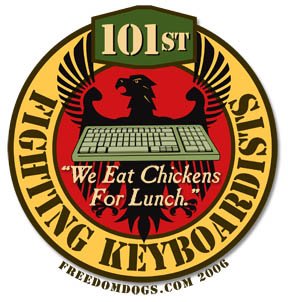
Just wanted to see if I could make "fighting keyboardist" logo that was a little less eastern european and to see if the writing came out okay.
So...testing; testing.
(see yesterday's post)
I am currently working on a project to identify problems and solutions for military information operations. Just wanted to pause from the brain work and do something fun. Feel free to use the logos if you want too.
Saturday, April 29, 2006
TESTING LOGO
Posted by Kat at 5:50 AM 0 comments Links to this post
Thursday, April 27, 2006
A CALL TO ARMS! 101st Fighting Keyboardists
So, you think you're doing nothing for the war effort? Do you want to do more? Too old to join the military or already done your service?
You can still do your part for victory in the War Against Islamist Terrorists. The Captain has the details:
Our friends on the port side of the blogosphere have had quite a time tossing around funny little nicknames for those of us who support the war on terror and use our blogs to express our convictions about it. We've seen the names here at CQ in the comments section -- the term "chickenhawk" has appeared more than once, and others in the blogosphere have assigned us to a unit called the 101st Fighting Keyboardists[snip]
I resolved to use the skills I had -- writing -- to make the case for fighting a forward strategy against terrorists. Eventually that led me to this blog, but in the interim I argued for a continued muscular offensive against the Islamofascists that had murdered thousands of our fellow Americans.[snip]
Is that the same as military service? Of course not. The men and women of the military do the real fighting, and we salute them and support them by supporting their mission. Milbloggers give us the best of both worlds by not only defending our nation and fighting (and beating) terrorists around the globe, but also by reporting on the fight first hand. There is honor in engaging in public debate for policies which we believe are in our nation's best interest as well. For many of us, we know that without presenting our arguments in the national forum, many in the media and the public will quickly overpower the debate and threaten the policies we feel give us the best long-term opportunity to defeat terrorism and the states that fund and shelter them.[snip]That's why Frank J of IMAO, Derek Brigham of Freedom Dogs, and I have decided to create -- for real -- the 101st Fighting Keyboardists and adopt the chicken hawk as our mascot. First of all, the term "fighting keyboardist" describes our efforts pretty well, and we think the pseudo-military terminology is pretty danged amusing. Derek himself designed the logo.
And why the chicken hawk? When we looked into it, it turns out that the chicken hawk is a pretty impressive predator. It's the largest of its family. This species vigorously defends its territory, getting even more aggressive when the conditions get harshest. It adapts to all climates. Most impressively, it feeds on chickens, mice, and rats.
Frank, Derek, and I invite you to join the 101st Fighting Keyboardists (motto: We Eat Chickens For Lunch). I'm starting a blogroll and will post the code for other members to display on their blogs. We welcome all of those who feel they qualify for the unit, but especially those who have a sense of humor as well as a sense of purpose. This way, the next time someone refers to you as a chicken hawk for your blogging, you can remind them that as a member of the 101, your talons are your best weapon and that feeding time is near!
Great minds work alike. I had asked a friend of mine to do a flag graphic for the 101st Fighting Keyboardist because I thought that, despite its negative connotation from certain folks, that it did seem more than apt. We may not be able to carry a weapon or walk in the sands of Iraq or Afghanistan, but we can be part of an important fight, to keep our nation moving forward against those that would kill or oppress our people and many freedom loving people around the world.
Head over to the Captain and sign up today!
Posted by Kat at 11:45 PM 0 comments Links to this post
Wednesday, April 26, 2006
A Heroe the Press Ignored
Capt. Brian Chontosh. If his name does not instantly equate in your mind to "hero", you're not alone and you probably do not read many military websites.
He's the forgotten hero like the hundreds of others before and since he received a Navy Cross for actions that resemble Sgt York, Auty Murphy and a whole host of other military heroes that went beyond the call of duty.
Blackfive talks about him on Pundit Review and talks about the shameful treatment of heroes by the media.
Go listen to what Capt. Chontosh did to earn his medal and why, in a world where the press panders to every idiot actors schizophrenic kleptomaniac tendency, Capt. Chontosh is not a household name.
They are the few.
Posted by Kat at 6:02 PM 0 comments Links to this post
Heroes In Action
From the Anchoress via Blackfive:
So it was with no small amount of suspicion that Staff Sgt. Martin Richburg observed an Iraqi civilian pacing nervously near the camp’s crowded Internet cafe that same evening.
It was around 9 p.m. on March 27, and Richburg was sitting behind the wheel of his “bongo” flatbed truck in the parking lot, talking to his wife on a cell phone.
“I saw this guy duckin’ and peepin’ outside the Internet [cafe],” said the 44-year-old Baltimore, native. “I said, ‘Let me keep an eye on this guy.’ ”
He did and now many people owe him their lives.
Read the rest.
Posted by Kat at 5:58 PM 0 comments Links to this post
Heroes In Action
From the Anchoress via Blackfive:
So it was with no small amount of suspicion that Staff Sgt. Martin Richburg observed an Iraqi civilian pacing nervously near the camp’s crowded Internet cafe that same evening.
It was around 9 p.m. on March 27, and Richburg was sitting behind the wheel of his “bongo” flatbed truck in the parking lot, talking to his wife on a cell phone.
“I saw this guy duckin’ and peepin’ outside the Internet [cafe],” said the 44-year-old Baltimore, native. “I said, ‘Let me keep an eye on this guy.’ ”
He did and now many people owe him their lives.
Read the rest.
Posted by Kat at 5:58 PM 0 comments Links to this post
Tuesday, April 25, 2006
Chai Tea, Mud Huts, Villages With No Names: Be Part of the Team

This war will be won over glasses of chai tea, in mud huts, in villages with names we cannot pronounce. - K. Henry"
Team Accepts Donations
By Jim Garamone
American Forces Press Service
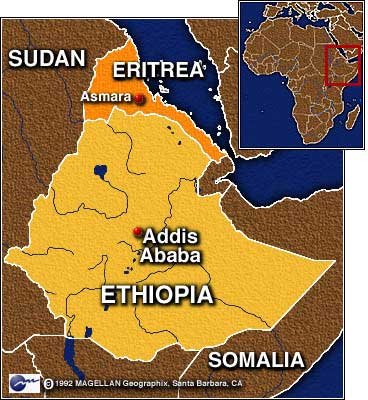
GODE, Ethiopia, April 22, 2006 – Ethiopian families in this rain-starved region are just barely surviving, and conditions stand to worsen as the drought in the area continues.
A team from the 96th Civil Affairs Battalion based here, though, has projects in mind that can help bring about changes, but just need a bit of startup money.
"We have a women's group that has a sound plan in place to farm sections near the river," said Sgt. 1st Class Stephen Starbuck, team sergeant. "All it will take is about $1,000 to get them what they need."
Medicines are another need. The team has refurbished a clinic in Gode, but there are no medicines. The team could buy medicines for the clinic from local sources, if funds were available.
And the Ethiopian children are just mad about soccer. "Everywhere we go, the kids ask us for soccer balls," said Staff Sgt. Terangelo Davis, the team engineer. "I would love to be able to give them some."
The team covers a region the size of Connecticut, and receives mail and supplies from its home base at the Combined Joint Task Force Horn of Africa in Djibouti every two weeks.
To help the people of Gode, send the team donations in care of Sgt. 1st Class Stephen Starbuck, E Company, 96th Civil Affairs Battalion, APO AE 09363. Clearly mark packages or envelopes as "Civil Affairs Donations."
The BBC says this about Ethiopia
The overthrow of the junta in 1991 saw political and economic conditions stabilise, but not enough to restore investors' confidence. This was dealt a further blow with the war with Eritrea in the late 1990s, which left tens of thousands of people dead.
A fragile truce has held, but the UN warns that ongoing disputes over the demarcation of the border threaten peace.
Ethiopia is one of Africa's poorest states. Its people are almost two-thirds illiterate. The economy revolves around agriculture, which in turn relies on rainfall.
Many Ethiopians depend on food aid from abroad. In 2004 the government began a drive to move more than two million people away from the arid highlands of the east in an attempt to provide a lasting solution to food shortages.
Other Mud Huts and Villages:
JALALABAD AIRFIELD, Afghanistan – Medical Marines from Task Force Lava kicked off a medical civic assistance program in Kunar Province on April 21.
Medical care was given to about 700 Afghan men on the program’s first day, with women and children receiving care beginning April 22.
The program, which is scheduled to continue through April 29, provides cost-free treatment to the province’s people. Many people in the mountainous rural northeastern province have only sporadic access to health care.
“Most of the people in remote provinces like Kunar have to travel miles and miles, sometimes across international borders, in order to receive medical treatment,” said Army Maj. Eric P. Zenk, TF Spartan public affairs officer. “Many people in Kunar haven’t seen a doctor or a nurse in months or years. This is a terrific opportunity for them to receive good health care in a timely, convenient manner.
The medical program is another sign of the growing partnership between the Afghan people and Coalition troops, Zenk said.
“This area was once known as a terrorist haven,” he said. “The progress is very heartening.”
Posted by Kat at 4:05 AM 0 comments Links to this post
Heroes in Action
MARINE CORPS BASE CAMP PENDLETON, Calif. (March 31, 2006) -- The Marines of Weapons Company, 1st Battalion, 5th Marine Regiment, 1st Marine Division and the Iraqi soldiers who were manning the entry Control Point at the North bride of Ramadi by Hurricane Point had a tough morning May 3, 2005.
The vans carrying the insurgents seemed to be just like any other that came through the ECP. Seconds after the insurgents stepped out of the van to allow the Iraqi soldiers to search the van, the insurgents pulled out their concealed weapons and began attacking the base.
The insurgents weren’t alone. They had a mortar team to the north and more supporting fire to the east. All in all, it was a well-planned assault.
Not good enough to take out combat-tested 1st Lt. David T. Russel and Staff Sgt. Timothy R. Cyparski.
“It took us just a couple seconds to realize what was going on, then we stormed in and did what we needed to do,” said Russel, the 25-year-old from Georgetown, Texas, and platoon commander of Weapons Company, who was shaving at the time of the attack. “I ran outside with shaving cream still on my face, I looked like Santa Claus in a flak jacket.”Cyparski, a 27-year-old from Erie, Pa. And section leader with the company, was no more than 10 feet behind Russel.
“You don’t have a chance to think about anything in that kind of situation,” said Cyparski, who was awarded his first bronze star for his actions in Fallujah on his first deployment. “Everything is a blur and all you’re doing is trying to take out the bad guys and keep the good guys alive.”
Soon after the intense fire fight began, Russel ran to assess the situation from the second deck. It was there he spotted an insurgent machine gun position and killed the insurgent with one shot. He also discovered that a Marine low on ammunition was isolated by the attack.
Russel then raced across approximately 75 meters of open terrain while under fire from at least six insurgents with Cyparski close by.
An enemy round struck Russel in the helmet, knocking him to the ground with a concussion.
The two Marines managed to get the ammunition to the isolated Marine with Russel bleeding profusely from wounds to his face and arms.
They then rushed back to direct the fight and establish accountability. Finding two men missing, the two Marines rushed across the open area again to retrieve a wounded Iraqi soldier despite explosions from more than twelve enemy grenades and a stream of machine gun and small-arms fire.
“The firefight lasted anywhere between 15 seconds and four days,” said Russel as he attempted to explain how time was distorted during the intense 10-minute firefight.
According to Maj. Mike J. Butler, commanding officer of the company, Russel’s actions before the firefight saved many lives.
“When Russel took charge of the ECP, he had the Marines set up a chain link fence protecting the open areas of the building where the platoon was staying,” Butler said. “During the attack, grenades from the insurgents were bouncing off the fence and back at them, which saved the lives of the Marines inside the building.”
For their heroic actions that day, Cyparski was awarded his second Bronze Star with Combat Distinguishing Device and Russel was awarded the Silver Star.
“I just want to tell 1st Bn., 5th Marines that it was an extreme honor to present these medals this morning,” said Maj. Gen. Richard F. Natonski, commanding general of the 1st Marine Division. “I couldn’t be any prouder of our awardees this morning and all of 1st Bn., 5th Marines for what they have accomplished on their numerous deployments to Iraq.”
Read more about Heroes in Action
Posted by Kat at 3:47 AM 0 comments Links to this post
Sunday, April 23, 2006
I Love A Parade!
Up to 20,000 people turned out Saturday for a parade to welcome home the National Guard's 278th Regimental Combat Team, providing a big-city atmosphere powered by small-town values.
The rains that had been pelting the region ceased and the clouds gave way to bright sunshine for the two-hour Celebrate Freedom Parade 2006 through downtown Knoxville. [snip]
As part of the Dogwood Arts Festival, the parade included awarding two battle streamers to the 278th's colors. Bredesen; Maj. General Gus Hargett Jr., adjutant general of the Tennessee National Guard; and Col. Dennis Adams, the 278th's commander, attached two new streamers to the regiment's flag. One streamer denoted the regiment's efforts in the global war on terror, and the other was for the team's work during Operation Iraqi Freedom.
"I thought it was great," Adams said afterward. "It's the first time since 1918 we've had something of this magnitude."
Adams said downtown Knoxville had not seen a military parade such as Saturday's since Gen. Lawrence Davis Tyson marched his troops through the city after World War I. The last time the 278th was awarded a battle streamer was for World War II, Adams said.
Officials said the 4,000 soldiers of the 278th stationed along the dangerous northeast border of Iraq captured or killed 550 insurgents. The soldiers encountered 288 improvised explosive devices, with 64 percent located before the objects could deliver fatal blows to soldiers or civilians. The soldiers built or repaired schools, government buildings, wells and mosques during their deployment, which ended for most of the 278th in late October.
As 67 parade units filled Gay Street, children squealed with delight at huge helium-filled balloons and adults swelled with pride at the accomplishments of their children or grandchildren in Iraq. [snip]
Gary Lee Reese Sr., of Ashland City, Tenn., lost his 22-year-old son Sgt. Gary L. Reese Jr. on Aug. 13, 2005, to a similar device. Serving in Iraq, Reese said, provided his son a perspective on life he never would have gained otherwise.
"I think the soldiers saw that these people should have the opportunity to have what we have," Reese said.
"He stood up for the right thing, and I'm very proud of that," Reese said. He added he rarely saw a picture of his son in Iraq without children surrounding the soldier.
"Those little kids who got to know Lee knew he wasn't there to teach them how to strap bombs on. He was there to help them have what he has.
Amen, Mr. Reese. I hope we have parades for all our men and women. They've earned it.
278th Regimental Combat Team Receives Parade in Knoxville
H/T: Instapundit
Posted by Kat at 10:03 PM 0 comments Links to this post
Tenn. girl received life-saving gift from Ohio soldier killed in Iraq
Posted by Kat at 10:00 PM 0 comments Links to this post
Chai Tea, Mud Huts, Villages With No Names
This war will be won over glasses of chai tea, in mud huts, in villages with names we cannot pronounce. - K. Henry"
CAMP TAJI, Iraq, April 20, 2006 – While the fight against enemy insurgents continues, Iraqi and Multinational Division Baghdad soldiers provided medical and humanitarian relief to local nationals caught in the middle and those without means to provide care for themselves.
Iraqi soldiers secured the immediate area as the U.S. soldiers provided desperately needed care at the Taji soccer stadium April 11.
After arriving at the location, the soldiers secured the surrounding area and set security checkpoints to ensure safety and security for local nationals entering the area for treatment. MNDB soldiers then drove around broadcasting a message in Arabic to let people know about the operation and invite them to seek help.
As coalition and Iraqi medics provided care, physician assistants diagnosed problems, and dental technicians saw patients needing dental care.
"We're here to provide medical aid to local nationals, specifically the ones who live in the local Fedayeen camp," said Army Capt. Casey Coyle, commander of Headquarters and Headquarters Troop, 7th Squadron, 10th Cavalry Regiment, 1st Brigade Combat Team, 4th Infantry Division.
He said the medical teams treated about 300 people. Most ailments the teams treated were skin infections and nose and chest congestion problems, Coyle said.
During the mission, civil affairs and Iraqi army personnel provided humanitarian supplies to locals after the families received medical care. "Our mission was to distribute humanitarian assistance," said Army Master Sgt. Ronnie Reece, civil affairs noncommissioned officer-in-charge of Company A, 490th Civil Affairs Battalion. "And if any of the area tribal leaders come, we engage them about economic, security and infrastructure issues."
The clothing, office supplies and soccer balls were donated by an assortment of organizations. Locals who took part in the operation were pleased about the care and assistance they received.
"I appreciate the help. I had eye trouble and back pain, and they gave me some medicine," Nehiah, a local woman, said. "Someone told us the American soldiers were here to help, and I came. God bless them."
Iraqi, USA Work together
Posted by Kat at 4:44 AM 0 comments Links to this post
Saturday, April 22, 2006
The Imperial Idealist in Me and Manifest Destiny (Part II)
Part I: Imperial Idealist in Me and Manifest Destiny
Lies, Myths and Legends
They say that those that do not know history are doomed to repeat it. I disagree. Instead, I see history influencing the future. Like painting and wallpapering the same wall over hundreds of years without ever resolving or removing some previous layers. Eventually, the paint starts pealing and some of those old layers are bound to start showing up, no matter how neat or liberal you were with the paint. That’s when you realize that fifty years ago, some one had atrocious taste in colors and had no idea how to hang wallpaper.
An old history teacher once likened history to a path: without it you don’t know where you’ve been, where you are or where you are going. I would add to that and say, if you don’t know history, you might as well wear a blindfold, put your fingers in your ears and skip down the path singing, “la-la-la-la-la” so you can’t hear history screaming at you that the bridge is out up ahead and the drop to the ravine below is fifty feet.
Then there are those who always look longingly to the past, standing still or only ever slowly walking backwards into the future. Those folks always imagine the past as “better times”, more perfect and less fraught with worry or troubles. It’s easy to imagine that because things in the distance tend to look blurry, even to those with some of the best eyesight, disguising the blemishes as it slowly fades away.
The truth is, though, that most people don’t know much about history. We don’t need snap surveys from the Jay Leno show, asking the man (or woman) on the street to name the first president (and utterly failing) to know that. You could simply pick ten people from your family or friends and ask them a few questions about American history. Or, ask yourself. Could you name three people who signed the Declaration of Independence? What year was it signed? Who wrote it? What are the three “unalienable rights” listed? What country did we declare independence from? Who was the king? What year was the Revolutionary war over? What was the name of the document that was first used to govern the United States? What document replaced it? How many amendments were in the Bill of Rights? Who wrote it? What was the fifth amendment? How about the ninth?
If they are computer savvy, they (or you) could look them up, but the odds are they can’t tell you off the top of their heads even half the answers. One may wonder why that is. I’ve heard it theorized that it is because Americans by nature are forward looking people with little time for the past. Frankly, I think that’s a romanticized version of the truth. I am always reminded of my stepsister’s comment when she was sixteen and I was trying to help her with her history class that she was failing. She said, “Why do I need to learn this? It’s not like I’ll ever use it.” Of course, she said the same thing about algebra only to be surprised a few years later when she was trying to balance her checkbook and I pointed out that she was using algebra to determine if all the checks had been deducted and figuring her actual balance. Talk about shock. In fact, she originally did not accept my point and argued with me for fifteen minutes that it was simple addition and subtraction.
For the most part, Americans don’t know much about their own history because they do not find it pertinent to their daily lives. It’s not really that they are looking forward; so much as they are not looking around at all. In fact, we’re a very myopic nation. Yet, somehow, we keep stumbling forward on the path, blindfolded and deaf, without actually meeting with complete tragedy. Of all the things to admire about this country and its people, maybe this incredible dumb luck is the most importantt.
Why is history so important? Because; knowledge is power. It’s not just a silly cliché. Without knowledge, people can tell you anything and lead you around by the nose. How do you make good decisions without knowledge? Without knowledge, your decisions are a crap shoot; a game of chance. You might as well decide what to do next by playing “Eenie-Meanie-Minie-Mo”.
Take for example, Ward Churchill, a professor of American Indian Studies at Colorado University. Half of his lectures are made up of myths and half-truths; and he is a professor who has educated hundreds if not thousands of students and given hundreds of lectures to focus groups on the subject. His most famous “myth as truth” is that the American Government provided blankets infected with small pox to Indians on purpose, with malice afore thought, with the plan to wipe out this first “red menace”. I’m certain that many people have heard this myth before and did not need Ward Churchill to say it.
The truth is, the treatment of American Indians was bad enough without adding myths. Some things happened due to ignorance, some due to idealism, some due to corruption and greed and still more from an overabundance of all three. That wasn’t just the white settlers and government. The Indian population had their share of fellow travelers on all of these paths. Even today, corruption, cronyism and nepotism on Indian reservations is rampant. But, if you hear it from Churchill, the American government and white European settlers were the first fascists that committed germ warfare and genocide. He neglects to inform his students and lecture listeners of the fact that medical science had not yet learned how germs were carried and certainly did not know how to treat certain diseases like small pox. He neglects to inform his students that small pox was a major disease that wiped out large parts of the white population during the same period. Entire settlements were abandoned after small pox decimated the population. It was one of the major causes of early mortality among children. At some points, it was tantamount to the medieval plague.
Of course, the return answer to this is that none of this would have happened if the dirty, nasty, brutish white settlers had never landed on the continent in the first place. That is supposed to shut you up and ask no more questions. Apparently, it is quite effective. At this point, you are either a fully indoctrinated convert (oh, converts are the most passionate and blind) or, by Churchill’s standard you are simply an ignorant white, genocide-denying oppressor.
It’s effective because, even people who study American Indian history or brush up against it in their other studies don’t really know much about American Indians. In fact, most people come in two categories of knowledge. The first are those whose only contact with American Indian history is through movies where everyone is a grunting, bare chested, breech-cloth, war bonnet wearing savage wielding a bow and arrow or they are the fully indoctrinated that imagines the word “Indian” immediately confers a spiritual nobility that defies petty human emotions and frailties, insisting that the Indians never knew jealousy, treachery or hate and never experienced so much as a broken bone, much less cancer or heart disease before a white man stepped foot on this continent.
If you believe any one of these three myths, germ warfare, total savages or noble race, are the true history of American Indians and white settlers, then you have entered into the second stage of “knowledge of American History”: myth. These myths get bounced around and said enough, read enough, seen enough; eventually they are part of our common discourse. They become history in place of history.
Americans are not the only nation or culture that experiences myths as history. There’s Tamerlane, Genghis Khan and the Mongol hoard; Salahdin’s nobility in the face of savage “civilized” Christian Crusaders; Joan of Arc, Boudicca and even modern myths like the Alamo and Manifest Destiny. For the most part, myths are the simplified way that people remember their history. The Good Myth and the Bad Myth take hold and often obscure “history”. Then it’s all “O, Pioneers” versus “Wounded Knee”.
Then along comes someone like Churchill or my Socialist friend and they start talking about history from their point of view, some of which includes myths or twisting some events to fit a narrative and some of which is simply similar ignorance of history. They talk to other people whose grasp of history is equally or even more tenuous and then they too either start believing or at least they begin to doubt what they think they know because it seems like the person has a better grasp of history than they do. In the case of Ward Churchill, who has a tendency to call others Nazis and “little Eichmans”, he uses the same techniques that Hitler did to formulate “history”. One only has to read Mein Kampf to understand how this works. If you read it, Hitler sounds very sane and logical in his thinking. He points to certain economic and political issues, he talks about moments in history and in between that he adds his own narrative or twist to facts so that it sounds imminently practical and realistic. Compound this with a certain rhetorical style and the next thing you know, hundreds of thousands of people have bought it and swallowed it, hook, line and sinker. Then you get real genocide and mass murder.
Therein lies the danger of not knowing history. What you don’t know really can hurt you.
What troubles lie in the reprisal of American 19th Century history? The first is the narrative that shapes the future of the United States. But, just like modern American history cannot be told without reviewing the 19th or 20th Century, you cannot understand the 19th Century without understanding the cause and effect of 18th century American politics and thinking.
We’ll start simple with post Revolutionary United States. By this time, the rebels had gotten what they wanted: Free United States. There was no country running this country. There was neither king nor parliament. In other words, they were completely responsible for the failure or success of the new nation. The first thing they did was squabble amongst themselves on the best way forward. Strong Central Government or Weak Central Government with strong States Rights and Sovereignty. Having just fought a war that was won on a shoestring budget and came within a hairs’ breath of ending in defeat at the hands of a strong government with an organized, professional military, many were not interested in creating their own central government with the same ability to oppress them. The opposition, like Alexander Hamilton, argued that without a strong central government, the newly formed country was vulnerable to attack and any or all states could be economically jeopardized by blockades or boycotts. Further, the states would be competing individually for international commerce. The danger there was in undercutting any individual state’s economy that might lead to internal war.
Of course, there were many other arguments for and against a strong central government. It wasn’t resolved over night. The Articles of Confederation governed the nation for almost 13 years. Eventually, the problems with this document became apparent. The central government could not sustain a military to defend the people. It could not impose taxes to support the central government. The taxes that it did impose were difficult to collect because states would choose to arbitrarily disregard whatever taxes they felt were oppressive and the central government did not have enough money to field the number of tax collectors required to oversee the enforcement.
On top of that, each state printed their own money and even within those states, each bank would have their own banknote that would be honored or not depending on relationships with other banks inside the state or in outside. The value of these notes was based on the assets of the individual banks. Exchange rates were outrageous and inflation was running rampant. The nation was in danger of collapse just a few short years after being born into existence.
To combat this, the founders decided to create a central bank, the Federal Reserve. The value of the notes would be based on the value of the Federal Reserve’s assets and performance that in turn was based on the performance of the entire nation. Large deposits of gold and silver backed this up. Because the notes could be exchanged for tangible wealth, the currency stabilized. Bank issued notes did not disappear completely, but they did become less common and less traded. Eventually, all that was left of the previous system were bank drafts (ie, checks), cashier checks and money orders (something most of us are familiar with today).
Depending on whom you read now or noted thinkers and businessmen back then, the Federal Reserve was equally lauded and despised. There were many banks that owned many assets and controlled large gold and silver deposits. Their bank notes were very valuable and it made the owners very wealthy. When the Federal Reserve came in and developed one currency with a stable value, some banks’ assets were immediately devalued. Others complained that a central bank that controlled the largest gold and silver deposits put too much power in the hands of the central government that could choose at any time not to honor the obligations of individual banks. He who controls the money, controls the country. Others were highly suspicious of individuals involved in setting up the bank; many were prominent businessmen. These suspicions ranged from a back door attempt to control the central government to trying to put other banks out of business.
You can read all sorts of letters, newspapers and debates on the subject. These same questions still exist today. It is one of the foundations of the “wealthy capitalists businessmen control the US government” conspiracies. What the conspiracy ignores, however, is that the Federal Reserve did not guarantee success. It was a huge risk that these men were undertaking, for themselves and for the nation. Forgetting that or dismissing it as unimportant is the first necessity in buying the far left and Socialist conspiracy that America’s foundation and continued existence is to benefit wealthy businessmen.
Then there is the question of the military.
Today, it seems very logical that we should have a standing army to defend the nation. The size, scope and purpose we continue to debate. Some people may be surprised to find that this argument is the same argument we were having in 1789. At that time, the pros and cons were more concerned about the possible use of military internally to suppress the people versus protecting the people. Now we are concerned about the military being used externally to suppress or expand versus simply protecting the physical borders of the nation. But, in the end, it’s still the same argument: How big and what for?
Why did the government feel that a standing army was needed? Several problems existed. Indian raids on the frontier settlements were common. All three of the European superpowers of the time still had colonies and garrisons of troops on the continent. The British concocted some of the Indian raids. British troops routinely pushed down into contested territories. There was piracy and various internal rebellions. Ships carrying letters of marque regularly interdicted ships from other nations and the United States, interfering with commerce and endangering the economy. The European nations, who still had colonies on the continent, were constantly at war and the Americans feared that they would be constantly at the mercy of these wars when they bled over onto this continent or the seas nearby.
This was no idle threat or imagination of the founders. Many of them, including George Washington, had fought in the French and Indian Wars that involved the main armies of England and France as well as the use of different Indian tribes as proxies. They feared that this war could be repeated or that Indians would be used as proxies against their nation. France and England were still at war at the beginning of the 19th Century.
These issues drove the practical, pragmatic representatives; generally those who were already in favor of a strong central government. Then there were the idealists who came from both sides of the aisle, both the pro-military and anti-military. There was talk among some of the Americans that Canada should be invaded and annexed. Others began to talk about spreading freedom and democracy to every corner of the continent. This was the first manifestation of Manifest Destiny. It was equally billed as a divine mission and a practical necessity for defense. Others believed in American Exceptionalism. In other words, only here in the thirteen colonies could freedom and democracy exist. It was limited to this place because only the right people with the right beliefs lived here. Attempting to expand it might weaken the nation and unfettered immigration or inclusion of “others” might bring in people who did not agree with or understand the concept, thus, endangering the future existence of democracy.
All of these arguments should sound familiar because they are the same arguments that we hear today. There are even groups in Canada and the United States that advocate annexing all or part of Canada. People who talk about immigrants today use the same arguments that people have been using for nearly the entire 217 years as a nation.
The problem with learning about the “true” history of the United States is that certain classes, specific education paths and even political persuasion tends to push people towards emphasizing one part of history over the other. That’s if they know anything at all. Most people who think about Westward Expansion simply think that pioneers looked west into a vast, unpopulated, undeveloped areas and decided to go there. That idea comes from two factors: the mythologized “Manifest Destiny” history of the United States and “O’ Pioneers”. Not that the myth has it totally wrong. Once western territories were made available for settlement either by purchase or annexation, many citizens and immigrants chose to move west precisely because they did see vast tracts of (largely) uninhabited lands just ripe for people and development.
Even before annexation or purchase of territory, many pioneers chose to move to these areas, not at the behest of the government in an attempt to populate areas and then claim them for protection of their citizens, but because what they really wanted to do was to get away from the government. Those who felt the centralized government was going to be too strong thought that distance could protect them. On top of that, as immigration increased to the country, the price of land continued to increase at a speedy pace in the established colonies/states whereas a man could simply move his family into the Ohio Valley, stake out some land, clear it, build a cabin and proclaim it his own. Free of charge. That is until the government eventually reached the area and began to collect taxes. Also, as immigration continued, the land in the valley began to get a little crowded for some.
This had its risks. Pioneers who moved beyond the reach of the government were also beyond its protection. They either staved off attacks from hostile Indians on their own or created local militia. If someone was sick, they had to rely on local healers who had learned the “art”. There were few professional physicians running around the frontier. Education? Roads? Law enforcement and judges? It was hit or miss for most people. Problems were settled between the plaintiffs. If someone in the family could read or write, it was likely they were teaching their own children and the neighbors’.
For some groups, it was certainly a matter of divine mission and direction from God. For most, however, God only entered into it when they were praying that the crops would hold, the cattle would increase and their families would remain safe. Not to mention Sunday services. That’s not to denigrate or try to depreciate religion in the Pioneers or try to prove that there wasn’t any. We are talking about the end of the 18th century. Language and life were peppered with references to God, divinity and guidance. Many of the earliest pioneers were Protestant descendents of the Calvinist movement that tended towards the concept of pre-ordination and pre-destination. Sermons, books and political speech were peppered with the concept. Not to mention, difficult times and a life of hardship tended to make people look for divine intervention. Sometimes, divine intervention was closer than the local militia or doctor.
This was another factor in Manifest Destiny becoming a predominant theme in America’s history, myths and legends.
Posted by Kat at 12:55 PM 0 comments Links to this post
Dispatch from Iraq: A tiny bit of comfort
A soldier sees and feels a wider variety of sights and emotions in a year than most people will experience in a lifetime. ...
In my short time in the military I have experienced more suffering than I could have imagined before joining up. I have held the hand of a dying Marine who had only one last wish: that someone would be with him and hold his hand as he passed on. So I sat there with a strange man, holding his hand, not saying a word, until he died. ...[snip]
On one of those days in Iraq where I wasn't sure if I'd see my daughter again, I was working at a checkpoint near a small camp in the desert. ... The locals would gather around our checkpoints to try to sell us things, beg for food or water, or just hang around the soldiers.
On this particular day one of the locals had his little girl with him. She was shyly watching me from behind his legs. When I smiled and waved at her, she brazenly ran up to me with a big smile and held out her arms, expecting to be picked up. At first I was shocked at her sudden bravery, and it took me a second to reach down and pick her up. When I did, she immediately kissed me on my cheek and then nestled in as if she meant to stay a while.
You've got to click the link to find out why she did it. It's a legit story in a legit Seattle Newspaper (don't laugh).
(Warning: Tissues are required)
Dispatch from Iraq: A tiny bit of comfort
Posted by Kat at 4:26 AM 1 comments Links to this post
Lebanon, My Lebanon
Just a little piece that started me thinking in the first two paragraphs, the more you think we are different, the more you know we are the same:
There are not too many addresses in Lebanon, in the precise, ZIP Code sense of the United States; they tend to be anecdotal, albeit spoken with authority. Such were the directions to Jdeidet, Marjayoun, a small Christian village tucked in a rugged corner of Lebanon, nestled between the improbable borders of Syria and Israel.
Go right at the larger-than-life portrait of Hasan Nasrallah, the leader of the Shiite Muslim group Hezbollah, I was told by my friend Hikmat Farha. At the picture of Musa Sadr, an iconic Shiite leader, turn left, he said. Then pass the posters -- and there are many -- of Shiite militiamen killed while fighting Israel. A checkpoint, Hikmat said, and from there you enter the stretch of Lebanon once occupied by Israel.
I had very similar directions trying to get to Chilahowie, Missour. Except, of course, the signs did not include "martyrs" and political leaders (well, all except the old Kerry is a poodle sign put up by the NRA last election and never taken down)
However, the rest of the story is a great read as well.
Lebanon, My Lebanon
Posted by Kat at 1:46 AM 0 comments Links to this post
Taboo-breaking 'coco' monologues steal show in Beirut - Yahoo! News
BEIRUT (AFP) - The audience gasped in awe then broke into applause as the unashamed actress declared that her genital organ, "coco", was angry, in the first Arab adaptation of the US hit play "The Vagina Monologues".
After winning a tough battle with censors, the taboo-breaking "Hakeh Neswan," or "Women's Talk", has taken Lebanese theatre by storm with sold-out performances and rave reviews.
In a Middle East ruled by strict social and religious traditions, calling genital organs by their name -- let alone their nicknames -- is an act of courage.
Even in more avant-garde Beirut, where the stage has recently offered plays about women's liberation, "Hakeh Neswan" beats them all.
This is why Beirut is considered the Paris of the Middle East. It may still have Islamists and it may still have censors that are tougher than ours, but it is still one of the most liberal nations in the Middle East, right next to Israel.
But, it still has issues. Like many other countries there, it isn't exactly free with information about violence against women and children:
"Many things happen in the Arab world where everything is allowed if nobody talks about it. But now at least, these very important issues are put out in the open in a very interesting and courageous manner," said Khalil Hayek, a teacher.
"Women learned that other women have similar problems. And men understood that women are not just hysterical, but have real and urgent issues," he said.
On a sparse set, the four actresses provoke gasps, laughs and sometimes uneasy silence by listing the various names for the female genital organ, most commonly known here as "coco," and its discomfort from tampons, G-strings and medical check-ups.[snip]
In a scene describing often-unreported rapes, the actress playing the part of an 11-year-old girl raped by a friend of the family says: "I could tell my parents that Israel has invaded Beirut, but I could not tell them that your friend has invaded me."
A lot more interesting info about the play and the process to get in shown here:
Taboo-breaking 'coco' monologues steal show in Beirut - Yahoo! News
Posted by Kat at 1:42 AM 0 comments Links to this post
On European v. American Version of History
I am not the only one looking at how and why we view history different than our European or Socialist friends.
Read Winds of Change: Bruce Bawer
Bawer's observations do ring true to my own experience of Europe and Europeans. They believe the most audacious things about the danger and violence and cruelty and racism of daily American life. They really think there is no difference between Nazi Berlin and modern D.C. They think we went to Iraq just to kill Iraqis. They mock us for our ignorance of the world, and certainly they can talk longer about America than we can talk about any one of their countries. But if 90 percent of what they know about us is twisted or just plain wrong, does that count as superior smarts?
At the same time, they know little and care less about each other's countries. Months after the Theo Van Gogh killing, I would be explaining it to Germans who lived not two hour's drive from where it happened, who had never heard about it.
Posted by Kat at 12:36 AM 0 comments Links to this post
Friday, April 21, 2006
I Am Not An Ogre
This article goes along with a previous post regarding the Shia split inside the UIA that has a lot to do with old sectarian politics: My Daddy Was Better Than Your Daddy.
Try not to cringe when you notice Newsweek playing footsie with Sadr's spokesman without calling him on certain things or even adding to the story by explaining the real situation. It's still a great way to get to know the politics on the ground so the continuing impasse (which apparently was resolved today) doesn't seem so bizarre and you are not confused by imagining that it is strictly a problem between reluctant Sunni and the new majority Shia government.
The very first part of the interview starts with Sadr's spokesman being completely disingenous and nobody calls him on it.
NEWSWEEK: There was a warrant out for the arrest of Moqtada al-Sadr in the assassination of Ayatollah Majid al-Khoei. What happened to that?
AL-SHEIKH: Those allegations were circulated during the time of [former U.S. envoy L. Paul] Bremer. They wanted to make Sayyid Moqtada an outlaw. He was not even near the location where Sayyid Majid was assassinated. They were trying to pressure him to drop his opposition to the occupation.
For those who don't know, al Khoei was assassinated on April 10, 2003; one day after Baghdad fell. At that time, Sadr was a little known factor in Iraqi politics. No one was speaking to him or about him. The assassination was conducted under cover of the war and was carried out for a number of reasons. Some of which, if you read the above article on the "family feud" in the UIA, is about long standing disagreements over the direction and leadership of the Shia in Iraq. Al Khoei had been in exile up to that moment and had returned to Iraq just that day.
The other problem that is glanced over and continues to be missed by most reporters is that he went directly to Najaf, the main seat of Shi'ism in Iraq. The Sadr faction, which had endured in Iraq during Saddam's reign, unlike al Khoei, took this as a direct challenge to their leadership and control of that mosque. Control of a mosque is a very powerful tool in Arab/Muslim society and politics. A mosque provides money through zhakat (charitable tax like a tithe) that is handed out to members and generates quite a bit of loyalty to who ever controls it. The money is also often used for "charities" or other programs like the development and arming of militias
Of course, it goes without saying that a mosque provides a "bully pulpit" and can swing the opinions of thousands of worshippers.
Al Khoei did come in on the tails of the American invasion, but don't let Sadr's spokesman fool you. That is not why al Khoei was assassinated. His family, like Sadr and Hakim, had a long history in Iraq and in Shia religious leaderhip. In fact, on the day he was assassinated, a very large crowd had come to hear him at the mosque. Two men ran out of the crowd and shot him, along with several other clergy and body guards, dead on the steps of the mosque.
Sadr's man is correct that Sadr was no where near the mosque at the time, but no one in Iraq doubts who was behind it or why. That was Sadr's first attempt to take over Najaf. Without the prestige of Najaf behind him, Sadr remains an uneducated wannabe cleric. The fact that he continues to be referred to as a cleric, simply because he preaches at a mosque or two, is false. To the Shia elite and those who are educated in Shia theological heirarchy (including the main body of Shias), do not see him as a possible leader of all Shia because of his lack of education. Any prestige that he has comes strictly from his father's place in Iraq history, reverence for his position as a highly educated Shia cleric and because the Sadr name has a long history of leadership in the Shia religious schools.
Sadr tried to take over Najaf again in 2004 with an armed militia. Unfortunately, not only was his credentials questioned, but his ham fisted treatment of the locals caused him to be in serious trouble and he was eventually "escorted" out of Najaf by Sistani after his militia was almost destroyed by the US army. Again in 2005 during the first elections for a parliament and again, right before the final election in December 2005, Sadr's followers tried to drive out Al Hakim's political offices.
Sadr does oppose US occupation. Largely because it has worked with Sistani and al Hakim's SCIRI party to set up government and because, while working with this group to set up the TAL (Transitional Authority Law), it was agreed that any three provinces (or more) could choose to become a federal state within Iraq. If this break up occurs, Najaf will be in the federal state controlled by Hakim's SCIRI in Basrah.
Sadr supported Jafari for several reasons. First, Jafari is actually an educated cleric, though standing for political office, which is the cover that Sadr needs considering his own lack of completed education. Second, Jafari is from the Dawa party which is also a rival of SCIRI in the UIA. He expects that lending his support to Jafari that Jafari will in turn lend his support to Sadr. Even possibly that, as the Prime Minister whose chosen sit on internal minstries, Sadr may be given certain mosques or provided with, what amounts to, a letter of cache that will move him up through the Shia ranks past his current position and prestige. Jafari opposes federalist Iraq and that worked in Sadr's favor. Sadr probably hoped that his support would influence the US to withdraw sooner rather than later. If it does, then the favoritisim shown to Sistani and even to SCIRI will be gone, along with any protection. Sadr imagines that he will then have an open field to either politically or physically depose his rivals. Sistani to Sadr is a limited threat in his eyes. He's old and bound to die. Further, even if he doesn't do so soon, Sistani's most important message has been to keep the Shia together as a majority and not break up since this is what has made it so easy for Saddam and past regimes to dominate them. Sadr must imagine that if Hakim and others were out of power or physically gone, Sistani would not oppose Sadr becoming the "leader" and would urge Shia to support him inorder to maintain unity.
It's a big game that Sadr is playing. In short, he hopes to by pass the normal process for clerics and noted theologians and jump right to the top. He uses his anti-occupation stance to attract the disaffected and grow his followers and militia. Regardless of his firey "patriotic" speeches on the subject, his reasons are totally selfish and pragmatic. These speeches are simply a cover; bread for the masses to chew while he sits and plots.
However, Sadr has several problems already outlined:
1) He never completed his education to become a cleric.
2) He is young and considered uncouth and untested.
3) It is widely acknowledged, though never mentioned, that he orchestrated, ordered or otherwise implied to his followers al Khoei's assassination (think, at least, Henry II and Thomas A Becket) on the steps of a Mosque. For one cleric to engage or be responsible for the death of another in that fashion, is very damaging.
4) He tried to forcefully take over Najaf, which many Shia see as the center of Shi'ism in Iraq and, to some degree, the neutral city where all scholars meet.
5) His brutish forces tortured and arbitrarily killed citizens of the city; setting up unauthorized Sharia courts without control or permission form the main Shia leadership
6) He was defeated by the Americans (at least his militia; fairly humiliating) and had to be saved by Sistani (such a thing engenders a certain obligation on Sadr whow will lose even more face if he goes against his will or attacks him directly which is why Sadr was attempting to use politics to move it in his favor without directly going against Sistani's wishes)
7) He is stuck in Sadr city. He not only has to fear arrest from the government or capture by US forces, but the Mahdi and Badr brigade have been clashing and it is very likely that he could be assassinated.
In fact, as I have said in earlier postings, do not imagine that all is goodness and light inside the UIA or Shia controlled areas. Many of the deaths (particularly of Shia clerics in Shia controlled areas) being attributed to "Sunni/Shia" sectarian fighting are actually infighting inside the Shia sect. Fortunately for the Shia, the Sunni and Al Qaida violence has provided them a cover. They can blame the violence on outsiders so that the face of the UIA still appears strong and unified. Further, they can continue to convince their constituence that the enemy is the Sunni and the reason why they need to maintain a militia. It also allows them to continue to do revenge killings and run Sunni ethnics out of the region to solidify their control.
All the killings are not strictly Shia on Shia. No one could say with any clarity what that percentage is. The Sunni definitely retaliate for the treatment of their people and are definitely trying to press their political wishes with violence agains the Shia in hopes of using the secession of violence as a bargaining tool for their demands. There are definitely ex-ba'athists and Islamists in the mix. Though, again, one would be hardpressed to define with any accuracy how much of any of these actually accounts for the violence and death.
Sadr definitely has bloody hands: both Sunni and Shia. No one should doubt that for a moment.
Sadr Spokesman: �He Is Not an Ogre� - Newsweek: International Editions - MSNBC.com
The resolution to the impasse came with Sistani's mediation. A very important part of this equation is in this paragraph:
But in a letter Thursday to the executive committee of the United Iraqi Alliance, the Shiite coalition, al-Jaafari wrote that he was prepared to "make any sacrifice to achieve" the organization's goals. "I tell you, you chose me, and I return this choice to you to do as you see fit."
"I cannot allow myself to be an obstacle, or appear to be an obstacle," al-Jaafari said in an emotional address on national television. He said he agreed to a new vote so that his fellow Shiite lawmakers "can think with complete freedom and see what they wish to do."
However, Kurdish politician Mahmoud Othman said al-Jaafari's change of heart followed meetings Wednesday in the Shiite holy city of Najaf between U.N. envoy Ashraf Qazi and both al-Sadr and Grand Ayatollah Ali al-Sistani, the nation's most prestigious Shiite cleric.
"There was a signal from Najaf," Othman told The Associated Press. "Qazi's meetings with (al-Sistani) and al-Sadr were the chief reason that untied the knot."
Aides to al-Sistani, the spiritual leader of the Shiite alliance, said the ayatollah was frustrated over the deadlock in forming a government and alarmed over the rise in sectarian violence that followed the Feb. 22 bombing of a Shiite shrine in Samarra.
Just so you understand, Sadr continues to be protected by Sistani, but Sistani still holds the reins of power. Further, whenever you hear one Shia leader or other calling for peace and an end to "sectarian violence" do not imagine that he is talking about or largely concerned about the Sunni/Shia problem. They are often urging their own people to stand down against one another. Sistani rightly sees the future ability of the majority Shia to rule Iraq is endangered by the continuing power struggle within the Shia body politic and the UIA.
Posted by Kat at 2:18 PM 0 comments Links to this post
How to Lose Your Job at a Saudi Newspaper
This is a great piece and it speaks about how important information is in shaping opinion and what happens when that information is not allowed to flow freely:
I was unceremoniously fired this month by my Saudi newspaper, a leading English-language daily called Arab News.
It didn't matter that I had been the senior columnist on the op-ed page for nine years or that my work was quoted widely in the European and American media, including this paper. What mattered was that I had committed one of the three cardinal sins an Arab journalist must avoid when working for the Arab press: I criticized the government.[snip]
But this is not just the story of an Arab journalist losing his job. It is a story with implications for the current American administration's efforts to "introduce" the Arab countries to democracy, of which independent, free media are a major building block.
What Arabs, including those masquerading as their newspaper editors, have yet to learn is that a free press, a truly free press, is a moral imperative in society. Subvert it, and you subvert the public's sacrosanct right to know and a newspaper's traditional role to expose. If the Western democracies work better than many others, it is because to them the concept of accountability, expected from the head of state on down, is a crucial function of their national ideology.[snip]
Democracy may be a political system, but it is also a social ethos. How responsive can a country be to such an ethos when its people have, for generations, existed with an ethic of fear -- fear of originality, fear of innovation, fear of spontaneity, fear of life itself -- and have had instilled in them the need to accept orthodoxy, dependence and submission?
The Arab world today, sadly, remains a collection of disparate entities ruled for the most part by authoritarian regimes that rely on coercion, violence and terror to rule, and that demand from their citizens submission, obedience and conformity. And that includes those citizens who call themselves "journalists," to whom, by now, responsibility to truth and logic has become irrelevant.
Read the rest:
How to Lose Your Job at a Saudi Newspaper
h/t: Terrorism Unveiled
This goes right along with our discussion about seeing the world through a specific prism.
I would also like to suggest reading Wahabism
Posted by Kat at 12:28 AM 0 comments Links to this post
Thursday, April 20, 2006
The Imperial Idealist in Me and Manifest Destiny (Part I)
Words have meaning. Since the first caveman grunted to another, we have been trying to interpret the meaning of each word, its level of application, the inflection indicating sarcasm, sincerity, anger, joy or disbelief. Over tens of thousands of years, we've added tens of thousands of words because one word or another just didn't seem to say what we wanted or what we meant. Even the production of a dictionary could not stop humans from arguing over the exact meaning and application of a word. Alliances have been made with words and wars have started over words. You watch politicians speak and they pick over their words hoping to say something without actually saying something. Writers make their livings conveying images and ideas via words and they've been lambasted over the use, appropriateness or lack of words.
In this medium, blogging, I have noticed that some of the biggest arguments begin over principle and end over semantics. In fact, I have participated in just such a discussion recently on several websites. At the Redhunter (a fellow blogger at Conserva-puppies with his own site), a very polite British Leftist dropped in and wanted to discuss American Idealism and what he (I believe the name belonged to a "he") believed was "the only redeeming quality" in America's current foreign policy. Therein ensued a discussion that meandered from such topics as American 19th century history, manifest destiny and modern politics that turned into a discussion about whether modern Americans believed in Manifest Destiny and, based on our current ability to project military, economic and diplomatic power around the globe, why the United States simply did not openly declare that it had an American Empire and admit other countries or territories under our "protection" as states, since they are affected by our policies, so that they may have a vote in our policies and actions, and that they may benefit from our best ideas on liberty and democracy.
Don't laugh. He (and many like him) are perfectly serious. Find out in the "read more" section.
Not the first time that I have heard this suggestion. In fact, I recall just such an opinion piece in the British Guardian newspaper during our last election (2004-Presidential) when the Guardian tried some activist journalism and attempted to get a town in Ohio to trade votes with British subjects accept that they were not advocating joining our union so much as insisting that, as a country affected by our policies, they should be allowed a say in our politics. That went over like a lead balloon.
In all of these discussions, including some great comments (and some not so great) at Harry's place, I have learned a great deal (though, I am sure its not enough) about foreign views of not only our modern politics, but even our shared history. In fact, these discussions have proved clearly a discussion I had not long ago at the Castle that truth is in fact, subjective. It can't be helped; we are a product of our own history, as individuals and nations, not to mention indoctrination through education and political persuasion.
So, there I was having a discussion with my Socialist English friend about American Idealism, Empire, History and Manifest Destiny. Our discussion, not surprisingly, ended with a disagreement over the meaning of Empire and whether it applied to modern American adventures and expansionism. Fortunately for me, I have learned a great deal about Socialists in the United States and Europe or I might have simply made some sarcastic remark about his political persuasion and gave it no thought.
For instance, did you know there are several kinds of socialists? There are the Stalinists and the Trotskyites as two examples. If I understand my political persuasions, Stalinists still believe that Stalin's USSR with its forced community farms, state owned industry, re-education camps, political gulags, aversion to free markets and, what these followers term, anti-imperialism, had it right. Even on to defending or excusing forced famines, re-distribution of lands, invasions of Eastern Europe and purging his political enemies. These are all blamed on circumstances that forced Stalin to make "terrible decisions"; circumstances that these folks believe were largely forced on him by imperial capitalists. Of course, don't dare to use the concept of "terrible decisions" forced by other circumstances as an explanation for actions of others. It is simply inexcusable. But, you understand, they still believe in universal human rights. One may be excused to wonder if being imprisoned for 20 years in a gulag, as forced labor is a universal human right.
Where as the Trotskyites (after the famed Communist and anti-Stalin Leon Trotsky who was eventually murdered by the KGB in South America) believe that Stalin perverted Marxist ideology, that Stalin's Communism was a disgusting totalitarian concept, that the lack of democracy in the USSR under Stalin betrayed Marxist ideology which stated that socialism required democracy and capitalism to flourish and that Stalinist Socialists are in fact impure heretics. Something both sides often throw at the other as they struggle for control of their party. Christopher Hitchens is a modern Trotskyite.
In England today, it appears that the Stalinists have control of the Socialist Party. These are the folks that run the SWP (Socialist Workers Party), which is supposed to be a Trotskyite organization, that had George Galloway as a front man and made alliances with various British Islamic (Islamist?) groups to form RESPECT, the anti-war political party. I am not totally up on the political make up of the British Parliament, but I believe that they won three seats, Gorgeous George being the most famous. Interesting that while he was appearing on Al Jazeera and trekking to Syria, amongst other places, making denunciations against England, the United States (dirty, imperialist, capitalist controlled by the Zionist lobby), Jews (Zionists) and insisting that Saddam Hussein was not a bad man (of course not, George had received a large chunk of money and oil vouchers from the fellow; he couldn't be all bad) he was defended and lauded by party members. Don't dare suggest to them that Saddam might have bribed him or that he had diverted funds from the Miriam charity that had accepted these oil vouchers from Saddam. It is all just a lie to discredit George.
Right up to the moment that George appeared on the British version of Big Brother, in a leotard, pretending to be a cat. Suddenly, George disappeared as the face of the SWP and Respect. Or, at least he hasn't been in the news quite as much. One could forgive SWP and Respect if they started to believe in the conspiracy that the Labour movement (which George had left in protest against the Iraq invasion) had sent George as an infiltrator or an agitator in order to discredit their movement. Then again, reading even current comments on the subject, he is still being defended like a principled prince of the people.
Ah, well. It's not much different than our own political structures here where you have the Liberals, the fringe left, Republicans, True Conservatives and Rinos, all of which seemed bent on defining their parties and jockeying for power before the next election, determined that they are the right message at the right time and that the rest are simply heretics to the cause.
You've heard it all before.
Trotskyite's like Christopher Hitchens are pro-war in Iraq in so far as it supports democracy and played to the humanitarian cause of relieving Iraqis of a genocidal maniac. Though, even in these ranks are those who support the war have various feelings on the subject including their own mixed guilt for supporting something that they half (or three quarters) feel was the result of a lie (WMD) and is part of the continuing hegemony or even new age imperialism of the United States that has resulted in a large number of deaths for Iraqis. I believe that my socialist friend at Redhunter (an interesting place, if you understand the gist of the name, to meet a socialist and converse) falls into this category.
One may wonder why this is at all important considering the title of this post. I believe that, to understand or even solidify our own ideas, you must compare them to others. As in trying to receive the objective truth, one must muddle through the subjective truth as provided by all witnesses. Even then, we’re likely to be missing something because, again, everyone experiences history through his or her own medium.
Which brings us to American History, or more distinctly, the history of the United States. Having been raised in the rural and suburban Mid-West, even in the post civil rights-Vietnam-rise of Liberalism (capital “L”; or, as my conservative friends like to say, hippy, free love, libertinism) era, American History was portrayed with a bit of triumphalism for the Great American Experiment and Manifest Destiny. We’re talking grade school through High School, not university. I can’t recall any teacher telling me or implying in anyway that I should be ashamed to be an American or of our history. While we discussed and debated Federalism v. State’s Rights and the causes of Civil War; slavery and John Brown; Locke v. Adams, the creation of the Monroe Doctrine; while we learned about Pilgrims and Pioneers, the Indian Wars and other events, no one ever said that these were Bad Things. Bad things happened for sure, but no one ever painted them as Things That Never Should Have Been. They were simply events in history. We were not asked to analyze them or even revise our opinions of America based on What We Know Now. It was all “America the Beautiful” and "Oh, Pioneers”.
We learned about the Trail of Tears and the internment of Japanese during WWII, but no teacher ever implied to me that I should feel guilty about these incidents. They were the past; events that occurred under different people and a different set of circumstances. At most, we looked at them as distasteful and Things That Should Never Happen Again. They were lessons in how, during such fantastic achievements of the nation, even the best intentioned could do terrible things in the name of National Security or greater movements and we should not forget lest we do them again. But neither “guilt” nor “shame” was implied as the outcome of that lesson.
That difference in how we view our history creates the difference in how we view our current endeavors. That difference is not simply between Americans and Europeans, but between the left and the right in America. Depending on how far left you go, the more guilt, shame and desire to change America today in order to make up for the past. We’re not simply talking about having learned lessons and never doing it again. I mean, some would go so far as to cut up America and give parts back to grievance groups. If you go far enough to the right, you can find such people as Buchanan who sees the US as having expanded beyond its original intent, whose military should be strictly used to defend the homeland and who is roundly referred to as an isolationist. Historically, he would have been the fellow that argued against such expeditions as the Banana Wars, the Panamanian excursion, interference in WWI and insisted we stay out of WWII. He would have read the Monroe Doctrine in its strictest interpretation and believes that it should be our guiding document on American Expansion or lack thereof.
Europeans, having a much longer history of expansion and contraction of Empires, have much more to feel guilty about. Particularly in light of new political ideology such as Communism and Socialism, which are not so dead on that continent and that rejects expansion of state’s power onto other nations as “imperialist”. The history of European Empires can be viewed as lessons in racism and how not to treat “subject” nations and their people. Self-determination was not an idea that these empires were familiar with or engendered in these subject nations. At least, not until post WWII when Empires began to totally break apart because damaged European nations could no longer support them financially or protect them militarily. Nations won or were given their independence, others were independent but became part of things like the British Commonwealth, an economic and security pact, but certainly no longer Empire.
But, it was the treatment of subjects during Imperial Europe that most troubles those on the left. Some, like my socialist friend, don’t see it as a total loss since they believe that England’s colonial rule of India provided the base of laws and ideas that led to the creation of Democratic India. That can’t be said for every imperial nation or subject country. For that reason, modern day left feel the need to flagellate themselves consistently, even if it was their great-great-grandfathers that did it, and look upon every action of modern states, every war that knocks off regimes, temporizes potential external and internal security threats and results in securing resources, as just another version of Empire Building.
One should not dismiss lightly the effects of colonialism on the modern world. Many continuing problems can be traced back to their imperial beginnings, but just as many problems began even long before. However, it is not simply modern European Imperialism that has changed the face of the world and affected the condition of modern nations. From Asia to the Americas, ancient empires to modern super powers, every nation has had an impact on the other. From genetics to culture, language to architecture, the expansion and contraction of empires have etched their imprint on every nation. Whether these expansions resulted in Empires as we imagine them with subject nations or simply wars that resulted in armistices or created client states, it is a matter of history. From the left’s point of view, these expansions and contractions are not simply episodes that have affected mankind, but are considered the worst of mankind and the cause of most of the world’s problems today.
Never mind that seems a little egotistical and self-indulgent of a well-developed guilt complex. I am unaware of any student in Mongolia feeling guilty about their Mongol ancestors and their Empire. I suppose that Europeans would be more apt to forgive that lack of guilt because Mongolians have been alternately invaded and oppressed as a subject nation by modern states and they are by no means a modern colossal able to project power beyond their borders. Because they are weak now, they are forgiven. Or maybe it’s a matter of subconscious racism that assumes that Mongols of the time were savages and could not know better, having not experienced the Enlightenment prior to or during the expansion of Empire so they had an excuse?
It is difficult to understand who gets a pass for Empire and under what circumstances. Then again, maybe it is simply a matter of modern psychology where guilt over actions is considered a purifying concept and not thinking about it and accepting that guilt is considered denial? That is almost exclusively a modern Western concept.
No real student of history would forget that civilizations, from the tribal to the city state, have expanded and contracted throughout history, even in pre-historic times, becoming dominant and then sometimes disappearing into other cultures all together. It is the history of man, not simply the history of modern nations. Some must feel that the evolution of thought since the Enlightenment should or would change that behavior. As if they could change the primal behavior of man with a simple thought. Rejecting that is a rejection of enlightenment and the universal rights of man. In fact, multi-cultural tendency is to try to preserve certain cultural aspects of other nations against the incursion of other nations’ culture brought on by globalization and advanced communications. This is considered progressive and enlightened. Others may reject that as rejecting the advancement of humanity, but that is another discussion.
The ego is a wonderful thing. For instance, there are British who still remember when Brittania ruled the waves and considers the British Empire to be a shining example of their nations ingenuity, creativity, strength and drive. They are rightly proud of their accomplishments. That is an expression of ego and some believe is denial regarding the reality of British Empire. There are others who see this period as an example of mankind’s worst towards others, oppression and rejection of modern British Principles. What they imagine is that, without the British Empire, some place like India would be different. If not better, at least it would not have changed at their hands. This is also an expression of the ego, imagining that all things in India stem from British Imperialism.
Some are even more conflicted since they believe that the British Empire was both good and bad. For instance, having spread British values on humanity and freedom, they may have injected humanitarian principles on an otherwise medieval or savage culture. One such principle was that colonial governors insisted that the practice of widows throwing themselves on the funeral pyres of their late husbands be stopped. On the other hand, they certainly exploited the cheap labor of indigenous tribes, took large amounts of resources with varying degrees of exchange for modern infrastructure, economy and education of the masses, recruited local men into the armed forces and used them to put down internal revolts against their own or other tribes.
Of course, maharajahs had been using the caste system and slave labor for centuries before the British came, fighting internecine wars, digging out jewels and metals, exploiting the system to gain wealth and land. The problem was, the British came and took advantage of the same system making their hands unclean in the Continuing Oppression of People. Which for socialists and other enlightened folks goes against all modern principles of universal human rights that should be looked upon with at least some aversion if not down right disgust. If not for the transplant of other British principles of equality that began the break up of the caste system, it would be totally irredeemable.
Not that the caste system is gone. You wouldn’t have Naxalists (communist Indian Maoists) running around India trying to overthrow the government if all was sweetness and light.
The point is, people have a tendency to imagine they are the sole arbiters of change, good or bad. They sometimes ignore the actions of others, insisting that through a tweaking of that, a dollop of this and not doing other things all together, the outcome would be, not just different, but better. They also have a tendency to look for redemption in their actions or those in the past while simultaneously flagellating themselves with guilt. It’s very Freudian. Worse yet, if modern history of a nation such a Germany includes other terrible acts in the not too distant past that included the rapine of nations and genocide of peoples, the guilt can overwhelm any attempts to find redemption. From that position, not only do they judge themselves, but the history of all nations.
To be continued....
Part II: American 19th Century History - Divine Mission or Pragmatism?
Posted by Kat at 6:27 AM 0 comments Links to this post
At Heart of Iraqi Impasse, a Family Feud
Read this excellent article. While there are some points I would disagree with, for the main part, it helps explain that the violence in Iraq and the political issues are not all Sunni v. Shia or Al Qaida v. Iraqis, but in fact include some rather violent clashes between rival Shia organizations for control of the Shia masses, mosques and the money that goes with it, not to mention the post of Prime Minister.
At Heart of Iraqi Impasse, a Family Feud
Posted by Kat at 6:21 AM 0 comments
Wednesday, April 19, 2006
Broken Hearts and Patriots
I've just heard at Iraq the Model that their brother in law was assissinated.
Last week our little and peaceful family was struck by the tragic loss of one of its members in a savage criminal act of assassination. The member we lost was my sister's husband who lived with their two little children in our house.
It was the day he was celebrating the opening of a foundation that was going to offer essential services to the poor but the criminals were waiting for him to end his life with their evil bullets and to stab our family deep in the heart.
Grief and pain is killing me everyday as I hold my dear nephews, my sister is shocked beyond words while my parents are dead worried about the rest of us.
My heart breaks for them. Iraq the Model was the first blog I ever read and inspired me to write my own blog. After two years, they are more like family than anonymous bloggers in another world. Without them, I cannot say that I would feel the same about Iraq or believe as deeply as I do in the dream, their dream. As always, even in the worst of times, the words of the brothers always give me strength.
They think by assassinating one of us they could deter us from going forward but will never succeed, they can delay us for years but we will never go back and abandon our dream.
We have vowed to follow the steps of our true martyrs and we will raise the new generation to continue the march, these children of today are the hope and the future.
What a difference between those who work to preserve life and those who work to end it…it's terrorism and crime and there are no other words to describe these acts.
They will keep trying to steal life from us and we will keep fighting back and we will keep exposing them but not with bullets and swords, we never carried arms and we will never do because we are not afraid and because we are not weak unlike those cowards who know no language but that of treason.
April will always be there to remind us of the sacrifice and remind us of the dream we fight for.
Our founding fathers would have recognized these men as what they were: Patriots.
Posted by Kat at 8:52 PM 0 comments Links to this post
Monday, April 17, 2006
U.S. Marines Repel Coordinated Assault - Yahoo! News
The most interesting part of the entire article which pretty much tells you what sparked the uptick in attacks was all the way at the bottom:
Another 17 bodies of people believed victims of sectarian reprisal killings were found Monday, including one in Basra and the rest in Baghdad. They included the body of Taha al-Mutlaq, brother of leading Sunni Arab politician Saleh al-Mutlaq, who was found in a Shiite area of west Baghdad.
The problem of course is that he could have been killed by Shia militia. Maybe he went to talk to one group or the other to try to move something forward for his brother who has cabinet aspirations and whose name has come up several times for President or Prime Minister along with that of Alawi. Although, why any Shia militia would be so stupid as to kill the brother of a highly visible Sunni politician and leave his body in the Shia area, thus sparking more sectarian violence, is a mystery. It seems quite foolish, unless of course it was Sadr's Mehdi militia who seem much more like trigger happy goons who probably wouldn't care who they killed as long as their identity card gave their sect as "Sunni". (I keep wondering when they are going to issue non-denominational ID cards).
Or, maybe al-Mutlaq's position seemed to be too conciliatory for one of the Sunni group and they killed his brother in warning.
Or, maybe the Sunni Islamist never liked al-Mutlaq in the first place, killed his brother and then tossed his body in a Shia area in order to stir violence. It could be a number of things. It will be interesting to find out what the Iraqi media indicates al-Mutlaq had been doing just prior to the murder.
In any case, it certainly could serve to harden Mutlaq's position against the Dawa or Sciri Shia in the Assembly.
One would need to be omniscient to know for sure what happened, but its very likely the Sunni insurgents decided to take reprisals against anyone they thought was involved.
On another note, according to the story, the Marine's fought of 50 insurgents (estimated). I support the effort there and our soldiers, but is anyone else wondering why in Ramadi 50 insurgents can seem to coalesce and attack our forces unnoticed in a secure area? We don't have more lookouts or patrols? Or, does anyone notice that every time an attack is being noted out of this area, somebody there consistently gives the number as "50"?
Who commands Ramadi? Is the commander a body count guy? Is this coming from our Iraqi counterparts who may be boosting the number of insurgents to off set the number of casualties his unit took? Two Iraqi soldiers died. Unknown wounded. Five insurgents died. Unknown wounded. But they fought of 50 attackers? And only took two KIA?
It stinks a little and I hope that the military is not turning in crazy numbers. I understand that this was a coordinated attack with two car bombs and just maybe that would mean 50 insurgents, but I still can't get past that number being replayed through every attack in Ramadi the last month or so.
If there are that many insurgents able to coordinate regular attacks, maybe Ramadi is ready to be Fallujah part II?
U.S. Marines Repel Coordinated Assault - Yahoo! News
Posted by Kat at 11:33 PM 0 comments
Sunday, April 16, 2006
Keeping Al-Qaeda in His Grip
I suggest reading this article. It discusses what the real issues within Al Qaida are from ideological compatriots and other mid-east experts. The main problem is that there is no real agreement on strategy, tactics, who and what they should be fighting and certainly their is a problem with even the ideology since there are many sects of Islam, not just Sunni and Shia, but Sunni Wahabi, Sunni Ashouri, etc, etc, etc.
Some of the best parts of the article:
CAIRO -- In January 2003, one of the two most wanted men in the world couldn't contain his frustration. From a hiding place probably somewhere in South Asia, he tapped out two lengthy e-mails to a fellow Egyptian who'd been criticizing him in public.
"I beg you, don't stop the Muslim souls who trust your opinions from joining the jihad against the Americans," wrote Ayman al-Zawahiri, deputy leader of al-Qaeda. He fired off the message even though it risked exposing him.
"Let's put it this way: Tensions had been building up between us for a long time," explained the e-mail's recipient, Montasser el-Zayat, a Cairo lawyer who shared a prison cell with Zawahiri in the 1980s and provided this account. "He always thinks he is right, even if he is alone."
and this
Zawahiri's visibility, eclipsing Osama bin Laden's, reminds al-Qaeda's enemies that the network is capable of more attacks. But a closer look at his speeches and writings, and interviews with several longtime associates in radical Islamic circles, suggest another motive: fear of losing his ideological grip over a revolutionary movement he has nurtured for 40 years.
In fact, this has been a problem all along and why all of these movements, while seeming popular, can never achieve the type of popular support they would need to bring themselves to power. The last letter to Zarqawi was pretty plain that he did not agre with Zarqawi's tactics or with his insistence on arguing with his local counterparts about which Sunni ideology would govern Sharia law as well as his compatriots enforcing a strict Sharia court and system on all areas they were invited to, of course finding "apostates" and other violations, and inflicting their severe punishment on their hosts.
Another issue, which this focuses on, is the difference in thinking on what constitutes the main objectives of the movement. The main they agree on is to establish the Islamic Caliphate, but whether it is to make Egypt an Islamic state first or whether it is Zarqawi's plan to over throw Jordan's King and create and Islamic state there, or other such considerations. They do not agree and each of the loosely associated groups continue to persue their own local agendas.
He is risking his credibility among Islamic radicals by speaking out on so many subjects, according to Osama Rushdi, an Egyptian who spent three years in a Cairo prison with Zawahiri in the 1980s and now lives in exile in Britain.
"He's trying to stay in control and give the impression that he's behind everything in the Middle East and everywhere else, fighting against the Americans in Iraq and against Britain in Europe," Rushdi said in an interview. "He is trying to take responsibility as a leader for what is going on in Iraq. But he knows, and everyone knows, that that is not true, that he has nothing to do with anything in Iraq."[snip}
"What they've started has taken on a momentum of its own," said Maha Azzam, an associate fellow at the Royal Institute of International Affairs in London. "Obviously, this is a global movement. And it has global support, and it can't be controlled centrally as much as perhaps they'd like it to be. It's almost as if Zawahiri doesn't want to be left behind. They don't want the events on the ground to supersede them."
Please read the rest and discuss.
Posted by Kat at 11:46 PM 0 comments Links to this post
He said, "I am the Resurrection and the Light..."
Johng Chapter 3
13And no man hath ascended up to heaven, but he that came down from heaven, even the Son of man which is in heaven.
14And as Moses lifted up the serpent in the wilderness, even so must the Son of man be lifted up:
15That whosoever believeth in him should not perish, but have eternal life.
16For God so loved the world, that he gave his only begotten Son, that whosoever believeth in him should not perish, but have everlasting life.
17For God sent not his Son into the world to condemn the world; but that the world through him might be saved.
18He that believeth on him is not condemned: but he that believeth not is condemned already, because he hath not believed in the name of the only begotten Son of God.
19And this is the condemnation, that light is come into the world, and men loved darkness rather than light, because their deeds were evil.
20For every one that doeth evil hateth the light, neither cometh to the light, lest his deeds should be reproved.
21But he that doeth truth cometh to the light, that his deeds may be made manifest, that they are wrought in God.
It was a radical message. In that day and age when men toiled at the behest of the state, when they could be made slaves for as little as denying that Caesar was a God, when life was oft a mean existence and the Pharisees took all power and governed life through their pronunciations that which was left after the Roman state had its say, when the God of the Pharisees was an angry and vengeful God who demanded sacrifices of bulls and turtle doves, when bribes to the Pharisees could buy a man absolution for the worst of sins, a new messenger came.
In his works he ministered to the poor and the rejected, those that the Synagogue and its righteous leaders had already condemned on earth as worthless or not worth their time because their condition was proof that they were sinners and already condemned.
But Jesus was the first to promote egalitariansim in his messages and works. He healed the poor, the sick and the lame, giving them a message of hope in a life in the hereafter. Men of wealth he admonished to do good works because money could not buy righteousness nor forgiveness. Forgiveness was not bought, but given. The cost of which was simple and required no gold, but simply that a man believe.
Jesus taught that men and women were his brothers and sisters, they were all sons and daughters of God.
It is understood that the Age of Enlightenment was an age of discovery spurred by science and great literature, but this age could not have existed without this message being resurrected. The message of equality in the eyes of God. Equally loved and equally deserving of his forgiveness and love. It was a message that, like that of Jesus, was radically different than that given by the church which supported Royalty and Nobles as being the few ordained by divine right, by God, to rule and decide on the fate of men.
It was this message of equality of men that the forefathers of the United States used to determine that men should be free and had "unalienable rights" "endowed by their Creator". Eighty years later, it was this message which spurred the abolitionists and convinced Lincoln to emancipate the slaves and truly live up to the founding of the nation, that all men are equal in the eyes of God.
This is a world of compensations; and he who would be no slave, must consent to have no slave. Those who deny freedom to others, deserve it not for themselves; and, under a just God, can not long retain it.
-Letter to Henry L Pierce, 1862
The tyranny of slavery is the same tyranny of kings:
It is the eternal struggle between these two principles -- right and wrong -- throughout the world. They are the two principles that have stood face to face from the beginning of time; and will ever continue to struggle. The one is the common right of humanity and the other the divine right of kings. It is the same principle in whatever shape it develops itself. It is the same spirit that says, "You work and toil and earn bread, and I'll eat it." No matter in what shape it comes, whether from the mouth of a king who seeks to bestride the people of his own nation and live by the fruit of their labor, or from one race of men as an apology for enslaving another race, it is the same tyrannical principle. October, 1858
It was the message of equality and forgiveness as taught by Jesus that spurred such men to fight and to determine that, in the final analysis, it was better that a whole nation perish than to not live by these principles, set forth by our founders and based on the teachings of Jesus and proof in his ministry to the poor, the lame and the sick, that all men are deserving and equal in the eyes of God:
The Almighty has his own purposes. "Woe unto the world because of offences! for it must needs be that offences come; but woe to that man by whom the offence cometh!" If we shall suppose that American Slavery is one of those offences which, in the providence of God, must needs come, but which, having continued through His appointed time, He now wills to remove, and that He gives to both North and South, this terrible war, as the woe due to those by whom the offence came, shall we discern therein any departure from those divine attributes which the believers in a Living God always ascribe to Him? Fondly do we hope--fervently do we pray--that this mighty scourge of war may speedily pass away. Yet, if God wills that it continue, until all the wealth piled by the bond-man's two hundred and fifty years of unrequited toil shall be sunk, and until every drop of blood drawn with the lash, shall be paid by another drawn with the sword, as was said three thousand years ago, so still it must be said "the judgments of the Lord, are true and righteous altogether" Innaugural address 1864
These are the principles which all enlightened Christians should be embued. Not simply to "love one another" nor to mouth the words that purport all men to be equal and deserving of God's love, but to practice it. In practicing it, it does not mean that we accept that men in another nation who are oppressors and that others are slaves and that we find the nation and those who practice it to be equal to the idea of liberty and equality, but that we should endeavor as did Christ in his teachings to spread the message, even and most especially in the face of tyranny, that all men are equal in the eyes of God and deserving of his love, deserving of unalienable rights of life, liberty and the pursuit of happiness. The chains created by injustice are cruel. Men who purport to be given the divine right by God to enslave men, to abuse them and use them in such ways as no man would want to have inflicted upon himself, are no better than Caesar in Rome or the Pharisees. Those who would say otherwise, that God gives them the power to tell a man whether he should pray, whom he should marry, that he is not worthy because of his color, his ethnicity or his religion, that a woman is less deserving than a man, are, in fact, false and we should not accept them or their creed.
In the final moments of Easter so long ago, the stone was rolled away from the tomb. Jesus appeared to his followers resurrected so that they would know the truth of his words and continue to minister as he wished, to spread the word. His resurrection, celebrated in the spring, is the symbol of hope for all men, a symbol of renewal.
Today, I pray for all of our men and women in harms way who may feel from time to time that this struggle we are in is never ending and wonder whether they toil in vane, that they receive this message of hope and renewal, that they may be renewed in their courage and their belief in a just cause. I pray that they find the message of Jesus, not only of forgiveness and love, not only the hope of the resurrection, but his message that all men are equal and deserving in the eyes of God.
I pray that those who have lost loved ones will remember the message of the resurrection, that there is life after death, that "who so ever believeth in him, shall not perish, but have everlasting life." That they shall be comforted in the knowledge that, just as Jesus rose from the tomb and was seen again by his disciples as proof of his message, that they too will see their loved ones again. I pray that they also recall Jesus's message of love and forgiveness even for those who took away his life. That they recall his message in his ministry, that all men are created equal in the eyes of God, equally able to receive his blessings, love and forgiveness, and that for this message Jesus gave his life. His Father gave his only Son to perpetuate this message and his mother wept at His feet as he hung upon the cross. Yet, the truth of His love and His message remains 2000 years later, just as the memory of their loved ones will remain and their efforts be forever known by future generations.
I recall from Psalms, "sorrowful, yet rejoicing" and that is the message of Easter.
Luke 24:
Now on the first day of the week, very early in the morning, they, and certain other women with them,[a] came to the tomb bringing the spices which they had prepared. 2 But they found the stone rolled away from the tomb. 3 Then they went in and did not find the body of the Lord Jesus. 4 And it happened, as they were greatly[b] perplexed about this, that behold, two men stood by them in shining garments. 5 Then, as they were afraid and bowed their faces to the earth, they said to them, “Why do you seek the living among the dead??
Rejoice, Jesus is resurrected and lives.
Posted by Kat at 12:54 PM 1 comments Links to this post
Saturday, April 15, 2006
Ivory Tower Stonewall
Well, I've said little on this subject and I should have. 9/11 was a turning point for me. I have now learned more than I ever want to know about Islam and the Middle East. I know more about the cultural disparities as well as any likeness of common humanity than I ever knew before. I have learned who the Taliban were, how they came to power, cultural and religious beliefs that mirror bin Laden and just how terrible their rule was in Afghanistan.
In this situation, with the Taliban spokesman being provided a Visa to the US (a primary issue here that I would like an explanation from the State Department exactly how that happened and why this fellow is still in the US; did he give us information in exchange for coming here for protection? I'd like to know since that may change my perception of the situation, on the otherhand, knowing may compromise intelligence and security issues so we are in a connundrum) and Yale gives him a free education, without good information on how this came to be, I must submit that I feel rather appalled if not down right angry at both the State and Yale.
Yale's limp response is meant to defray the situation and pray that the questions die down and don't effect alumni donations. But, reading about Kathy Bailey and Margaret Pothier trying to get a response as both a family member of a 9/11 victim and the mother of a student who paid over $150,000 for their daughter to attend, one would think that Yale would go a little further in reaching out and clarifying the situation.
But, that's not what's happening. They are pretty much playing the waiting game, hoping that other issues will come up and give them cover. I think they owe a serious explanation for this apparent lapse in moral clarity, sympathy and understanding.
Read this article and you'll understand why, after all this time, though I've said little, it stays on my mind.
A 9/11 survivor asks Yale to explain why it admitted the Taliban Man.
From my perspective, this is tantamount to Yale admitting Goebbels or Yoshimoto in 1942 and telling us that we should have them here so we can "learn" something from them and they can learn about global conflicts. I found that statement interesting because the first thought that came to my mind is how many of these people come to our universities, get educated in chemistry, engineering, computer systems and geo-politics, only to turn around and go back to the Jihadists as well educated bomb makers, propagandists or researchers hoping to figure out how to make, store and use enough chemical weapons to kill thousands of people.
Yes, I still remember the video from Afghanistan that showed AQ testing ricin or sarin on a bunch of dogs in cages; watching them die slow, painful and ghastly deaths; I also remember that the Islamist like Hashemi see us as dogs to be killed. Frankly, I'm sure that I don't want to "understand" anyone like that or the "anger, bereavement" or whatever else some of the Yale speakers on 9/16/2001 talked about as excuses for the attack (and that is what they are: excuses).
In all honesty, I'm not sure Yale can say anything that would make me "understand" their decision accept that they were actually doing it as a payoff for any intelligence this guy gave our country. Of course, Hashemi's life would be in danger, but I'm not feeling very compassionate about that, all things considered. If he was part of that, he would have gotten a new name and identity. So, as much as I would hope for that sort of situation, knowing then that Yale was actually assisting with our efforts by providing part of a deal, I doubt it with all seriousness.
So, we're back to square one. What the hell was Yale thinking? All of these universities must think they are a world unto their own and can operate within this country as their own country, disregarding the people wherein they reside and trying to turn out good little indoctrinated folks who they call "educated".
What the hell was the State Department thinking? It seems like these folks should be saying something as well and maybe some heads should roll.
I'm a tax payer. I watched the towers fall and the Pentagon burn and smoke roll from the field in Pennsylvania. I am a US citizen. I remember that the Taliban refused to give up Osama and that they are now killing our people and helpless Afghani who only want to live and prosper. Does Yale or Hashemi have any comment about the Taliban who are killing teachers and blowing up schools (which they did way back before we were there as well) right now so that boys and girls cannot get educated like Mr. Hashemi and learn to help their country?
I'm disgusted. I hope Yale Alumni and other donors make it plain to Yale that they are equally disgusted.
As for the State Department, I think I will write a letter because I find this breach of public trust and safety more than disgusting, I find it criminal.
Posted by Kat at 7:45 PM 0 comments Links to this post
A Suicide Bomber Was Closing In...
Reading Michael Yon on Friday, I noted in his article he was on his way to Lashkargar, Afghanistan. He talked about the poppy fields and the base they were building for the British who are taking over the area. He discussed the security issues there. At the end of his post, he talked about feeling that he wasn't very safe and that he was right, a suicide bomber was closing in. That was Friday, April 14th.
As a note on how slow some of the news travels from this place, the AP reports today (Saturday) that:
Elsewhere in Helmand, a Taliban suicide car bomber rammed a British military convoy in the provincial capital of Lashkar Gar on Friday, wounding three British soldiers and one Afghan national, coalition officials said.
But, the thing that he didn't discuss was also telling since its probable he knew what was up before hand:
SARTAK, Afghanistan - Security forces backed by U.S.-led coalition helicopters attacked a suspected Taliban hideout in southeastern Afghanistan, sparking an intense battle that killed 41 rebels and six police, a senior official said Saturday. [snip]
Ullah said Afghan police surrounded Sartak, about 25 miles southwest of Kandahar, on Friday morning and asked villagers to evacuate, but some were still inside their homes when the fighting broke out.[snip]
The violence also is a growing concern to other nations contributing troops under the mandate of NATO, which is doubling its current force of 10,000 troops to about 21,000 by November, as it gradually assumes command of all the international forces in the country. Some 6,000 mainly British, Canadian and Dutch troops have started moving into the rebellious southern provinces.
I'd stay tuned to Michael's site if you want to get a good picture of the Afghanistan situation, or, as we who watch call it, "the forgotten war". The battle for Iraq dies down and Afghanistan starts heating up. It appears the mujihadeen feel its safer to go to Afghanistan now to fight the much smaller forces arrayed there than to go head to head with our boys in Iraq. This is a multi-front war and we should not forget that.
Posted by Kat at 6:47 PM 0 comments Links to this post
Friday, April 14, 2006
Fundamentals of Company Level Counterinsurgency
I was perusing Michael Yon's revamped site when I came across this great little gem: Fundamentals of Company Level Counterinsurgency. I'm not sure if anyone on the mil-blog ring has discussed it at any length (I can't remember anyway), but I thought I would point to it and indicate some items I found very interesting considering other posts here and around concerning our current counterinsurgent activities in Iraq and Afghanistan.
According to the bio on the writer:
Dr. David Kilcullen served 21 years in the Australian Army, commanded an infantry company on counterinsurgency operations in East Timor, taught tactics on the Platoon Commanders Battle Course at the British School of Infantry, served on peace operations in Cyprus and Bougainville, was a military advisor to Indonesian Special Forces, and trained and led Timorese irregulars. He has worked in several Middle East countries with irregular and paramilitary police and military units, and was special adviser for Irregular Warfare to the 2005 U.S. Quadrennial Defense Review. He is currently seconded to the U.S. State Department as Chief Strategist in the Office of the Coordinator for Counterterrorism, and remains a Reserve Lieutenant Colonel in the Australian Army. His doctoral dissertation is a study of Indonesian insurgent and terrorist groups and counterinsurgency methods.
I thought the opening was great considering that several deployed mil-blog officers have indicated that TE Lawrence has become a big read for the officers, recommended by their own commanders.
Your company has just been warned for deployment on counterinsurgency operations in Iraq or Afghanistan. You have read David Galula, T.E. Lawrence and Robert Thompson. You have studied FM 3-24 and now understand the history, philosophy and theory of counterinsurgency. You watched Black Hawk Down and The Battle of Algiers, and you know this will be the most difficult challenge of your life.
I made that recommendation last year as a staple and noted that certain actions of the military had obviously changed and seemed to reflect TE Lawrence's 28 point Bulletin on the subject of interacting with the locals (interesting that Kilcullen makes his Fundamentals 28 points as well). Not the least of which is to stop doing things for the locals and let them do it themselves or at least make it appear like they are doing it themselves so that the local leaders can maintain face or "wasta". If you impede on that, you will get little cooperation. It works that way in Afghanistan, too (h/t Mudville).
Point 10 he says:
This demands a residential approach,living in your sector, in close proximity to the population, rather than raiding into the area from remote, secure bases. Movement on foot, sleeping in local villages, night patrolling: all these seem more dangerous than they are. They establish links with the locals, who see you as real people they can trust and do business with, not as aliens who descend from an armored box. Driving around in an armored convoy day-tripping like a tourist in hell degrades situational awareness, makes you a target and is ultimately more dangerous.
That has taken us a long time to re-establish. As with the current critiques about the conduct of the war at the beginning where many an ex-General has insisted that they knew the insurgency would occur and that the best way to keep it from happening was to have overwhelming force, the insistance on force protection and overwhelming fire power is often a hold over from post Vietnam malaise against state building. No one wanted to have to engage in state building. Everyone wants to pretend at the military level that they can fight a totally military war and would be better without the politicians and other political considerations. Which is true in a sense if you are ready just to let your military roll over an area and obliterate everything. These folks forgot the basic Clausewitz principle that war was an extension of politics and vis-a-versa, subject to political demands, expectation and will:
23 [snip]The war of a community—of whole nations and particularly of civilised nations—always starts from a political condition, and is called forth by a political motive. It is therefore a political act. Now if it was a perfect, unrestrained and absolute expression of force, as we had to deduce it from its mere conception, then the moment it is called forth by policy it would step into the place of policy, and as something quite independent of it would set it aside, and only follow its own laws, just as a mine at the moment of explosion cannot be guided into any other direction than that which has been given to it by preparatory arrangements. This is how the thing has really been viewed hitherto, whenever a want of harmony between policy and the conduct of a war has led to theoretical distinctions of the kind (ed...Shinseki, Zinni, Eaton and Newbold should re-read Clausewitz). But it is not so, and the idea is radically false. War in the real world, as we have already seen, is not an extreme thing which expends itself at one single discharge; it is the operation of powers which do not develop themselves completely in the same manner and in the same measure.[snip]
24.—War is a mere continuation of policy by other means.
We see, therefore, that war is not merely a political act, but also a real political instrument, a continuation of political commerce, a carrying out of the same by other means. [snip]
for the political view is the object, war is the means, and the means must always include the object in our conception.
This was billed, not just as an attack to disarm Saddam and his regime, but a war of liberation and a war for democratic rule. You do not obliterate the entire country and cause hundreds of thousands of civilian deaths. Certainly, adding 300k troops on the invasion would have created 300 times more incidents of people firing their guns in defense and 300 times more possibility of destroying all political aims inside the country and out.
Everyone has heard expressed by political leaders and serving generals alike that the war (read: insurgency) requires a political solution. Most people have accepted this on the peripheral level and thus view the formation of the government of Iraq and Afghanistan as the pivotal moment at which the insurgency will, in the words of Shakespeare, "to be or not to be". Thus, our frustration at their continued lagging in this matter. Even I have expressed some views that mirror this idea. At the same time, a large part of our population focuses on the "winning" (ie, fighting off insurgent attacks; killing or capturing leaders) and "losing" (ie, attack by IED or VBIED, kills soldiers, no enemy captured or killed) of battles, including deaths of our forces or the insurgents, as an indication of "winning" or "losing" the war.
Kilcullen explains through this educational piece for officers on counterinsurgency what are the real indicators of success. They are not through decisive battles with cadres, large or small, of the opposing force nor at the high level national political level. The real indicators are at the company level, in areas of operation and are determined by the action or inaction of the company level operators.
13. Build trusted networks. Once you have settled into your sector, your next task is to build trusted networks. This is the true meaning of the phrase "hearts and minds", which comprises two separate components. "Hearts" means persuading people their best interests are served by your success; "Minds" means convincing them that you can protect them, and that resisting you is pointless. Note that neither concept has to do with whether people like you. Calculated self-interest, not emotion, is what counts. Over time, if you successfully build networks of trust, these will grow like roots into the population, displacing the enemy's networks,
He goes on to detail exactly what is required to do this and then states:
[snip] build common interests and mobilize popular support. This is your true main effort: everything else is secondary. Actions that help build trusted networks serve your cause. Actions even killing high-profile targets that undermine trust or disrupt your networks help the enemy.
This is why those forces who do build schools, clinics, local government and community structures and action groups have a legitimate reason to complain about the lack of coverage in the media. IEDs or other bloody attacks along with body counts do not represent the true nature or status of this war. The insurgency will not be resolved by national politics of Iraq. It will be resolved one block, hamlet, village, town, city at a time and it will largely be resolved through non-violent means.
He also comments on those officers who have not learned the lesson and believe that they will go to an area of operation, patrol in such a manner that in provokes confrontation and kill or capture insurgents, thus "winning" the war. While he is polite as he is hoping to convince officers to take his advice, his point is that these officers and companies will fail in pacifying their areas. In short, if any soldier (officer, NCO or enlisted) currently serving does not understand that his primary mission is to make friendly with the locals, but insists that they should be finding, fixing and killing the enemy, his command has failed to prepare him for this war.
It is also why such ingenuous commentary Eaton, Newbold, Shinseki or Zinni on the size and make up of deployed forces is non-sensical. It is not the war we are fighting. It is the previous wars: state on state; or, at least, the wars they want to fight because their experiences in Vietnam have convinced them that low level insurgencies, applying economy of force, cannot be won. This includes commentary on the use of such forces as artillery or MP as civil affairs units (and the like); commentary that insists that a larger infantry force, with rifle companies and such, would negate the necessity of using these forces outside of their MOS. It simply is not effective, neither at the brigade, division or "army" level nor at the company level as Kilcullen explains here:
3. Organize for intelligence. In counterinsurgency, killing the enemy is easy. Finding him is often nearly impossible.Intelligence and operations are complementary. Your operations will be intelligence driven, but intelligence will come mostly from your own operations, not as a product prepared and served up by higher headquarters. So you must organize for intelligence. You will need a company S2 and intelligence section including analysts. You may need platoon S2s and S3s, and you will need a reconnaissance and surveillance element. You will not have enough linguists you never do but consider carefully where best to employ them. Linguists are a battle-winning asset: but like any other scarce resource you must have a prioritized bump plan in case you lose them. Often during pre-deployment the best use of linguists is to train your command in basic language. You will probably not get augmentation for all this: but you must still do it. Put the smartest soldiers in the S2 section and the R&S squad. You will have one less rifle squad: but the intelligence section will pay for itself in lives and effort saved.[snip]
4. Organize for inter-agency operations. Almost everything in counterinsurgency is interagency. And everything important from policing to intelligence to civil-military operations to trash collection will involve your company working with civilian actors and local indigenous partners you cannot control, but whose success is essential for yours. Train the company in inter-agency operations get a briefing from the State Department, aid agencies and the local Police or Fire Brigade. Train point-men in each squad to deal with the inter-agency.
23. Practise armed civil affairs. Counterinsurgency is armed social work; an attempt to redress basic social and political problems while being shot at. This makes civil affairs a central counterinsurgency activity, not an afterthought.
In otherwords, whether you are a rifle company, infantry, a mortar platoon, artillery, mechanic, mess or adminstration, in an insurgency, you are Civil Affairs first. It just so happens that your company is well armed and can shoot back IF necessary. Complaints or insistence otherwise means that you have not accepted that you are fighting an insurgency and your commanders have not conveyed that to you effectively or not accepted it themselves. This is a fact that the American civilian populace, politicians and apparently many military officers, serving and retired, have refused to accept or cannot comprehend.
While it would be nice to have many more civil affairs units that specialize in this activity and an interesting theory that such a make up would allow other forces to maintain their specialty (MOS), there is no way that any army can create and maintain the number of Civil Affairs units and the number of combat only forces needed to provide security to conduct a counterinsurgency in this manner.
Kilcullen has many other specifics about how to build and use a localized network against an insurgency, how to build or train forces and use available resources. He also gives pointers to those officers whose commanders have not yet accepted that fact either and demand other action (such as body counts and arrests):
What if higher headquarters doesnt get counterinsurgency? Higher headquarters is telling you the mission is to kill terrorist, or pushing for high-speed armored patrols and a base-camp mentality. They just do not seem to understand counterinsurgency.This is not uncommon, since company-grade officers today often have more combat experience than senior officers. In this case, just do what you can. Try not to create expectations that higher headquarters will not let you meet. Apply the adage first do no harm. Over time, you will find ways to do what you have to do. But never lie to higher headquarters about your locations or activities: they own the indirect fires.
This war will not be won at the point of a gun. Adding American forces will not win this war. Adding Iraqi security forces is only a tool, not the solution. The war will not be won at the national ballot box nor in the Iraqi assembly. This war will not be won by generals with brilliant strategies for deploying tanks, artillery and large combat formations. This war will be won by Captains, Lieutenants, Sergeants and men (or women) named Specialist Smith who will have learned to do effective counterinsurgency long before we stop debating how many troops or types of weapons we should've, could've, would've deployed.
This war will be won over a cup of chai in a mud hut in a village with a name no one can pronounce.


Also posted at the Castle
Victor Hanson: Dead End Debates
Mil-blogs and Posts that support this document and post are below the fold in the "Read More" section:
Major K
Haifa Street
Honest Broker
The TV Guy
The First Report Is Always Wrong (disregarding Hurricane Katrina commentary)
I was the Intelligence Officer for an Infantry Battalion in one of the most violent sections of Baghdad as many of you know. One of the things that my section tried to promote throughout the Battalion was what we called "tactical patience." Tactical patience is giving a situation enough time to develop and unfold before trying to determine its meaning, significance and how to react to it. Tactical patience can sometimes require only a few seconds and sometimes require many hours. [SNIP]
As the intelligence adviser, the commander would come to me and ask me for my analysis of the situation and if it indicated a pattern or a new development. Many times, my first answer was that we didn't know enough yet. "We just got the initial report in, Sir, and the first report is always wrong." On several occasions, what was thought to be a rocket impact based upon hearing a nearby explosion and seeing the resulting plume of smoke, turned out to be merely a controlled detonation of captured explosives by the EOD team. This is why tactical patience is so important - so that we don't overreact to what we think something is.
Fighting God's Will
Lost in Translation
On Misbehavior (The public eye is on you in your AO and abroad. You need to minimize these incidents because they can set you back, in your AO as well as the entire war effort if it's big enough, Abu Graihb comes to mind, amongst others.)
Also Bad Apples
Dry Holes (Have your own intelligence section; do not wait for prepared info from headquarters to plan operations; they are always behind and do not know your area like you do)
Victory Disregarded (Do many small patrols at the same time, not one or two big patrols; your enemy cannot attack all patrols or know where they are; you can quickly bring around another patrol to support patrols under fire; small patrols are small targets)
Chasing Abu (Cultural Issues and building intelligence; also note comment regarding mentality about performing intelligence duties in a unit that believes it is a combat unit that should be kicking in doors)
Getting the Hang of the Democracy Thing (More "war will be won over a cup of chai" and, according to this post a lot of sweat and cigarette smoke)
Infighting (Local politics determine how you function in your area; you must be aware and step carefully, use tactical patience. Some reports of "terrorists" are people settling scores or tribal disputes.)
Quiet (putting a local face on operations)
Two Steps Forward, One Step Back (self explanatory if you read the PDF)
We Got'em (If you think you are infantry and should be kicking down doors instead of Civil Affairs or Intel, think again)
CSI Baghdad
Arhabi (Mirror the enemy, fight the enemy's strategy, whatever he does wrong you must do right)
March 18, 2005 (Be There; foot patrols, know the locals and the area)
Assisted Suicide (Fight the enemy's strategy; you want people to believe you will be there for them and protect them so they should help you; the enemy will do acts that tell the people that you will not be there, they will kill at will so the people should support them to avoid this death)
Signs Are Everywhere (Know the locals, build networks, replace the insurgents in the hearts and minds)
Sick of Being Sick
Day Tripping Tourists In Hell (as well as non-violent tactics)
The Three Ps (You are Civil Affairs that can shoot)
From Mudville Dawn Patrols
Tea with the Turks
Everything Has Been Busy (If the enemy comes out in force to attack you, it is not a set back; it means that you have been doing your job and he is very anxious about your ability to replace his network and influence)
Taliban PR Disaster
Solatia (Know the local customs; do foot patrols; interact with the people; winning hearts and minds)
Public Scrutiny
Iraq Pictures
Foot Patrols 1
Foot Patrols 2
Foot Patrols 3
You are Civil Affairs
Posted by Kat at 5:15 AM 0 comments Links to this post
Thursday, April 13, 2006
ABC News: Exclusive: Jill Carroll Middle Man Says Kidnappers Demanded $8 Million
Frankly, I think this guy is full of crap. Not because I don't believe they asked for a ransom, but that he is trying to leverage a little good will in order to keep his situation in the political arena on the upswing with the US contingent considering the downswing of the Shia/US relationship.
Everybody knows Carroll was kidnapped within yards of al-Dulaiymi's office and she was released within yards of the Iraq Islamic Party, a Sunni Islamic political group that has ties to the insurgency.
The only thing this fellow said that I believe is the truth is that the kidnapping was a mistake. The amount of publicity it got and the very real, strong implication it was a group known by these political entities put them in a bad situation right in the middle of delicate negotiations. Not just with the US for support, but within the Assembly where they were trying to engineer a coalition with Kurds, Sunni and dissafected Shia from the UIA.
Whether the political entity was complicit in or had knowledge before hand of the kidnapping didn't matter in the scheme of things. Just the implication was enough to make this group have a teetering moment on the precipe where they would be simply military targets instead of a political entity that could eventually negotiate security and economic concerns for their group.
The final problem with his explanation was that the money was given to "widows and orphans". Only an idiot believes that one. If you distributed 8 million dollars among a small group (which it would have been) their economic situation would have been improved beyond belief. Most likely scenario, if there was any money, went to a "charity" and then to "middle men" (maybe women and children) who delivered it on pain of death to the insurgents for their use. But, I highly doubt it. Either there was a ransom and it went directly to the insurgents or there wasn't and this guy is talking crap to maintain his position as both an insurgent spokesman and a politically acceptable face to the Iraqi government.
Honestly, I think he's full of garbage.
ABC News: Exclusive: Jill Carroll Middle Man Says Kidnappers Demanded $8 Million
Posted by Kat at 5:59 PM 1 comments
U.S., Iraq Commanders Dislike Leave Rules - Yahoo! News
ABU GHRAIB, Iraq - U.S. and Iraqi commanders are increasingly critical of a policy that lets Iraqi soldiers leave their units virtually at will — essentially deserting with no punishment. They blame the lax rule for draining the Iraqi ranks to confront the insurgency — in some cases by 30 percent or even half. [snip]
The commander said a shortage of troops is the unit's biggest problem — and pinned the blame on both the policy and unmotivated soldiers.
"Under the military agreement, they can leave anytime," said Col. Alaa Kata al-Kafage, while his troops waited for a roadside bomb to be detonated. "After (soldiers) get paid and save a little bit of money, they leave."[snip]
Some Iraqi officers believe the casual attitude toward unauthorized absences is a good thing because it helps morale among young soldiers who have never been away from home and joined mostly because they need money.[snip]
Added Maj. Gen. Jaafar Mustafa, an Iraqi army officer in Sulaimaniyah: "We do not want any soldier to stay against his will, because this will affect the performance and the morale of the Iraqi army. By giving the choice for the Iraqi members to stay or leave, more people will volunteer in the army."
Let me stop there for a second and say what a bunch of crud that is. Every person needs limits, goals and expectations to focus their efforts and determine if they are meant for the job of being a soldier which is not part time unless it is a reserve or National Guard component. Which seems to me is what is missing here. Maybe more people would be interested in being citizen soldiers in Iraq on that basis. It would be less money, as is ours, and training would be slower, but it would certainly decrease cost and allow for a closer community supported troop. It might even be able to replace the political militias as the local security forces made up of all local citizens with relations to the local and to the central government.
The issue here, of course, is the other political and security problems which forced our commanders to drop the multiple force construct of the Iraq security forces and roll them up into the one: Iraq Army. An army which seems to operate more like a poor National Guard then an army.
I come to this conclusion based on this part of the article:
U.S. trainers also frequently criticize the Iraqi army's leave policy, which grants soldiers 10 days off a month and further trims the ranks of available troops.
Ten days. We've known all along that was a problem. Its been complained about by officers and enlisted in the US army for the last two years.
The other problem, of course, is that this Iraq army is in the middle of a war and it has an impact:
Large-scale insurgent attacks have intimidated many Iraqi soldiers into abandoning their posts.
In the town of Adhaim north of Baghdad, Iraqi soldiers said two insurgent ambushes in December — one that killed 19 troops, and another that killed eight soldiers and wounded about two dozen more — cut their battalion of about 600 soldiers in half.
"We lost altogether about half of our battalion," said Akid, a 20-year-old soldier from Diwanayah treated for a gunshot wound at a U.S. military hospital in Balad at the time. "They gave up." [snip]
In the Qaim area near the Syrian border, dozens of soldiers complained last month that they had not been paid in months. The Iraqi Ministry of Defense has struggled to build an infrastructure to both supply and regularly pay its troops. Iraqi soldiers also often live in dilapidated barracks that are slowly being refurbished.
Honestly, its nothing more or less than the Continental Army pre-Von Stuben at Valley Forge. It shouldn't be shocking in the least.
U.S., Iraq Commanders Dislike Leave Rules - Yahoo! News
Posted by Kat at 5:08 PM 0 comments Links to this post
Briton Punished for Refusing 3rd Iraq Tour - Yahoo! News
In a follow up to an earlier post, Lt Kendall-Smith gets eight months for refusing to obey orders. Interesting is the fact that, beyond refusing deployment, he also refused to take part in training and other activities prior to deployment which would have been regular military activities, even without deployment which I believe is where this fellow went wrong.
Kendall-Smith's lawyer read a statement from him in which he equated the training with the actual actions and insisted that was why he refused those orders as well. The prosecution said little accept to remind people that the British armed forces were operating under a UN mandate and at the invitation of the current Iraqi government which probably put paid to Kendall-smith's argument that the war was illegal and so was the deployment he refused under international law.
An interesting aside in the last two paragraphs of the peace, the usual little dig about US armed forces comes out (why it is in relation to this situation, I don't know) without any corresponding facts:
The Pentagon says more than 5,500 U.S. servicemen have deserted since the war started in Iraq. It is unclear how many have challenged the legality of the war.
It's unclear who has challenged the legallity or how many because they leave out salient information such as the fact that these "desertions" numbers are nearly on par with desertions from previous years that did not inlclude deployment to conflicts such as Iraq and Afghanistan. It's that little piece of the puzzle these reports like to leave out in order to shape their article to the opinion they wish to generate. In this case, that the LT is not the first to desert and has some commonality in his objections with these other 5,500 deserters.
Its bad reporting as usual and some poor slob surfing the net at their desk job at Widget's Inc got the implication in spades.
Briton Punished for Refusing 3rd Iraq Tour - Yahoo! News
Posted by Kat at 5:06 PM 0 comments Links to this post
You've Been Propagandized Part II
Or maybe it's part 2000 or 100,000. Who knows? Not even the media knows because it is part and parcel of the problem.
Attempts to be "objective" usually result in the media simply giving you two people's view of whatever (if you're lucky to actually get two unfiltered views) without critical analysis or real attempts to get accurate information. Even a blogger can get the same information from thousands of miles away and make better or at least equally factual analysis of the situation.
In it's modern version, the American press is no longer the American press serving the American people. They believe they have a wider audience they are responsible for so they believe they need to give the other side equal time and it is almost always uncritical simply quoting from them or showing their videos. It is almost as if Goebbels sent Leni Reifenstahl's pictures and movies to the media and they simply showed them without comment or acted as if they were completely accurate, reprinting or repeating there words and images as facts.
It's no doubt difficult to decide if someone is giving you accurate information and images from 9000 miles away. It's probably more difficult when the images and words seem to reflect your own ideological perspective. But, one of the most egregious acts a media organization can do is to be confronted repeatedly with the fact that an employee is indeed presenting you with inaccurate and often completely staged images and stories and still try to protect him, even present him as an award winning journalist, all the while talking about journalistic integrity.
And that is what happened. We aren't talking Dan Rather and Mary Mapes. That was pretty egregious. We are talking about a current and ongoing employee that is pretty obvious has participated with the insurgents in their attacks as a propagandist. Note that I do not equate a journalist who simply ends up with some insurgents or at the site of an attack and presents information from their side (though that is a very thin line), but one that is consistantly able to move within these groups without danger and, worse yet, actually presents obviously staged photos as fact and provides information about the acts in the photos as fact while the incidents either did not happen, were not actually happening at the time of the events or were being represented as greater or different than actual events.
And they are going to keep protecting this guy and acting like he is a real journalist?
Shame. Shame. Shame.
Posted by Kat at 12:07 AM 0 comments Links to this post
Tuesday, April 11, 2006
BBC NEWS | Scotland | Piper jailed for killing bandmate
A piper who killed a fellow band member in an attack after criticising his playing during a competition has been jailed for three years and nine months.
BBC NEWS | Scotland | Piper jailed for killing bandmate
Who knew that being a piper was so dangerous?
Sgt B?
Posted by Kat at 8:34 PM 3 comments Links to this post
BBC NEWS | Europe | Madrid bombing suspects charged
My thoughts on that? Finally. Although, it's interesting that I just watched a short video commemorating the Madrid bombings and several people were expressing displeasure that the government had these people in custody for two years and no one had been charged.
Then again, most of the people still see this as a domestic law issue and not an act of war so they don't comprehend intelligence gathering and exploitation. They see this as a simple criminal act that should be prosecuted.
I will be interested in how the government's case is presented considering the early mis-steps regarding ETA involvement and questions of evidence custody on one or more of the bombs.
What I find most interesting is the number of people that are being charged. It's quite extensive:
A Spanish judge has charged 29 people over the Madrid train bombings of March 2004 which claimed 191 lives and left nearly 2,000 injured.
Most of those charged are Moroccan nationals, and the indictments run to almost 1,500 pages.
The trial is expected to go ahead early next year and to last 12 months.
So far, more than 100 people have been arrested in the course of the investigations into the attacks, which have been blamed on Islamic radicals.
1/3 of those arrested during the coarse of the investigation are being charged with complicity in murder and attempted murder:
Judge Juan del Olmo has accused five Moroccan men - Jamal Zougam, Abdelmajid Bouchar, Youssef Belhadj, Rabei Ousman Sayed Ahmed and Hassan el Haski - of 191 murders and 1,755 attempted murders.
Jose Emilio Suarez Trashorras, a Spaniard suspected of providing the bombers with explosives, was charged with 192 murders - including the death of a policeman killed during a raid on suspected bombers after the attacks.
The others have been charged as accomplices over the 10 co-ordinated explosions on four trains during the busy morning rush hour.
I would be interested in knowing if the state purports Trashorras knew what they were using the explosives for or if he was simply a criminal conduit without knowledge of the attacks.
One interesting point, which seems to be getting echoed in England regarding the July 7 bombings is that Al Qaida did not "order" the attacks, but that the Madrid bombings were simply carried out by a small cell with sympathies and no direct connection.
This comes out of the contention that Al Qaida is not a command and control organization, but more of a clearing house for Jihadists. However, I think this approach by the state in insisting there was no connection maybe an attempt to limit exposure of the state's security apparatuses. From past activities of Al Qaida, the question of their involvement is not a matter of "yes" or "no", but the depth of it. AQAMs have used the connection with AQ parent organization to get monetary, logistical and training support if not simply pass on messages or pass interested people on to the cells for use and execution of plans.
I think some people have gone from over-estimating their ability to underestimating it completely.
BBC NEWS | Europe | Madrid bombing suspects charged
Posted by Kat at 8:12 PM 0 comments Links to this post
British LT Refuses Deployment Siting "Unlawful Orders"
An RAF doctor facing charges over his refusal to serve in Iraq has told a court martial that he disobeyed orders "as a duty under international law".
Flt Lt Malcolm Kendall-Smith, 37, who was based at RAF Kinloss in Scotland, has already served twice in Iraq but last year defied an order to return.
He claimed his actions were justified as the UK involvement was illegal.
But the prosecution says:
"The presence of British forces was not unlawful and as a regular serviceman he could not pick and choose those orders he did or did not wish to obey and no question of any unlawful order being given to him arises in this case," he told the Aldershot hearing.
There is another question hanging over this proceeding, but I believe that this question is interesting to discuss among military men and afficianados. For instance, does the fact that he did not find a problem with his two prior deployments affect his ability to claim that it is now an illegal operation?
Does being called to be part of invading force or even an occupation force against another nation infer an "unlawful order" or are "unlawful orders" strictly related to direct orders given to a soldier to perform or act in ways that are not acceptable under the law of land warfare and the Geneva Conventions? Such as the rounding up of civilians into concentratrion camps or mass murder or other depravations? Or, extra judicial execution of surrendered opposing forces?
Can the over all act of committing war between two nations or people with subsequent deployment of forces (whoever fires the first shot or is the "invader") be considered an "unlawful order"?
This lieutenant stated in a letter of resignation after his refusal to be deployed:
"I refused the order out of duty to international law, the Nuremberg principles and the law of armed conflict," he told the hearing.
Which I believe points to several problems. The first is the attempt to push "international law" as superceding the sovereignty and laws of a nation or even superceding that nations national security interests. The second is that he points to the "Nuremburg principles" which hark back to charges against Goering and others of having committed "aggressive war" against Poland and its neighbors. This I believe is what the Lieutenant is charging against his own government.
From my perspective, it has little similarity to the acts of Nazi Germany.
The Lieutenants case has other problems as well:
He said the officer applied for early release from the RAF in May 2005 but was informed he would normally be expected to serve about another 12 months.
"The background to this case appears to be a sense of grievance felt by the defendant, firstly that he could not immediately resign from the RAF, and secondly that he remained eligible for deployment overseas," Mr Perry said.
The Lieutenant is going to try to argue this point by arguing the dateline for his resignation and refusal to deploy v. notification of deployment.
BBC NEWS | UK | Iraq service refusal 'justified'
Posted by Kat at 7:54 PM 0 comments Links to this post
Monday, April 10, 2006
Zarqawi Was Propaganda?
I believe we are supposed to be shocked by this: U.S. military plays up role of Zarqawi; Jordanian painted as foreign threat to Iraq’s stability.
The U.S. military is conducting a propaganda campaign to magnify the role of the leader of al-Qaeda in Iraq, according to internal military documents and officers familiar with the program. The effort has raised his profile in a way that some military intelligence officials believe may have overstated his importance and helped the Bush administration tie the war to the organization responsible for the Sept. 11, 2001, attacks.
The documents state that the U.S. campaign aims to turn Iraqis against Abu Musab al-Zarqawi, a Jordanian, by playing on their perceived dislike of foreigners. U.S. authorities claim some success with that effort, noting that some tribal Iraqi insurgents have attacked Zarqawi loyalists.
So, which part are you shocked by? Anything? First thing this fellow does is continue the meme that the administration has been lying to the American public in order to get support for the war. However, the actual reason for the "propaganda" campaign is in paragraph two, "The documents state that the U.S. campaign aims to turn Iraqis against Abu Musab al-Zarqawi, a Jordanian, by playing on their perceived dislike of foreigners."
Note that neither the author of this piece nor the US military says that Zarqawi isn't there. The point is, we focused on him in order to bring internal strife into the insurgency and hopefully convince the others that their best bet is not to align with this character and commit the kinds of attrocities that he is known for, but to join the Iraq government. The military and the administration has repeatedly said (since the end of 2004 I believe, but I will search to find the links) that the Islamist are a "small but vicious" part of the insurgency. They have also regularly informed reporters through press conferences and we have separate reporting from Iraq which indicates that the ex-regime and other malcontents make up the largest part.
But now, supposedly, we are dupes of a propaganda campaign (or the Iraqis are or we all are):
For the past two years, U.S. military leaders have been using Iraqi media and other outlets in Baghdad to publicize Zarqawi's role in the insurgency. The documents explicitly list the "U.S. Home Audience" as one of the targets of a broader propaganda campaign.
But, speaking of propaganda campaigns, this fellow participates in his own version. While his first paragraph talks about the US trying to link Iraq to the War on Terror making it out as a purposeful disinformation campaign, he commits a serious error and deliberately re-enforces his own conclusion by leaving out an important date in this next paragraph:
There has been a running argument among specialists in Iraq about how much significance to assign to Zarqawi, who spent seven years in prison in Jordan for attempting to overthrow the government there. After his release he spent time in Pakistan and Afghanistan before moving his base of operations to Iraq.
In what year did Zarqawi move his "base of operations" to Iraq? This fellow leaves it out, but the year is 2002, October of. At least five months prior to the US invasion. From other intelligence, it's possible he had other visits or contacts there well before his official arrival.
And, with bloggers and freepers going all out on the translation of documents captured from Saddam's Iraq, it's clear that we do not need Zarqawi any longer to put Saddam and Iraq right in the middle of the terror war:
Origins Of War: The latest in a stream of eye-opening Iraqi documents shows Saddam Hussein's regime was planning suicide attacks on U.S. interests six months before 9-11. Why won't Washington get the word out?
Last month the Pentagon began releasing records captured during Operation Iraqi Freedom. Among the documents is a letter dated March 11, 2001, written by Abdel Magid Hammod Ali, one of Saddam's air force generals.
According to an unofficial translation, Page 6 of the letter asks for "the names of those who desire to volunteer for suicide mission to liberate Palestine and to strike American interests."
Where can you find this information? On Captain's Quarters.
The top secret letter 2205 of the Military Branch of Al Qadisya on 4/3/2001 announced by the top secret letter 246 from the Command of the military sector of Zi Kar on 8/3/2001 announced to us by the top secret letter 154 from the Command of Ali Military Division on 10/3/2001 we ask to provide that Division with the names of those who desire to volunteer for Suicide Mission to liberate Palestine and to strike American Interests and according what is shown below to please review and inform us.
(Europe and Middle East countries write the date dd/mm/yyyy for clarification)
The Captain paid two translaters on different sides of the planet who did not know that the other was also paid to translate the document and they came up with the same translation. Free Republic has had a Lebanese member translating the same and came up with the same translation. Yet, we do not hear a peep from the MSM and certainly, it did not make any appearance in the original article about Zarqawi and propaganda meant to convince the American public of Iraq's terror connections.
Unlike that fellow though, I wouldn't want to conflate the two to mean the same though other documents translated have indicated that Saddam and Al Qaida had many more contacts than previously noted even by Steven Hayes. Still, Zarqawi being in Iraq does not have to be the same as Saddam searching for volunteers to commit suicide activities. It could be the convergence of coincidence. In either case, it totally blows Mr. Ricks supposition that the administration needed to or needs to link Zarqawi to Iraq to make it part of the war.
Zarqawi does exist. He did plan and execute many suicide attacks on civilians and US bases. He did take over several cities, including Fallujah and Mosul with his confederation of Mujihadeen, ex-ba'athists and disaffected Sunni (he was even referred to as the Emir -Prince- of Fallujah by captured letters and statements from captured insurgents). He directed attrocious acts on the people of these cities. His own propaganda wing put out statements by him regarding attacks.
This is not a non-existent boogey man made up by the military. This man even misrepresents Colonel Harvey's comments:
Although Zarqawi and other foreign insurgents in Iraq have conducted deadly bombing attacks, they remain "a very small part of the actual numbers," Col. Derek Harvey, who served as a military intelligence officer in Iraq and then was one of the top officers handling Iraq intelligence issues on the staff of the Joint Chiefs of Staff, told an Army meeting at Fort Leavenworth, Kan., last summer.
In a transcript of the meeting, Harvey said, "Our own focus on Zarqawi has enlarged his caricature, if you will -- made him more important than he really is, in some ways."
"The long-term threat is not Zarqawi or religious extremists, but these former regime types and their friends," said Harvey, who did not return phone calls seeking comment on his remarks.
In this kind of war that is played out largely through information war (which is how insurgencies are fought when the insurgents do not have the ability to defeat opposing forces militarily) there is always the possibility that, as you paint the foe as a terrible deviant committing all sorts of acts, it will actually lend him the aura of invincible leadership that will actually draw followers to him at the same time that you are hoping to divide him from the general population.
The other thing that you hope to do is to divide the opposition. Whether that is completely in half or peeling off a small part that can be chewed up depends on other factors like political considerations. Obviously, we've been working on a political solution with the Sunni and ex-Ba'athists.
So, those who want to believe that the administration has lied to them and is lying to them, will believe this article confirms, once again, their suspicions. The general public will be confused and those who have been following the war closely will remember that even Rumsfeld has been saying that Zarqawi is only one part of the problem, a small and vicious part responsible for many suicide attacks (spring 2005 epidemic of suicide car bombs for instance), but only one part. And the even smaller group of people who have been studying insurgent warfare will shrug their shoulders because they knew why the focus was on Zarqawi even in the midst of a larger insurgency.
The question may be who you are, what you know and what you want to believe.
He continues to raise an important question throughout the article which he dismisses through sly conjectures that the military, denying that American's were targets of the campaign, is lying although he couches it in less libelous terms. Yet, one military person explains the situation succinctly:
U.S. military policy is not to aim psychological operations at Americans, said Army Col. James A. Treadwell, who commanded the U.S. military psyops unit in Iraq in 2003. "It is ingrained in U.S.: You don't psyop Americans. We just don't do it," said Treadwell. He said he left Iraq before the Zarqawi program began but was later told about it.
"When we provided stuff, it was all in Arabic," and aimed at the Iraqi and Arab media, said another military officer familiar with the program, who spoke on background because he is not supposed to speak to reporters.
But this officer said that the Zarqawi campaign "probably raised his profile in the American press's view."
With satellite television, e-mail and the Internet, it is impossible to prevent some carryover from propaganda campaigns overseas into the U.S. media, said Treadwell, who is now director of a new project at the U.S. Special Operations Command that focuses on "trans-regional" media issues. Such carryover is "not blowback, it's bleed-over," he said. "There's always going to be a certain amount of bleed-over with the global information environment."
You think? Particularly with the media's insistence on "it bleeds it leads" and Zarqawi definitely was linked to a lot of bleeding in Iraq. But, even a barely tentative watcher of the news would be able to tell you that Zarqawi's name has not been so prominent in the lastt 6 months or so. The media has been casting the violence as "Sunni/Shia sectarian strife". The probability that Zarqawi's name has been less famous lately because the military no longer uses it as often in press releases is pretty clear. Thus, its also clear, as I pointed out in yesterday's post, that the media lacks serious ability to report and analyze the situation. They are just as confused as anyone about who is doing what to whom and why.
You may have been propagandized, but the question is, by whom?
I find it funny that the media wants to blame its inherently incomplete reporting on the military as if it was an all powerful, monolithic force that controls the media through mere suggestion.
Must be the same power the Zionists have to control the government of the US.
Update: Speaking of propaganda, I suggest this article on photographs.
Posted by Kat at 7:43 AM 0 comments Links to this post
Sunday, April 09, 2006
Iraq Liberation Day and Civil War
Today is Iraq Liberation Day. In Iraq they are calling it "Freedom Day". While I still hold hopes for Iraq and still maintain, without caveat, that Arabs, Kurds, Turks, Persians and/or any person that follows Islam can and will practice Democracy as is understood in Western ideology and politics, it would appear to me that Civil War, open and without reserve, may be the outcome of Iraq.
As I stated on another blog, it's not that I don't believe civil war is occuring now, it is just that there is a difference between open civil war and the tit for tat killings that we see now in what must be best termed a power struggle. In my supposition, the current situation reminded me of the 1850's in the United States where groups of people moved from one state to the other to stuff the ballot boxes and determine entry as free or slave state; where armed militias would ride into different towns or even across state borders to raid and punish towns that they thought were "stacked" or in order to punish those citizens for possible beliefs. John Brown and Harper's Ferry, the Lawrence Raid, there were many other incidents that took place before the official opening of the American Civil War. The election of Lincoln was the straw that broke the camel's back. In Iraq, it may be the selection of the Prime Minister which does the same.
Interestingly, Caleb Carr wrote today a piece that advocates allowing the Iraqis to have their civil war.
As the violence in Iraq has expanded, analysts have been asking: Are we witnessing the beginning of a formal Iraqi civil war? But far more important when we consider what role our troops might play in the extended fighting is the question: Does the United States have any right to forcibly stop such a war, when and if it begins?[snip]
And although civil wars, like revolutions, can be influenced by outside forces as well as ideological considerations, sometimes they are merely struggles for power. Still others -- like the American Civil War -- are contests over not just politics or power, but some high motivating moral principle as well.
No such principle would seem to be at play in Iraq, for one of the insurgency's glaring deficiencies has always been its lack of a coherent ideological rallying point for all Iraqis. Its aim, by contrast, has been simple: the return to power of the Sunni Muslim minority that held sway under Saddam Hussein, or, failing that, the kind of endless anarchy that will make any other government's rule impossible.
The last is the truth, except where I would say the power struggle within the Shia sect is equally violent. Many of the deaths of Shia political and religious leaders have been blamed on the Sunni ex regime or al Qaida Islamist affiliates, but some of them have certainly been murdered by other Shia groups as the Shia jockey for power, not just of the national government, but for cities, mosques and financial power brought by reconstruction money. So, when we speak of the possibility of civil war in Iraq, we are not talking about civil war that we are familiar with, two opposing sides. Caleb Carr gives a hint to that, but doesn't really fill out how many potential "sides" would be involved, who they are or why. It's difficult to tell since no one knows what might drive one group to ally with another. It's not even a given that the Shia would be one monolithic "side" in this fight. In some ways, Carr presents a three sided theory with Kurds, Shia and Sunni making the main groups, but that, like the current situation, would be far too simplified.
Aside from the MSM coverage which is all death and little economic or living situation reporting, the MSM has failed to really provide informative analysis of the different groups and what is really going on politically or even in the deaths. The usual fare consists of "Sunni/Shia sectarian strife", where as I am indicating that the strife is far more complex and involves strife between sub groups under each of these sects. The Islamists kill the ex ba'athists or Sunni shiekhs who cooperate with the coalition. The Sunni shiekhs kill the Islamists for revenge or in order to clear them from their territory because of their treatment of their people. Some Sunni clans fight each other for control of land or water rights or because of some offense to honor. There may even be the possibility that Sunnis who practice Ashouri Islam attack their Wahhabist co-religionist for religious reasons, though this is less reported than the Shia incidents. Of course, in the Sunni areas, there is much less money from tourism of pilgrimages to their mosques and less money for reconstruction (since it has little tourism involved and most Sunni religious sites for pilgrimages are in different lands like Saudi Arabia).
The Shia, for their part, have several very high profile and important mosques in Iraq that attract many pilgrims, such as Najaf and the Ali Mosque. There's a lot of money in controlling, not only the mosques, but tax revenues from tourism, money from bribery and extortion (such as security details, clearances, permits for opening businesses or operating street side carts, construction permits and contracts, etc); then there is the money for reconstruction from the Iraq and US government. The money from the mosque comes from donations of wealthy patrons or the zakhat (tax for charity; like Christian tithing) that can buy a lot of good will, particularly when it comes time for elections.
Of course, the political power of being able to preach and reach a secure audience in a highly populated area can guarantee votes.
Finally, the ideological struggle of Islam is not just liberal v. conservative or Shia v. Sunni, but the Shia have an internal ideological struggle as well, underneath all the power struggles that are purely secular in nature. The question is whether Iran's Qom or Najaf, Iraq is the center of learning, the director of sharia law, the decision as to whether Islam is political, controlling the state and the law or strictly religious, which guides the people's lives and only influences the state, leaving politics to the secular.
It's a long standing issue that has been going on long before Western powers ever thought about crusades to Jerusalem, much less discovered oil. The question may be whether a civil war within Iraq will actually resolve these issues to the point where sectarian internal and external killings actually stop or whether it will just drive it underground once a "winner" has been determined; for now anyway. It will not resolve the entirity of the struggle in the Middle East, but it may reconfigure Iraq into a "state" instead of the anarchist territories that exist today.
Caleb goes on to write:
If Americans ever had the power to stave off such a conflict, the past three years of misguided military policy have exhausted it. But military ability to stop a civil war is not the key issue. Nor should excessive concern for our own national security cloud our policy decisions: The first casualties of any expanded fighting will almost certainly be both Saddam Hussein (who has been kept alive thanks to U.S. insistence on his trial -- and thanks to U.S. guards) as well as Abu Musab al-Zarqawi, who is now despised more than Hussein by many Iraqis. No, the real issue of importance for Americans with regard to any impending Iraqi civil war is: Are we morally justified in trying to prevent it?
Here, I believe, Carr makes one mistake in his analysis. US involvement in staving off the conflict has little to do with morality. That is a question for the philosophers. This is real politics. If Iraq starts into open civil war and we do not try to intervene on behalf of one or the other side, we will leave the field open for influence from Syria, Saudi Arabia and Iran who will certainly provide weapons and money for the groups they wish to win and who would then be beholden to those governments. Neither state is a friend of the US and would certainly make Iraq not the ally of the US in the region, which was one of the agenda items for this entire escapade. Ignoring that expectation and real geo-political situation for the "moral" is a bit of sheer blindness on Carr's part.
However, he makes an argument that sounds nearly sane in comparing Britain's consideration of interference in the US Civil War with the final decision not to after careful warning from Lincoln. The difference, of course, was that England did not have any significant forces in the Unites States already, had not invaded us and turned over the governmet. If it had, it would have been in the same position as we are: deciding to support one side against the other and throwing their forces behind it in order to insure a friendly government or withdrawing totally until the issue was decided.
Carr makes another valid point:
Indeed, if polls in Iraq are reliable (and they seem to have been, thus far) then the American presence there is only increasing the likelihood that if civil war comes, it will be more vicious. The presence of U.S. troops, noble as their efforts at control may be, only fuels more rage, since they keep Kurdish and Shiite forces at bay while failing to stop the Sunnis from committing daily murder.
Two sides may hate each other, but they will never love the peacemaker in the middle and that is our situation. In short order, if there is no resolution to the government and the assembly does not decide on an immediate date for a new vote, open civil war can be guaranteed.
It is this and only this that I would agree to pulling back and letting them go at it. In fact, I almost agree with Carr that we just sit back and support no one, particularly since it's obvious the Shia are just as likely to commit murder on civilians, executing prisoners and doing other things that are not kopascetic with our own rules of war or the Geneva Convention which our participating would require. The Vietnam issue was greatly complicated by the South Vietnamese actions (and our own) that greatly depressed world opinion of the war. We should remember that and insure that we do not become embroiled in the situation.
There is still time for political resolution, but, even as a supporter of the war, I think it is important to be ready to recognize when the political resolution no longer exists and its time to let the Iraqis sort it out between themselves.
John at Castle Arrggh has another post that echoes a conversation we had several months ago in the midst of the terror in Iraq regarding the benefits of total war. Or, at least following Powell's Doctrine (Clausewitz said it first) of overwhelming force.
What Clausewitz said:
3. Utmost use of force.
[snip]
Now, philanthropists may easily imagine there is a skilful method of disarming and overcoming an enemy without causing great bloodshed, and that this is the proper tendency of the art of War. However plausible this may appear, still it is an error which must be extirpated; for in such dangerous things as war, the errors which proceed from a spirit of benevolence are just the worst. As the use of physical power to the utmost extent by no means excludes the co-operation of the intelligence, it follows that he who uses force unsparingly, without reference to the quantity of bloodshed, must obtain a superiority if his adversary does not act likewise. By such means the former dictates the law to the latter, and both proceed to extremities, to which the only limitations are those imposed by the amount of counteracting force on each side.
This is the way in which the matter must be viewed; and it is to no purpose, and even acting against one's own interest, to turn away from the consideration of the real nature of the affair, because the coarseness of its elements excites repugnance.
If the wars of civilised people are less cruel and destructive than those of savages, the difference arises from the social condition both of states in themselves and in their relations to each other. Out of this social condition and its relations war arises, and by it war is subjected to conditions, is controlled and modified. But these things do not belong to war itself; they are only given conditions; and to introduce into the philosophy of war itself a principle of moderation would be an absurdity. [snip]
4.—The aim is to disarm the enemy.[snip]
Here then is another case of reciprocal action. As long as the enemy is not defeated, I have to apprehend that he may defeat me, then I shall be no longer my own master, but he will dictate the law to me as I did to him. This is the second reciprocal action and leads to a second extreme (second reciprocal action).
When I was talking to John about as we sat in our comfortable chairs at the bar in the Outback eating steak and chatting with SWWBO was historical war. Not simply modern wars that we remember and hark back to like WWII and Vietnam when we talk about the Iraq War, but medieval war. When medieval knights took a town they didn't simply do battle with the defending army. They sacked and pillaged. They would burn down the peasants homes and take most of their grain and other stores. It wasn't just for the pleasure of it or to provision their own forces. Without huts for shelter or grain or salted meats that had been stored away for the winter, the peasants spent most of their time building their homes and replenishing their stores so they wouldn't starve. Thus they had little time for rebellion. In modern times that translated to the total war of WWII.
As Clausewitz noted, the further we become civilized, the less we remember why war was so terrible and the less terrible we try to make war which usually results in:
Now, philanthropists may easily imagine there is a skilful method of disarming and overcoming an enemy without causing great bloodshed, and that this is the proper tendency of the art of War. However plausible this may appear, still it is an error which must be extirpated; for in such dangerous things as war, the errors which proceed from a spirit of benevolence are just the worst.
And the worst is what we are seeing in Iraq. Zarqawi may yet get his wish to begin a civil war between Sunni and Shia. It will certainly cause the US to rethink its situation in Iraq, but I believe that Zarqawi has placed his bet with the losing side because the Sunni simply cannot muster the amount of forces and weapons that the Shia will and it will be all undone for the Sunni. Or maybe we should feel pity for the Sunni who obviously did not realize that they were not the majority and no longer controlled the military. The slaughter they will have engendered by their insistance on joining forces with Zarqawi and ex-Ba'athists is just too terrible to contemplate.
Still, on Iraq Liberation Day, Carr has a valid point:
We went to Iraq, according to our president, to make Iraqis free. If that is so, and if their first decision as a free people is to declare war upon one another, just as Americans once did, where do we derive the right to tell them they may not?
As another famous blogger once said, "Indeed."
Posted by Kat at 1:00 PM 3 comments Links to this post
Thursday, April 06, 2006
Islam, Freedom and Democracy
In this post from yesterday, I argued the point made by the writer that democracy is not fit only for Western man with his base of Judeo-Christianity. The writer stated:
The problem with Iraq, Mr. Will said in a Manhattan Institute lecture, is that it "lacks a Washington, a Madison, a [John] Marshall--and it lacks the astonishingly rich social and cultural soil from which such people sprout." There is no "existing democratic culture" that will allow liberty to succeed, he argues. And he scoffs at the assertion by President Bush that it is "cultural condescension" to claim that some peoples, cultures or religions are destined to despotism and unsuited for self-government. The most obvious rebuttal to Mr. Will's first point is that only one nation in history had at its creation a Washington, Madison and Marshall--yet there are 122 democracies in the world right now. So clearly founders of the quality of Washington and Madison are not the necessary condition for freedom to succeed.
He is right. No culture nor religion guarantees or precludes sane democracy with elemental human rights. In fact, most religions and cultures do have some tenets which mirror our own. It is not these things that engender or block democracy.
Interesting, I looked up the definition of "democracy" in the heritage online dictionary. I thought it was interesting how many definitions exist:
de·moc·ra·cies
1) Government by the people, exercised either directly or through elected representatives.
2) A political or social unit that has such a government.
3) The common people, considered as the primary source of political power.
4) Majority rule.
5) The principles of social equality and respect for the individual within a community.
In truth, democracy, as described by a sixth grade social studies class, is the direct rule of the people where all people have a vote. There is no leader, per se, all decisions are communal. It is one reason that the United States and other modern democracies have "representative democracy". Because rule by majority is often the tyranny of the majority. In the tyranny of the majority, unlike the fifth description above, individual rights are not protected, but subject to the ideas of the majority. Individual freedom to practice religion, to be speak freely, to do business or study topics as an individual sees fit, these are rarely present in a "true democracy" or in democracies that lack that one essential item: the social contract between individuals that insures individual space and rights.
That's why democracy as we know it is not simply "democracy" as in the original Greek template that was hard pressed to survive, nor even simply a "representative" democracy which allows a representation of a cross section of the governed. Western Democracy, the democracy that we understand to mean "democracy" is based on individual rights that include the primary, unalienable rights to "life, liberty and pursuit of happiness" wherein we understand that individuals have the right to live. This is the "primary directive" of all democracies based on humanist enlightenment.
From the western perspective, this includes the right to protect "life, liberty and pursuit of happiness" whenever another member of our society threatens the individual's right to life. Even should one member take the life of another, we go further and insist on knowing the reasons and circumstances. Was their life or the life of another threatened by the member of our society that was killed. In short, the right to self defense to protect that holiest and most vital unalienable right to "life".
However, we place limits on ourselves to insure that people do not perceive every instance as a threat to "life" and thus limit the justifications for taking life of another member of our society. In otherwords, we hold even the lowest among us to have that right to "life" and that it is precious above all other things.
Still, we must consider that the threat to life, to end it, is not the only threat. Liberty and happiness, even "life", may be bound up in the concept that the health of the body, being damaged in anyway or threatened, provides the right to self defense or the right to be defended by another. This goes towards establishing the limits by which a Western democracy, understanding the basics of enlightened humanism and reasoning, can and will impose punishment, up to and including death. It also establishes basic concepts that insure the law and reason is supreme above the majority who may otherwise commit vigilante justice without the procedures of law that protect every citizen and insist that acts against another are within the procedures of law applied with reason.
So, how does this delicate balance maintain itself within society when any number of people may feel that their life or health is threatened and all out anarchy could exist?
It is the concept that every citizen must learn, the "social contract" which is beyond even the procedures of law, but insists on reason and reasonable understanding of the concept of equal rights for all and the balance of individual rights. It also insists that the individuals trust that the law, more often than not, will be just and fair in its actions.
The secondary directive of Western Democracy believes in individual freedoms and rights above the rights or beliefs of the group. This insists that, while the group as a whole must be secure against the loss of life, that security is limited to the physical danger. There is no loss of security or "life" expected in Western Free Democracy whould an individual believe in a different god than the majority. As long as the individual still believes in and adheres to the social contract protecting the primary right to "life" of the others as well as a few basic laws that maintain the thread of society, such as not stealing or cheating, their ideas, their religion, cannot harm the group.
It is this idea alone which is "missing" according to such great thinkers as Buckley or Fukyama. But, these go a step further in insisting that the development of this social contract can never exist or be grown because culture, or religion, has engrained such contrary concepts that this humanist enlightenment cannot be gained.
According to the writer of the WSJ article, and to which I agree, this is absurd based on all democracies that have come in existance today straight from despotic rule; and there are many.
I pointed to France as an example of similarity with Iraq and its struggle for democracy with sectarian infighting and "death squads". There is another similarity. In fact, France was ruled by a despotic king who, through ignorance or purpose, oppressed and starved the people. And, he had help. There were limited few at the top, nobles, who took as their privilege often what little those below them had through either corruption, extortion or outright theft. They routinely murdered or arbitrarily punished those without power without true procedure of law or equal justice.
This was society based on post fuedal Europe which could never in it's wildest dreams be refered to as a group of countries or peoples with any proclivities towards democracy or humanist enlightenment. Fuedal connections through marriage (like modern Arab tribal relations) and allegiance, maintained the ruling elite with their military and economic power, but also provided the fabric through which the local populace was protected. Individuals who went outside of that fabric or did not conform were considered to be dangerous to the security of the whole and were punished with everything from public stocks to horrific execution. The church was not, at that time, a leader in humanist enlightenment or champion of the individual. The success of the church depended on conformity and perpetuated the rule of nobles by re-enforcing the necessity of conformity, not just in religion, but in every aspect of life. The nobles in turn provided protection for the church in a quid pro quo.
How and why did this change? Simply put, the idea that conformity protected the security of all began to disappear. It could be linked to a number of indicators. Economic development that created a wealthy burgeois that provided tax revenues to cities and fuedal lords alike and sustained the nations. It could be the advancement of weapons where the lowly serf once could only afford and was only allowed simply tools for farming that he used as defense, now could afford swords, axes, bows and arrows and other weapons. Or, they were supplied in order to fill out the ranks of ever greater and larger armies, providing the means for equality. In fact, this can be seen in the complaints of knights about bowman being "unchivalrous" and "cowardly", but was really about the knight becoming the victim of the "low".
In the Islamic Arab world, the concept of the group security overriding the rights of the individual still exists. This group security, for centuries, is based on conformity. This conformity came from tribal blood relations and religion; the concept of the Umma. This served the Islamic nation from its birth to growth into an empire, providing the ties and wealth to pursue empire, even into it's decline when the empire nations broke into smaller mandates with borders that did not recognize the suzereignity of tribal locations. Groups became the aliens within these states and their security depended on the tribal and the Umma of Islam.
The difference here may be the speed in which ideas and material development, including improved living conditions, economics, industrialization, technology and even weapons can be assumed into a culture. In a global world, this increases exponentially over every development. It would be inappropriate to assume that these developments need to be simultaneous or equal. It would be helpful if economics, industrialization and improved living conditions developed faster than the acquisition of weapons. But, as the Umma or tribe or other unit leaves security from conformity, the sense of or physical requirement for security through other means, including weapons and military increases. It may not be necessary to use them, but it does provide even the sense.
In Iraq, this security was not only provided through tribal and sectarian relations, but through the auspices of the totalitarian government that suppressed all but a few equally. There was uniformity and conformity on the pain of death. The instant release of this conformity through the state of Iraq into anarchy. There were no controls, no slow release from the pressures and there were instant need to redefine the parameters of security. Where the ideology of the social contract did not exist or was held in place through brutality, not society, the inability of the government or invading military forces to exert security across the broad spectrum required groups to fall back on known security patterns: tribe, sect, umma.
It does not stand to reason that the government or invading forces were automatically going to need to provide additional force to provide security. In this case, outside forces that threatened security and well developed demands for revenge due to past grievances internally, promoted the feeling of insecurity. Further, political grievances that did not provide for political resolution (which continues today) increased the insecurity. While it was likely that some killing would take place during the transition and while society determined their security needs along with their personal demands, it was not necessary that sectarian strife begin. Even with external factors. Yet, it was a matter of power shift with the existence of massive amounts of weapons that provided two of the developments for "equalized" society.
Does this mean that there is no chance for ideology and economy, among other things, to develop into democracy? The answer is no because these things do not preclude that development. One thing that might provide the idea of security for the group without conformity would be a large outside threat that was a threat to all groups. This would have existed in Iraq with Al Qaeda, but the Sunni minority made a mistake in allying themselves with these terrorists in the hopes of recreating their power base. This was an obvious mistake considering their minority numbers. However, it is not a death knell for the development of democracy in Iraq.
Eventually, the growth of economics and improved living conditions can outstrip the sectarianism as long as government and ideology develops apace (though, again, not necessarily equally or simultaneous; jumps in either one can provide the stabilization or attrition against the violence.
The question is how to promote ideology? Education. The printing press of the Renaissance was a great equalizer. Economic growth provided the ability for the middle class to educate their children. It's a matter of all of these things. Truly, history, culture and religion do not preclude or engender attributes for the development of democracy.
History has proven this effectively. History has proven that sectarian strife or even civil war will not preclude democracy or the advent of freedom. And, it is not simply democracy as a process that will instill stability or free democracy as we perceive it.
Individual rights and the sanctity of human life as the primary unalienable right included in the social contract must come to exist.
This is why some place like Iran is not a free democracy however they may style themselves a republic. They do not respect individual rights, they demand conformity, it is the tyranny of the majority that are conservative Muslims.
And this is why, despite what must be common sense, they feel that they can punish a woman with death for killing her husband who tried to rape her 15 year old daughter from a previous marriage. While I would not condone cold murder without the procedure of law, in this society, there is no protection for women. There is none because this society, this security depends on a male dominated, sectarian, tribal association. To maintain the power structure, they must insure that women have no value. Thus, it would have been acceptable for this woman's daughter to have been raped and she would have been killed for adultery. It's a no win situation.
So, what is left for a woman to do in those situations?
Support this woman please.
Posted by Kat at 4:46 AM 0 comments Links to this post
Wednesday, April 05, 2006
The Wrong Time to Lose Our Nerve
I can't believe I missed this while looking at the Islamic Imperial Dreams, but this is good:
A small group of current and former conservatives--including George Will, William F. Buckley Jr. and Francis Fukuyama--have become harsh critics of the Iraq war. They have declared, or clearly implied, that it is a failure and the president's effort to promote liberty in the Middle East is dead--and dead for a perfectly predictable reason: Iraq, like the Arab Middle East more broadly, lacks the democratic culture that is necessary for freedom to take root. And so for cultural reasons, this effort was flawed from the outset. Or so the argument goes.
My favorite lines:
Does Mr. Fukuyama believe Iraqis prefer subjugation to freedom? Does he think they, unlike he, relish life in a gulag, or the lash of the whip, or the midnight knock of the secret police? Who among us wants a jackboot forever stomping on his face? It is a mistake of a large order to argue that democracy is unwanted in Iraq simply because (a) violence exists three years after the country's liberation--and after more than three decades of almost unimaginable cruelty and terror; and (b) Iraq is not Switzerland.
And this one about "cultural differences":
The problem with Iraq, Mr. Will said in a Manhattan Institute lecture, is that it "lacks a Washington, a Madison, a [John] Marshall--and it lacks the astonishingly rich social and cultural soil from which such people sprout." There is no "existing democratic culture" that will allow liberty to succeed, he argues. And he scoffs at the assertion by President Bush that it is "cultural condescension" to claim that some peoples, cultures or religions are destined to despotism and unsuited for self-government. The most obvious rebuttal to Mr. Will's first point is that only one nation in history had at its creation a Washington, Madison and Marshall--yet there are 122 democracies in the world right now. So clearly founders of the quality of Washington and Madison are not the necessary condition for freedom to succeed.
I will add here one country he does not mention in their democratic struggles: France. Only an unserious student of history would forget that one of the more celebrated democracies of history that claims itself an ally of the US began with a period of time called "the Reign of Terror". It started out with some noble intentions and ended with the "terrorists" beheading (yes, beheading) thousands of fellow French. First they started with the "oppressors" and then they moved on with denouncing each other as "traitors". Even the grand "terror master" Robespierre ended with his neck under the blade. I believe this revolution continued from 1789 until 1794 with the most horrific year being 1793 to 1794 where, according to wikipedia:
Although the regime under which the Terror took place began to assemble itself as early as 2 June 1793, the Terror as such started on 5 September 1793 and lasted until the executions following the coup of 9 Thermidor Year II (27 July 1794), in which several key leaders of the Reign of Terror were executed, ushering in the Thermidorian reaction. The Terror took the lives of between 18,000 to 40,000 people (estimates vary widely, due to the difference between historical records and statistical estimations). In the single month before it ended, 1,300 executions took place.
1,300 executions in a single month. Imagine that. And this was in a "civilized" nation. Today, we would be seeing headlines that assured us France was a lost cause and would never see democracy. Of course, unlike Iraq, they had little external support to stabilize or ward off the inevitable return to despotic rule under Napolean and the return of the monarchy for several decades.
Another interesting similarity:
In the summer of 1793, the French Revolution was threatened both by internal enemies and conspirators, and by foreign European monarchies fearing that the Revolution would spread. Almost all European governments in that era were based on royal sovereignty, whether absolute or constitutional, rather than the popular sovereignty asserted by the revolutionary French. Foreign powers wanted to stifle the democratic and republican ideas, which they feared to pose a threat to their own respective countries’ stability. Their armies were pressing on the border of France (see French Revolutionary Wars).
We often see bloggers discuss the similarities in developing democracies in nations such as Japan and Germany where democratic ideas had little if any history. We talk about how long it took to build government and infrastructure, create a democracy. But, in all the struggles for Democracy, I've always found the French/Iraq comparison to be the most viable save that the French had try to destroy their clergy as oppose to use it as a base for governance as we see in Iraq.
It took the French four years before they finally executed King Louis XVI. They even argued over whether it was right, necessary or beneficial. He even received a trial, though I'm certain it was a lot less judicial than Saddam's circus. The political wranglings of post Revolutionary France were no less torturous. Maybe even worse, all things considered.
Yet, here they are, 200 years later, believing themselves to be the arbiters of real democracy and foreign policy. The most tolerant society.
So, the policy of democracy and freedom are dead?
Or, is it that the "realists" are still trying to cling to the throne of their "righteousness"?
A response to Messrs. Buckley, Will and Fukuyama
I also recommend this video for self education. (h/t Blackfive)
Posted by Kat at 6:19 PM 0 comments
Saddam Says Shiites Plotted to Kill Him - Yahoo! News
And that makes it alright to kill 300,000 or so because he was in fear for his life.
Apparently, Goring didn't know the right defense to use at Nuremburg. He was in fear of his life from the Jews and the gypsies and the gays and those dastardly social profligates who hated Wagner.
Saddam Says Shiites Plotted to Kill Him - Yahoo! News
Posted by Kat at 3:24 PM 0 comments Links to this post
Transcripts Give a View of Those at Guantanamo - Los Angeles Times
According to the Pentagon, 490 detainees still are at Guantanamo. The transcripts released Monday detail hearings held by camp officials late last year as part of their first review, to be repeated annually, of whether those still being detained remain a threat to U.S. security or whether they have any intelligence value. Bryan Whitman, a Pentagon spokesman, said 120 detainees have been transferred to their home governments as a result of the review process, and another 15 have been released.
Most of those who agreed to appear before the review tribunals — which were made up of mid-level American officers — pleaded their innocence, saying they were in Afghanistan only to teach Arabic, or to look for work, or to help the poor. The findings publicly issued against them by the military are frequently vague or based on inconclusive evidence. Almost all detainees insisted that if released, they would return to their home countries and find a wife, or take care of their families, or look for a job.
"I came to Afghanistan to study the Koran for a whole year; after a year I wanted to go back," said a Yemeni accused of fighting alongside Osama bin Laden, in a typical exchange. "If I go back to Yemen, I [would] like to continue my education, and look for a house and find a wife, get married and live with my family."
Well, I don't see any specifics to the "vague findings" or "based on inconclusive evidence". By whose standards? Is the writer of this article an attorney? Are they a member of JAG? Have they ever even seen a court proceeding?
Of course, all this writing is to inform you of the writers opinion that these men are no longer threats to security or never were and have not received their just rights, therefore, must be released because, you know, their stories are so plausible and the US government, not disclosing every intelligence to the media to judge accordingly, must be lying bastards trying to railroad some poor, defenseless sheep herder for reasons unknown. Or, maybe we know. The government must make some pretense at fighting a war on terror that doesn't exist or is, at a minimum, their own fault for our dastardly foreign policy.
Need ocean front property in Arizona?
Transcripts Give a View of Those at Guantanamo - Los Angeles Times
Posted by Kat at 3:20 PM 0 comments Links to this post
Video Claims to Show Pilot Being Dragged - Yahoo! News
BAGHDAD, Iraq - A video posted on the Internet Wednesday in the name of an extremist group claimed to show Iraqi insurgents dragging the burning body of a U.S. pilot on the ground after the crash of an Apache helicopter.
Video Claims to Show Pilot Being Dragged - Yahoo! News
So, are you disgusted? Angry? Are we going to hear demands for our soldiers to be brought home?
Maybe we will, but probably not so much as in 1993. Largely because we know this enemy. We already know that he is low and barbaric. We also have had three years of war to inure us to the blood and horrific deaths of soldiers and civilians alike.
For most of us, we would have liked the war to have gone differently. If you're like me, you were possibly surprised by the insurgencies continuence, not by its existence. Then, as it became clear that the Islamists had been planning for this "insurgency" along with the Ba'athists long before we came, it became less of a surprise.
Even more so, while it would be nice to imagine leaving people to simply kill each other over the dried and disgusting bones of a genocidal regime, as that appears to be the primary drive for the current "insurgency", leaving is out of the question, regardless of how horrific it looks and sounds (though less so than on any given day of news coverage, each event is magnified simply because it is no a daily event and thousands are not murdered everyday).
Drag the bodies of the dead? Not surprised and does not evoke a murderous rage. We've seen it before in Somolia and Fallujah. We've seen what they've done to their own people.
For me, this simply girds the heart and mind against the pleas of understanding about the enemy's "grievances" and demands that we withdraw.
This is simply another cheap trick. It worked in Somolia so they hope it will work here. But, Iraq is not Somolia. We know who we fight here. This is not some post USSR collapse world dreaming of the "peace dividend". There is not peace with these men, simply death of one or the others men and ideology.
It will not be ours and we will not withdraw.
Posted by Kat at 1:11 PM 0 comments Links to this post
Tuesday, April 04, 2006
Islam's Imperial Dreams
When satirical depictions of the prophet Muhammad in a Danish newspaper sparked a worldwide wave of Muslim violence early this year, observers naturally focused on the wanton destruction of Western embassies, businesses, and other institutions. Less attention was paid to the words that often accompanied the riots--words with ominous historical echoes. "Hurry up and apologize to our nation, because if you do not, you will regret it," declared Khaled Mash'al, the leader of Hamas, fresh from the Islamist group's sweeping victory in the Palestinian elections:This is because our nation is progressing and is victorious. . . . By Allah, you will be defeated. . . . Tomorrow, our nation will sit on the throne of the world. This is not a figment of the imagination but a fact. Tomorrow we will lead the world, Allah willing. Apologize today, before remorse will do you no good.
Efraim Karsh goes on to give a brief but excellent history of the growth of the Islamic Empire from the time of Muhammad. He notes something important about the date September 11 in Muslim history that I had noted previously:
By the middle of the 17th century they seemed poised to overrun Christian Europe, only to be turned back in fierce fighting at the gates of Vienna in 1683--on September 11, of all dates. Though already on the defensive by the early 18th century, the Ottoman empire--the proverbial "sick man of Europe"--would endure another 200 years. Its demise at the hands of the victorious European powers of World War I, to say nothing of the work of Mustafa Kemal Atatürk, the father of modern Turkish nationalism, finally brought an end both to the Ottoman caliphate itself and to Islam's centuries-long imperial reach.
I would read the rest because it will help readers understand that, contrary to what many would like to believe that it is just words that cover their real anger at "American Foreign Policy", it is a real agenda item, number one on the list.
Muslim political ambitions aren't a reaction to Western encroachments.
As usual, the real problem that ended the Muslim empire was not the encroachment of the Western world. That was simply the last straw. What really ended the Muslim empire was the incestuous and increasingly corrupt government of the Islamic rulers at the time. Something that the jihadists see as the modern cause of their increasing loss of the "Umma" and the only unifying commonality between all: Islam.
The riches of the empire, moreover, were concentrated in the hands of the few at the expense of the many. While the caliph might bestow thousands of dirhams on a favorite poet for reciting a few lines, ordinary laborers in Baghdad carried home a dirham or two a month. As for the empire's more distant subjects, the caliphs showed little interest in their conversion to the faith, preferring instead to colonize their lands and expropriate their wealth and labor. Not until the third Islamic century did the bulk of these populations embrace the religion of their imperial masters, and this was a process emanating from below--an effort by non-Arabs to escape paying tribute and to remove social barriers to their advancement. To make matters worse, the metropolis plundered the resources of the provinces, a practice inaugurated at the time of Muhammad and reaching its apogee under the Abbasids. Combined with the government's weakening control of the periphery, this shameless exploitation triggered numerous rebellions throughout the empire.
In reality, these same problems plagued many empires throughout time and saw their demise: corrupt government, exploitation of conquered people, inability to maintain a well armed, disciplined and experienced fighting force to protect it. This is the same destruction of Rome, of the European empires and so forth. Interesting, these same ideas of re-invigorating these lost empires have spawned such movements as Nazi Germany and Fascist Italy where Il Duce and Hitler both used symbols and accoutrements of Roman empire to represent their new Reichs.
This included helmets with plumes, the golden eagle standards (something Napolean used as well), field marshal batons (that resembled the batons given to people like Caesar and other Roman military leaders as devices of power from the Roman people). Many other symbols were present. Even the raised right hand salute was used in the Roman legions.
Similarly, Muslim empire seekers try to hark back to the period of Muslim Empire in words, deeds, dress, flags and propaganda images. Even specific historic dates, as I've noted and so has this piece, influence their actions.
Read this history of Islam and understand that what the modern Islamists say about their plans are not simply a cover for other grievances, but is their main agenda item. The grievances of "policy" are only meant to garner support from other Muslims that may not buy into their other plans or whom they feel need a unifying cry beyond the idea of Islam to invoke their support. Regardless, grievances are a cover for the actual political and physical agenda.
People like to pretend that the omnipotent United States of America, with it's military power, it's isolation and it's economic power is not threatened by any such group, but we are because this group is not just talking about conquering any territory. They are planning very carefully the strategic areas that will give them the most power over the US and it's continued success. There is nothing accidental about bombings of oil rigs or hijacking oil ships. There is nothing accidental about "pirates" from Somolia roving the area just south of the Suez Canal where all sorts of goods and energy resources traverse from east to west.
There is nothing accidental about these things because this is how the Muslim Empire controlled the world once upon a time (even before oil because these same routes controlled other important resources at the time).
And they would like to again.
Cross posted at the Castle Hi-fires
Posted by Kat at 10:53 PM 0 comments
Saturday, April 01, 2006
Jill Carroll Freed and the Crowd Goes Stupid
I should have realized that, as soon as some parts of the story were released, the National Inquirer Blogosphere would get to work putting their impressions of Jill Carroll's kidnapping and release out into the binary atmosphere. I've never seen so much rude, crude, barely facetious comments that imply Jill Carroll is some sort of "traitor" or was complicit in the activities of her kidnappers or even simply was a willing dupe that should have chosen "death over dishonor".
That is the implication of most of the writings going on in the conservative blogosphere. Equally egregious are the political left blogs who, as usual, think that statements from or on behalf of enemy forces should be taken at face value. In this case, according to Power Line (who, by the way, imply Carroll should have chosen "death before dishonor"), direct people to "Think Progress" who state: "It is totally inappropriate to assume that [Carroll's] description of how she was treated is motivated by anything other than a desire to tell the truth." These guys are right to say that accepting Carroll's statements at face value when all other things are considered, is complete idiocy. They kidnapped her, kept her in a room, never let her out, threatened to kill her and probably committed other humiliating acts. Further, it appears that they threatened her if she stayed in Iraq and talked to anyone, particularly in the Green Zone.
I think it's important to remember some facts of her kidnapping as outlined in the above story:
1) She went to Al Dulaiyma's office to get an interview. It is still unclear whether this was pre-arranged or if she went there simply hoping to catch up with him and get the interview. Al Dulaiyma indicated earlier on that he did not know of an appointment with her. Al Dulaiyma is a member of a Sunni Iraqi political party although I don't know if it is the IIP.
2) The criminal/militia/political situation is very complex. There are criminal groups, large and small, that will commit kidnappings for hire or simply do the kidnapping then sale to the highest bidder. There are tens, if not hundreds, of petty militia's attached to every political group. Some are not even politically motivated so much as part of neighborhood or tribal group or simply groups of people that believe they are protecting something. The militia's often have nominal relationships with political groups with little command and control. Sunni militia's, while not directly related in all cases, have used the Muslim Scholars' Association and various Sunni political groups as middlemen for negotiations. It's unclear how deep all of these relations go.
3) They shot her driver and killed her translator, though she had no idea until she was released their final fate. Her translator was not simply someone she worked with, but a friend. It seems pretty obvious that she would not be complicit in causing her friend's death by arranging this herself which seems to be the implication of many comments or, at least, many seem to believe she was overcome by "Stockholm Syndrome" because of her comments.
4) During her capture she was threatened with death unless "all the female prisoners" were released. That never happened though some obviously were. Which seems to me, whoever the person that they wanted released was, it didn't happen. But, equally, the thing that saved her life was not that she was a woman, but because this group was not Al Qaida or simple criminal gang, they have nominal relations with the political group. HOw do we know this? Besides where she was released and kidnapped (pretty good indicators considering that each political group has their own militia that would be very unlikely just to let some strange car drive up in their area without knowing who and why they were there. Secondly, while they threatened to kill her several times, and probably would have under different circumstances, the fact that the kidnapping took place on the way back from a political party building (within 100 yards) and it was widely publicized as such, most likely saved her life because the political parties knew that it would implicate them, not just in her kidnapping, but in her death. Not good when the Sunni political parties are trying to court American power brokers to help protect them from their self induced genocide as well as assistance in their struggle for power within the newly forming government. (Right at the time that the Shia are voicing increasing anger at the US for raids and various other incidents.
5) She was released near the IIP or Iraqi Islamic Party and pointed in that direction. Why? Why did she go there immediately? It's pretty clear what the situation is on the ground. While she might not have been safe leaving a political party headquarters, once she was released, only a very stupid political party would not keep her safe and insure she was delivered to the Americans, particularly at a time when they are courting American power for protection and political assistance. While I do not want to deal in rumors (though I am making several conjectures based on existing information), it is possible that the kidnappers had relations with this party and had made arrangements with them for her release for just such a cause. Even contrary to the statements of the party that they are unaware of the reason she was sent there. It's one of these two reasons she was there. The party was a "neutral" party. I don't expect them to say anything else on the matter since they do not want to implicate themselves in the matter under the current situation.
6) Making a propaganda statement? My answer is "so what?" She is not in the military. She is under no obligation to give only "name, rank and serial number". Her only obligation as a victim was to cooperate and try to secure her own release. Frankly, I would have done the same thing knowing that, when I was released and somewhere safe (which is far away from Iraq for obvious reasons I'll explain momentarily), I would make my own statements on the subject. Until she was out of Iraq, her safety was not guaranteed. Further, her statements after the fact about not being harmed and that she was fed and allowed to shower are simple statements that don't say much, but also don't really say anything good or bad about her captors. Any group insisting that her comments prove their own beliefs, in either direction, are a bunch of fools. She is neither stating that she agrees with the kidnappers or stating they were evil. Other reports indicate that the group said they were holding other hostages and had possibly already killed an American hostage. Maybe she's being smart and not saying anything that might jeopardize other prisoners until she is somewhere safe and nothing she says can cause a problem for her or others? Is she under some obligation to make denunciations in the press for our edification and justification of our ideas? My answer is, "No." The only thing that she is obligated to do is to make sure she gets out of there alive. After that, all things are lesser importance.
7) Not talking to or not wanting to talk to anyone in the Green Zone or go there. Let's keep our emotions under control and comprehend the situation. Starting with number one, in the manner in which she was kidnapped and later statements from her kidnappers telling her that the Green Zone was infiltrated, I think she needed little convincing (and neither do I) that this is true and that her life would still be in danger until the moment she left Iraq. Jill Carroll was not one of those kidnap victims who were simply culled out and followed around until an appropriate opportunity presented itself. Her kidnappers did not simply pull up in a car next to her and shoot her driver or translator. Her kidnappers knew where she was going and why. It was very likely she was lured there under false pretenses. Her kidnappers actually knew where she was going and had planned the kidnapping as something other than a "drive by". They had secreted themselves around the road and, when they were driving by, stepped out in the road and stopped them with guns drawn, shooting the translator and driver, then driving her off in her own transportation. This was well orchestrated and timed which means someone talked. Accidently or on purpose, somebody in what they generally considered their "secure" group gave it up. If I was her, I wouldn't be too keen on going there and saying anything either.
In short, all those on either side of the equation are so caught up in their political ideologies that they can't seem to remember that she was kidnapped and threatened with death. She's a victim who does not need to answer to either group for her actions. She is a live and that is what is important in Iraq. She will most likely never be able to go back there or at least, for a very long time. It's likely that she is being debriefed at Landstuhl AFB after she meets her family and may give useful information there. Whatever she says or does has little political value here except for the meanderings of less than sympathetic voices on either side of the poltical aisle.
Even LGF, where I find some amusement in the overweening angst that get's perpetrated by the commenters as well as the sometimes snarky funny or equally snyde implications from Charles Johnson, had a number of commenters go over the top as far as I'm concerned. It's funny really because their comments match the the comments made by my moonbat brother who regularly declares Bush as an illegal President that lied about the war and should be impeached. The fringe on either side are just about equal when it comes to insanity.
The stupid comments from either side has forced Carrol to make a statement about the propaganda which LGF, in all fairness, carried immediately:
During my last night of captivity, my captors forced me to participate in a propaganda video. They told me they would be released if I cooperated. I was living in a threatening environment, under their control, and I wanted to go home alive. So I agreed.
Things that I was forced to say while captive are now being taken by some as an accurate reflection of my personal views. They are not. The people who kidnapped me and murdered Alan Enwiya are criminals, at best. They robbed Alan of his life and devastated his family. They put me, my family and my friends _ all those around the world _ who have prayed so fervently for my release _ through a horrific experience. I was, and remain, deeply angry with the people who did this.[snip]
Also, at least two false statements about me have been widely aired: One, that I refused to travel and cooperate with the U.S. military and two, that I refused to discuss my captivity with U.S. officials. Again, neither statement is true.
I want to be judged as a journalist, not as a hostage. I remain as committed as ever to fairness and accuracy _ to discovering the truth _ and so I will not engage in polemics. But let me be clear: I abhor all who kidnap and murder civilians, and my captors are clearly guilty of both crimes.
I'm sure that some will be ready to apologize and that others will insist that they will never change their minds because they are right and we just don't know it yet.
Posted by Kat at 1:44 PM 0 comments Links to this post