Thursday, June 30, 2005

Border Control My Ass!

Two Iraqis who paid alien smugglers in Mexico to help them gain illegal entry to the United States were arrested yesterday by Mexican authorities in a border town near San Diego.

The Mexican Attorney General's Office said Samir Yousif Shana and Munir Yousif Shana were taken into custody by Mexican federal agents, along with two suspected alien smugglers, in the Paso del Aguila district of Tecate, some 30 miles east of San Diego.

The Iraqis, according to a statement, had made contact with the smugglers in Tijuana, located south of San Diego, who then accompanied them by bus to Tecate.

Mexican authorities said investigators were told the Iraqis had been advised by an unidentified person in Baghdad that he could arrange for them to be smuggled across the U.S. border once they got to Mexico.

The Baghdad smuggler demonstrates that the porousness of the U.S.-Mexico border is becoming "common knowledge" on the Arab street, one U.S. law-enforcement official said yesterday.

U.S. national security officials have fretted often in the past about the Mexican border being an attractive conduit for Islamic terrorists.


Yeah, they fretted so much they called the Minutemen "vigilantes".

Stay tuned for the car bomb explosions coming near you.

Read More...

Little Words, Big Impact

The brothers at Iraq The Model have posted their on going update about the status of the constitutional process in Iraq. Good thing since we wouldn't know what was going on otherwise.

Baha' Al-'Araji, a member of the constitution drafting committee told Al-Mada paper yesterday that there are going to be 5 spots in each Iraqi province where citizens can find designated boxes where they can put their opinions and suggestion as to the process of writing the constitution.[snip]

One million "suggestion forms" are planned to be distributed nationwide soon and there will be specialized teams to read, sort the received forms and prepare summaries that will eventually be submitted periodically to the main committee.


However, the brothers point to a troubling line in the new Bill of Rights:

As you can see, the document is too big to translate but my 1st impression is that it's acceptable in general, especially when it comes to equality among citizens, the laws of citizenship and the freedom of expression except for that...well, there were probably too many clauses that contained something like "…has the right to…unless that contradicts with the basic values and teachings of Islam and the traditions of the Iraqi society".


The brothers hope that this gets ommitted from the final version and, for their sake, I hope so, too.

The danger, as we in America should know, of including this sort of limit on the rights of the people, means that their rights, instead of being expanded, are automatically contracted and made subjugated to something "higher" enshrined in law. In this case, the subjugation is to "Islam" and "traditions of Iraq" whatever those are.

Aside from the subjugation of the people's rights to this nebulous "Islam", there is a problem with defining which "teachings of Islam" since there is Shia and Sunni and inside of each of those there is Salafi, Sufi, Sadrist, Diyawa, SCIRI teachings...so, whose teachings take precedence?

Secondly, by subjugating the rights of people to these "teachings of Islam" where the Bill of Rights give people the freedom to worship God as they see fit, this means that by default Christians, Jews or any other minority religions in Iraq (of which there are several including Zoarastion) are subject to Islamic teachings, meaning that they could be persecuted by the state or others without protection.

As I noted in a comment to the brothers, the other disturbing issues going on is that the SCIRI/Badr brigade down in Basra have been doing their version of the Saudi "morality police" and going around forcing women to cover themselves, beating students, enforcing gender rules such as not being seen with anyone of the opposite sex who is not your direct relative, etc.

Enshrining the teachings of Islam above the rights of the people means that these groups can get away with this with little censure from the government because they will say they are adhering to the "teachings of Islam and traditions of Iraq".

Secondly, if some one should complain about these activities and make denigrating remarks about Shia Islam, they might be prosecuted for "violating the teachings of Islam".

Frankly, I see this as a back door attempt by the SCIRI and the Sunni religious parties to sneak in some sort of vague "sharia" or law of Islam after Jaafari indicated that there would be no such thing in their constitution.

My note to the brothers: This way leads to tyranny.

Read More...

Discussions and Phone Calls on CSPAN

This morning, I caught Rep. Blackburn (R) and Rep. Sanchez (D) on CSPAN answering questions and discussing Gitmo. These ladies are both on the House Armed Services Committee and were in the question and answer session on Tuesday with the commanders of Gitmo.

Before I go to far, I'd like commend these ladies for both avoiding, for the most part, partisan rhetoric on the subject. At least, until the last 10 or 15 minutes of the program. It got a little sticky there.

Both ladies had interesting points about what should be done at Gitmo. I'm not talking the abuse issue. I'm talking about who get's to make the rules and whether more guidance is needed. Do we need somebody to set the rules for tribunals? Who gets to say how long we will detain the EPWs?

Rep. Sanchez was good enough to point out that she believed these detainees were "EPWs" (non-uniformed combatants) as opposed to POWs and that, for all intents and purposes, under the Law of War and the Geneva Conventions, we do not have to give them any rights. However, we do choose to give them nearly every right guaranteed under the conventions except, of course, they are not immune to interrogations, particularly "coercive" interrogations, though all rules indicate that they cannot be tortured.

Rep. Sanchez did point out that it was Congress's job to regulate and over see the treatment and disposition of prisoners and that congress had abandoned the role to the administration. She said this without implying (too much) that the administration was intentionally trying to keep this out of congress's hands.

As it was a reasonable point, I thought I'd help Ms. Sanchez with a little back up (since she didn't come prepared to make that point beyond indicating the all knowing and all seeing Supreme Court told them so):

Article 1, Legislative Branch:

To define and punish Piracies and Felonies committed on the high Seas, and Offences against the Law of Nations;

To declare War, grant Letters of Marque and Reprisal, and make Rules concerning Captures on Land and Water;


So, Ms. Sanchez is correct. It is Congress's job. One might wonder if the Democrat party was too busy talking about "gulags" to remember that it was their job to make sure it didn't turn into it? Some caller called in and said that the President should be put in front of an international tribunal for these infractions. The guy had to be at least 50 (and a smoker considering his voice). One might ask a sitting Democrat in congress if they would feel the same should they know, as a member of "this administration" and person responsible for over seeing this process that dereliction of duty is not a good defense for themselves, either?

I digress. Ms. Sanchez was right.

Ms. Blackburn responded by saying the military did not need to be micro managed. She also made one brief comment about the danger of letting our known interrogation methods and information come out in public tribunals which Ms. Sanchez advocates. I understand Ms. Blackburn's concern about "micro managing" the military. Mainly because some of Ms. Sanchez's compatriots are, shall we say, challenged in separating partisan searches for destructive materials against the administration from securing the nation. Pelosi recently called for another "transparent" committee on the subject. I'm thinking the House and Senate Armed Committees are the right place to discuss it and no other committees seem necessary. Right behind her was Reid and Rangel making noises about lies and such which did not give me a good feeling about what these folks were trying to accomplish.

If I felt that this was strictly for the purpose of congress taking on its responsibilities, I'd be fine, but I'm not sure these folks wouldn't sell us down the river a time or two, getting sound bites in Al Jazeera while trying to score political points. Who knew that the subject of prisoners in a time of war would be beaten to death as a partisan discussion?

Of course, one could wish that Ms. Blackburn wuld not have used the word "micro managed" because it implies that congress should take its hands off the military. That is a big no-no. I understand her concern about the opposition, but that does not set the right tone. If I was the Republicans, I would insist on some clear rules about about the expectations of any bill, guidance on tribunals or release of information since I don't put it past these folks t let something out in a moment of laissez politics.

The other concern from me is that, if congress decides or demands to have the military hold tribunals in a specific time frame that was too short, it may compromise our activities in on going investigations.

Ms. Sanchez insisted that there really could not be any "actionable" intelligence after prisoners were outside the organization for three years in detention and, even if they knew about a person three years ago and that person moved up in the organization, how much good could this really be? Almost sounds reasonable. However, this is one of those "semantic" arguments that needs some discussion.

Sort of like, "depends on what your definition of "is" is."

Ms. Sanchez is thinking about how much info could a guy give you that would let you go out tomorrow and scoop up some terrorists or off set a planned attack directly off the detainees info. Certainly, if someone could give you that, it would be "actionable".

However, Ms. Blackburn is correct as well, that info does come out and get used. Even if the guy in Gitmo only knew Abu X three years ago for a year or so, he would know things like where he was from, where his family was, who he hung out with, if he had a preference for a part of the world, etc, etc, etc. From that, someone could build an investigation to start finding this new leader character.

NO, it doesn't mean that a detainee can tell us something and we could run out the next day to catch the guy, but we shouldn't be telling these folks what our detainee informants are saying about them since it would make them change practices.

So, Ms. Sanchez is right semantically, but wrong on the over all. Or, at least, should take in consideration our concerns about "open" tribunals held too soon. That goes for our friendly Supreme Court, too.

Ms. Blackburn, I would add, should not try to keep Congress from its job by continuously invoking the "this wil hurt our troops" meme. But, I would sincerely support her if she said, "Partisan BS keeps me from supporting this idea since we all know what certain members of your party really want to do with this idea."

But, she really can't say it, so I suppose the troop thing is going to continue to be their excuse.

On a quick closing note, most of the callers were pretty decent until around 7:30 AM. At that point, you could tell the normal folks had went to work and all that was left were unemployed or retired. Both Republican and Democrat partisans came out of the wood work with finger pointing at that point instead of the nice calm questions from the earlier folks. However, the second thing I noticed was that by 8 AM, the only people that were calling in were Democrats. Except one guy. They had about 5 callers that were spouting off some true idiocy about international tribunals for the President and big lies and stealing the Americans blind and...and...

Well, Haliburton of course.

Oh...and the Downing Street Memos where the caller then insisted that everyone in the US was an idiot because we don't believe those memos say, "We're going to war tomorrow so get me a nifty presentation that makes the enemy look like an idiot and, no, I don't care what the reason is, make one up!"

She kept saying we should all research and read for ourselves.

Some folks should take their own advice. I did research and, you know, there is this funny thing where we do threat assessments and make pans for possible wars all the time and include our allies in the planning. Doesn't mean that we were planning to go all along, but we were planning in case we had to.

PS...Rush to war? A whole year of talking with allies and prepping is a "rush to war?" I'd hate to see the tortoise part of this race. Damn thing would be dead and dried up in the shell before it got off the starting line.

Semantics, semantics, semantics.

That's what it boils down to.

Read More...

Reviewing "Knights Under the Prophets Banner"

Part I: Creating Zawahiri

About four months ago, I put up a link to the book Knights Under the Prophet's Banner written by Zawahiri in 2001 and published by Al-Sharq Al-Awsat newspaper in an 11 part excerpt series.

In light of many current conversations going around the political world and blogosphere, I thought it was time to do a more thorough review of this book and note those important things which he wrote that have come to pass or apply to the current situation in both Iraq and Afghanistan.

Special thanks to Liberals Against Terrorism for cleaning up the translated version from FAS and finding links to other books and information on the subject.

Introduction

In the introduction to the book Al-Jihad leader says: "I have written this book for an additional reason, namely, to fulfill the duty entrusted to me towards our generation and future generations. Perhaps I will not be able to write afterwards in the midst of these worrying circumstances and changing conditions. I expect that no publisher will publish it and no distributor will distribute it."


The main part of the book, his personal history, history of the Al Jihad movement in Egypt and issues with the west, including reasons and strategies for fighting, was written just prior to 9/11 and the remaining sections about the ongoing war in Afghanistan was obviously written in October and November 2001. Thus the introduction discussing "worrying circumstances and changing conditions" written at this time. This might even have been the reason why US commanders at the time felt that they had been very close to Zawahiri and bin Laden at some point of the war (Tora Bora?)

To understand Zawahiri, a brief history of his introduction and involvement in Al Jihad in Egypt and his development from fighting against the Egyptian government to recognizing the west, in particular, the United States, as the true enemy of Islam.

Al-Zawahiri, who comes from a wealthy Egyptian family, joined the ranks of the opponents of the late Egyptian President Anwar al-Sadat when he was only 16 [as published; when Al-Sadat became President, Al-Zawahiri was already 20, since he was born in 1951]. He was later imprisoned on the charge of involvement in Al-Sadat's assassination.

Al-Zawahiri formed a group all of his own, of which he was the leader [amir]. It included his brother Muhammad, nicknamed the Engineer, who was extradited by the United Arab Emirates to Egypt in 2000.

Prior to October 1981 [month in which Al-Sadat was assassinated] Al-Zawahiri was introduced to military intelligence officer Abbud al-Zumar, who persuaded him to join Abd-al-Salam Faraj's group. Al-Zawahiri was arrested in connection with the assassination of former President Anwar al-Sadat and spent three years in jail. In 1985 he left Egypt for Peshawar and there he succeeded in uniting the Afghan Arab groups.


The question to answer is why after all that time being involved in the Islamic Jihad did they decide to assassinate Sadat?

On November 19, 1977 Sadat became the first Arab leader to officially visit Israel when he met with Israeli prime minister Menachem Begin and spoke before the Knesset in Jerusalem. He made the visit after receiving an invitation from Begin and he sought a permanent peace settlement (much of the Arab world was outraged by the visit). In 1978, this resulted in the Camp David Peace Agreement, for which Sadat and Begin received the Nobel Peace Prize. However, the action was extremely unpopular in the Arab and Muslim World. Many believed that only a threat of force would make Israel negotiate over the West Bank and Gaza Strip, and the Camp David accords removed the possibility of Egypt, the major Arab military power, from providing such a threat. As part of the peace deal, Israel withdrew from the Sinai peninsula in phases, returning the entire area to Egypt by 1983.

In September of 1981, Sadat cracked down on Muslim organizations and Coptic organizations, including student groups; the arrests totaled nearly 1600, earning worldwide condemnation for the extremity of his techniques.

Meanwhile, internal support for Sadat disappeared due to his style of government, economic crisis and suppression of dissidents. On October 6, the month after the crackdown, Sadat was assassinated during a parade in Cairo by army members who were part of the Egyptian Islamic Jihad organization, who opposed his negotiations with Israel as well as his use of force in the September crackdown. He was succeeded by his Vice-President Hosni Mubarak.


During Nasser's time in office he had received monetary and military assistance from the Soviets. By 1981, the Soviet money mill was already showing signs of weakening. Egyptian economy was suffering and needed another infusion of capital that would not be forth coming from the Soviets. Sadat made several conciliatory moves towards the west and Israel. The issue of the Sinai Penninsula can be explained by its location and the Suez Canal the total control of that and ports were important to improving Egypts economy.

While Zawahiri might have been against the secular, socialist government and wished to over throw it to establish an Islamic government, he found this to be the ultimate betrayal. On top of that, directly after the treaty, the crackdown on slamic dissidents began in earnest. Zawahiri felt that this was at the behest of the western powers in an attempt to save Israel and in payment for the financial aide package that was offered.

Further betrayal was on the way as Mubarak took control after Sadat and continued his brutal crackdown on the extremists while taking money from the west. Zawahiri determined that he and his compatriots idea for an Islamic Egypt would never take place as long as the United States was a tacit backer of the regime.

For the United States, these extremists were hardly a blip on the screen. Its major concerns at the time were in securing Israel's existence and off setting the growth of Communism in the African Continent and the Middle East in the post Viet Nam era. "Flipping" Sadat to the west was just one move in the game of chess being played.

For Zawahiri, it was much more personal.

Read More...

30 Days With Islam

I caught the new "30 Days" program that put a white Christian with a Muslim family for 30 days and had him attend Mosque, learn some about Islam, learn about prayer and customs.

Most of the program was the simple things that some of us already know, such as the concept that Islam is an "Abrahamic" religion, or traces its roots back to Abraham. Then it simply explained that Judaism believes in one God, but that the Messiah had not come yet. Christians believe that Jesus was the Messiah and the Son of God. Islam believes that Moses, Jesus and Mohammed, the founder of their religion, were "spiritual sons of God" or prophets, but not the Messiah (if you've read here before, you know that Islam's name for the "savior" is the Mahdi; the name which Sadr took for his army of the Mahdi).

They explained simple things like prayer (including the "women in the back so men don't look at their rears while they're supposed to be praying; my one thought on that is, why don't these folks think that men's rears in women's faces are any more or less tempting to look at when they are at prayer?), haalal food and butchering. They took the time to review the whole "jihad as a personal struggle to submit yourself unto God" as opposed to "holy war".

That's nice. It's probably true for a large part of the Muslim population. It's too bad that you can't just buy that explanation straight out for everyone that is a Muslim. If you could, then we wouldn't have jihadists in Iraq and Afghanistan or coming from Saudi Arabia or Sudan or Nigeria. So, one must wonder which is the true jihad or maybe, one must just accept that there are two kinds of jihad and the only way you can tell the difference is if the guy is not strapping a bomb on himself but is simply refusing alcohol, praying and meditating?

This is one area that the program really didn't address well enough for me. As a matter of fact, it was a fairly shallow review of the subject of Islam. Maybe something you'd show your fourth grade class to get the basics out there.

There were two parts of the program that I did find most interesting and had they focused on the subjects more, I might have appreciated the program better.

The host and the guest (our intrepid Christian white male), had a discussion about whether the host believed there were any terrorists sleeper cells among the 250k Muslims in Dearborne, Michigan. The host declared sincerely that he felt the government was rounding up Muslims and declaring them "terrorists" just to make them look good. The hosts wife said that this problem was because Muslims did not step forward and try to mingle with mainstream America and was not vocal enough in condemning the acts of terrorism. Her husband responded that he felt he had nothing to apologize for, these men did not represent him.

Some thoughts on this subject. First, I don't believe that the government arbitrarily rounds up Muslims and declares them "terrorists". I do believe that their were Middle Eastern people, particular Arab Muslims that were associated with groups known to have relationships with certain charities and organizations that made them "persons of interest". I believe this happened a lot directly after 9/11. While I understand the erstwhile hosts concerns, I can't find myself as sympathetic on that issue. As far as today's arrests are concerned, I don't believe that it is the same method or reason and that the federal agencies are more careful about making cases and developing evidence before making arrests.

On the other hand, I believe I understand why this gentleman would feel this way. The first issue must be how difficult it is to accept that someone is claiming your ideology, your religion as their reason du jour for killing people, particularly when you must live among your own large group of people who do not follow that concept. On the other hand, I wonder if this guy was being purposefully disingenuous on the subject?

I was thinking this because of a comment he made later about, "we need to ask ourselves why 19 men would do such a thing. No one just kills themselves and 3000 people for no reason." Which leads me to believe that he has heard the discontent in his nieghborhood or among his fellows, possibly even believed it himself to some small degree. These comments always seem to smack of some sort of sympathy, even if the person, as he did, follows it up with "I condemn these acts, my friends and all of Islam condemns these acts."

From my perspective, I wonder why it is the victim must always establish themselves as completely blameless and pure in order for an heinous act perpetrated against them to be condemned without caveat?

But, his wife was interesting in that she said to him that Muslims should be concerned about making their voices heard condemning these acts. A further bit of discussion between all three (it was slightly heated) from the Haque's (Hawk) point of view, these men were simply fringe elements. Not just fringe elements of Islam, but fringe of humanity because their acts were inhuman. I can tell you that she came across very sincere. Of course, so did her husband.

In many respects, I agree that that they are "fringe", if I or others didn't really believe that we would be at war with a whole lot of other people. Unfortunately, this "fringe" element or "cult" as Prince Turki of Saudi Arabia once referred to them has gained an increasing number of followers and they come from Saudi Arabia largely where a rather larger number of religious and educational institutes appear to have a rather larger number of "cutl" figures running around. I'm not sure how else one could explain a couple thousand Saudis wondering in and out of Iraq and Afghanistan for "Jihad".

Watching this program has made me think about that both the Muslim community and the non Muslim community were both victims on September 11. We share a bond of betrayal in many respects. The betrayal I aluded to yesterday which is the betrayal of hospitality and what Bill Whittle once called "sanctuary". We might not all have the same culture, but we do have some similar views on what is acceptable behavior from your guests when you open your home to them. Maybe the feeling is worse among the main part of the Muslim community because it was like inviting your brother into your home that you share with these other room mates and your brother destroys the home and kills a couple of your room mates.

Mr. Haque said a couple of times that he condemns these acts, but does not think he should have to apologize for them. I wondered after that if it wasn't he himself who felt the guilt, right or wrong, and if he wasn't trying to convince himself?

Well, I'm not sure what other non-Muslim Americans feel about Muslims, but I never expected an apology. What I was hoping of course was that they would immediately begin to look around and see if there were any people in their midst that might be a threat and to help out in that regard.

I understand, also, in some respects the desire to draw back into the comfort of their own groups and not begin fishing for suspects among themselves. This is how cultures, tribes and even religions have survived over the centuries and decades. Pull in tight against the outsider and save the group first before you start looking internally. I also think if I was in their shoes, it would be hard to accept that there would be more within this group of people, the people that you have found refuge with this whole time in a place where you are the foreign and they are your connection to home and your comfort, that any more would betray them.

I think the second issue of the program I felt was interesting was the question of discrimination. The white Christian guy who took on the job of spending time with the family, grew a beard, wore a cap and a long shirt, not exactly a thobe or dishdash, and basically took on, as close as he could, the appearance of being a Muslim. What was interesting was that he was blond and green eyed. As he attempted to speak to people on the street, he received some very interesting responses.

Before I go on, while I understand there is some question about whether there was a preconceived ending for this program, during the program, this gentleman did present some sincere issues with praying in the mosque and did not participate exactly. He was concerned that he did not understand the prayers and their meanings and that he would be betraying his own beliefs and possibly country if he uttered the prayers without knowing what they said. He sought out information about what the prayers were and he did express issues with saying that Mohammed was God's only messenger as he clearly believed that Jesus was the messenger. So, whatever the other aspects of the suspected outcomes were, I felt that this was a truthful representation of the situation since I would feel the same concern.

At some point, he had discussions about discrimination and threats with some members of CAIR and with a local city council man. The first conversation was about the call to prayer which these gentlemen wanted to have broadcast over a loud speaker outside of the mosque. This caused some issues with the local populace who proceeded to send emails to the councilman. One aspect of this I thought was a little over blown was the characterization of the emails as "threats". While I'm sure that there have been threats because you can't know the extent of everyone's intent or behavior, the emails they were showing did not contain "threats" or were not really "threatening" as threatening an action so much as complaints. They showed two in particular. One was generally respectful but still opposed the call. The other did not contain rough language but was obviously more stringent in its plaints, noting that "this was a Christian neighborhood" and the people "did not all worship their God" and they felt they should not do it. I can't quote the email exactly, but I would say that even I, as a Christian, felt the email could be easily classified as bigotry.

An important note that was made, but not elaborated on, was that the actual "threatening" emails were being investigated by the FBI. Something that is appropriate as it is a threat against an American citizen and they all deserve protection under the law.

Back to the response to the "pretend" Muslim and discrimination, he took a petition from CAIR asking people to stand against racial and ethnic profiling of Muslims and went around asking obviously white, non-Muslim people (and one Asian gentleman) if they would sign the petition. Most of them just said, "no thanks". I believe that the show was attempting to show this as discrimination, but the sane part of me who has been involved in petitions and had petitions shoved at me, knows that people aren't necessarily judging the petition or showing prejudice towards Muslims so much as not wanting to be bothered by a political activist as they go into a restaurant.

On the other hand, when some people were asked directly what a terrorist looks like and there were direct answers that said, "dark, middle eastern". Our erstwhile pariticipant asked a Korean gentleman directly who were terrorists. He replied, "Muslims from the Middle East". Our participant then said to the Korean man, "Well, what about Oklahoma or the Atlanta Olympics?". The Korean man replied, "But that is who the terrorists are now." Meaning of course, Muslims from the Middle East. One couldn't exactly refute that point.

Except, that I will slightly. My own views on racial profiling is that it has inherent problems. For instance, Chechnyan's are largely white and speak Russian. Nigerians are largely black and speak a multitude of languages: English, French, and multiple languages from different tribal and ethnic groups. Of course, one might remember Padilla is Hispanic and Richard Reid was mullato.

Then of course, we have Walker Lindh and a few other caucasians from the US and Australia and France and Britain, etc, etc, etc.

It seems that once you profile, you may become lazy in looking at other potential threats.

So, all in all I felt the program was a little lame with only two even relatively interesting parts and they were only interesting because I had thoughts on the subject and wanted to expand on it. Otherwise, it never really dwelled on it enough to make a real impact.

I would be interested in someone making a much broader film encompassing a lot more discussion on the issues of import these days.

Read More...

Wednesday, June 29, 2005

My Town: We Don't Forget

Union Station is an historic site in Kansas City. A central rail station during the great days of rail travel, this historic site has seen the great movement of America. A few years back it was turned into a museum and event center.

One of it's current displays, which I will be going to see this week is September 11: Bearing Witness to History.

Union Station is privileged to present the exhibit dedicated to remembering the profound historical significance and the moving personal accounts of September 11. The Smithsonian's National Museum of American History presents the images, the artifacts, the emotions of 9/11. Visit the official exhibit Website.


You can see more about this exhibit at the Smithsonian website

I'll be taking pictures and posting if I can.

At the Smithsonian site, there are personal stories of people from all over the country and the world about witnessing September 11. They are asking for personal accounts if you have one. You don't have to be a resident of New York or Washington DC. Just tell your story.

They ask for a brief story and then they ask you a couple of questions. Here are some of the comments that I found interesting:

From the Pentagon:

Did you fly an American flag after the events of September 11th?

Yes. I think the flag is beautiful and that everyone in this country should fly it. I know everytime I hear the Star Spangled Banner I cry. The land of the free...I can't believe someone would attack us because we are free.


I picked this one because I was recently reading the words of our national anthem. Not just that first stanza that everyone knows, but the entire anthem. Every time I read it, everytime I hear it, I feel the same way.

[second stanza]On the shore, dimly seen through the mists of the deep,
Where the foe's haughty host in dread silence reposes,
What is that which the breeze, o'er the towering steep,
As it fitfully blows, now conceals, now discloses?
Now it catches the gleam of the morning's first beam,
In full glory reflected now shines on the stream:
'Tis the star-spangled banner! O long may it wave
O'er the land of the free and the home of the brave


That always reminds me of September 11. "What is that which the breeze, o'er the towering steep, as it fitfully blows, now conceals, now discloses?"

From a nurse at St. Vincent's Hospital, New York:

I left for work on Tuesday morning and the thing that struck me most was what an absolutely beautiful day it was. I love New York in the fall. I work at St Vincent's hospital in downtown Manhattan. One of the surgeons called the recovery room from home to tell us that a plane had hit the WTC. He was watching it out his window. We immediately turned on every radio and television that we could find. We couldn't believe our eyes. How did this happen? It's a perfectly clear day outside. This, was not an accident. But, who? Who would do such a thing? I ran to the other side of the building which has a clear view of the trade center. There was the trade center with a huge, gaping hole in the side of it. Our patients were asking us to turn their stretchers around so that they could look out the window (They later would be sorry as they had a clear view of the second plane's impact). It was devastating. Then, over the loud speaker, we heard-Code 3-the external disaster code. No surprise, we had been waiting for the official announcement. As I was walking from one side of the building to the other, the second plane hit. This cannot be happening. We hurried to prepare for the casualties. Set up IVs. Get emergency meds. Sterile sheets, saline, gauze, fluids for the burn patients. Ready the ORs for the traumas. Teams of nurses and physicians braced for the onslaught. I went to look out the window and as I did, I saw Tower 2 disappear. Thousands of lives extinguished before my eyes. I sank to a chair and cried. Quite suddenly, I realized just how many people I knew who would be effected by this and how many may be gone forever. Where is my brother? He's a NYC firefighter. Where is my sister-in-law? She is a NYC police officer, working downtown, at 1 Police Plaza. Oh my God, what about Ed? and Tim? and.....I didn't have time to think anymore. We were getting patients and I had to get to work. It was busy. We didn't eat. It was hard to see all these people. Not only were you handling physical injuries, but also psychological and emotional ones. By the time night rolled around, we were tired but none of us wanted to sleep. We had hoped for so many more patients. The fact that no more patients are arriving is deeply saddening. We kept thinking that someone must be alive down there. Where are all the survivors? By now, I knew that my brother and sister-in-law were okay. They would be working at Ground Zero for months to come. Everyone I was worried about is accounted for. I felt incredibly blessed. I went out for some air on 7th Avenue. Unreal. Cameras lined 7th avenue, military covered the streets. F14s, 16s, Apache helicopters had been flying overhead all day. I feel like I am living in another country. Again, this cannot be happening. I cry somemore. I don't think Ive ever really stopped. [snip]

What do you think should be remembered about September 11th?

The way that we stood as a country, united in our sorrow but also in our resolve.

Did you fly an American flag after the events of September 11th?

Yes, I flew a flag. No, my feelings have not changed. I have always been proud, and felt lucky, to have been born in this country. I have always respected this country, and our flag, even when I might not have agreed with some of it's policies. I grew up listening to my Dad sing God Bless America, with his friends, at every large gathering. I knew the words to that song before I could feed myself. I love this country and that will never change.


I picked out her story because a number of phrases that she said echoed through my mind many times. I think it's true for many people. One of the things that I remembered was how blue the sky was that morning. I live near the airport and the sky was filled with many contrails of planes as they landed at the near by air port and then the contrails faded away and there wasn't even a cloud in the sky. It was blindingly blue and eerily silent.

Everyone seems to remember it the same. Right after I typed the above paraghraph, readthis man's account from Nashville, TN:

I live in Nashville, Tennessee, so I witnessed the events of September 11, 2001 from a distance, via TV and other media, like most Americans. This is what I remember most vividly from that day and the few days that followed: It was a brilliant late-summer day; the unrelenting heat that marks a Nashville summer had begun to die off, and the morning was crisp and clear. [snip]

I remember seeing the live shot of both towers burning, and commenting that the towers were engineered to stand a thousand years, and that this would probably render them unusable, but that they would stand. Seconds later, the south tower collapsed, and I initially refused to believe it, thinking it was the facade of the building. [snip]

There were no contrails in the sky, but I remember looking up and seeing a solitary plane, flying very high and very fast in an eastward direction--almost certainly a military aircraft.


I suppose one may wonder why I posted something about September 11 after my long post yesterday about abandoning freedom. Or would you? Maybe you are all like me and it creeps up on you once in awhile, like a voice whispering in your ear, "Remember".

I have found it hard to forget. Even in the cacaphony over Iraq and "quagmires" (shouldn't somebody give Sen. Kennedy a new dictionary that has more than one page from the "Q" section?) it's still there. It's there every time I see the pictures of car bombs and body parts. You know, the psychiatrists and therapists say that too much exposure to these images is bad for our people. I figure our men and women are seeing them up close and personal so I should not hold myself immune.

The only images I have not been able to make myself watch are the beheading videos. My AF brother called me the first time Nick Berg's video was released and asked me if I had seen it. I told him I had only seen the still shots, but not all of them. He said to me that I should watch it because I should know the enemy and should put the memory in my heart and mind, so I shouldn't forget who and what we are fighting.

I never did. Not because I didn't want to know or remember. I know who and what we are fighting. The media can continue to call these folks "insurgents". I have a few other words for them. None of which include anything nearly so romantic sounding as "insurgent" or "resistance". The words I have for them stick in my throat. My thoughts make me ball up my hands into fists.

I didn't watch the beheading videos because somewhere, deep down, I was afraid. Not afraid of these men or afraid that it would happen to me someday. But afraid I would lose my humanity and vengence would take over. Does anyone undertand what I'm saying? I fear the darkness in me, not in them.

Part of that darkness is because they hid among us. There can be no greater betrayal than to offer the hospitality of your home and then be attacked by the people that you gave shelter and bounty to. This was the betrayal of our freedoms and openness that these men planned and meant to use against us as an emotional weapon beyond the actual attacks on our people and land. The only thing that keeps me from exploding sometimes is the thought that in the tribal world from which they came, that betrayal is "haram", unclean and unacceptable. Except to practice "taqiya" which is the art form of "lying to deceive your enemy" which is acceptable, particularly if the enemy is a "kafir" or unbeliever.

That's some of what I've learned in the last four years. I've learned words that had never before entered by vocobulary and had to think through the morass of information that comes pelting our way in short little clips or long verbal notes from the enemy or on Jihad websites or books or from my Iraqi friends who are suffering under these same folks.

Most of us who read or write on these blogs know these things. We know them because we made it our business, dare I say our "crusade" to do so for so many reasons. To try to understand. To try to get a fix on the enemy. To try to determine what it would take to defeat them. To try to figure out how to protect ourselves from it again. Because, I do not accept that it must happen again. Not that I think that it can't or it won't. But I refuse to believe that it "must".

But, we know many citizens don't know, don't think about it as deeply or often. Whether from purpose or from distance, it's the way it is. It's this way because somebody, somewhere decided that it would be better not to go full throttle on exposure, on information, on explanation. After examining my own emotions, I think I understand a little bit why that might be.

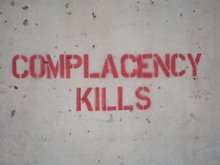
Just my own theory, as I try not to swirl into the darkness that demands destruction, but I wonder if people really understood the enemy and the fight if they would be so complacent and so willing to let things unfold as they have? I wonder if people really understood what went on in Saudi Arabia or in Palestine in regards to television and education, would they feel so complacent and willing to accept that there are "good" Muslims and "bad" Muslims?

You know, without the ability to distinguish between that fact, people might have and may still one day, demand something more in the form of retaliation.

That is what I mean about why I'm afraid to watch those beheading videos. Because, in the thoughts of having to protect me and my family from such a thing, from such episodes as I see in Iraq and Afghanistan, I feel my humanity quake and the darkness whisper "annhilation".

Yes, yes. I know that sounds a little melo-dramatic. I remind myself that the important thing to remember is that I haven't advocated for that. Yet. Of course, I am not crazy and I understand that I'm not imagining anhilating the religion of Islam. I mean, that is, for all intents and purposes impractical and, deep down, residing beside the darkness, is the other part of me that reminds me "not all Muslims follow this creed or wish our destruction".

But, I know from which countries our original attackers came from and I know from which countries many of the hijackers come from and I know which countries have very bad records of inciting or harboring the kind of fanatacism that promotes this.

Then the calmer, reasonable side of me keeps kicking in and reminding me that it isn't necessary. We can fight this war differently. We don't have to revert to old methods. I mean, of course, the old method of total war.

When I see images of Iraq and the "Sunni triangle", it reminds me of why the Norman invaders of England set about burning down villages and fields and slaughtering the animals, even if they weren't going to eat them. It was the basic technique that was used to insure that the conquered had little time for rebellion and spent most of their time figuring out how they were going to survive. It's the concept of total defeat.

That idea, too, keeps wondering around down there with "the darkness", peaking out once in awhile. I stomp it down and recall that "mass punishment" doesn't always work. Does it?

Like I said, I think I have an idea why nobody wants to jam a lot of war information and reminders of September 11 down our throats. Not because of the mass psyche damage it would do, but because someone, somewhere must understand the usual human response to such things and know, maybe, as divided as we are today, had we kept seeing this and kept the people informed of the reality of the enemy and some of our so called "allies", they might demand some other response all together.

Maybe I give them too much credit? Maybe I give them not enough for not calling for such a thing. Who knows.

I find these thoughts wondering around at odd times. Tuesday night I went to get something to eat. As I drove up to the stop light, I saw the car in front of me was an unmarked police car. You know the kind that just has a government tag on the back and some red and blue lights in the back window, but no other markings? As I noted this, I also noted the beat up pick up truck that pulled up beside us in the other lane with an equally beat up plastic tool box in the back. The big kind that stretches across the back of the cab.

For a second, I found myself wondering what it must be like to drive in Iraq today and fear pulling up beside, in back or in front, of a police or military vehicle. I was thinking that it must be the most nerve racking drive to the grocer one could ever take. Little wonder that the people want to stay far away from these guys.

It would completely suck to be sitting at a traffic stop and have a car come barreling out of nowhere to plow into the police car and explode it, or just pull up, nonchallantly, like the truck next to me and then have it explode. No explanation. No warning. No, "excuse me, would you mind getting out of the way so I can kill these guys?".

Just me, listening to the radio and then, "boom!" Gone or damaged beyond belief.

For what?

That's always the question isn't it? I pretend to understand. I read up on the subject, I hear their words, they say why they are doing it and they "justify" it, but, I can't understand it. Not really. Probably because I have not let that darkness ever take me. I resist it as we in the civilized world always try to do. Not to say that people don't give into it. Obviously, some do, even here. Why else would you have a Dennis Rader on TV reciting his crimes so dispassionately as if he was talking about a book he read or simply chewing his food?

It's easy to think these men are a bunch of wild eyed fanatics, chanting themselves into a frenzy before they commit such acts. I know that some do. Especially the "cannon fodder suiciders" as I call them. The newbies that convince themselves to go on Jihad, pack their bags, kiss their families good-bye and tell them that they are going to study at university, only to have their names appear on a Jihad website a few weeks or months later, having driven a suicide car into a pack of kids near a US humvee or into the local restaurant full of police officers and other unknowing innocents.

Those guys do get a mentor that talks them through the process and gets them "revved up" to go do the deed.

But, there are men like Zarqawi and his little commanders who are not fanatics in that sense. They aren't wild eyed and crazy. Well, maybe crazy in our sense, but not in that "put them in a straight jacket before they hurt themselves" crazy. They are the cold and calculating kind. Like Dennis Rader, the BTK killer from Witchita. Calmly and coldly selecting their victims. If there are others around to get hurt, it doubles the pleasure. Then, they sit down and eat their meals, drink their black coffee and tell jokes to one another as if it was another day.

I think now, that even the "darkness" I talk about that lurks inside of me is not even that kind of darkness. In a strange way, I can almost relate to the actual suiciders becaus theirs is at least a passion. My own darkness that screams vengence is not the cold kind, but the angry passionate kind. It is the dispassionate killer that I cannot understand and pray that I never really do.

I believe there is another good reason not to let the "dark" over take us. That is the "passionate vengence" issue. Acts done in haste and poor planning never turn out quite right. Sort of like that old cliche, "vengence is best served cold".

It is so much easier to suppress the passionate vengence actually. Probably because I have had many years of indoctrination that says "civilized people are compassionate and caring and don't plan the mass murder of their fellow citizens".

It strikes me as interesting that this is the very thing that these men want to use against us. I know that there is a theory out there, swimming around that says they actually wanted to provoke us into an all out attack so they could have a big propaganda win that would convince many muslims to run to their side. But, on these days, I think that what they really want to use is that "civilized, compassionate" concept against us.

They think that it makes us weak that we would not readily or needlessly sacrifice our men and women or attack with disregard targets that include men, women and children.

Reminds me of that old, very first "Highlander" movie where the Kyrgyn is in the chapel with McLeod, holy sanctuary where they are not to fight, and Kyrgyn is talking to the priest, but really talking to McLeod when he says, "He cares for these silly humans. That makes Him weak." Or, something to that effect.

Not the first time an enemy has ever thought that about us.

It's also true more than not. I keep reading the military bloggers and they say, "we pulled back and didn't fire because we knew their were women and children in the building" or the one I read recently and wish I could find the link to where they were after a bad guy and usually would throw in a "flash bang" to knock the baddies of balance, but they knew women and children were in there so they didn't. Seems that the "flash bangs" can have a very bad effect on children. Instead, our guys went in without it and two ended up being shot by the bad guy before the others could bring him down.

That's not some made up story to try to "enoble" our military, but a fact.

So, here we are. In someways the same, but in many ways, the important ways, different than our enemy.

And they say it's our weakness. Maybe so. Maybe so.

But, I believe in all reality, that the enemy is a bit blind when it comes to this. They haven't really tasted our steal yet. Just the bare point of it. I wonder if they really think that their families are safe back in their home countries from retaliation or suffering while they galavant around playing Jihad Johnny?

In all reality, these guys don't and can't play in the big leagues. Even if, by some bizarre and pessimistic imagination, these guys do let off a dirty bomb or bio terror, do they know what we would do in turn? Do we know?

You know, the darkness I was talking about. September 11 was one massive, tragic event. It took some serious walking and talking to keep the war drums from beating out "bomb them into non-existence". What would it be like if tomorrow or the next day, a dirty bomb went off? What would it be like if today, twenty suicide car bombs went off in this country?

It is almost too painful to contemplate. Not just the thought of the injuries to our citizens, but what would begin after that.

Which brings me back to that swirling darkness. That's what I fear. Not the physical hurt, but the spiritual hurt. Because, it may galvanize a country that seems so split today about war into a machine that would be even less likely to contemplate mercy or ideas of "Muslim Arab" citizens wondering around free.

For the record, I'm not advocating anything. Just exploring my thoughts on what it might mean.

You know, it is amazing when I look at Iraq and see that, after all the violence, blood and killing, the Shia have not gone on a total rampage and demanded that the Sunni, good or bad, be locked up or driven out. Some part of me fears that we would not be so pragmatic and capable of separation. And, when I say "we", I mean to include myself. A part of me believes that I would not advocate any such idea or feel relief from it. Yet another part of me thinks that, if the circumstances were tragic enough, I'm not sure what I would support.

That's the "darkness" thing I think. I think that my survival and those of my family would start becoming more important to me than "civil rights". Aside from our internal security, I think about what the response would be on our external front. I wonder if we haven't, in an unofficial way, whispered in some folks ears out there in the great beyond, "If this happens again, you will be the first"? I wonder how many we've told that too? If the word was passed along in any significant way?

Well, who knows? Maybe yes. Maybe no.

In any event, I was thinking about it last night. I don't dwell on it all the time. If I did, if we did, I'm not sure I'd be able to function. Which is, of course, one o